The crisis in scientific publishing: from AI fraud to epistemic injustice
There is a crisis in scientific publishing. Science is haunted. In early 2024, one major publisher retracted hundreds of scientific papers. Most were not the work of hurried researchers, but of ghosts: digital phantoms generated by artificial intelligence. Featuring nonsensical diagrams and fabricated data, they had sailed through the gates of peer review.
This spectre of AI-driven fraud is not only a new technological threat. It is also a symptom of a pre-existing disease. For years, organized networks have profited from inserting fake papers into the scholarly record. It seems that scientific publishing’s peer review process, intended to seek truth, cannot even tell the real from the fake.
These failures are not just academic embarrassments. In fields like global health, where knowledge means the difference between life and death, we can no longer afford to ignore them. Indeed, the crisis in scientific journals is not, at its heart, a crisis in publishing. It is a crisis of knowledge—of what we value, who we trust, and how we come to know. That makes it a crisis of education.
Crisis in scientific publishing: The knowledge we ignore
Consider what Toby Green has called the “dark side of the moon.” He is referring to the vast body of knowledge produced by established experts in international organizations. Volumes of high-quality reports and analyses come from organizations large and small. They contain immense expertise. Often, not only do they qualify as science. They may be more likely to shape policy and practice than most academic outputs. Yet this “grey literature” is rarely incorporated into the scholarly record. This is why Green is actively implementing projects to find, collect, and index such materials.
If the formal knowledge of some of the world’s leading experts is being left in the dark, what hope is there for the practical wisdom of a frontline nurse?
In the rigid hierarchy of evidence that governs global health, a randomized controlled trial sits at the pinnacle. At the very bottom, dismissed as mere “anecdotes,” lies the lived experience of practitioners. A nurse in a rural clinic who discovers a better way to dress a wound in a humid environment has generated life-saving knowledge that could be useful elsewhere. A community health worker who develops a sophisticated method for building trust with vaccine-hesitant parents has solved a problem in context. Yet, in our current culture, their insights are not data. Their experience is not evidence.
To dismiss such knowledge is an act of willful ignorance. Science, at its best, is a process of disciplined curiosity. Its fundamental purpose is to reduce ignorance and expand our understanding of the world. To willfully ignore entire categories of human experience and expertise is therefore a betrayal of the scientific ethos itself. It is an active choice to remain in the dark.
Crisis in scientific publishing: the architecture of exclusion
This devaluation of practical knowledge is not an accident. It is a feature of a system designed to exclude. The modern ideal of science began with a radically open mission. As the scholar John Willinsky has meticulously documented in his history of Western European science, the creation of scientific journals in the 17th century was intended to create a public commons of knowledge, accelerating progress for the benefit of humanity. The principle was one of access. How was this mission corrupted?
The architecture of modern science was built on a colonial foundation. Its violence was not only physical but also scientific and intellectual. Frantz Fanon, the Martinican psychiatrist who became a theorist of decolonization in the crucible of Algeria’s war of independence, described colonization’s deepest work as the effort to “empty the mind of the colonized.” This is a systematic process of convincing people that our own histories, cultures, and ways of knowing are worthless.
Generations later, the Māori scholar Linda Tuhiwai Smith detailed how this was put into practice. She showed that Western research methodologies themselves were often not neutral tools of discovery but instruments of empire. The acts of observing, classifying, extracting, and analyzing were used to control populations and invalidate their knowledge systems, replacing them with a single, supposedly universal, European model of truth.
This worldview pretends to be a neutral, “view from nowhere,” a concept also critiqued powerfully by the white American feminist philosopher Donna Haraway. She argued that all knowledge is situated—shaped by the position and perspective of the knower. You see the landscape differently from the mountain top than you do from the valley. A complete map requires both perspectives.
Echoing this, her philosophical and geographical sister Sandra Harding argued that by excluding the perspectives of marginalized people, dominant science becomes “weakly objective.” It is blind to its own biases and assumptions.
Crisis in scientific publishing: Fear of knowledge
A common and deeply felt fear among scientists is that embracing diverse forms of knowledge will lead to a dangerous relativism, where objective truth dissolves and “anything goes.”
Harding’s work shows this fear to be misplaced. She argues that the “view from nowhere” provides not a stronger, but a more brittle and fragile grasp of the truth. A truly “strong objectivity,” she contended, is achieved by intentionally seeking out multiple, situated perspectives. This does not mean that all views are equally valid. It means that by examining a problem from many standpoints, we can triangulate a more robust and reliable understanding of reality. We can identify the biases and blind spots inherent in any single view, including our own.
This process is the antidote to the willful ignorance mentioned earlier. It strengthens our grasp of objective truth by making it more complete and more honest.
Can change be paved by good intentions?
Today, the need for a change in research culture is widely acknowledged. The world’s largest research funders publish reports calling for more diversity and inclusion. Yet we observe paralysis rather than progress. The individuals who sit on the decision-making committees of such institutions will almost certainly not fund a project with a primary investigator whose work is not validated by the existing system of prestigious but exclusive journals. Elite global scholars leading the vital movement to “decolonize global health” first established their legitimacy by adhering to conventional norms, then began using the master’s tools to have their critiques of the system heard. Such contradictions illustrate how deeply the exclusionary norms are embedded.
Since top-down change is caught in such contradictions, a meaningful path forward may be to change the culture of science from the ground up. The core challenge is to correct for epistemic injustice: the wrong done to someone in their capacity as a knower. This injustice takes several insidious forms.
The most obvious is testimonial injustice. Imagine the scene. A senior male doctor from a famous university presents a finding and is met with nods of assent. His words carry the weight of evidence. A young female nurse from a rural clinic presents the exact same finding based on her direct experience. Her knowledge is dismissed as a “story” or an “anecdote.” She is not heard because of who she is. Her credibility is unjustly discounted.
Even deeper is hermeneutical injustice. This is the wrong of not even having the shared language to make your experience understood by the dominant culture. The community health worker who builds trust with hesitant parents may have a brilliant system, but if they cannot articulate it in the formal jargon of “implementation science,” their knowledge remains invisible. They are wronged not because they are disbelieved. They are wronged because the system lacks the concepts to even recognize their wisdom as knowledge in the first place.
Projects like Toby Green’s grey literature repository or initiatives like Rogue Scholar, pioneered by Martin Fenner, that assign a permanent Digital Object Identifier (DOI) to science that was not previously in the scholarly record, are practical interventions. But this not a technological problem. It is an educational one. Changing a culture that perpetuates these injustices is the primary work. Within this larger project, new tools can serve as tactics of resistance. As such, they can be used to support acts of epistemic defiance, for example by creating a formal, citable record of knowledge that exists outside the traditional gates. Yet they remain tools, not the solution.
The science of knowing
You cannot fix a broken culture by patching its systems. You must change its DNA. The crisis haunting science is not ultimately about publishing, fraud, or peer review. It is a crisis of education—not of schooling, but of how we come to know. If physics is the science of matter, education is the science of all sciences. It provides the architecture of assumptions and values that shapes how every other field discovers and validates truth.
A new philosophy of education is needed, one that includes these three principles:
It must recognize that the most durable knowledge comes from praxis—the cycle of acting in the world and reflecting on the consequences.It must be built on collaborative intelligence, understanding that the most difficult problems can only be solved by weaving together many perspectives.It must pursue strong objectivity, not by erasing human perspective, but by intentionally seeking it out to create a more complete and honest picture of reality.To change science, we must change how scientists are taught to see the world. We must educate for humility, for critical self-awareness, and for the ability to listen. This is the work of creating a science that is not haunted by its failures but is directly contributes to a more just and truthful account of our world.
References
Boghossian, P., 2007. Fear of knowledge: Against relativism and constructivism. Clarendon Press.Couch, L., 2021. Wellcome Diversity, equity and inclusion strategy [WWW Document]. Wellcome. URL https://wellcome.org/what-we-do/diversity-and-inclusion/strategy (accessed 11.8.22).Fanon, F. (1963). The wretched of the earth. Grove Press.Fenner, M., 2023. The Rogue Scholar: An Archive for Scholarly blogs. Upstream. https://doi.org/10.54900/bj4g7p2-2f0fn9bGitau, E., Khisa, A., Vicente-Crespo, M., Sengor, D., Otoigo, L., Ndong, C., Simiyu, A., 2023. African Research Culture – Opinion Research. African Population and Health Research Center, Nairobi, Kenya. https://aphrc.org/project/african-research-culture-opinion-research/Green, T., 2022. Wait! What? There’s stuff missing from the scholarly record? Med Writ 31, 44–48. https://doi.org/10.56012/ajel9043Haraway, D. (1988). Situated knowledges: The science question in feminism and the privilege of partial perspective. Feminist Studies, 14(3), 575–599. https://doi.org/10.2307/3178066Harding, S. (1991). Whose science? Whose knowledge? Thinking from women’s lives. Cornell University Press.Smith, L. T. (2012). Decolonizing methodologies: Research and indigenous peoples (2nd ed.). Zed Books.The Social Investment Consultancy, The Better Org, Cole, N., Cole, L., 2022. Evaluation of Wellcome Anti-Racism Programme Final Evaluation Report – Public. Wellcome, London. https://cms.wellcome.org/sites/default/files/2022-08/Evaluation-of-Wellcome-Anti-Racism-Programme-Final-Evaluation-Report-2022.pdfWellcome Trust, 2020. What researchers think about the culture they work in. Wellcome, London. https://wellcome.org/reports/what-researchers-think-about-research-cultureWillinsky, J., 2006. The access principle: The case for open access to research and scholarship. MIT press Cambridge, MA.Image: The Geneva Learning Foundation Collection © 2025
#AIFraud #DEI #diversityAndInclusion #DonnaHaraway #epistemicInjustice #epistemology #hermeneuticalInjustice #LindaTuhiwaiSmith #philosophyOfScience #RogueScholar #SandraHarding #scientificPublishing #strongObjectivity #testimonialInjustice #TobyGreen naturepoker
 Peter Cock
 Reda Sadki
 Asta v. Schröder
 Florian U. Jehn
 Egon Willighagen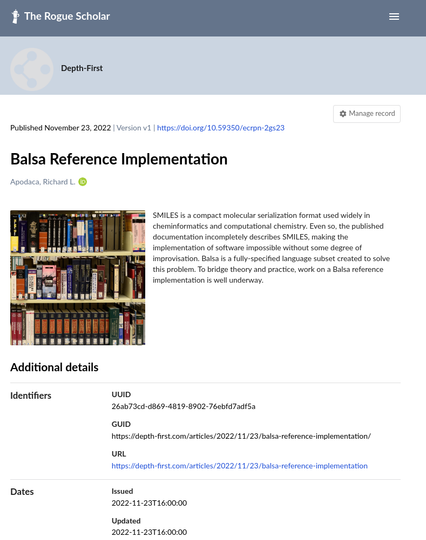
 Rogue Scholar

