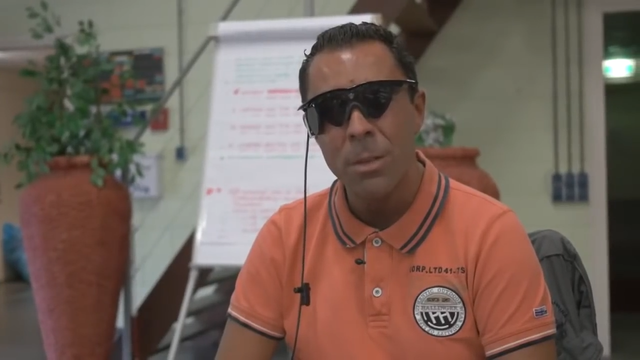
Electronic Retinal Implant Restores Vision. Stanford ophthalmologists PRIMA system includes a subretinal wireless implant and wearable video camera. #blindness #maculardegeneration #amd #prima #retinalimplant
https://www.instagram.com/p/DQdpWA_kS0y/
Howard G. Smith MD, AM on Instagram: "Electronic Retinal Implant Restores Vision Age-Related Macular degeneration is the leading cause of adult blindness, but Stanford University research ophthalmologists have developed an electronic retinal implant that promises to restore sight to millions. Their device, nicknamed PRIMA standing for photovoltaic retina implant microarray, includes a subretinal wireless implant and wearable video camera. The camera, mounted on an eyeglass frame, detects an image. That image is converted by a pocket processor into infrared laser light signals that are directed through the lens of the eye to the implant under the retina. The implant, in turn, creates the neural electrical signals that restore sight. The implant is entirely light-powered and requires no external power supply. This PRIMA system underwent a multisite, primary clinical trial at Stanford, the University of Pittsburgh, and Germany’s University of Bonn. A remarkable 27 of 32 implanted patients, 84%, regained the ability to read books, labels, and even street signs. Some could even correctly make out some of the smallest lines on a standard eye chart. The vision is black and white. Further refinement of the PRIMA chip is underway that promises a higher resolution and a refined grayscale. No word yet as to whether this system will restore full color vision, but bioengineering ingenuity might just achieve that result…..someday soon. https://www.sciencedaily.com/releases/2025/10/251022023118.htm#google_vignette https://www.nejm.org/doi/10.1056/NEJMoa2501396 #blindness #maculardegeneration #amd #prima #retinalimplant"

A new electronic retinal implant, PRIMA, is being tested in clinical trials and has shown remarkable results, with 84% of patients regaining the ability to read books, labels, and street signs. Further refinement of the chip is underway, and the device is entirely light-powered, requiring no external power supply.

Instagram

People with blindness can read again after retinal implant

https://go.nature.com/48JVwrv

#HackerNews #retinalimplant #blindness #innovation #technology #health

People with blindness can read again after retinal implant

An electronic eye implant has restored vision in people with blindness caused by age-related macular degeneration.

@theguardian_science

The article botched the link to the scientific paper, so here it is:

"Subretinal Photovoltaic Implant to Restore Vision in Geographic Atrophy Due to AMD", Holz et al. 2025
https://www.nejm.org/doi/full/10.1056/NEJMoa2501396

#neuroscience #retina #RetinalImplant

Bionic eye gets a new lease of life https://spectrum.ieee.org/pixium-bionic-eye-tech-rescued by @meharris; Ex-#Neuralink exec Max Hodak's new company rescues #Pixium technology; "It's very important to us to avoid another debacle like Argus II."

"Hodak says that Science will hire the majority of Pixium’s 35 engineering and regulatory staff, in a push to get the technology approved in Europe as quickly as possible." (CE mark for medical devices.)

#RetinalImplant #BCI #NeuroTech #blind #blindness

Bionic Eye Gets a New Lease of Life

<p>Ex-Neuralink exec Max Hodak's new company rescues Pixium technology</p>

IEEE Spectrum
Axonal stimulation affects the linear summation of single-point perception in three Argus II users https://www.medrxiv.org/content/10.1101/2023.07.21.23292908v1 #RetinalImplant
Axonal stimulation affects the linear summation of single-point perception in three Argus II users

Purpose. Retinal implants use electrical stimulation to elicit flashes of light ("phosphenes"). Single-electrode phosphene shape has been shown to vary systematically with stimulus amplitude and frequency as well as the retinal location of the stimulating electrode, due to incidental activation of passing nerve fiber bundles. However, this knowledge has yet to be extended to paired-electrode stimulation. Methods. We retrospectively analyzed 4402 phosphene drawings made by three blind subjects implanted with an Argus II Retinal Prosthesis. Phosphene shape (characterized by area, perimeter, major and minor axis length; normalized per subject) and number of perceived phosphenes were averaged across trials and correlated with the corresponding single-electrode parameters. In addition, the number of phosphenes was correlated with stimulus amplitude and neuroanatomical parameters: electrode-retina ("height") and electrode-fovea distance ("eccentricity") as well as the electrode-electrode distance to ("between-axon") and along axon bundles ("along-axon"). Statistical analyses were conducted using linear regression and partial correlation analysis. Results. Simple regression revealed that each paired-electrode shape descriptor could be predicted by the sum of the two corresponding single-electrode shape descriptors (p<.001). Multiple regression revealed that paired-electrode phosphene shape was primarily predicted by stimulus amplitude, electrode-retina distance, and electrode-fovea distance (p<.05). Interestingly, the number of elicited phosphenes increased with between-axon distance (β=.162, p<.05), but not with along-axon distance (p>.05). Conclusions. The shape of phosphenes elicited by paired-electrode stimulation was well predicted by the shape of their corresponding single-electrode phosphenes, suggesting that two-point perception can be expressed as the linear summation of single-point perception. We also found that the number of perceived phosphenes increased with the between-axon distance of the two electrodes, providing further evidence in support of the axon map model for epiretinal stimulation. These findings contribute to the growing literature on phosphene perception and have important implications for the design of future retinal prostheses. ### Competing Interest Statement The authors have declared no competing interest. ### Funding Statement This work was supported by the National Eye Institute of the National Institutes of Health under Award Number R00-EY029329. ### Author Declarations I confirm all relevant ethical guidelines have been followed, and any necessary IRB and/or ethics committee approvals have been obtained. Yes The details of the IRB/oversight body that provided approval or exemption for the research described are given below: The data was previously collected as part of the Argus II Feasibility Protocol (Clinical Trial ID: [NCT00407602][1]), and our study did not involve human subjects research. IRB of the University of California, Santa Barbara waived ethical approval for this work. I confirm that all necessary patient/participant consent has been obtained and the appropriate institutional forms have been archived, and that any patient/participant/sample identifiers included were not known to anyone (e.g., hospital staff, patients or participants themselves) outside the research group so cannot be used to identify individuals. Yes I understand that all clinical trials and any other prospective interventional studies must be registered with an ICMJE-approved registry, such as ClinicalTrials.gov. I confirm that any such study reported in the manuscript has been registered and the trial registration ID is provided (note: if posting a prospective study registered retrospectively, please provide a statement in the trial ID field explaining why the study was not registered in advance). Yes I have followed all appropriate research reporting guidelines, such as any relevant EQUATOR Network research reporting checklist(s) and other pertinent material, if applicable. Yes All data produced will be available online upon acceptance at <https://github.com/bionicvisionlab/2023-ArgusPairs> [1]: /lookup/external-ref?link_type=CLINTRIALGOV&access_num=NCT00407602&atom=%2Fmedrxiv%2Fearly%2F2023%2F07%2F26%2F2023.07.21.23292908.atom

medRxiv
(podcast) Pixium Vision: bionic vision for the blind https://open.spotify.com/episode/4xEpjvM1vLt3eRhWmB8So7 with Lloyd Diamond, CEO of Pixium Vision, at The Bleeding Edge of Digital Health; #BCI #NeuroTech #RetinalImplant #blind #blindness
Pixium Vision: Bionic Vision For The Blind

Listen to this episode from The Bleeding Edge of Digital Health on Spotify. In this week’s episode, host Mike Moore speaks with Lloyd Diamond, CEO Pixium Vision, about their technology that focuses on bionic vision for those who have lost their sight. Pixium Vision utilizes the latest advancements in visual processing, micro-electronics, optoelectronics, neurobiology, and intelligent software algorithms to create Bionic Vision Systems. By leveraging their expertise in machine brain interface and artificial intelligence, Pixium Vision aims to develop these systems to address severe vision loss and enhance the autonomy, movement, and overall well-being of individuals affected by retinal degenerative diseases. Today, Mike and Lloyd discuss Pixium Vision's bionic vision technology, which aims to restore sight for visually impaired individuals. Lloyd explains the company's background, their first-generation technology called Iris, and their second-generation technology called Prima. He demonstrates how the technology allows patients to read a weather forecast and identifies basic features using the glasses. They also discuss the surgical process, the uniqueness of Pixium Vision's technology, and their regulatory status. Notable Quotes “Basically, we're targeting dry AMD. Dry AMD is a disease where the photoreceptor cells no longer function, what we do is we create a small incision in the retina, and we inject our premier implant in the subretinal space, we apply gas or oil to reattach the retina.”- Lloyd (05:23) “I think as humans inherent in the cellular level of the retina, we can see red, green, and blue, but then everything else is learned. When you're a kid, the teacher says, Oh, this is yellow. And now you learn that that's yellow. So inherent in the retina is only red, green, and blue.” - Lloyd (12:22)  In This Episode (01:59) The origin story of Pixium Vision (05:11) The technology behind Pixium Vision's product (10:30) How a legally blind patient can read a weather forecast using bionic vision technology (12:20) The ability to enhance contrast and identify facial traits (14:53) The target indications and market potential (21:27) Detaching the retina and surgical training (23:10) Advancements in implant technology (26:59) Regulatory progress and commercialization plans (32:26) The company's investment and future plans (33:26) Clarity on the investment process (33:48) Classification of investments Our Guest Lloyd Diamond is the CEO of Pixium Vision. He has 25 years of experience in medtech, leading disruptive technology commercialization in life sciences. He successfully penetrated markets in Europe and the US, including a NASDAQ IPO. He holds dual degrees in Biochemistry and Marketing and an MBA. Resources & Links Mike Moore https://www.linkedin.com/in/michaeljeffreymoore/ https://www.linkedin.com/company/thebleedingedgeofdigitalhealth/ The Bleeding Edge of Digital Health Apple Podcasts Google Amazon Spotify YouTube Lloyd Diamond https://www.pixium-vision.com/ https://www.linkedin.com/in/lloyd-diamond

Spotify

#Pixium #Vision — Focusing on reaching the #PRIMAvera milestone https://www.edisongroup.com/research/focusing-on-reaching-the-primavera-milestone/32260/ On Pixium's #cash burn rate: Pixium "expects its funds on hand to last until approximately the end of July" (!); $ALPIX

May #The_vOICe be with you!

#RetinalImplant

Pixium Vision — Focusing on reaching the PRIMAvera milestone

Having completed the required 38 implantations in late 2022, Pixium Vision’s key upcoming clinical milestone is the primary efficacy data, expected in or around year-end 2023, from the PRIMAvera European pivotal study assessing the safety and clinical benefits of the wireless Prima System in patients with geographic atrophy due to age-related macular degeneration (GA-AMD). The company’s FY22 results showed a milder operating loss than expected, coming in at €11.9m, below our €12.5m estimate. Pixium has since taken further steps to curb its cash burn rate, and it now expects its funds on hand (€4.7m gross cash as of 31 March) to last until approximately the end of July, versus its prior guidance of June 2023. It is working actively to raise additional funds and has hired two investment banks to reach potential investors worldwide. We have rolled forward our estimates and given that we expect the company’s focus in 2023 and 2024 will be on preparing the Prima System for EU market approval and launch (which we continue to model in H125), we have pushed back our US commercialisation forecast by one year, to H227. We now obtain a pipeline rNPV valuation of €140.1m (vs €146.3m previously).

Edison Group
Pixium Vision announces FDA Breakthrough Device Designation for the Prima System in Dry AMD

Pixium Vision announces FDA Breakthrough Device Designation for the Prima System in Dry AMD Pixium Vision to receive interactive communication with FDA...

Pixium Vision

Bionic Implants Can Go Obsolete And Unsupported, Too

When a piece of hardware goes unsupported by a company, it can be frustrating. Bugs may no longer get fixed, or in the worst cases, perfectly good hardware can stop working entirely as software licences time out. Sadly, for a group reliant on retinal implants from company Second Sight, the company has since stopped producing and supporting the devices that give them a crude form of bionic sight.

The devices themselves consist of electrodes implanted into the retina, which can send signals to the nervous system which appear as spots of light to the user. A camera feed is used to capture images which are then translated into signals sent to the retinal electrodes. The results are low-resolution to say the least, and the vision supplied is crude, but it gives users that are blind a rudimentary sense that they never had before. It's very much a visual equivalent to the cochlear implant technology.

The story is altogether too familiar; Second Sight Medical Products came out with a cutting-edge device, raised money and put it out into the world, only to go bankrupt down the road, leaving its users high and dry. Over 350 people have the implants fitted in one eye, while one Terry Byland is the sole person to have implants in both his left and right eyeballs. Performance of the device was mixed, with some users raving about the device while others questioned its utility.

However, all the users of Second Sight implants are now on their own. Any failure or issue will go unrectified, as the company and its staff no longer exist to support or service the implants or associated hardware. For some, the implants still work. For others, like Barbara Campbell, the device simply powered down one day and has left her without sight ever since. Medical problems can crop up too - one patient was unable to get an MRI as doctors couldn't secure information on the device after the company collapsed.

It's a sobering tale of what can happen when a tech company goes out of business. It's a story that bears thinking about for anyone taking on a medical device from a new, untested company. Video after the break.

[Thanks to Ben and Adrian for the tip!]

#medicalhacks #eyeball #eyes #implant #medical #medicalimplant #medicine #neuralimplant #retinalimplant

Bionic Implants Can Go Obsolete And Unsupported, Too

When a piece of hardware goes unsupported by a company, it can be frustrating. Bugs may no longer get fixed, or in the worst cases, perfectly good hardware can stop working entirely as software lic…

Hackaday