Stellar Rotation Enhances Mixing in Red Giant Stars, Solving Longstanding Surface Chemistry Mystery
📰 Original title: Supercomputers just solved a 50-year-old mystery about giant stars
🤖 IA: It's clickbait ⚠️
👥 Usuarios: It's clickbait ⚠️
View full AI summary: https://killbait.com/en/stellar-rotation-enhances-mixing-in-red-giant-stars-solving-longstanding-surface-chemistry-mystery/?redirpost=9cdaa483-130a-4390-957f-5695aad03d2e
#astronomy #redgiants #stellarmixing #supercomputersimulat...
Stellar Rotation Enhances Mixing in Red Giant Stars, Solving Longstanding Surface Chemistry Mystery
Astronomers have resolved a decades-old puzzle about red giant stars: how material from their nuclear-burning cores reaches the surface, altering the star’s chemical composition. For nearly 50 years…

The 'baritone' of red giants refines cosmic distance measurements
A fresh look at red giant stars offers key insights into cosmic distance measurements and a way to measure the universe's expansion with the highest accuracy.
A new type of red giant known as old smokers at the center of our galaxy is rich with heavy elements, so these red giants have a high metallicity. As they age, they can cast off clouds of dust that can obscure the star for a time.
#science #sciencefacts #RedGiants #stars #oldsmokers #oldsmoker #metallicity

Discovery Alert: The Planet that Shouldn't Be There - NASA Science
A large, gaseous planet orbits a red giant star that should have destroyed it. It's 530 light-years from Earth.

Distant planet-devouring star shows Earth's fate
The first direct evidence of a dying Sun-like star engulfing an exoplanet gives us a preview of the end of (our) world.
Interesting new paper on APOGEE red giant ages by the StarHorse team. #StarHorse #APOGEE #RedGiants
https://arxiv.org/abs/2304.08276
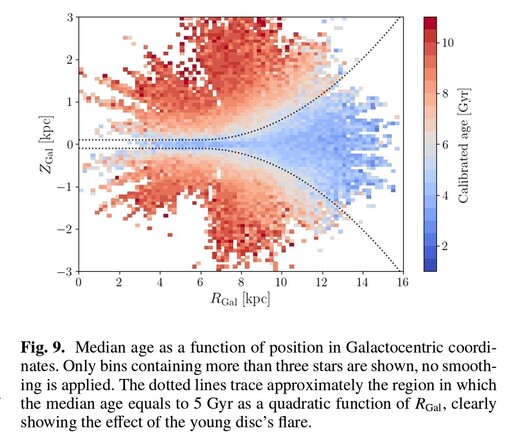

Spectroscopic age estimates for APOGEE red-giant stars: Precise spatial and kinematic trends with age in the Galactic disc
Over the last few years, many studies have found an empirical relationship
between the abundance of a star and its age. Here we estimate spectroscopic
stellar ages for 178 825 red-giant stars observed by the APOGEE survey with a
median statistical uncertainty of 17%. To this end, we use the supervised
machine learning technique XGBoost, trained on a high-quality dataset of 3060
red-giant and red-clump stars with asteroseismic ages observed by both APOGEE
and Kepler. After verifying the obtained age estimates with independent
catalogues, we investigate some of the classical chemical, positional, and
kinematic relationships of the stars as a function of their age. We find a very
clear imprint of the outer-disc flare in the age maps and confirm the recently
found split in the local age-metallicity relation. We present new and precise
measurements of the Galactic radial metallicity gradient in small age bins
between 0.5 and 12 Gyr, confirming a steeper metallicity gradient for $\sim2-5$
Gyr old populations and a subsequent flattening for older populations mostly
produced by radial migration. In addition, we analyse the dispersion about the
abundance gradient as a function of age. We find a clear power-law trend (with
an exponent $β\approx0.15$) for this relation, indicating a relatively
smooth radial migration history in the Galactic disc over the past $7-9$ Gyr.
Departures from this power law may possibly be related to the Gaia Enceladus
merger and passages of the Sagittarius dSph galaxy. Finally, we confirm
previous measurements showing a steepening in the age-velocity dispersion
relation at around $\sim9$ Gyr, but now extending it over a large extent of the
Galactic disc (5 kpc $<R_{\rm Gal}<13$ kpc). [Abridged]

Astronomers discover irregularities in the cores of red giants
Red giants are dying stars, in advanced stages of stellar evolution, which have depleted the hydrogen in their cores. In a study published today in Nature Communications, a team of astronomers mainly from Instituto de Astrofísica e Ciências do Espaço (IA), have found new evidence that red giant stars experience "glitches"—sharp structural variations—in their inner core.
Astronomers discover irregularities in the cores of red giants
Red giants are dying stars, in advanced stages of stellar evolution, which have depleted the hydrogen in their cores. In a study published today in Nature Communications, a team of astronomers mainly from Instituto de Astrofísica e Ciências do Espaço (IA), have found new evidence that red giant stars experience "glitches"—sharp structural variations—in their inner core.
#astronomy #exoplanets #stars #RedGiants An article published in the journal "Astronomy and Astrophysics" reports the discovery of 26 planetary systems within the TAPAS (Tracking Advanced Planetary Systems) project.
https://english.tachyonbeam.com/2021/03/10/planets-discovered-orbiting-ancient-stars/ Planets discovered orbiting ancient stars
An article published in the journal 'Astronomy and Astrophysics' reports the discovery of 26 planetary systems within the TAPAS (Tracking Advanced Planetary...
 KillBait
 Corrado
 ScienceActually
 NASA
NASA hesgen
 Galaxy Map
 ᴄᴏʀʀᴀᴅᴏ
 Phys.org
 Massimo Luciani