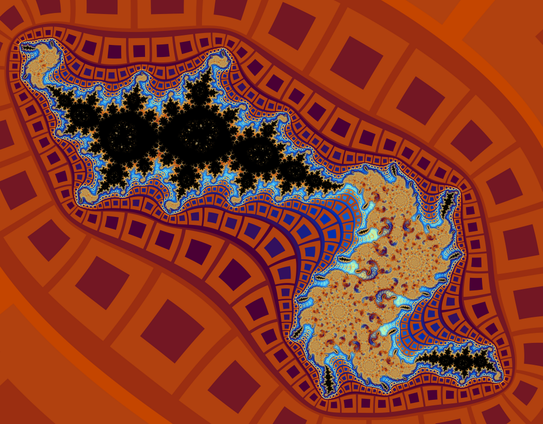
Inspired by https://en.wikipedia.org/wiki/Herman_ring#Herman_and_parabolic_basin

with a sightly different parameter 'a' and a more interesting coloring.

\(z_{n+1}=e^{2 \pi i t}z_n^3\frac{1-\bar{a}z_n}{z_n-a}\frac{1-\bar{b}z_n}{z_n-b}\)

with
\(t=0.6141866\)
\(a=0.25+0.008i\)
\(b=0.0405353-0.0255082i\)

#fractal #fractalart #juliaset #rationalfunction #escapetimefractals #rendering #distanceestimation

Herman ring - Wikipedia

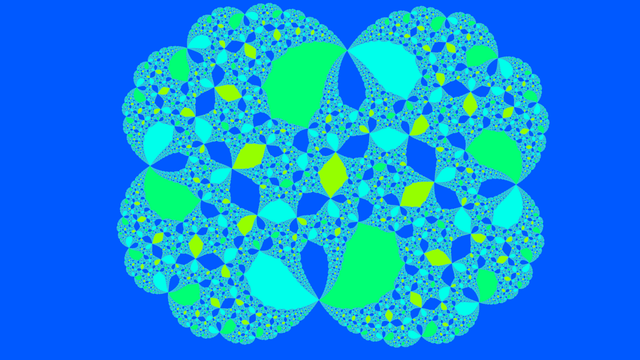
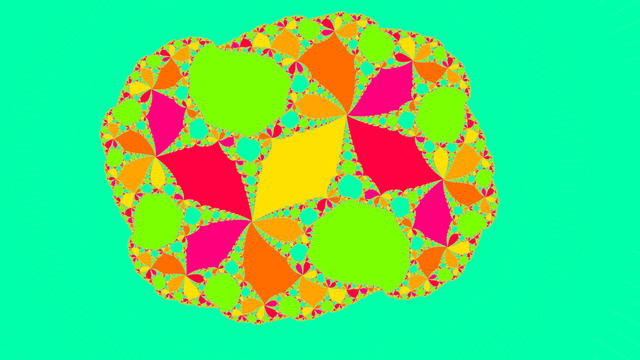
I implemented Slow Mating for quadratic polynomials using the equations and hints in Chapter 5 of Wolf Jung's 2017 paper "The Thurston Algorithm for quadratic matings" https://arxiv.org/abs/1706.04177

My code is 145 lines of quite-straightforward C, vs 2249 lines of C++ with various state hidden in mutating objects for the code accompanying the paper (which admittedly does a lot more, working from angles to compute the complex points and (pre)periods that are the input to my code). I'll do a blog post next week once I've tested more cases to make sure I haven't done any big mistakes.

There were a couple of subtleties, 1. needing to use cproj() to normalize infinity's representation and avoid NaNs; and 2. in one place, converting (a - b) / (a - c) to (1 - b/a) / (1 - c/a) so that it still works when a is infinite.

Attached images are the north period 4 island mated with the west period 4 island (blue background), and 2/5 bulb mated with 1/2 bulb (turquoise background).

#Quadratic #JuliaSets #SlowMating #RationalFunction #maths #fractals
The Thurston Algorithm for quadratic matings

Mating is an operation to construct a rational map f from two polynomials, which are not in conjugate limbs of the Mandelbrot set. When the Thurston Algorithm for the unmodified formal mating is iterated in the case of postcritical identifications, it will diverge to the boundary of TeichmΓΌller space, because marked points collide. Here it is shown that the colliding points converge to postcritical points of f , and the associated sequence of rational maps converges to f as well, unless the orbifold of f is of type (2, 2, 2, 2). So to compute f , it is not necessary to encode the topology of postcritical ray-equivalence classes for the modified mating, but it is enough to implement the pullback map for the formal mating. The proof combines the Selinger extension to augmented TeichmΓΌller space with local estimates. Moreover, the Thurston Algorithm is implemented by pulling back a path in moduli space. This approach is due to Bartholdi--Nekrashevych in relation to one-dimensional moduli space maps, and to Buff--ChΓ©ritat for slow mating. Here it is shown that slow mating is equivalent to the Thurston Algorithm for the formal mating. An initialization of the path is obtained for repelling-preperiodic captures as well, which provide an alternative construction of matings.