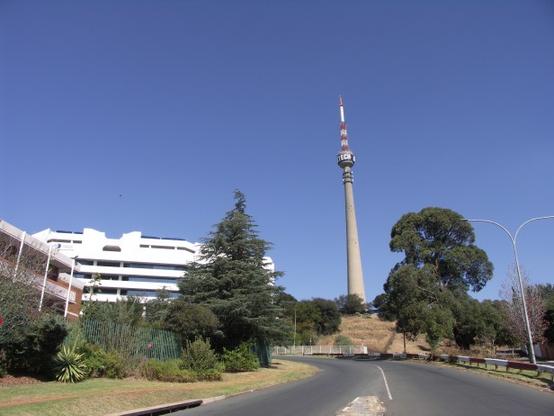
Channel Africa: “60 years of telling stories”

The station keeps it short, with a look back at the Radio RSA history (that’s the name under which the undertaking started in 1966), and a more recent staff member’s testimony.

The website has been refurbished recently, but Channel Africa’s shortwave transmissions ended in 2019.


#Africa #foreignRadio #internet #RadioRSA #shortwave #SouthAfrica

My First Day at writing Reception Reports

My logbooks of the 1980s are long gone, but most probably, the first reception report I ever wrote went to Radio RSA in Johannesburg, South Africa, on December 6, 1985. But I beg your pardon, I should explain what a reception report means in this context. This is what a reception looks like. "SINPO code" is mentioned without further explanation, but you can find one on Wikipedia.

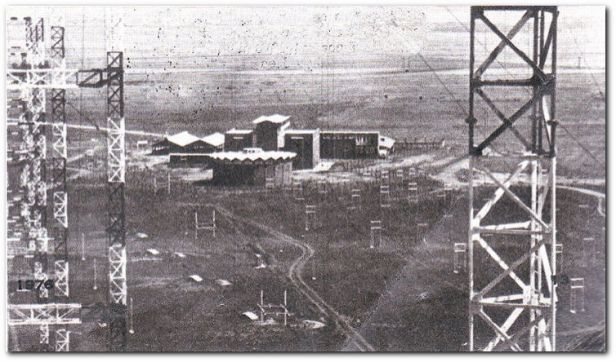
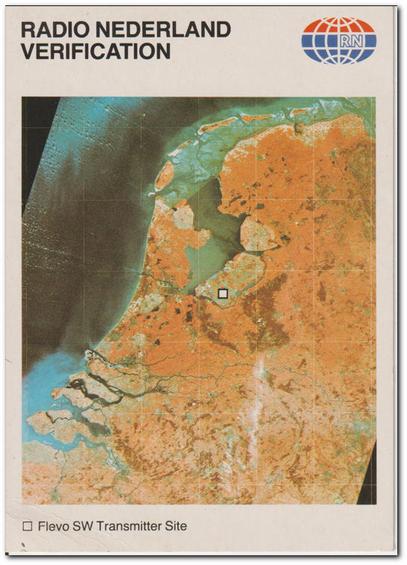
So that’s a reception report. My second reception report – that’s what my chaotic QSL card archive suggests today – came from the Netherlands, but just like Radio RSA, it "confirmed an African country", as we used to say, as I had listened to Radio Netherlands on 9715 kHz, from its Madagascar relay (picture above). That was on December 8th, and that was a Sunday, and that means that I listened to "The Happy Station Show", usually produced and presented by Tom Meyer at the time.

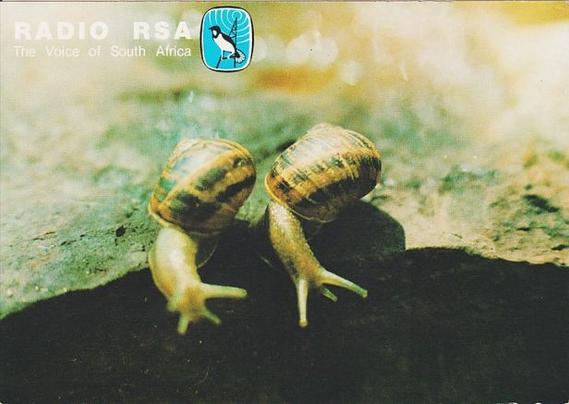
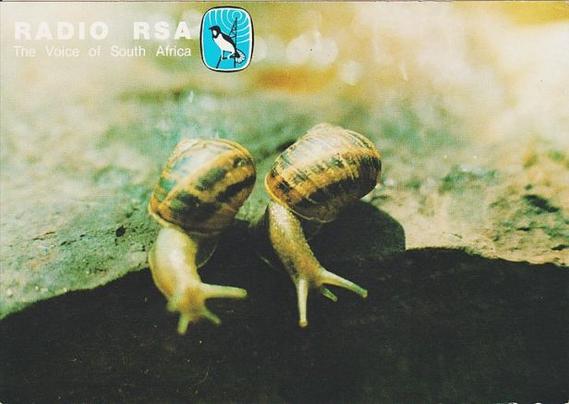
The QSL card from South Africa was a bit of a disappointment, because it showed garden snails, rather than something spectacular from, say, Kruger National Park.


Yes, garden snails. Seriously. But it is still my first-ever QSL card.

Having a QSL card from South Africa felt kind of sensational all the same – I had never been on a plane yet, and the distance to the country felt unimaginable. I used a typewriter to write reception reports (aka listening reports), and those were probably of some help for many of the shortwave broadcasters at the time, especially when you lived in their target areas. In contrast to nowadays, they couldn’t turn to a remote receiver on the internet then, to check the quality signal in the targeted regions.


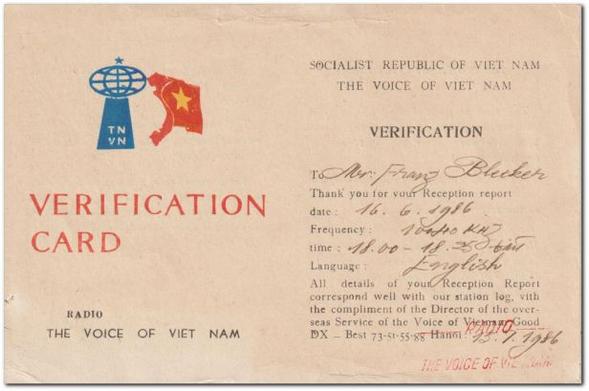
Here’s another QSL card. It isn’t one of my earliest, as I wrote my first reception report to Voice of Vietnam on June 16, 1986, but it remains particular to me for several reasons. First off, it was handwritten – my other two favorites were typewritten. Secondly, I’m not sure if I have ever seen a handwriting as beautiful as this one, certainly not on a QSL card. And also, the "Voice of Vietnam" was the first shortwave broadcaster I ever listened to. They didn’t have German programs at the time, so I happened on a transmission in English, probably on 10040 kHz. That was a few years before 1986, probably in 1981. The programs weren’t exactly fascinating, but knowing that this was a station transmitting from Southeast Asia felt exciting.

It still does, even though I’ve been to East Asia countless times since, and even though the internet has made the world look so much smaller.

It is still international radio rather than the internet that gives me a sense of how big the world is in fact. You wouldn’t want to walk it afoot, and you can’t walk its lakes and oceans anyway, unless you are Jesus.

There’s no first day of that kind of walk in my life, but to me, writing my first reception report feels about as special as my first day at school or at work.


#africa #dailyprompt #dailyprompt2151 #radioNetherlands #radioRsa #shortwave #vietnam

A Story of Radio RSA (7): “A Process of Integration”

  Previous blog:
A Story of Radio RSA (6),  June 8, 2025  

Adapting the Message

By the late 1970s, while still an apartheid state, South Africa wasn’t the same as it had been in the 1960s – and it had taken ways neither Hendrik Verwoerd nor Albert Hertzog would have approved of. In 1977, Stellenbosch University opened its doors for a few black students, provided that there were no stages for further education available for them at non-white universities, according to German news magazine “Der Spiegel” at the time. At the same time, some relaxation in racial segregation probably made the rules even more elaborate, like joint inter-racial sports teams were OK, black-and-white staying at the same “international hotels” and having meals there at the same tables was legal, but dancing together or swimming in the same pool was as forbidden as ever. Racial segregation had been formalized and made universal in South Africa in 1953. In 1971, one hotel become multi-racial on an experimental basis, a number of "international hotels" followed, and the end for "whites-only" hotels came in 1986.

A quote from then foreign minister Roelof Botha probably helps to summarize the late-70s status: "I’m prepared to go to war over our right to exist, but I’m not prepared to die for signs in a lift."

Strikes, although illegal according to the apartheid script, had been a way for the black working South African majority to make its power felt to the white rulers, and quotes from ruling Boers, passed down from the 1960s, showed that this power was really feared. The boom years had ended in the 1970s, and at the same time, skilled or half-skilled labor came into high demand. 1973 saw an accelerated emergence of new unions and growing union membership, and although the government did its best to neutralize their attractiveness to the black workforce, it also recognized labor unions, for the first time under apartheid, in 1979. Probably to the chagrin of the government however, the black unions were much more politically aware than expected. And obviously, they were very aware that South Africa was a welfare state for white, but not for black workers.

The ANC thought of itself as a people’s movement and army. That may have been so, but it was probably more radical in its demands, including its call for international economic sanctions, than the general South African population – blacks included. Not only the white minority was divided during its rule, but so was the "black majority", plus Coloreds, Indians, yes, Chinese, too (though not so many after 1910.

I’m not familiar with the programs of the ANC’s Radio Freedom that broadcast from Tanzania, and later from Zambia, but a radio drama on one of the recordings of the ANC’s Radio Freedom that is available on Youtube takes divisions between black South Africans into account – divisions even within families. And while much of the programs may have been rather "foreign" to Radio RSA’s European listeners (and hard to relate to, especially the obligatory machine-gun fire at the opening of each program), there is an element of progressiveness in the radio drama that follows here: the preparedness of a man’s daughters and wife to address Daddy’s erroneous views on the 1984 elections to a tricameral parliament, – right into his face. That was probably in line with the same values that would be expressed in any progressive household in Europe or North America, or in Wembley (on certain days).

The Boer propaganda was elaborate, but it was out of tune with "the trend that normally will triumph because it agrees with the great myths of the time, common to all men".1

So Radio RSA took on some new stories. Rather than praising purported "harmony and peace" between South Africa’s "ethnic groups and races", they now emphasized that "a process of integration" was underway and that the need for skilled labor had "already led to integration at the workplace." The program added that "sanctions would interfere with exactly this process of healthy evolution"2.

Besides content, the station’s technology park had also seen changes. From 1966 to 1979, Chris Greenway counted the installation of seventeen transmitters at Meyerton, seven of which were dedicated exclusively Radio-RSA – the four 250-kW transmitters as had been known since the beginnings in 1966/67, plus three 500-kW transmitters, added "in the late 1970s"3.

The Usual Suspects

Radio RSA continued to discount the ANC as a mere "terrorist organization", alleging that the ANC wouldn’t even be illegal if it wasn’t "responsible for bomb attacks, sabotage, or murder"4.
Which was rich, when you look at the time table of apartheid legislation through the 1950s and 1960s. It didn’t take much to be illegal in South Africa.

My hometown wasn’t full of shortwave listeners and DXers. Nobody in my school class shared my radio hobby. In that light alone, Radio RSA couldn’t have been a game changer, even if its message had been whole-heartedly bought by every listener.
But although shortwave wasn’t a universal medium, "Sender und Frequenzen", a German version of the WRTH (but no relation), reportedly had 40,000 users5.

Neither TV nor radio made me aware of what was missing in Radio RSA’s presentation of South Africa. As far as I was concerned, the realities presented on South African shortwaves and on German and Dutch VHFs contradicted each other, but they co-existed without demanding judgment.

Two books carried the weight to broaden my horizon.

Can Themba wasn’t well-known even among bibliophiles in my hometown, but an anthology of political essays and prose excerpts had just been published in Hamburg6, almost at the same time I happened on Radio RSA. The collection of articles and short stories included "Crepuscule", published in 1972. It told a few days in the life of a black Sophiatown resident in the 1950s, legally in love with Brandy, and illegally with a white girl ("chocolate on cream").

The story didn’t exactly get me at the time, but it did point out realities to me that weren’t there in Radio RSA’s German programs. There, it was Afrikaans language, Afrikaans poetry, and Afrikaans what-have-you when it wasn’t Our Wildlife Heritage. It helped that the edition of Themba’s story7 that I read was a German translation. That’s how that non-white parallel universe of Radio RSA’s, South Africa’s "crepuscule" world, became visible for me.

Another reality, never mentioned by Radio RSA either, was torture in South Africa. James Michener’s "The Covenant", also in a German translation, informed me. And "Der Spiegel", again from Hamburg, noted that 21 non-white prisoners in South Africa had died, frequently in mysterious ways", within about just twenty months8. Radio RSA did bring up necklacing however – the other guys’ kind of torture and murder.

Themba’s stories also shed light on divisions within racial groups – divisions that were big enough for the Sophiatown first-person narrator to crack jokes about "African nationalists who profess horror at the thought that any self-respecting black man could desire any white woman," and bridges wide enough for a cop to let the narrator emerge from his Johannesburg subway arrival station without passport control because it’s "the one who drank with me Sis Julia’s shebeen on an afternoon off." In short, there was disagreement within the privileged white class and within the oppressed majority respectively, enough to enable a lot of illegal action or nonfeasance.

As far as international radio was concerned, just as there was Radio RSA, always on message with up to 500 kW, there was the ANC’s Radio Freedom, always on message with maybe 50 kW. That was one reason why you wouldn’t usually catch Radio Freedom’s shortwave signals in Europe. Another was that South Africa’s authorities reportedly jammed Radio Freedom’s transmissions. And, of course, the ANC’s target area was always south of Zambia and other "frontline states" that helped Radio Freedom out with airtime on their shortwave stations – the opposite direction of Europe or North America. Radio RSA’s signals always went north, and were carefully targeted at African and Western countries and regions.

Even 50 kWs of ANC radio were too much for Pretoria though. Any listener in South Africa who listened to it could face up to eight years imprisonment, if caught.

How did Radio RSA handle the parallel universe, in that "crepuscule"? At times by demonization, and mostly by omission. There was a series about the Zulus in the late 1980s, but it was about Zulu history, with King Shaka at the center, not about modern, let alone urban, life.

Listener’s Questions

Listeners’ questions didn’t always get answers either: Ake Magnusson, author of an academic booklet about Radio RSA in 1976, wrote that

The foremost programme for listenersis called ‘P.O. Box 4559’. In this so called Mailbag programme it was announced on February 5, 1974: ‘Mr. Ake Magnusson of the Institute of Political Science at Göteborg’s University. We have written to you, giving the details you wanted on Radio RSA.’ Along with a rather stencilled description of a technical nature of the Voice of South Africa, this was the station’s answer to a letter from me concerning four vital questions about the South African shortwave station. Another letter from me has not led to any reactions at all. This example, though it may be a unique case, shows how the letters from listeners are sometimes used in dubious ways.9

To be fair, I’m pretty sure that no shortwave broadcasters at the time answered every question they were asked – nor would they nowadays. But of course, Magnusson’s experience wasn’t unique. When Radio RSA had a news bulletin about a group of French parliamentarians who had concluded their visit to South Africa with a lot of – reportedly – complaisant findings, the newsreader made no mention of the delegation’s party affiliations. In the most unfavorable case, that could have meant a complete National-Rally traveling group, and as there was no internet to answer my question, I turned to P.O. Box 4559’s German edition. Rather than answering my question, the mailbag program simply repeated the original message from its earlier news bulletin:

The deputies declared on a concluding press conference that after their visit, they are of the view that Apartheid had been abolished, and that they also heard in talks with the numerous political groups and population groups that South Africans, with an overwhelming majority, opposed sanctions. Indeed, the parliamentarians noted that there is a problem of rural flight in South Africa,that there are mixed-races residential areas, that the vexed passport legislation that had led to a discriminating cuts into free movement of persons, have been abolished, that the blacks’ standard of living has risen this much, in contrast to rises in the white population’s real incomes, for example, that the question of residence must, logically, beyond the [group areas act] develop into a further process of integration.10

So I sent another letter and repeated my question.

Answer:

We endeavor to give a balanced view of South Africa, and in the cases we remember, when we rendered statements from foreign politicians, their party affiliations were also mentioned as a matter of principle. If that didn’t happen, it was an unintended oversight we would like to apologize for. However, there are German or rather German-speaking politicians who only come here to confirm preconceived views to shine with on TV at home later on. As these views existed before these Gentlemen came to South Africa We don’t consider such statements productive when it is about our mission to raise understanding for the situation of this country.11

I’ll never know who those visiting guys from France were, back in 1986.

Radio Freedom seems to have had some success among younger listeners in South Africa, despite the threat of jailtime, and despite reported South African jamming. One important reason was probably the music they played – music that was frequently banned in South Africa. One of the best-known names among the bands and musicians could be “Dollar Brand”, aka Abdullah Ibrahim, a jazz musician.

Whatever the South African radio landscape looked like, it wasn’t everyone’s stuff, not even among whites. "Lourenco Marques Radio" (LM Radio) from Mozambique wasn’t an opposition broadcaster, but a private station with a lot of the kind of music younger South Africans wanted to listen to, and that wasn’t greatly available on SABC programs. Although medium- and shortwave-based, LM Radio seems to have been a real alternative – until it "lost much of its sparkle", when taken over by the SABC in 1972.

I’m not sure how much Radio RSA really stood out within the South African radio landscape. Above all, its target area, in terms of content and target areas, wasn’t South African. But while the SABC, the domestic service, wasn’t necessarily popular among all segments of their audience, Radio RSA seems to have ruled among international shortwave listeners of the 1960s, 1970s and 1980s. They regularly were among the top-three stations in the German SWL club’s ADDX (Assoziation Deutschsprachiger DXer) popularity polls, often along with the BBC’s and Radio Canada International’s German services, and they were probably liked both for their ways of presentation that came across as rather spontaneous, and for showing appreciation for their listeners. Appreciation manifested itself in effusive praise for listeners’ fidelity, and in unusually refined letter paper, for example, and, according to Peter Orlik during the first years of Radio RSA’s life cycle, the station’s mailbag program P.O. Box 4559 reacted to listener feedback in a respectable manner:

The letters come from all over the world including some of the nations of Black Africa and deal with facts about South Africa as a whole as well as its music and personalities. Little attempt is made to hide the fact that some of these letters are critical of the Republic and its policies. Many of these are rebutted over the air and it is RSA’s hope that "the facts we have given in reply have led to a better understanding of our position: to know is to understand. We believe that most of the misconceptions about South Africa are the result of misunderstanding and misinformation. The task of RSA is clear." (RSA CAlling, No. 1 /1968, p. 1)
It is to the credit of the program that these replies are entertainingly presented with never the slightest hint of ill-feeling.12

I don’t know if that remained so until the end. As far as Radio RSA’s German service was concerned, some of their staff sometimes reacted rather accusingly to criticism from the audience. But that probably didn’t hurt in terms of acceptance in the German-speaking target areas. While shortwave doesn’t provide media with market segmentation tools as powerful as the internet, at least the smaller languages – like Dutch, German, and (for a few years) Danish – provided some opportunities to do so after all. In English or French, only the way Radio RSA directed and slewed its antennas would be of some help.

Next — A Story of Radio RSA (8): People and Concepts   »

________________

Notes

1  Jacques Ellul: Propaganda, New York, 1965, p. 42 2  Radio RSA, German Service, P. O. Box 4559, October 22, 19873  Donald R. Browne: International Radio Broadcasting, New York, 1982, page 2064  Radio RSA, German Service, P.O. Box 4559, October 10, 19865  ADDX-Kurier, Sept 15, 19906  Das Rowohlt aktuell Lesebuch, Reinbek, 1983, 1984, pages 179 to 1897  An audio book of "Crepuscule" can be found here. 8  “Kopf gegen die Wand”, Der Spiegel, December 11, 19779  Ake Magnusson, The Voice of South Africa, Uppsala, 1976, page 5010  Radio RSA, German Service, P. O. Box 4559, October 22, 1987 – same as quoted under FN-2. I’m not sure if the Group Areas Act is what the mailbag program referred to at the time, but I suppose so. In German, Radio RSA said "Gruppenwohnraumvorbehaltsgesetz", and they pointed out that South Africa’s need for skilled labor had already led to "integration at the workplace". Their original answer in German:

Die Abgeordneten erklärten auf einer abschließenden Pressekonferenz, dass sie nach ihrem Besuch die Auffassung vertreten, dass die Apartheid abgeschafft worden sei, und sie außerdem im Zuge der Gespräche mit Vertetern der zahlreichen politischen Gruppierungen und Bevölkerungsgruppen vernommen haben, dass man sich in S.A. in der überwältigenden Mehrheit gegen Sanktionen ausgesprochen habe. In der Tat haben die Parlamentarier festgestellt, daß esin S.A. ein Problem der Landflucht gibt, daß es in S.A. gemischtrassige Wohngebiete gibt, daß die leidlichen Paßgesetze, die zu einer diskriminierenden Einschneidung der Freizügigkeit in der Bewegung geführt hatten, abgeschafft worden sind, daß der Lebensstandard der Schwarzen derart gestiegen ist, im Gegensatz zur Steigerung z. B. des Realeinkommens der weissen Bevölkerung, daß sich die Frage des Wohnsitzes über das Gruppenwohnraumvorbehaltsgesetz hinaus in der Zukunft als logische Konsequenz zu einem weiteren Integrationsprozess entwickeln muß. Der Bedarf an Fachkräften durch die südafrikansiche Wirtschaft hat ja letztendlich schon einmal zur Integration am Arbeitsplatz geführt, zu einer gezielten Kampagne um die Schuausbildung der schwarzen Bevölkerung auf den gleichen Stand mit der weissen Bevölkerung zu bringen …

You get the picture.)

11  P.O. Box 4559, Radio RSA German Service, November 5, 1988:

Wir bemühen uns zwar, ein ausgewogenes Bild Südafrikas zu zeichnen und in den uns erinnerlichen Fällen, bei denen wir in unseren Nachrichtebsendungen Aeusserungen ausländischer Politiker wiedergaben, wurde aus Prinzip auch die Parteizugehörigkeit solcher Politiker genannt. Wenn dies nicht geschah, so ist das ein Versehen, das bestimmt nicht beabsichtigt war, und für das wir uns gern entschuldigen wollen. Es gibt jedoch deutsche oder sagen wir besser deutsch-sprechende Politiker, die hier her kommnen, nur um eine vorgefasste Meinung zu bestätigen, mitder sie dann späterim Fernsehen in ihrer Heimat brillieren. Solche Aeusserungen halten wir für wenig produktiv, wenn es um unseren Auftrag geht, Verständnis für die Lage dieses Landes zu wecken. Da die dort geäußerten Meinungen und Ansichten längst bestanden, bevor diese Herren nach Südafrika kamen, sehen wir sie auch kaum als berichtenswerte Neuigkeit. […]

12  Peter Orlik, The South African Broadcasting Corporation, page 186 #Africa #foreignRadio #Germany #music #propaganda #RadioRSA #SouthAfrica
A Story of Radio RSA (6): “The Voice of South Africa”?

  Previous blog:
A Story of Radio RSA (5),  May 25, 2025  

As described in part 5, the SABC had been a holdout against Broederbond rule before taken over in 1961, thirteen years after the National Party, and therefore the Boers, had taken political power in South Africa. But we should look beyond the broadcaster, at the state of the country in general, as this probably helps to explain why the SABC was inevitably compromised in the long run. Outside the SABC, the Broederbond had swept to the control panels of legislation and control in most regards long before the end of the 1950s.

A timeline of the 1950s and the early 1960s (by no means exhaustive):

Y-M-D  Event1950-06-09  Population Registration Act, ICJ1, Geneva 1960, p. 151950-06-23  Suppression of Communism Act passed, ICJ, p. 15, “under the guise of non-racial political legislation”, pp. 50 – 5121953 unspec  Government Notice No. 2017, ICJ, p. 52 – a watershed re freedom of association for political purposes, according to the ICJ.

"Until 1953, there were no serious limitations upon the freedom of Africans to associate for political purposes. In that year, Government Notice No. 2017 prohibited meetings of more than ten Africans without permission of the Minister for Native Affairs. In 1954, a controversy arose out of complaints against the attendance of detectives’from the special branch of the police at certain political meetings not open to the public. While the courts have taken a position against police intervention, the Ministry of Justice blamed judges so ruling for neglecting their duty. As a resuit, a Bill was passed to strengthen the police control over political activities. The Criminal Procedure and Evidence Amendment Act of May 13, 1955, gave the police explicitly wider powers of search and attendance at meetings. It also empowered the police to proceed without warrant if it was believed that the delay would defeat the object of the intervention."

1953-03-04  Public Safety Act, allowing government to declare states of emergency.1959-06-08  University law re access, ban on non-whites attending white universities.1960-03-21  Sharpeville massacre.1960-03-30  State of emergency as a follow-up to the Sharpeville massacre.1960-04-01  UNSC Resolution 134 (and also change of heart at ANC concerning violence as a means of resistance)1960-08-31  End of State of Emergency3


The 1961 South African public referendum, an all-white affair, had a rather narrow outcome, with 52.29 percent in favor of a republic, and 47.71 against it, and a turnout of 90.77 percent. I don’t know how many of the votes went along Boer/English lines, but the 52/48 ratio really resembles the Boer/white-English-speakers’ statistics of the 1960 census: 1.6 million (or more) Boers out of a total of 3.08 million whites overall.

In Radio RSA’s programs however, no such divide was noticeable. In fact, an answer to a letter of mine in the station’s P.O. Box 4559 of October 30, 1986 pointed out that a radioplay about "Oom Paul Kruger" that painted the Boer leader in absolutely radiant colors had been scripted by Leon Shirley, a former manager of the English-language department.

Radio RSA’s German service started on March 5, 1967, less than a year after the English, French, Portuguese and Afrikaans services. To explain its mission to its listeners, the Germans read out a statement, much of which had been published in Radio RSA’s English-language program leaflet less than a year earlier4, too. The following is my translation from the German reading5.

Dear listeners!

Radio RSA, the voice of South Africa, will begin broadcasting a daily program in German for Europe today. This new shortwave service is under the supervision of the South African Broadcasting Corporation. We will endeavor, to the best of our ability, to convey to you, dear listeners, a positive and objective picture of the beauty and wealth of our country, its people and their achievements, its culture and art, its past and present, its traditions and future ideals.

Radio RSA will promote mutual understanding between peoples and nations by serving as a means of goodwill and not as an instrument of airwaves warfare. South Africa harbors no aggressive intentions. Radio RSA shall be a source of knowledge and factual information about this country. As such, we will not only report on the various ethnic groups and races of our population, who live together in harmony and peace and can develop to their full potential, but also on South Africa’s economic strength and industrial potential, its achievements in the field of science, and the development of social institutions.

We will always strive to achieve a better understanding of South Africa, strengthen old friendships, and foster new ones. You can all share in South Africa’s three hundred years of experience on the African continent. South Africa, young and vibrant, is a land of contrasts and thus offers unique opportunities for our programming.

We hope you will enjoy our broadcasts and would appreciate your feedback on our programs and reception."

The SABC’s foreign service was a rather white voice. The "three-hundred years" on the African continent were one of the German service’s leitmotifs. In fact, a radioplay series was called "Three Hundred Years in Africa", and focused on the initially Dutch, French-Hugenot or German colonists at the Cape, and later in the Boer republics of South Africa’s East. Given that everyone with a real say at the SABC seems to have been a Broederbonder, and probably pretty much so at Radio RSA, too, the focus on the world of the Boers, past and present, is easily explained, although the matter of course in which it shaped the programs may still have surprised listeners.

How Afrikaans was the SABC’s external service?

When Peter Orlik took a tour of Radio RSA’s English-language program in 1968, he mentioned "Comment" (the SABC product that Radio RSA was obliged to broadcast while reportedly enjoying some editorial independence otherwise), "World Affairs", "Africa Survey", "It’s a Deal", "This is South Africa", "Conversation Corner"6, "The World of Science", "P.O. Box 4559", "South African Panorama", "South African Hit Parade", "Economic Survey", "Music of the Bantu", "Afrikaans Light Music", and "Musical Tapestry" ("choral selections rendered, in the main, by English and Scottish ensembles", and "remarks of inspiration", according to Orlik7 at the time.

The English program looks fairly diverse at the time, although "It’s a Deal" put Orlik, a U.S. researcher, off for another reason. It wasn’t about the fame of Boer civilization, but it was a radioplay that make the "Americans", impersonated by Radio RSA staff, look like

straight out of the ‘The Lone Ranger‘s radio days and perhaps, RSA’s actors used transcriptions of this program as a means of obtaining what they thought to be typical United States articulation. Indeed, as the Americans’ diction seems to get worse, that of the South Africans retains its pristine correctness. From an American standpoint, the restulting contrast is quite ungratifiying. To make matters even worse, the Americans continually mispronounce local names and must be patiently, if somewhat condescendingly, corrected by the South Africans.”8

On the other hand, Orlik liked "This is South Africa", which

is an interesting and well-structured series spotlighting various aspects of South African life. The program often focuses on the language, culture, and diversity of the Republic’s Black population and sometimes includes excerpts from the presentations of Radio Bantu. Done with taste and finesse, "This is South Africa" presents a far better picture of the country’s qualities (and of RSA’s productional talent) than does the vaguely abrasive ‘It’s a deal’".9

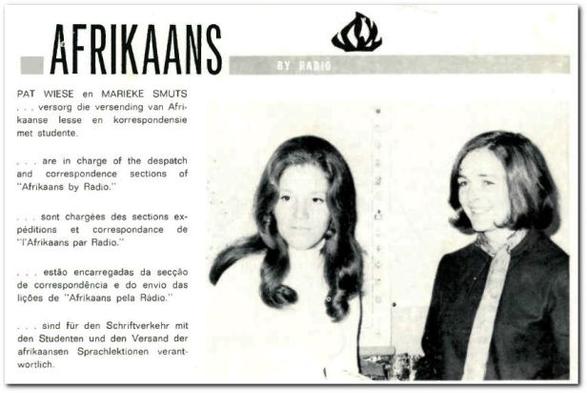
The Afrikaans by Radio program, "Conversation Corner", had diversified into a beginners’ and an advanced course by 1970, on Mondays and Thursdays respectively10. By 1971, the same was true for German learners, also on Mondays and Thursdays11. An "RSA Calling" program schedule in 198812 said that the courses were designed for "English, French, Dutch and German speaking listeners", and had been since the early 1970s.

The purpose of these short, ten-minute lessons is to introduce listeners to the Afrikaans language, its history, grammar and pronunciation. Each course is individually written for a specific target area and every lesson is light and entertaining. Booklets with additional information and homework exercises are available on request. The language tutor at Radio RSA corrects and returns all homework submitted and answers queries related to the language lessons. At the end of each years, all students who have completed the course successfully, receive a certificate and a book prize."

During the broadcasting period of May to October 1984, some sixteen years later, Radio RSA’s programs for the U.S. and Canada included news, "Under the Southern Cross", "Our Wild Heritage", the Afrikaans-teaching "Conversation Corner", "Africa Today", the inevitable "Comment", "Spotlight", "P.O. Box 4559", and "Touring RSA". The news and comment were broadcast daily, other programs varied, depending on the day of the week. Another rather Boer program probably was "Farming in South Africa", by J. P. J. van Vuuren.

Contrasting the English service for North America and for German-speaking Europe, these are the Afrikaans or Afrikaans-related programs of either program, roughly:

Programs for NA  Programs in GermanConversation Corner / Afrikaans by Radio  Lernt AfrikaansAfrikaans Light Music (in the 1960s)  Boer Music (Burenmusik)  
  • Three-Hundred Years in Africa
  • Oom Paul Kruger (about 1986)
  • Afrikaanse Poetry (Afrikaanse Dichtkunst), 197113 and again in 198714

All in all, the German program seemed to be more "Afrikaans"-leaning at the time than the English or the Dutch services. But apart from "singing and dancing", and the occasional warnings of Mangosuthu Buthelezi or other "homeland" leaders against the ANC and its "real intentions", the country’s popular majority wasn’t really part of the "Voice of South Africa" in German.

Most of the recorded material from Radio RSA that you find on Youtube is from the station’s German service. It makes for a nice audio library, although many of those recordings are obviously edited. As my own audio archive is rather limited, I’m making use of quite a lot of those online videos (which are in fact audios, with a few photos, usually QSL card motives, added).

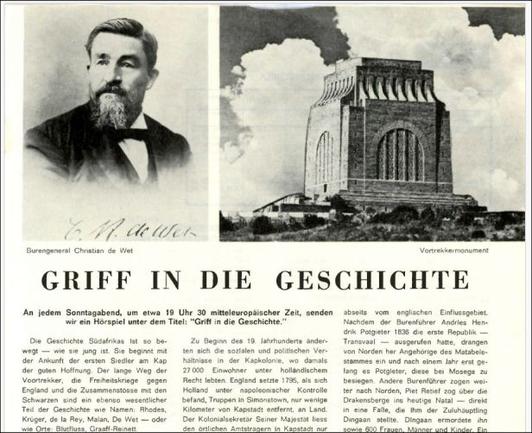
Germans were probably among the most dedicated listeners. Given that West Germany had always been a large potential audience, that’s probably not surprising, but as far as I’m concerned, I believe that cultural proximity was an important factor, too. Both the German service, while broadcasting from a mostly "black" country, was exclusively "white", and so was most of the German audience. The predominance of Boer culture and historical narratives struck me as odd (and occasionally hilarious) as a teenager and twen, but I didn’t spend much time asking myself about where the black majority was in the program. As that was in the 1980s, I’m not sure if I was still confronted with lines like "the history of South Africa is as eventful as it is young. It begins with the arrival of the first settlers at the Cape of Good Hope"15. But if I was, it probably didn’t puzzle me.
To cut a long story short: as far as I as a listener was concerned, the German service of Radio RSA came across as rather accessible. Radio Moscow … not so much.

Radio RSA’s task was to present the country as likeable, as one with problems, but who hasn’t, and so on. The events listed in the 1950s/early 1960s timeline above weren’t an issue in their programs. Even South Africa’s "white polity" was "divided against itself", and the country’s rifts only started there, but "The Voice of South Africa" suggested otherwise.

____

Outlook, part 7: "Crepuscule" – but I might change my mind about the topic until next time.

Notes

 1  International Commission of Jurists, Geneva 1960, see org status on page 2 there (consultative status), see also International_Commission_of_Jurists 2  The commission itself was by no means "communist": in fact, it had been "[b]orn at the ideological frontline of a divided post-war Berlin, the ICJ was established following the 1952 ‘International Congress of Jurists’ in West Berlin". 3  ICJ, Geneva, 1960, p. 17 4  quoted by Peter Orlik, 1968, page 173 5  Radio RSA German service, taken from a program at Radio RSA’s 10th anniversary – audio link 6  aka “Afrikaans by Radio” 7  Peter Orlik, 1968, page 183 – 189 8  ibid., page 184 9  ibid.10  RSA Calling, Febr 1970, page 311  RSA Calling, Sept/Oct 1971, page 812  RSA Calling (revived after severl years’ hiatus), page 113  RSA Calling, Sept/Oct 1971, page 814  Radio RSA schedule, January – December 198715  RSA Calling, Sept/Oct 1971, page 9


#Europe #foreignRadio #Germany #radioDrama #RadioRSA #shortwave #SouthAfrica

A Story of Radio RSA (5): Broadcasting under Broederbond Rule

To understand the state of affairs at the South African Broadcasting Corporation (SABC) when Radio RSA was founded, the battle between Gideon Roos (in charge of the SABC from 1949 to 1961, and not a Broederbonder), and Pieter Meyer (a Broederbonder) as described by Daniel Silke1 is instructive. Roos himself was apparently himself a Boer nationalist, but, compared to many others, a broadcaster with a high degree of professional integrity.

  Previous blog:
A Story of Radio RSA (4),  May 14, 2025  

On the other hand, no matter how they saw themselves or how they referred to themselves, Roos’s opponents, who kept undermining his position as SABC director-general until he finally resigned in 1961, were Boer hegemony propagandists. That’s why they wanted to replace Roos in the first place. Pieter Meyer was installed by telecommunications minister Albert Hertzog in 1959 – both Hertzog and Meyer were hardline Boer nationalist, both were Broederbonders. Meyer didn’t wield much influence against Roos at the beginning, but his Brothers made sure that he got all the legislation he needed to take full control of the SABC within two years. Meyer provided a particularly plain quote from SABC officialdom in a speech to the Broederbond (held in secret, for obvious reasons), emphasizing

[…] the need for the ‘complete political nationalizing and eventual cultural Afrikanerizing of our English-speaking co-citizens’ with the objective being ‘politically of permanent value, ensuring the continued existence of the Afrikaner, only if it is coupled with the Afrikanerizing of the economy’.”2

If China’s leaders had ever been in need of a western colonial concept for assimilating Tibetans and Uighurs, Piet Meyer’s Afrikanerizing-of-the-English recipes would have been that.

Piet Meyer’s ideas didn’t sell well enough to become a general policy beyond the SABC. But they might help to explain why Radio RSA became more of a voice of the Boers than a real "Voice of South Africa", and be it only a "white" South Africa. The Broederbond was firmly in control.

The way Radio RSA’s position within the SABC is seen seems to vary. It was indeed run as the external service of the SABC from the beginning, but overseen by the Department of Information until its demise in the wake of the Muldergate scandal, and by the South African Ministry of Foreign Affairs after August 19853. Relying on two interview partners, among them Thami Ntenteni4, Abeli Zahabu Kilonda wrote in 19895:

Paradoxically Radio RSA enjoyed an editorial independence: from the outset, the Foreign Affairs department [foreign ministry] admitted not to be broadcaster, and left the station very much to the radio itself, only asking for extensive coverage of South African politicians and their travels around the world. The SABC had some editorial control, but was given the message that as an external broadcaster, Radio RSA had to say more than the national broadcaster to have some credibility with the listeners."

I’m not familiar with domestic SABC’s coverage at the time, but Radio RSA wouldn’t be the only foreign broadcaster to get some extra legroom in an otherwise rather narrow vehicle. Iran’s "Press TV", earlier this century, appears to have enjoyed a credibility and independence bonus among staff hired from abroad and from prominent interviewees before the Iranian leadership reined in on the broadcaster – or before it did so more noticeably than before.

Compared to nowadays’ "social media", shortwave transmissions were hard to direct at different target groups. Or, as Magnusson observed in 1976, "the senders have to take into consideration that in most cases the audience has a disparate composition. Thereby very likely the propagandist’s possibilities of influencing certain target groups with one technique and others with another are impaired."6

That said, Radio RSA’s propaganda didn’t need to vary the central message, or the approaches of entertaining and informing foreign listeners so as to alleviate a pre-existing distrust of South African media. The main message was the same for North America and for Europe (maybe less so for Africa). In fact, a real pain in terms of target groups was "the comment of the South African Broadcasting Company" a bête-noire among many Radio RSA employees, that much that in a mailbag program, replying to a letter of mine, they said that

[…] the comment is written by the SABC’s comment department, but that’s announced daily. This broadcaster was really established for broadcasts inside South Africa, and the comments occasionally result in something different from what we would like to have as a statement for our listeners abroad. We will have to live with that for now, but we are trying to gain influence here, too and to tailor our comments still more in accordance with the concerns of our listeners abroad."7

But overall, the approach at the SABC and Radio RSA were probably not so different.
According to Silke, quoting the "Cape Times" of Oct 31 1961 with "official SABC directives that ‘the broadcasts of messages likely to cause despondence and alarm should not be broadcast"8, or, also quoting the "Cape Times" of that day, SABC news service director Gert Fourie saying that "we do not broadcast threats to protest, strike or boycott. Such news as there will be a general strike by Natives in a week’s time must not be broadcast. We would be helping in the commission of a crime."9

Radio RSA, in the same mailbag show as quoted above, saw eye to eye with him, even twenty-seven years later:

But we cannot and we don’t want to make our station available to people who advocate revolution in South Africa. We gladly leave that to our colleagues in Europe and elsewhere."10

As a matter of fact, there were two reasons why they couldn’t have done that anyway. One was the Suppression of Communism Act, passed on June 23 in 1950, "under", as the International Commission of Jurists commented, "the guise of non-racial political legislation".11
And if that hadn’t been enough, South Africa was under a state of emergency at the time, and had been, since June 1986.

What’s propaganda?

Are there "propaganda-free" broadcasts, anywhere? I doubt it. Broadcasting can be a relatively fair and balanced business, in the sense of the U.S. "fairness doctrine" which probably made a real difference in public debate before its abolition in 1987. But to consider any opinion process in real life free of propaganda looks like an unfounded claim to me, no matter how "totalitarian" or "free" the society in question may be.

Both Radio RSA and its critics considered propaganda to be a negative thing – most Westerners do, no matter if they are American, European, or whatever else. Most media workers from emerging countries like Brazil or post-apartheid South Africa wouldn’t like to be referred to as "propagandists" either, and nor would the public there find "propaganda" trustworthy.

But propaganda is a somewhat complex term. For one, Chinese and Vietnamese people wouldn’t think so negatively of it – in fact, the Chinese Communist Party explicitly runs a propaganda department, although they have replaced the English "propaganda" term with "publicity", to make it more palatable to an international public. But inside China, not too many people would find fault with propaganda. Or rather: there can be good or bad propaganda – it depends on who’s doing it.

Among those who dislike propaganda per se, propaganda is always done by the bad guys. Good guys don’t need to depend on propaganda. Besides, good guys don’t do propaganda because that would be bad.

This is basically what the proponents of a South African foreign radio service said from the beginning: the government’s (or country’s, or what have you) case was good enough, could be presented to the world as is, and there was no need for "propaganda"12. That’s what telecoms minister Albert Hertzog claimed, too, when discussing it in 196513, four years after the demise of Gideon Roos as the SABC’s director-general.

Hertzog almost certainly knew better. If the general staff at the SABC and at Radio RSA also did, is another question.

Part 6 there.

Footnotes

1  Daniel Silke, “The Broadcasting of Politics in South Africa”, Cape Town, August 1989, pp. 80 to 90, avaliable online2  ibid., p. 933  Robert B. Horwitz: Communication and Democratic Reform in South Africa, Cambridge 2004, p. 287, available online4  Thami Ntenteni is an ANC communications officer and a former spokesman for Thabo Mbeki5  Abeli Zahabu Kilonda, External Radio Broadcasting: Ideology and Propaganda in the Discourse, A Content Analysis of Radio RSA’s News Reports Oct – Nov 1985, University of Natal, Durban, 2003, p. 34, avaliable online6  Magnusson, p. 127  Radio RSA, German Service, "Postfach 4559", Nov 5, 1988. Original German quote:
"[…] der Kommentar wird von der Kommentarabteilung des Südafrikanischen Rundfunks geschrieben. Das sagen wir aber auch täglich. Diese Rundfunkanstalt wurde eigentlich für Sendungen innerhalb Südafrikas gegründet, und bei den Kommentaren kommt dann gelegentlich etwas anderes heraus, als wir es uns als Aussage für unsere Hörer im Ausland wünschen würden. Damit müssen wir wohl vorläufig leben. Aber wir versuchen, auch hier Einfluss zu bekommen und unsere Kommentare noch mehr auf die Belange unserer Hörer im Ausland zuzuschneiden."8  Silke, p. 909  ibid., p. 9110  Postfach 4559, Radio RSA, German Service, Nov 5, 1988, "Postfach 4559", Nov 5, 1988. Original German quote:
"Aber wir können und wollen unseren Sender nicht solchen Leuten zur Verfügung stellen, die der Revolution in Südafrika das Wort reden. Das überlassen wir gern unseren Kollegen in Europa und anderswo."11  International Commission of Jurists, Geneva 1960, p. 50, avaliable online12  See footnote 2 there.

13  

Mosia, Riddle, Zaffiro, From Revolutionary to Regime Radio: Three Decades of Nationalist Broadcasting in Southern Africa, Africa Media Review Vol 8 No. 1 1994, page 14, avaliable online


#Africa #apartheid #broadcasting #foreignRadio #propaganda #RadioRSA #shortwave #SouthAfrica

A Story of Radio RSA (4): The Magic of the Word

In the world today, there are three great propaganda blocs: the U.S.S.R., China, and the United States. These are the most important propaganda systems in terms of scope, depth, and coherence. Incidentally, they represent three entirely different types and methods of propaganda."

  Previous blog:
A Story of Radio RSA (3),  May 11, 2025  

That’s what Jacques Ellul, a French philosopher and sociologist, wrote in 1962. His book, titled “Propaganda”, also became widely read in the United States, in the mid-1960s. Other socialist republics in Europe and Asia, Ellul wrote, were named as countries that

model their propganda systems on that of the U.S.S.R., albeit with some gaps, some lack of understanding, and without adequate resources. Then there are West Germany, France, Spain, Egypt, South Vietnam, and Korea, with less elaborate and rather diffuse forms of propaganda. Countries such as Italy and Argentina, which once had powerful propaganda systems, no longer use this weapon."

Ellul didn’t mention South Africa, but he had remarks about the “Negro problem of the American South”, i. e. the segregationist southern states of the USA, that might be applicable to South Africa’s history from 1948 to 1992 as well:

The local Southern milieu [in the USA] is hostile to Negroes and favorable to discrimination, whereas American society as a whole is hostile to racism. It is almost certain, therefore, despite the deep-rooted prejudices and the local solidarities, that racism will be overcome. The Southerners are on the defensive; they have no springboard for external propaganda – for example, toward the European nations. Propaganda can go only in the direction of world opinion – that of Asia, Africa, almost all of Europe. Above all, when it is anti-racist, it is helped along by the myth of progress.”1

To be successful, Ellul argued, propaganda needed to be in line with the “trend that normally will triumph because it agrees with the great myths of the time, common to all men.”2

"Independence", according to Ellul, was a myth among 1960s contemporaries for the same reason:

an extremely profitable word from the point of view of effective subversion. It is useless to try to explain to people that national independence is not at all the same as individual liberty; that the black peoples generally have not developed to the point at which they can live in political independence in the Western manner; that the economy of their countries permits them merely to change masters. But no reason can prevail against the magic of the word."3

I can’t tell if Ellul’s assertion that Argentina and Italy didn’t do propaganda any longer was correct. What is certain is that South Africa did have a propaganda system, and it was probably powerful. Also, it wasn’t quite out of tune with the times worldwide when apartheid was "invented": apartheid, by other names, was probably as much a British colonial as a Boer legacy. The Boers wanted the system to stay though, when the British empire, not to mention African nationalism, had made up their minds to move on. Still, the Boers had both the ideology and the players to make racial segregation stay in South Africa, at least for some time to come.

While struggles between black and white workforce in that country were an important driver of apartheid, Boer nationalism was another. British colonization of South Africa, including its Boer republics, certainly propelled the Boer self-consciousness that followed, and the atrocities of Lord Kitchener’s warfare against the Boers during the first years of the 20th century also did. After all, the Broederbond, which prepared the Boer takeover of political power in 1948, wasn’t a labor union – it was a secret society of civil servants, military and politicians who would become the "elite" of a Boer-dominated republic later on. But long before open Boer hegemony could begin, a Boer political leader, J. B. M. Hertzog, formed a governing coalition with the South African Labour Party in 1924. Hertzog might be referred to as the father of a – whites only – welfare state. He was also the father of Albert Hertzog, South Africa’s telecommunications minister when Radio RSA and the Bloemendal transmitter site were established in the mid-1960s.

Albert Hertzog, in that ministerial office from 1958 to 1968, is particularly well-known for his opposition against the introduction of television in South Africa. In fact, the first official TV broadcast in the country aired only in 1976.

Hertzog’s reasons to dislike the idea of South African TV seem to have been of a practical kind: "South Africa would have to import films showing race mixing and advertising will make [black] Africans dissatisfied with their lot", he was quoted. He is also said to have considered TV the "devil’s own box", but other sources suggest that he referred to it as a "small bioscope".

Calvinists aren’t known to be the greatest lovers of pictures anyway, but the Boer-English or Afrikaner-English relationship in South Africa probably mattered, too. You could get tons of productions in English, but not in Afrikaans. And the Broederbond hadn’t achieved hegemony for Afrikaans in South Africa to recklessly give its dominant position away again.

There was, however, a significant film industry, and one of its fun facts is that South Africa’s government had started sending out propaganda movies to TV stations abroad long before the country had any TV of its own. Films produced by the Republic of South Africa’s "Department of Information Films" were reportedly shown by their hundreds on American TV in the mid-1960s, and at a number of about 2,000 by 1972.4

The same is true for Afrikaans as a language for foreigners. When Radio RSA took off in 1966, Afrikaans featured rather modestly in terms of hours per week, and was soon down to 3.5 hours per week, and, by 1984, to 27 minutes per week – a short religious studio service in Afrikaans on Sunday mornings, targeting East and southern Africa on three frequencies.5

But while Afrikaans didn’t play a great role as a program language, Radio RSA ran an extensive Afrikaans language course for overseas listeners. In the English programs, it was referred to as the "Conversation Corner", or as "Afrikaans by Radio" and as "Lernt Afrikaans" in German. According to Radio RSA’s program schedule for 1987, the language courses were part of the Dutch and French services, too. Peter Orlik in 19686:

Although the informality is sometimes coy and the hilarity is often forced, the program does manage to convey a basic Afrikaans vocabulary and, along the way, praises, embellishes, and subtlely glorifies the Afrikaner’s history and culture which the Nationalist Party is so adamant about preserving and strengthening."

Orlik counted eighty English, forty-five Portuguese, twenty French, and six German-speaking learners who were regularly "sending in their homework" to "Conversation corner" in October 1967.7 According to Ake Magnusson, 1967 overall read 100 English-speaking “active pupils” from the SABC Annual Report, 12 in German-speaking, 30 French-speaking, and 76 Portuguese-speaking learners. By 1972, the number of English-speaking learners had risen to 1,400, and the number of German-speaking learners to 1,100.8 The overall number was at 3,400 learners. TV wasn’t for South Africa in the 1960s, but radio was big there, for audiences at home and abroad.

Continued: Broadcasting under Broederbond Rule, May 25 2025
________________

Notes

1   Jacques Ellul: "Propaganda", New York, 1965, p. 422   ibid.3   ibid., p. 744   Ake Magnusson, "The Voice of South Africa", Uppsala 1976, p. 45 (chart)5   Radio RSA, May/October 1984 program schedule6   Peter Orlik, "The South African Broadcasting Corporation: An Historical Survey and Contemporary Analysis", Wayne State University dissertation, Detroit, p. 1857   ibid.8   Magnusson, p. 37

________________

#Africa #broadcasting #foreignRadio #propaganda #RadioRSA #shortwave #softPower #SouthAfrica

A Story of Radio RSA (3): Countering Cairo

An article by German newsmagazine "Der Spiegel" noted in 1984 that the Soviet Union’s global radio propaganda produced more than 2,000 program hours per week in 84 languages1, "and 300 transmitting stations carry Moscow’s message around the world. Likely costs per year: two billion dollars." Also billions were reportedly spent on jamming of broadcasts from Western countries.

  Previous blog:
A Story of Radio RSA (2),  May 5, 2025  

There was no question that Radio Moscow, "Radio Peace and Progress", Radio Kiev, Radio Tashkent and other shortwave broadcasters from the USSR were maximum leaders on shortwave. But who counted the "program hours"? Were rebroadcasts of the same programs left out of the count? Did "Der Spiegel" refer to airtime rather than to program times? And were airtime hours multiplied with the number of frequencies used at one time? (They weren’t, as far as I can tell – that would have made Deutsche Welle numbers look implausibly small.

When it came to West Germany’s Deutsche Welle (DW), "Der Spiegel" stated airtime rather than "program hours" – 500 hours per week, in 33 languages and on 27 transmitters. That would mean 2.17 hours daily for every language on average. But of course, German and English had much more airtime than that, and that means correspondingly less for other services.

All the data needs to be taken with a spoonful of salt. According to Magnusson2, DW’s weekly output was closer to 800 than to 500 hours. As for the 33 languages, there is no difference between Magnusson (1976) and "Der Spiegel" (1984), but it seems unlikely that DW should have greatly reduced its airtime during those eight years.

Voice of America, also according to "Der Spiegel" in 1984, spoke only half as many languages as Radio Moscow with only 110 stations and a twentieth of Radio Moscow’s budget. That was to change however: President Reagan wanted a much stronger voice and pledged a billion dollars for the six years from 1984, to modernize and expand VoA’s equipment. The USIA or "United States Information Agency", a precursor of today’s USAGM, saw an increase of 28 per cent year-on-year, and "Radio Martí" was founded, the broadcaster targeting Cuba in Spanish.

Radio RSA had started with 127 hours per week, with May 1966. That would be a quarter of Deutsche Welle andx could be done with the four new 250-kW transmitters newly installed at Bloemendal, south of Johannesburg, but it doesn’t seem unlikely that Paradys, the older station southwest of Bloemfontein, was still involved, too, especially for African audiences. Referencing the World Radio TV Handbook’s 1968 and 1972 editions, Chris Greenway writes that Paradys was listed as still active in 1968, but no longer in 1972.

Based on Magnusson’s statistics3, Radio RSA’s weekly output had risen to 182.8 hours per week by November 1971.

Compared to November 1966, transmission hours to Africa have risen by 4 hours by November 1971, to 98. North America is targeted with 34 hours per week, an increase by eight hours, and Europe is targeted with 35 hours per week, up 29 hours. Here, Europe’s lingual diversity may have been a factor. Radio RSA, by late 1971, had started services in Dutch and in German, although if you go by Magnusson’s data on page 30 there, neither of the two had more than 15 minutes of airtime a day at the time. This seems to suggest that English and French, two services that had been in existence from the beginning, saw most of the increases.

Output would still grow further, to 194 hours in May 1984, but by and large, those 1971 – 1972 numbers define Radio RSA’s weight in the global shortwave broadcasting world in the 1970s and 1980s.

A few categories have changed by May 1984 – Africa, the Middle East and Europe have become more integrated. If that has led to more commonality in programs, I can’t tell. Africa 84.7 hours per week, Africa and Europe 42.7, Africa/Europe/Mideast 13.07, Europe 13.07, and North America 6.53. The airtime for Europe, if divided by half, results in 6.53 hours for the Dutch and 6.53 hours for the German service. While the 1967 and 1971 charts were based on statistics quoted by Magnusson, this chart is based on the May 1984 program schedule provided by Radio RSA.

To base a rough-estimates hitlist based on on another chart by Magnuson (p. 8, itself based on “The Right to Know” and Sveriges Arsbok 1971):

1.  USSR2,000   hours per week2.  USA1,800   hours per week3.  PR China1,600   hours per week4.  USSR Eur satellites   1,200   hours per week5.  Deutsche Welle800   hours per week6.  Great Britain700   hours per week7.  Egypt600   hours per week8.  Albania450   hours per week9.  Cuba350   hours per week10. Portugal320   hours per week11. Japan250   hours per week12. Sweden220   hours per week13. France200   hours per week14. Ghana180   hours per week15. South Africa170   hours per week

Egypt apparently featured as the leading broadcaster on the African continent, and there was an awareness in Cairo that the country wasn’t only an Arab, but also an African country. Announcing its Swahili programs in 1954, Radio Cairo dedicated the language service to “the liberation of the African continent, in which the Nile flows, from all forms of imperialism”. Indeed, according to Orlik4, South Africa’s apartheid politicians found Radio Cairo’s Swahili language service “particularly ‘vicious'”.

Radio RSA wasn’t a heavyweight, globally speaking, but in its target areas, it could be reliably listened to. The Dutch and German service always ran two parallel frequencies during their daily 56-minutes broadcasts in the 1980s (and probably most of the 1970s), and that also helped Radio RSA’s deft frequency planning. When one originally well-chosen frequency needed to be changed after all, be it because of interference, be it because of poor propagation, such a change could be announced on the remaining scheduled frequency. The same was true for most other language service, although not for every hour on air.

As can be seen by Radio Cairo’s Africa policy, propaganda on the continent wasn’t a one-way street. In fact, Radio Cairo – i. e. Egypt’s foreign radio service – was founded in the early 1950s and had pissed the British off, too, by early 1956. There were even worries in the House of Commons that London might jam those broadcasts.)

While London was worrying about its rule of East Africa, Pretoria worried about clandestine South African radio. Radio Freedom, operated by the African National Congress (ANC) from within South Africa in the early 1960s, before the Rivonia raid5, and from outside South Africa later on.

Coming soon: part four of this miniseries. If you see things to add or to correct, please let me know.

________________

Notes

1    "Der Spiegel", March 25, 19842    Ake Magnusson: "The Voice of South Africa", Uppsala 1976, p. 83    ibid, p. 264    Peter Orlik, "The South African Broadcasting Corporation: An Historical Survey and Contemporary Analysis", p. 1665    Eugene Fortein, "The Battle of the Airwaves: The Role of Radio in Mission and Colonialism/Apartheid", Bloemfontein, 2023, p. 9

________________

Related topics

Estimated total programme hours,    Wikipedia acc 2025-05-28Feconau, Radio de las Comunidades Nativas,   May 7, 2024


#Africa #foreignRadio #jamming #RadioRSA #shortwave #SouthAfrica

A Story of Radio RSA (2): Early Days at Bloemendal Transmitter Site

Most shortwave listeners outside South Africa, provided that they were teenagers or older in the 1970s and 1980s, will think of Radio RSA when South African radio is mentioned. But Radio RSA’s parent organisation, the South African Broadcasting Corporation (SABC) was founded in 1936, and some early broadcasting seems to have taken place as early as in the 1920s.

  Previous blog:
A Story of Radio RSA (1), April 23 2025  

According to Orlik1, South Africa’s first steps into international broadcasting started in 1950, only two years after the National Party, the one that implemented the apartheid policy that would determine South African politics for more than four decades, had come to power. Around 1950, a small shortwave station with only one transmitter was built in Voortrekkerhoogte, southwestern Pretoria2 and / or in Welgedacht, and in early 1957, a much larger station went into operation in Paradys, southwest of Bloemfontein.

From the 1960s onward, South Africa was at odds with most of the world as far as its apartheid policy was concerned. At the same time, interest in isolating it economically was limited, certainly in Western countries. And despite much of the All-African rhetoric, South Africa’s degree of isolation in its neighborhood, on the African continent, varied, too.

The Non-Aligned Movement – with the exception of countries on the African continent – appears to have been regarded as a lot of lost souls by the South African Broadcasting Corporation (SABC), the parent organization of Radio RSA. China and the USSR weren’t heavyweight trading partners anyway.

And if it was up to many or most of the National Party politicians, that was nothing to be hurting of. According to Ake Magnusson3, a researcher with Gothenburg University in the 1970s, the second man in charge of the Bloemendal shortwave project was Albert Hertzog, telecommunications minister in the Nationalist Party cabinet. His boss was Hendrik F. Verwoerd, South Africa’s prime minister. Neither of them was quite the liberal.

Two years after Radio RSA had gotten started from Bloemendal, the SABC wrote4:

All that remains to be added are broadcasts to Latin America and the Far East. These transmissions have already been planned but it will be some time before they are put into effect."

Radio RSA did add Latin America and – for some time – Australia and New Zealand to its target areas during the years or decades that followed, but as far as I can tell, there never were any dedicated Radio RSA transmissions to or language services for China, India or Indonesia.

Western or West-leaning countries were apparently deemed to be the propaganda battlefield. As Magnusson noted, "politically as well as economically Europe and North America are more important to South Africa at short sight than for instance Latin America and the Asian states."

In 1971 nearly 45% of the programme time was devoted to working on and disseminating information to the politically important states in North America, Europe, Australia and New Zealand. These nations are South Africa’s interchagne partners. Trade, investments and immigrants form South Africa’s umbilical cord to the outside world and the placenta was, and still is, formed by several „western“ countries. The Third World and the Communist states had begotten and were still actively nourishing the strategy of isolating South Africa from the outside world. In order to prevent this strategy from being put into political practice South Africa is working on the Western Powers energetically. An element in this work is made out by shortwave broadcasts to the countries mentioned."

Prime Minister Verwoerd pushed the inagural button on October 27, 1965 at what was soon to become the H. F. Verwoerd Shortwave Station, after the Verwoerd’s assassination a year later. The transmitters‘ location was at Bloemendal, near Meyerton, Gauteng Province.

It is said that there were four transmitters at 250 kW each5 in Bloemendal at the time, that could be taken on the air on May 1 1966 when Radio RSA officially went into operation with its first schedule. Based on this source, this is what Radio RSA’s schedule from November 1966 to March 1967 looked like.

The bar chart shows three target areas: Africa, the Middle East, Europe, and North America. Africa is targeted with 94 hours weekly, while the Middle East gets only one hour per week. Europe is at six hours, and North America is at 26. Based on data by Magnusson.6

It seems that Europe was actually the SABC’s or Radio RSA’s first target area outside Africa7. That would make sense for a number of technical reasons (I’m guessing here). When we look at an azimuthal map, Europe didn’t require a beam range as wide as North America.

Working hours may have played a small role, too: the time difference between (western) Europe and South Africa was minimal. A continuity announcer for this audience, if live on air, would be at the microphone in the early evening hours South African time. At least some of the continuity was indeed spoken live. Also, it was hoped that some of the transmissions for Europe could be heard in North America, too.8 Either way, South African radio became much easier to „DX“, and even to simply listen to, than before 1966.

Adrian Peterson, father of the „Wavescan“ programs, gave a detailed technical account of the shortwave transmitter site when Sentech put it off air in 2019.

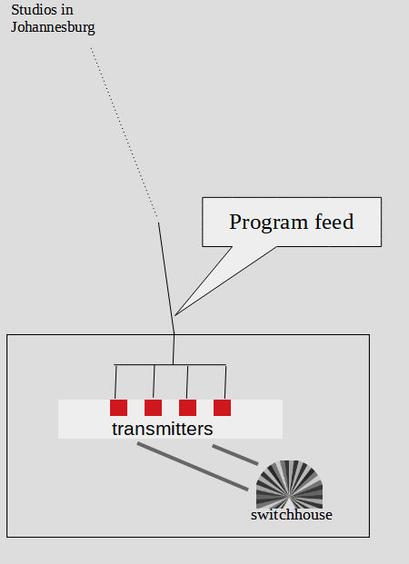
Entering the coordinates of 26°35’34.0″S 28°08’24.0″E at Google Maps should still take you to a rather instructive aerial view of the station at Bloemendal, some ten kilometers east of Meyerton, and some 40 kilometers south of Johannesburg (both beeline distance). The coordinates 26°35’10.6″S 28°08’21.6″E will take you to the cake-tin shaped switchhouse where Radio RSA’s first internationally-dedicated four Brown-Boveri transmitters would be connected to any of the station’s 38 antenna arrays by the push of a button9. From this cake tin, the antennas were also slewed into their desired sub-directions.

In some detail10,

(1) the African and European array centered at 7.5 degrees which, with slewing, serves East and North Africa as well as Euirope and the Middle East, (2) the West African array centered at 20 degrees whioch, with slewing, covers West Africa as ffar South as Angola and Wet Europe, (3) the North American array at 55 degrees which, with slewing, covers all of that continentn and, when reversed, serves Australia and New Zealand. A fourth array has also been provide for, which, when put into operation at 105 degrrees, will cover Central and most of South America and when reversed, will serve India and the Far East."


The way I understand the sources‘ description of Bloemendal transitter site

While the Radio RSA studios were always in Johannesburg, through all the Bloemendal operational years from 1966 to 2019, they hadn’t been in Auckland Park from the beginning. The previous address had been Commissioner Street.

"[South Africans] have tried to make our voices herd in a small way in the past and now from today we are joining those other countries of the world, wether great or small, who make their voices heard to the furthest ends of the earth", Orlik quotes then South African prime minister Verwoerd11, during the opening ceremony at Bloemendal transmitter site.

But what did that radio world look like, and how did Radio RSA compare to stations like the BBC World Service, Radio Peking, Radio Cairo, Radio Moscow, or Voice of America in terms of transmitters, number of languages and broadcasting hours per week?

During that better half of a century that Radio RSA and then Channel Africa were broadcasting on shortwave, both South Africa and the world saw a lot of change. But that’s for the next blog on Radio RSA.

________________

Notes

 1   Peter Orlik, Dissertation, 1968, p. 164
 2   ibid
3   Ake Magnusson: „The Voice of South Africa“, Uppsala, 1976, p. 48 (footnote 11)
 4   ibid, p. 28
 5   Wavescan, Mar 31 2019
 6   Magnusson, p. 26
 7   Orlik, 1968, p. 168
 8   ibid
 9   ibid, p. 169
 10   ibid, p. 170
11   ibid, p. 167


#Africa #apartheid #broadcasting #foreignRadio #RadioRSA #shortwave #SouthAfrica

Radio RSA - Wikipedia

A Story of Radio RSA (1): „That will be our Image“

This is the first of a few blogs on „Radio RSA, the Voice of South Africa“.

Radio RSA was the foreign radio section of the South African Broadcasting Corporation (SABC). The SABC had been founded in 1936, before the second world war and before the political advocates of apartheid had come to power in 1948.

The station went into operation in May 1966. According to Wavescan, the SABC had previously "procured a tract of land containing 1250 acres south of Johannesburg in a hilly country area due east of the town of Meyerton" in 1964.

Apartheid had become practice in South Africa in 1948. It soon became an elaborate system of discriminatory rules, and those probably led to conflict from day one.

The Sharpeville massacre on March 21 1960 is said to have been a turning point in the international perception of South Africa. A number of resolutions concerning apartheid had been passed by the UN General Assembly before, but this time, the UN Security Council actually passed a resolution, number 134,

"Recognizing that such a situation has been brought about by the racial policies of the Government of the Union of South Africa and the continued disregard by that Government of the resolutions of the General Assembly calling upon it to revise its policies and bring them into conformity with its obligations and responsibilities under the Charter of the United Nations."

Most white South African voters – the only voters anyway – weren’t prepared to go along with that, and in a further move into isolation, in a referendum, all provinces except Natal voted to turn the Union of South Africa into a Republic of South Africa. All votes cast at the time were "white", of course. That in turn led to an end to South Africa’s Commonwealth membership, and the Commonwealth didn’t approve South Africa’s application for re-entry, as described here by British prime minister McMillan.

But while evolving into a pariah politically, South Africa recovered and expanded economically1). Therefore, there was still a lot at stake for the country. Task one: convincing the West that South Africa "was particularly important to the Soviet Union due to its location and, therefore, worthy of its support". Task two: reminding the West "that 71% of their gold production came from South Africa." Eugene Fortein, in a paper published in 2023, and quoting a third source (page 6), establishes a link between the two tasks spelled out above, and shortwave radio. The mission was stated in a parliamentary debate on May 20, 1965 (or May 21 according to another source), by a National Party MP:

"The content of those broadcasts will be directed positively at the outside world. It will not be positive propaganda because it is of no avail to try to refute propaganda with propaganda. The SABC will give a positive picture of South Africa as a civilized country …
We shall make the outside world acquainted in a positive way with the fact that we are not, for example, a police state; that we are not, for example, still living in the dark ages … (and) that there is no slavery here and thatone can worship God here in South Africa …
We shall give the world a positive picture of the fact that we in South Africa are a civilized and highly developed nation. That will be our image …"2)

At the time when parliament approved the establishment of Radio RSA, there seems to have been only one 20-kW shortwave transmitter.3) That one was to be replaced by a transmitter site with four 250-kW transmitters. South Africa’s prime minister Verwoerd inaugurated the site personally. Only one of the four transmitters was ready to go on air at the time, but the three others followed within months, probably before Radio RSA officially went on air in May 1966.

Radio RSA’s German service started in March May on March 5 19674. English and French services were a constant through the broadcaster’s history from 1966 to the end in about 1992, both for the African continent and for Western countries, and Africa was always a top target area, ahead of the rest of the world. Ake Magnusson, a lecturer at Gothenburg University at the time, published a small book in 1976, and one of the things he focused on there was in which global regions Pretoria hoped to hold sway over public opinion by radio.

Western, and arguably even more so African, countries would be the main target areas for Radio RSA during the decades that followed.

What I want to find out is if Radio RSA was a real success for South Africa’s government. That depends on the criteria you define, of course – it almost certainly didn’t backfire against Pretoria.

But these will be considerations for another blog.

_______________

Notes

1) Eugene Andre Fortein (page 6) quoting Lamola, M. J. 2021. Sowing In Tears. A Documentary History of the Church Struggle against Apartheid 1960–1990
2) Ake Magnusson, „The Voice of South Africa“, Uppsala 1976, page 18
3)Magnusson, ibid.
4) Correction of May 29 2025, source: Radio RSA, May 1 1976

#broadcasting #Europe #foreignRadio #RadioRSA #shortwave #SouthAfrica

Wavescan