Very interesting paper by Padget et al. (Proc R Soc B) about guppy predator inspection. Theory predicts cooperation should decrease as group size increases, but they found the opposite. I wrote a blog post about it here
https://nadiah.org/2023/01/15/padget
#cooperation #guppy #VolunteersDilemma #coordination #PublicGoodsGame

Guppy predator inspection
I read a very interesting new paper by Padget et al. (2023), published late last year in Proceedings of the Royal Society B. The paper describes an experimental study of guppies’ predator-inspection behaviour, and it presents a bit of a mystery and a challenge to theoreticians.
I don't know if good photos go to heaven, but surely bad ones go everywhere. Additional reflections on sharing contents in the Internet public goods game, and giving credit where it is due.
#PublicGoodsGame #attribution #acknowledgement
https://giuseppevizzari.github.io/posts/2024/1/Bad-photos-go-everywhere/
Bad photos go everywhere
Shared contents end up everywhere; it’s fine, but an acknowledgement would be nice…
Contributing to the public goods game…
A few suggestions on harmless ways to contribute the Internet public goods game…
Almost had a disaster the other week when the "fishing game" we use to teach Tragedy of the Commons was down. But I found a good online platform to replace it that does the #PublicGoodsGame and other behavioural economics type experiments.
https://nadiah.org/2023/10/31/veconlab-pgg

Web-based public goods game and other experiments for teaching
Each year since 2017, I’ve been taking one lecture for Ryan’s subject LSM4255 Methods in Mathematical Biology, teaching evolutionary game theory and adaptive dynamics. After the class, we usually have a tutorial where we play the fishing game, a simulation of a fishery that teaches students about the tragedy of the commons.
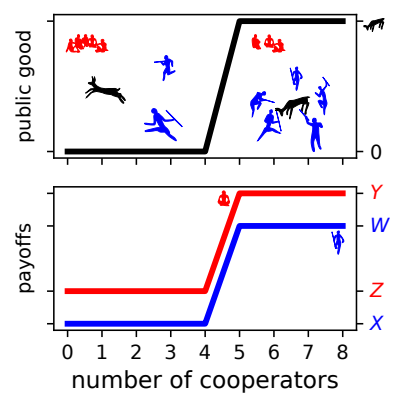
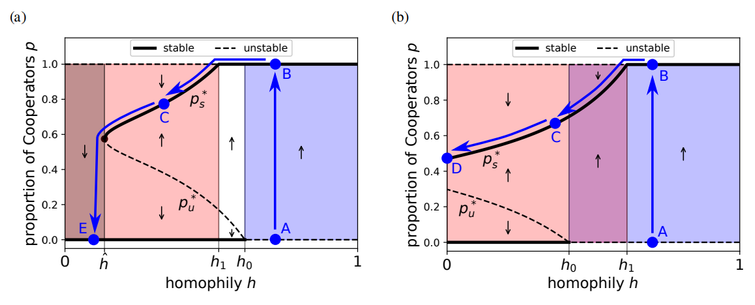
Ancestral social environments plus nonlinear benefits can explain cooperation in human societies
Human cooperation (paying a cost to benefit others) is puzzling from a Darwinian perspective, particularly in groups with strangers who cannot repay nor are family members. The beneficial effects of cooperation typically increase nonlinearly with the number of cooperators, e.g., increasing return...
 Nadiah Kristensen
 Giuseppe Vizzari