Wrote my first comment on a paper over at @PubPeer today: https://pubpeer.com/publications/E336CA398E25647EBF5620F2378D72
How did I do?
I don't doubt that I missed some errors in the paper - it's chock-a-block full of oddities!
#PeerReview #Postpublication
PubPeer - Designing Ecological Networks to Foster Regional Economic Su...
There are comments on PubPeer for publication: Designing Ecological Networks to Foster Regional Economic Sustainability: source identification in the Longdong Loess Plateau using self-organizing map and complex network theory (2025)

Using PubPeer to screen editors
2023 was the year when academic publishers started to take seriously the threat that paper mills posed to their business. Their resear...
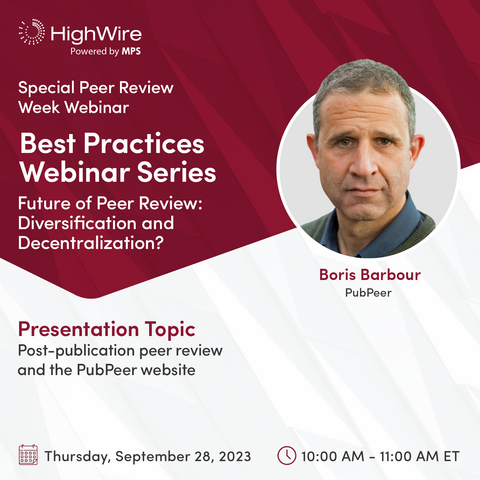
Meet our presenters for the HighWire's Best Practices Webinar.
@BorisBarbour is from @PubPeer, which is a nonprofit that aims to improve the quality of scientific research by providing a platform for the scholarly community to discuss about scientific research after publication. Boris will talk about ‘Post-publication peer review and the PubPeer website’.
Register for the webinar here: https://us06web.zoom.us/webinar/register/WN_JhLG9pnLR_ypeP-XyiIaDg
#PostPublication #PeerReview #CommunityEngagement #ScholarlyResearch #PubPeer


Welcome! You are invited to join a webinar: The Future of Peer Review: Diversification and Decentralization?. After registering, you will receive a confirmation email about joining the webinar.
"Scholarship is iterative; it builds on itself. Researchers conduct experiments based on the experiments that were conducted in the past, with the hope that the articles describing their experiments and conclusions will be cited by other researchers in the future. A research article can be seen as a conversation between scholars, and in the past, this conversation almost exclusively took place privately between colleagues, and then more officially as part of the anonymous peer review process. Today technology allows this conversation to take place in the open, in forums like preprint servers, or as part of reviewed preprint outputs and the conversation can be ongoing with post publication commenting. The reputation and the utility of peer review performed outside of the journal setting has improved and there are now multiple providers of what is sometimes called “community peer review” offering various services targeted at different parts of the scholarly communications ecosystem, from preprint to reviewed preprints to journal peer review to post-publication commenting.
This Peer Review Week Webinar will examine different types of community and third-party peer review services, and examine how community peer review, including pre-submission and post acceptance review, fits into the future of peer review."
Join us on 28 September 10 am – 11 am ET. Panelists include representatives from PREreview, eLife and PubPeer.
Zoom@ebrandom It's a post-publication peer review platform much like F1000 Research. Qeios make their money from authors paying to have their AI send out reviewer invites.
On PPPR: https://scholarlyassessmentreports.org/articles/10.29024/sar.26
https://www.ncbi.nlm.nih.gov/pmc/articles/PMC4472664/
#PeerReview #PostPublication #PPPR