 GreenDotGuy
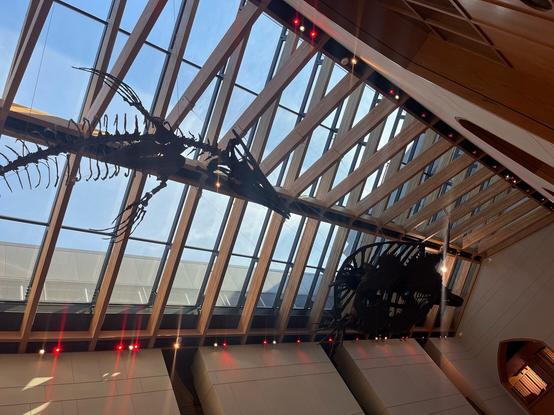
One of my favorite #architecture effects is when a new building is built upon an old one and they leave parts of the the original in the new. This is in a hallway at the Yale #PeabodyMuseum .


Explore this photo album by Robin Haettich on Flickr!

Explore this photo album by Robin Haettich on Flickr!
The Repatriation Project
Tribes in #Maine Spent Decades Fighting to Rebury Ancestral Remains. Harvard Resisted Them at Nearly Every Turn.
by Mary Hudetz and Ash Ngu
Dec. 4, 5 a.m. EST
"Donna Augustine was in tears as she read the letter from Harvard University that winter morning in 2013. Looking around the room inside an elementary school on Indian Island, Maine, she saw other elders and leaders from the four Wabanaki tribes were also devastated as they read that the university was denying their request to repatriate ancestral remains to their tribes.
"The Wabanaki tribal nations — an alliance of the #Penobscot, #Passamaquoddy, #Maliseet and #Mikmaq — wanted to rebury the ancestral remains. But Harvard’s #PeabodyMuseum of Archaeology and Ethnology said, as it had in past years, that the tribes didn’t have enough evidence to show that they could be tied, through culture or lineage, to the ancestors whose remains the museum held.
"The denial felt like a rejection of Wabanaki identity for Augustine, a Mi’kmaq grandmother, who had spent years urging Harvard to release Native American remains.
"'Every one of us in that room was crying,' she recalled. 'We jumped through every hoop.'
"The group representing the only four tribal nations in present-day Maine had furnished a deeply researched report documenting their histories in the region, even sharing closely held stories passed down within their tribes from one generation to the next that told of their ancient ties to Maine’s lakes, islands and forests.
"Now they could see it hadn’t been enough for Harvard, which especially prized the remains of 43 ancestors buried for thousands of years near Maine’s Blue Hill Bay.
"Complicating matters for the tribes, another museum, the similarly named but smaller Robert S. Peabody Institute of Archaeology, housed on the campus of the #PhillipsAcademy, a Massachusetts preparatory school, held items from the same ancient burial site.
"Instead of sending a letter as Harvard did, the Phillips Academy museum director, Ryan Wheeler, had asked to meet with the tribes. Seated at the table that morning, he was initially uncertain what he would do. He would later say that it became evident during the meeting that the tribes exhibited a strong connection to the ancestors they sought to claim, both from the report they had provided and their reaction to Harvard’s decision.
"He recalled leaving the meeting certain he would repatriate. 'There was really no question about it,' he later said.
"What the Wabanaki committee and Wheeler didn’t know, however, was just how hard Harvard would push back. In the two years that followed, the director of the Harvard museum went to surprising lengths to pressure Wheeler to reverse his decision.
"A #ProPublica investigation this year into repatriation has shown how some of the nation’s #elite museums have used their power and vast resources to delay returning ancestral remains and sacred objects under the #NativeAmericanGraves Protection and Repatriation Act. By exploiting loopholes in the 1990 law, anthropologists overruled tribes’ evidence showing their ties to the oldest ancestral remains in museums’ collections. We’ve also shown that museums and universities have delayed repatriations while allowing destructive analyses — like DNA extractions — on ancestral remains over the objections of tribes.
"Harvard, where the remains of an estimated 5,500 Native Americans are stored at the Peabody Museum, used these loopholes over the span of three decades to prolong the Wabanaki tribes’ repatriation process while remaining in technical compliance with the 1990 law, our review found.
"For Augustine and her colleagues, few things were more frustrating than knowing that NAGPRA had empowered museums to decide whether Indigenous people had a valid connection to their ancestors. These were the same institutions that had collected the human remains and objects from ancestral burial sites. Despite NAGPRA’s intent to give Indigenous people say over ancestral remains, institutions still made the final decisions on whether to repatriate.
"'The wolves are in charge of how to deal with the sheep,' said #DarrellNewell, a former vice chief of the Passamaquoddy Tribe who helped create the Wabanaki Intertribal Repatriation Committee to accelerate negotiations with the institutions. 'It’s just not a good way.'
"Harvard in recent years has apologized and promised to speed repatriation, saying it aims to repatriate all #NativeAmerican remains and the items once buried with them within the next three years and recently doubled staffing in the Peabody Museum’s repatriation office. However, the school has yet to return more than half of the human remains it reported holding under NAGPRA, according to federal data from November. Only two institutions, of the hundreds that must comply with NAGPRA, hold more human remains than Harvard."
#Repatriation #NativeAmericans #Wabanaki #WabanakiConfederacy #HarvardUniversity #CulturalGenocide
Super interesting day with #yale and #TrinityCollege historians partnered with #nasa climate modelers collaboratively figuring out how people through antiquity responded to climate shocks. - even the best prepared weren’t immune.
Finished our day at the
#PeabodyMuseum which will re-
Open this spring and include a public display about our joint effort along with their incredible renovation…
Couldn’t help myself.


 robinhaettich
 DoomsdaysCW
 legraLeGra
 BC Info Bot
 PerryTrails