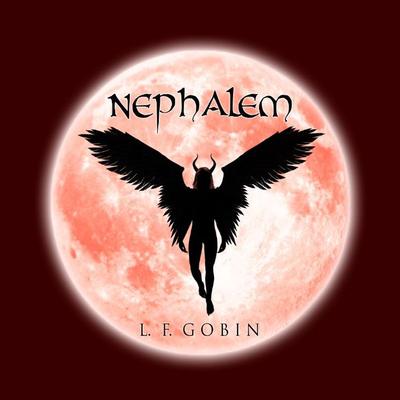
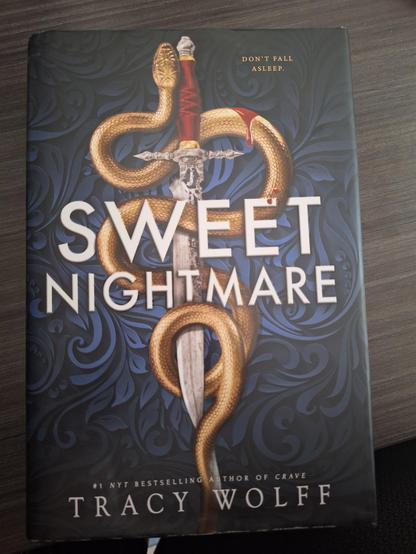
A book about teen angst - February 25, 2026 - This is the first book in a series about a high school for paranormal teenagers. Drrrrraaaaamaaa! It's cute, and the author doesn't pull punches just because it's written for young adults, but the tone is still a bit too juvenile for my enjoyment.

Rating ⭐️ ⭐️ ⭐️ 1/4

#popsugarreadingchallenge #bookstodon #bookstodoner #fantasy #youngadultfiction #paranormalbooks

Reading list for paranormal investigation and research

In a recent discussion with a paranormal investigation group, I found myself referencing recommending books to check out for the latest on interesting facets of the field. I decided to share this annotated list.

First, there are three books that are “Handbooks” for spontaneous cases. They put ghost-hunting gadgetry in its place and re-orient the investigator to the proper aim of investigation: define the claim, assess if anything is happening, and then solve the problem. I consider these the best modern guides. If you are intent on pretending to be a TV-type investigator, then go waste your money on the paraceleb guides.

Scientific Paranormal Investigation (2010) by Benjamin Radford.
I reviewed this book here where I recommended it as a much-needed critical and logical guide to actually solving mysteries. Get it.

Radford expanded on the 2010 book with Investigating Ghosts: The Scientific Search for Spirits (2018) to tackle more specifics in depth including EVP evidence.

Ghostology: The Art of the Ghost Hunter (2015) by Steve Parsons. Why are you using that gadget? Why do you conduct a “sweep” of the room? Do you even know why or is it just because you saw it on television? Parsons hits every point and is clear about what you should or should not bother with. This is a true ghost hunting guide. For more details, I reviewed it here. Get it in Kindle.

It’s important to have a background on the cultural history of ghosts. The classic book on the historical context of ghosts is Ghosts: Appearances of the Dead and Cultural Transformation (1996, 2nd ed.) by R.C. Finucane. You simply can’t claim to understand the present phenomena of ghosts if you know nothing about how ghosts were depicted in the past. Get it.

Spirits of an Industrial Age: Ghost Imposture, Spring-heeled Jack and Victorian Society (2014) by Jacob Middleton . I was enamored with this book from which I learned an incredible amount of historical context for spirits and cultural ideas about haunting. The genuine stories taken from the media reports of a bygone era are fascinating. This book is highly readable, yet scholarly. Pick it up on Kindle for a steal.

The Haunted: A social history of ghosts (2007) by Owen Davies. This volume is incredibly well-researched. It can be dry at times but it is an essential volume to have as the social history of ghosts is THE history. This book is highly regarded and regularly referenced by scholars of ghost lore and literature. Get it.

The following three books are key volumes on modern examinations of ghost activity and cultural aspects.

Australian Poltergeists: The Stone-throwing Spook of Humpty Doo and Many Other Cases (2014) by Paul Cropper and Tony Healy. Stories of stone-throwing and fire-starting troubling house ghosts are not new. Yet the same themes occur in the present day. Cropper and Healy do an excellent job of documenting these cases, many of which were researched in person. Though they can’t explain what’s going on, I can’t recall another volume of this type. I wish the same book was done for other places in the world. More in my review here. Get it on Kindle.

Paranormal Media: Audiences, Spirits and Magic in Popular Culture (2010) by Annette Hill (no relation) This book is based on research into paranormal popular media addressing both a UK and US perspective. I used this book heavily for my thesis work. It is a scholarly book so the price is a bit steep but borrow it if you have to as this is essential information to consider when evaluating ghost claims. I reviewed it here.

Parapsychology: A Handbook for the 21st Century (2015) edited by Etzel Cardeña, John Palmer, David Marcusson-Clavertz. This textbook is hefty but necessary. If one is to claim that they work in the field of amateur parapsychology, then you ought to at least know the state of the science. Even a perusal of this volume will show the wide chasm between ghost hunters and academic parapsycholgy. Read more about this here in my review. It’s often available through university libraries but the Kindle edition is reasonable.

In Alan Brown’s Ghost Hunters of New England (2008) you read firsthand candid views and opinions from amateur groups who bumped up against the “top” group The Atlantic Paranormal Society (TAPS) who went on to do the Ghost Hunters TV show. The groups interviewed for this book expressed their ties or distance to or from TAPS and the Connecticut-based, self-styled demonologists, Ed and Lorraine Warren. I saw their comments as revealing, provide curious trackbacks to what motivates a group and how they attempt to either follow an already forged path or try to differentiate themselves from the group in the next town. Some animosity and jealousy is apparent as groups hide their data from each other and stake out territory. Brown also tackled the groups in the South in a similar book. Get it.

Finally, these two volumes are excellent at discussing the booming paranormal business of today in historical contexts. If you don’t think that’s important to understand, you are missing a huge body of understanding.

Ghostland: An American History in Haunted Places (2016) by Colin Dickey. This book was so entertaining and enjoyable I could not put it down. After getting it from the library, I had to purchase a copy. It delves into the accurate history of places like Salem, the Lalaurie mansion, and the Winchester House. I was enlightened. And sometimes really angry at how the truth is buried for a quick buck. Absolutely grab this one.

Haunted Heritage: The Cultural Politics of Ghost Tourism, Populism, and the Past (2015) Michele Hanks. This book was an expansion of a thesis. Hanks covered a good bit of what I did as well in my book but in the UK so there are some differences. But it was critical to see how she developed the contexts for ghost researchers at their various levels of involvement. She showed how they long for experiences and ownership of their own heritage. U.S. readers will find these themes resonate in their communities as well. It will reveal a whole other level of meaning for participation in paranormal activities. Get it.

And of course, please purchase my book on paranormal researchers, Scientifical Americans. Head over to the page for more info.

I’m still reading so I may have a part 2 to this list. Please subscribe to the blog in the right sidebar.

#bookListForGhostHunters #bookReview #ghostHistory #historyOfGhosts #Paranormal #paranormalBooks #paranormalInvestigation #paranormalInvestigators #recommended https://sharonahill.com/?p=6802
Author interviews paranormal & ufos aliens

YouTube
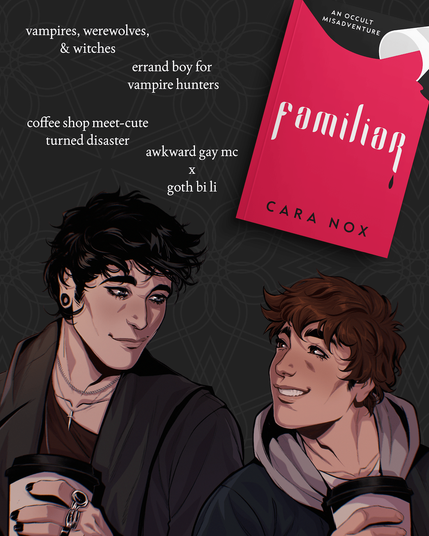
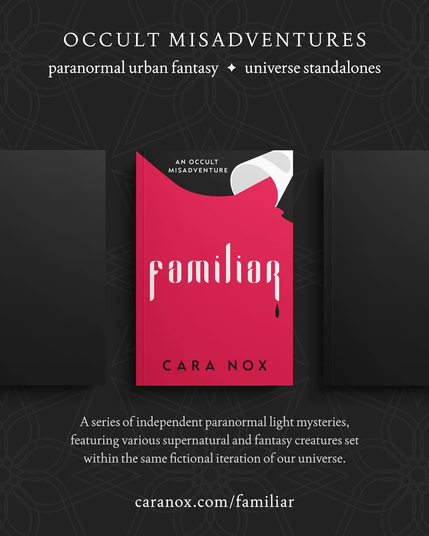
🖤🩸FAMILIAR is a fast-paced, LGBTQ+ paranormal standalone you should check out if you're into vampires, vampire hunters, witches, and werewolves.

🎨 art of Jules & Saint by Martina Belli (https://martinabelli.carrd.co)

https://caranox.com/familiar


✨ Occult Misadventures — paranormal urban fantasy standalones (read in any order series)
📖 Familiar
A series of independent paranormal light mysteries, featuring various supernatural and fantasy creatures set within the same fictional iteration of our universe.

🖤 90s/00s-feel paranormal/urban fantasy
🩸 errand boy for vampire hunters
🖤 awkward gay mc x goth bi li
🩸 mistakes™ were made
🖤 coffee shop meet-cute turned disaster
🩸 hunters with ulterior motives
🖤 chaotic first person narration
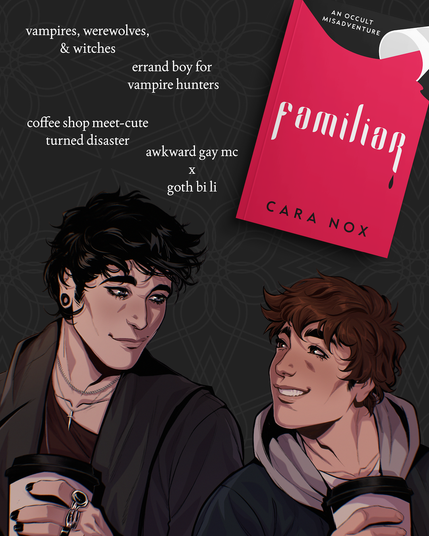
🩸 vampires, werewolves, & witches


#Books #Bookstodon #UrbanFantasy #QueerBooks #LGBTQIAbooks #VampireBooks #ParanormalFantasyBooks #ParanormalBooks
🖤🩸FAMILIAR (aka: "That Time I Got Drunk and Accidentally Became a Vampire's Familiar") is a fast-paced, LGBTQ+ paranormal standalone you should check out if you're into vampires 🥰

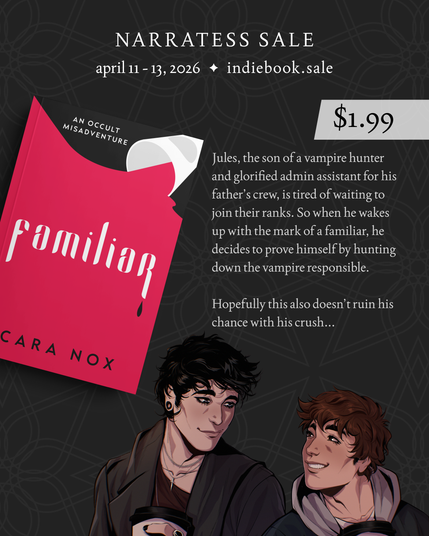
Jules, the son of a vampire hunter and glorified admin assistant for his father’s crew, is tired of waiting to join their ranks. So when he wakes up with the mark of a familiar, he decides to prove himself by hunting down the vampire responsible.

Hopefully this also doesn’t ruin his chance with his crush...

🎨 art of Jules & Saint by Martina Belli (https://martinabelli.carrd.co)


✨ Occult Misadventures — paranormal urban fantasy standalones (read in any order series)
📖 Familiar
A series of independent paranormal light mysteries, featuring various supernatural and fantasy creatures set within the same fictional iteration of our universe.

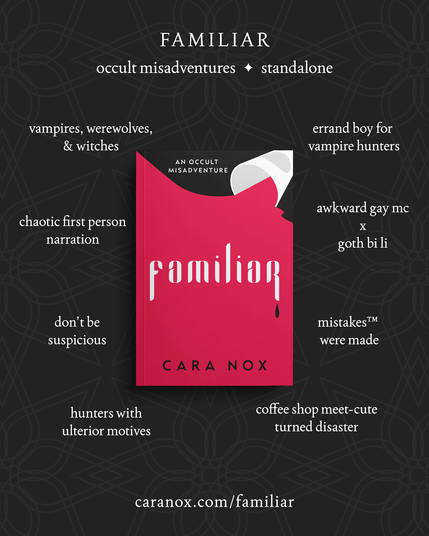
🖤 90s/00s-feel paranormal/urban fantasy
🩸 errand boy for vampire hunters
🖤 awkward gay mc x goth bi li
🩸 mistakes™ were made
🖤 coffee shop meet-cute turned disaster
🩸 hunters with ulterior motives
🖤 chaotic first person narration
🩸 vampires, werewolves, & witches

https://caranox.com/familiar


#Books #Bookstodon #UrbanFantasy #QueerBooks #LGBTQIAbooks #VampireBooks #ParanormalFantasyBooks #ParanormalBooks

Author Spotlight: Paranormal Author Jason A. Kilgore

Jason A. Kilgore (he/him) is a multi-genre writer in speculative fiction, including horror, fantasy, and science fiction, as well as poetry, scientific publications, and essays, and has published five books so far. By day he is a scientist.

Jason lives in Oregon and when he isn’t writing, he loves hiking and camping in the mountain wilderness areas and the Pacific coast.

Author Links:

@worldskilgore on every platform:
Facebook
Bluesky (worldskilgore.bsky.social)
X
Instagram
YouTube

Website: jason-kilgore.com

Amazon Author Page: author.to/JasonKilgore

GoodReads: Author Page

Christmas time in the UK is traditionally a time to tell ghost stories, so let’s talk about your paranormal collection of shorts, Around the Corner from Sanity. How did you choose the stories for the collection, and decide which opened and closed it?

I love that tradition! What better to celebrate it than with a collection of supernatural short stories? This book has a mix of traditional horror stories, some “gentle” haunting stories, and even four humorous stories. I want the reader to be taking on an emotional rollercoaster through the supernatural as they read through all fourteen short stories.

I decided to open the book with a humorous one, though, because laughter and joy is the best emotion. But then this is followed by a traditional horror which has dire consequences for the protagonists. I also end the book on a humorous story so that the reader can sort of “cleanse the pallet” with laughter after reading so much horror. Also, supernatural humor isn’t very common, so opening with such a story helps readers appreciate the novelty of this collection. In fact, one of the stories, “The Last Gift of Christmas,” is about a family opening gifts and one of them is uniquely supernatural. It’s another of the humor stories, actually.

What inspires you to weave the paranormal worlds of gods, angels, demons, and other entities, into the mundane/contemporary settings of these horror stories? 

I grew up in an actual haunted house, with shadow people darting around, things moving on their own, strange sounds, and general creepiness all the time. It primed me to understand that there is a spiritual world all around us, everywhere we go, and it isn’t always benign. The (fictional) stories in Around the Corner from Sanity tap into that feeling. Supernatural entities shouldn’t be limited to decrepit mansions or cemeteries. So the stories in this book are set in everyday settings, such as a corporate office, a person’s yard, or an apartment being renovated. It brings a novelty to the stories.

Are there any themes/tropes that link these stories, for example, dark secrets, haunted by the past, etc? What is it about these themes/tropes that drew you to write about them?

There’s no particular theme between these fourteen stories, other than that they all explore supernatural entities and situations, and I generally try to avoid tropes. I want each story to be fresh and novel from one another. But I guess if there could be anything else in common between them, it would be surprise at the supernatural situation that the protagonists find themselves in and having to deal with the situation as best they can.

The collection has been praised for its atmosphere, descriptions, and how effective they are at horrifying the reader. Do you have any tips on building suspense in a short story?

The best stories are the ones with a slow burn. Start by describing what seems like a normal setting and situation, with maybe slight creepy tones or a subtle supernatural element.

I think of the story as a placid river with the reader in a boat enjoying the ride. Then slowly add more supernatural or horror elements (as if things are seen lurking along the shoreline) until suddenly the reader is carried along on rapids, descending into a horrorscape and unable to steer the boat any longer. Will they survive the trip to placid waters again?

The “author tools” to do this include subtle foreshadowing, careful word choices that leave subliminal emotional traces in the reader’s mind, and symbolism in the “props” in the settings. I might also include hints at unresolved situations in the beginning of the story – the sort that can come back to haunt the protagonist (literally).

Tell us more about the story you opened with, the story that is in the middle of the collection as the midpoint of the book, and the story you chose to end on. Why did you pick these stories to go at these points of the collection, and what do readers enjoy about them?

I mentioned in an earlier answer how I started and ended with humorous stories, since I like making people laugh and it sets up the “rollercoaster of emotions” for the reader, and I also like to leave readers laughing.

In the opening story, “Purgatory’s Price,” a man dies and discovers he has to play a game show to get into heaven. He tries to change up the rules, even. And in the final story, “Corporate Spirit,” an office worker discovers that his workplace is haunted by a spirit that seems to feed on employees’ despair upon hearing corporate-speak. He comes to realize that the managers are in on it. How will he deal with the situation, particularly since he’s been angling for a promotion himself?

The midpoint of the book is a novelette called “Magnolia House,” which is one of the “gentle haunting” stories. This tale is about a young couple and their two small children who have moved into a grand plantation-style home in central Mississippi. But the couple’s children start playing with young friends: children who are only glimpsed by the parents from afar or who seem to disappear when they come around. They come to realize that these playmates are ghosts of children who had lived on the property in times past. How will they come to grips with this?

As a multi-genre author, what is your biggest challenge when starting a new project, and how do you pitch it to different audiences?

As I write this, I’m actually in the process of starting a new book: book 3 of my fantasy series (The Heartstone Series). As with the prior two novels, it is told from the point of view of an ancient dragon and a young female mage. Additionally (as with book 2), it is also told from the point of view of a scheming demon and a cruel general.

These novel points of view give this series a very unique perspective that is fun to write and fun to read. Additionally, they are all seeking an ancient relic. Whomever can possess it will wield incredible power and the potential to control the world’s magic. But it is a challenge to balance these points of view evenly through the book, weaving the different story lines in a coherent way. It certainly adds to the amount of time it takes to finish the project.

Though there can be a lot of overlap for readers between the different speculative fiction genres, they do have different audiences. My fantasy series is very popular among teenagers, especially girls, though I hadn’t written it for that demographic. They get excited when I mention dragons, a young female mage, and the adventure of it all. Though adults certainly are entertained as well.

My science fiction space opera novel, The First Nova I See Tonight, however, has explicit sex scenes (with aliens!) and thus only sold to adults, has lots of fast-paced adventure, and is most popular among middle aged men. And my poetry book, Guide Me O River, is most popular with older men and women. So the pitches vary widely in order to serve those demographics the most.

What other work would you recommend readers go for after this collection, and do you have anything in the pipeline for readers to look out for? 

I’ve got an exciting supernatural thriller coming out in 2026, which will be titled The Parable of Sam.

The novel is told from the point of view of a young man, Ed, who discovers that his lifelong friend, Sam, has been hiding incredible powers of supernatural strength and invulnerability. Sam saves Ed from a mountain lion attack by killing the beast with his bare hands and is unharmed by the beast’s teeth and claws.

Sam claims that these powers are gifts from God and that God speaks to him directly, asking him to do things, and tells Ed that this is only the beginning. He makes Ed swear to stay by his side and be a witness to what’s to come.

But these actions take a darker turn, leading to murder, and challenging Ed’s friendship and loyalty. Just how far will the chaos will go?

Like This? Try These:

#AuthorInterview #AuthorSpotlight #paranormalBooks #shortStoryCollection

Author Spotlight: SFF Serial Fiction Author Lem McMillan

As a kid I loved telling stories through cartoons and drawings, heavily inspired by movies Return of the Jedi, Tron, and the animated Lord of the Rings. It wasn’t until High School that I took up reading in any recreational sense. That’s when I realized that I enjoyed the telling of the tale more then the drawing of it.

I started a few projects, but didn’t have the confidence of drive to follow them to completion. For years I dabbled through short stories and running TTRPGs. I didn’t take writing seriously until 2015 when I finished my first manuscript and realized with confidence, I could finish a story. I committed to writing everyday and took a Creative Writing Course. All to improve. Now here we are, nearly 10 years later.

Taking inspiration from every thing I see and hear, I write tales that interest me, sprinkled with bits of my lived experiences and what I see in the world around me. I prefer Speculative Fiction and Paranormal stories, but I’m always trying my hand at other genres. I love writing stories about marginalized people living lives not defined by that which would make them targets in the real world, I love feedback.

Author Links:

Wattpad: LemuelMcMillan

TikTok: @author.lem.mcmillan
Instagram: @author.lem.mcmillan
Threads: @author.lem.mcmillan

You are a prolific writer with 23 works available for people to read for free at the moment, but we’re going to be talking specifically about 3 of them –  Raving Moon, Demon Hunters: Last Class, and Light, Glorious Light. First of all, tell us about these stories, where to read them, and a little bit about why the Wattpad route was/is a good fit for you and your work.

Oh, I like this question a lot! Raving Moon was born of a vampire story I started when I was Freshman in High School. Inspired by The Anita Blake series by Laurel K. Hamilton, the story was all about vampires and werewolves in a darker version of our world. Even then, it was important to me that the main character be a black man. Years later, I tried to rewrite it and the idea of the black vampire in a world reluctant to accept him grew even greater as did my vision for the world.

In November of 2018, I revisited my idea and it flowed out of me as if it had always been waiting for that moment. Vampires, werewolves, magic, and social commentary smothered in a murder mystery, dear to my heart.

Demon Hunters: Last Class is a novelization by a TTRPG I created and ran for my wife and sister years ago. It was a great adventure that brought us together and meant a lot to me as a game runner and as a storyteller. This story is a love story to those women and the time we had. It follows two young ladies as they discover that the world they live in is far larger than they grew up to believe. It’s a coming of age tale that is a prelude to a grand adventure that spans time and space.

Light, Glorious Light was the capstone project for my Creative Writing Course. The story started out as just the first three chapters, but I loved the story I’d started and could not leave it as it was. Over the course of the next couple of months, I lived in the land of The Bright Waste where roving bands of bandits kill and plunder to survive and Phalanx stands as the last bastion of peace and civilization.

Somehow, this story has become my most popular. Female protagonists fighting mutants, a harsh landscape, and bandit queens. It’s quite a rife. As I said before, I love feedback and Wattpad creates a space where readers can comment on your work in-line as soon as you post.

The community is strong and for me the experience has been rewarding. Book Clubs have helped me grow as a writer and reader feedback has inspired more than a few of the other stories I’ve written.

What sort of representation can readers expect to find in these 3 stories, and can you tell us anything about the reception of these characters with readers?

My protagonists are always people of color, usually black or green! Most of my many characters are women and more than half are queer. I just find a certain kinship with characters who love who they want and stand strong and secure in their differentness. People seem to resonate with my characters and the stories they tell.

Light, Glorious Light had very few reads for a long time, but when it blew up I received so much positive feedback from women who loved my characters that I was quite surprised. I didn’t expect the same sex relationship within to received the fanfare it did.

Let’s talk about the settings of these books – Light, Glorious Light is a dystopian future, Demon Hunters: Last Class is set in a contemporary USA where angels and demons are real, and Raving Moon takes place in an alternate universe in the fictional Gorgon City. What inspired the settings for each one, and how do you go about worldbuilding?

Once the idea starts to take root, I ask myself questions that will constantly make me think of the the story’s world. What inspires this world, why is it different from this one? Why is it the same?

Light, Glorious Light was an extreme vision of a world ravaged by climate change and science unchecked. If the world burned, what would grow from the ashes.

Demon Hunters: Last Class took inspiration from post-apocalyptic games where demons and angels fight over the remnants of humanity. How would a world destined for that fate have looked before the ‘end’?

Raving Moon has lived in my head for so long, it’s become kind of a default contemporary world for me. if I have a dark fantasy idea, my first thought is how does this fit into Gorgon City? I have to say the Anita Blake series and underworld have definitely shaped this world, but so have things like Neil Gaiman’s Neverwhere and Vampire: The Masquerade. In a modern world where monsters rule, what would a day in the life for said monsters look like?

What are the central themes of each of these books, and how do the settings and worlds of each book work to bring them out and help you explore them?

Light, Glorious Light: Love in a world where weakness will get you killed.

The Bright Waste is harsh and unforgiving so I attack the love between the two MCs from every angle. Forcing them to fight for their love constantly.

Raving Moon: Faith in one’s self and fighting the ghosts of the past. The man character is a vampire who believes in the Christian God and the power of his salvation. yet this very faith is a weapon against him, harming him as well as it helps him. How do memories and family secrets affect a man who’s centuries old?

Demon Hunters- Last Class: Found family and self-discovery. The ladies in this story have lost everything and are learning about the world with fresh eyes as newborns. Both are dealing with loss and betrayal, so I constantly asked myself how would they find each other or how did they find each other. This story was unique in it was based on characters played by people and so I had to reconcile my questions with how the characters behaved in the game they came from. This one was surprisingly difficult.

Do you find yourself revisiting the same/similar themes in your work, and if so, which ones? 

A recurring theme in all of my work is faith and what does it look like to different people. There are always themes of acceptance, from self and from society. Learning to love one’s self is also a prominent element. The settings directly shape how these themes are approached. Whether in a desert wasteland or a school for misfits or a city ruled by vampire, the way the characters seek acceptance from themselves is very different and part of the protagonists’ tale is finding it in their own way.

What are you most looking forward to writing in the future, and are you/do you think you would consider other publishing routes? 

Light, Glorious Light has a ‘Sidequel’, Roar, Lioness, Roar, which follows the antagonist of the first book. I loved writing it so much that I’ve been toying with the idea of writing another ‘Sidequel’ following the villain introduced in the second book.

Raving Moon and Demon Hunters: First Class were both always intended to be the first books in their own series. I look forward to returning to those worlds one day. I have the outlines finished or near completion and it’s just a matter of finding the inspiration and time. It truly feels like I have dozens of stories in my head and no time to write them down.

I want to pursue self-publishing, but I have to admit, I don’t know what needs to be done. People have pointed me towards videos and articles, but they confuse me more than help me. I’ll get it eventually, but I do sometimes become disheartened. Lol. The traditional publishing route is also an option, but I don’t write to market and it feels like that’s all the big publisher’s want. Wattpad gives me platform to post what I want, but what I really want is to hold my books in physical form.

Read Lem’s books for free online while you can!
https://www.wattpad.com/user/LemuelMcMillan

Like This? Try These!

#BlackAuthor #fantasy #fantasyBooks #freeFiction #indieAuthor #paranormalBooks #serialFiction

Author Spotlight: Cosy Paranormal Mystery Author Terri Reid

Terri Reid is the author of the Mary O’Reilly Paranormal Mysteries. Reid uploaded her first book “Loose Ends – A Mary O’Reilly Paranormal Mystery” as an independent author in August 2010. By the end of 2013, “Loose Ends” had sold over 200,000 copies. Reid lives in northwest Illinois near Freeport, Illinois, which is the setting of the Mary O’Reilly series. A mother of seven and a grandmother of 23, she loves sharing ghost stories with her family. She writes a weekly blog called Freaky Friday through her website at www.terrireid.com. She can be reached at [email protected].

Website: terrireid.com

Facebook: terrireidauthor

Instagram: @terrireid10

X/Twitter: @terrireid10

Amazon Author Page: Terri-Reid/author/B004S8D0R0

When you began the Mary O’Reilly series with your first book release in 2010, what were your initial expectations for it in terms of planned length and reception, and has/how has that changed over the past 14 years of writing?

I have to admit that I didn’t have many (or any) expectations for the book. It had taken me years to write it and because of the market crash, I had time on my hands and was looking for some way to earn money. The Wall Street Journal had just published an article about Kindle and interviewed this new rising generation of indie authors. One of them was Karen McQuestion – who was kind enough to answer my questions about the viability of publishing through Kindle.

After her positive response, I uploaded Loose Ends in August and then Good Tidings in November, and they both sold more than I could imagine. From that point, I tried to upload a new book every 4-6 months. I just looked at my KDP reports and Loose Ends has sold 385,000 copies. So, how has that changed over the past 14 years? The market is so much more crowded with authors. I know that I got in at the right time because there weren’t that many choices. I have found that books can be shorter—I like to come in at about 55,000 words—because readers like to be able to devour a book in one sitting. I have also been blessed with devoted and loyal readers and a much more intimate relationship with them (thanks to social media.) And I think having that kind of relationship is important.

Where did the character of Mary come from, and what about her presented herself to you as a protagonist for your novel “Loose Ends”?

My sister, Mary, and her (now ex) husband used to buy houses in Ohio and flip them. I have to say – Ohio is a spooky state. She had worked all day, came home and took care of the kids, put them to bed, and then scrapped an old parquet floor on her hands and knees until about 2 a.m. Her husband was out of town for work. She dragged herself to bed, and when she was almost asleep, she felt like someone was watching her. She rolled over in bed to see the ghost of a Civil War soldier standing next to her bed, his head in his hands (not attached to his neck) and bullet holes seeping blood throughout his torso. My sister looked at him and said, “No! I am too tired for this crap tonight. You need to leave now.” And it did. She is my inspiration for Mary O’Reilly.

What is the spookiest thing that has happened to you in real life (if you’re happy to share that!) and did that, or a version of it, make it into the series?

I was up late – like 4:30 a.m. – writing up in my attic office. My dog, Riley (a Bernese Mountain Dog), was sleeping on a couch in my office, keeping me company. As I was typing, I happened to see him raise his giant head and look towards the attic stairs, his fluffy tail wagging a welcome. I was in the middle of a thought I didn’t want to lose, and I figured it was my husband coming up to check on me, so I kept typing. Then, out of the corner of my eye, I saw this GIANT man standing on the attic stairs. He was dressed in overalls and a flannel shirt, and my quick impression was that he was the size of a linebacker. When I turned to look, he was gone. I tried to talk myself out of the fact that I had just seen a ghost when I remembered Riley saw him first. Later, when I was chatting with a descendant of the people who built our 150-year-old farmhouse and was beginning to tell him about my encounter, he stopped me before I could describe the ghost and instead described him to me. He described him perfectly. It was his grandfather – the man who had built the house.

Other than your MC, which character do readers love in the first novel “Loose Ends”?

My readers love Bradley – Mary’s love interest. So much so that I just released a book retelling Loose Ends from Bradley’s point of view. It’s called Divergent Paths. They also love Rosie and Stanley – a couple of senior citizens who are just a hoot.

Where did you get the idea for the “Loose Ends” plot, and can you tell us a bit about your process in drafting that initial idea into a full mystery?

Well, as I mentioned earlier, from my sister’s experience, but I also wanted to write about a character who was real. Someone who was teased by older brothers but loved by them, too. Someone who had insecurities but also believed in herself. Someone who came from a loving family who supported her. Someone who doesn’t go down into the basement when she hears a weird noise because she’s watched those movies, too. And, I have always loved ghost stories – from the time I was little, we shared ghost stories. So, it’s a legacy thing for me – sharing my ghost stories with my readers.

What’s next for Mary O’Reilly?

I’m not sure. She has over 23 books about her, a bunch of short stories, and now the new Bradley book. My readers love to visit with those characters. Many of my readers re-read the series every year so they can visit with them again. (That just fills my heart with joy when I hear that.) I’m sure that there is another book or two – perhaps Ian’s point of view or Mike’s story. I’m not sure yet – I’m still pondering on that.

Like This? Try These:

#AuthorInterview #AuthorSpotlight #murderMystery #paranormalBooks
I can't believe my gay vampire book has been out for over a week. 🥹🖤🩸

After my horror wip and/or space Robin Hood, I plan on diving into the next book in this universe. While it won't really be featuring vampires and the main character has a far greater grasp on his life than Jules, I think there's a genderfluid gremlin of a demon that will keep the narrative interesting. 👀🖤🔮

https://caranox.com/familiar


#Books #Bookstodon #UrbanFantasy #QueerBooks #LGBTQIAbooks #VampireBooks #ParanormalFantasyBooks #ParanormalBooks