 Joel
Joel 

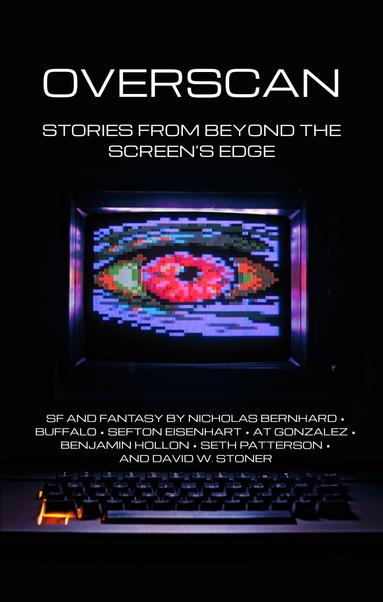
Well, here's my review for #Overscan, long overdue. A fantastic collection of short stories from many authors.
A book by the Fediverse, for the Fediverse that I highly recommend to anyone here. This is day 15 of #100DaysToOffload

Well, here's my review for #Overscan, long overdue. A fantastic collection of short stories from many authors.
A book by the Fediverse, for the Fediverse that I highly recommend to anyone here. This is day 15 of #100DaysToOffload
I just gave another read to #Overscan, the anthology of short fiction compiled by @nantucketlit that I read last year and never reviewed.
I'll be correcting that mistake very soon, what a great work this is!

@BigBadBiologist ProTip: Install a small LaceScan module for increased resolutions:
• 640×400 becomes 732×480, a 37% increase (only 688×… on the SM124)
• 640×200 becomes 820×284, a hefty 80% increase
Who needs fancy graphics cards when you can push the boundaries of your ST quite a bit!
This add-on goes well with 4 MB of RAM, your productivity applications have waaaay more screen space, e.g. extra 5 lines of text.
Just finished #Overscan, an anthology by @nantucketlit ! Featuring seven short stories written by humans, for humans.
I really enjoyed it! Took me a while to get to it lol

My copy of #Overscan by @nantucketlit and featuring 7 short stories (including one from @amin ) finally arrived! Got another short story bundled with it, which I'll have to check out as well :P
Get yours here! The digital edition is actually pay what you can! :P

@atpfm There was a lot of consternation from John @siracusa about parts of the screen that were neither part of the active area nor outside the active area …
Yet this is not only part of the history of paper documents — margins on written pages, typeset books, and Microsoft Word — but it was always a part of computer display systems
(My first ever Wikipedia edit decades ago was for https://en.wikipedia.org/wiki/Overscan …)
The early text-mode displays always had an area of the active signal that was not used for data; when 8-bit gave way to 16-bit PCs like Commodore Amiga and Apple IIgs, this “border” area became controllable and a color could be selected (via text-mode BIOS-style settings, or graphic-mode Control Panels).
And all the way into the present day, even 15 years after the death of the CRT, video editing still enforces the concepts of Action Safe and Title Safe. Historically these were huge with CRTs at 5% and 10%, then got tweaked as aspect ratios changed, then thinned out as flat panels made screen geometry more predictable.
But it never went to zero — Title Safe in particular will never reach the edge of the display, and you will never find a logo (or watermark) touching the edge of the display.
However! You still have to DESIGN to the edges, or fill it with active signal. “Shoot and protect”, as they’d say in filmmaking.
You HAVE to put something in the edges, whether it’s an adjacent graphic extending from the inner areas to the ends, or just a piece of background vision.
This kind of “wasteful” image production is completely normal outside the computer Iindustry, and is in fact universally applied in every other industry. You MUST fill in more pixels that you’ll never use, and possibly never see, in any canvas containing graphic design.
“Sorry but it’s true”, as Ja’mie would say
#underscan #overscan #titlesafe #actionsafe #gui #ux #uxdesign


حل مشکل برید شدن گوشه تصویر تلویزیون در گنولینوکس اوبونتو
اگر از بریده شدن گوشههای تصویر لپتاپ روی تلوزیون رنج میبرید، یک راه حل ساده را در این مقاله معرفی میکنم. https://fediverse.blog/~/آزاد/حل-مشکل-برید-شدن-صفحه-نمایش-در-تلویزیون/
 Chrono
 Regionales Retro-Rechenzentrum
 Seth Patterson
 Christian Kent 𝘊𝘒 :\﹥
 𝙆𝙉𝙏𝙍𝙊
𝙆𝙉𝙏𝙍𝙊 ahangarha