
Demographic Losses in Croatian-Ottoman Wars

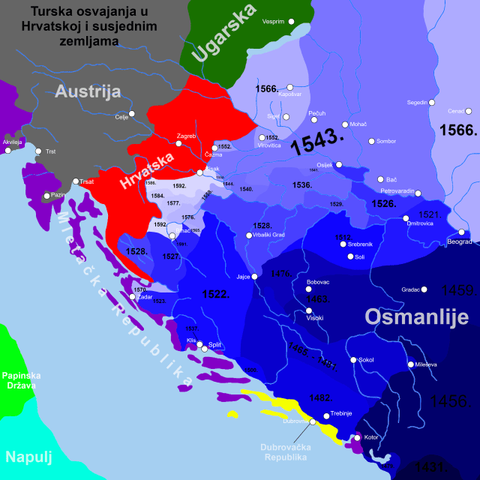
Croatia has fought against the Ottomans for four hundred years, from 1391, when Ottoman raids began penetrating southern reaches of Hungaro-Croatian kingdom, until 1791, when last Austrian-Ottoman war concluded with rather meagre Austrian gains due to threat of Prussian intervention. Most of the warfare however consisted of constant raids and attacks, which targeted the civilian population in order to destroy the opponent’s demographic and economic basis. Robbery, enslavement and slaughter of civilians was normal. Raiders would watch the water sources and even villages, capturing people, cattle and valuables. Even worse were demographic losses, making the Ottoman Wars one of the greatest biological disasters in Croatian history, matched only by the Second World War and the entrance to European Union.

These raids caused demographic damage which was devastating on multiple levels. Most obviously, loss of population destroyed the demographic, financial and recruitment base which the kingdom depended on. But the loss of nobility was devastating also on more etheral basis. Croatian nobility were the carriers of the proto-national identity and sovereignity of Croatia; they were the first defenders of Croatian sovereignty against depredations not just from Constantinople, but also from Vienna and later Buda. Yet these two groups were heavily codependent. Nobility obviously depended on the work of common people for their wealth, and was highly motivated to defend them. Common people meanwhile depended on nobility for protection against depredations not just of Ottoman raiders, but also of bandits and, as time went on, German mercenaries that were increasingly present in Croatia following the 1527 election of Habsburgs for kings of Croatia.

Period from 1493 until 1593 – from Battle of Krbava until Battle of Sisak – was especially bloody. During this war, Croatia lost significant portion of its population. In some areas, losses exceeded 80% of the population. In fact, just during the Great Turkish War or Long Vienna War, 1683 – 1699, Slavonia had lost 80% of population while Lika and Krbava had lost 95%. This led to massive demographic changes, as the the emptied areas were settled by Serbs and Wlachs (who were later Serbianized), which ended up causing no end of trouble to Croatia through 19th and 20th centuries. At the same time, Kosovo had been completely emptied of its Serbian population, and empty areas were settled by the Albanians.

But that is just the top of the iceberg.

As noted, first Ottoman raids started hitting Croatia and southern Hungary sometime in 1390 or 1391. These crossed Sava, robbing and destroying the villages and taking people to slavery – those that they didn’t kill outright anyway. Defense against these raids fell mostly to local nobles: while king attempted to form a standing army formed of garrisons in border forts, these were not able to reliably intercept the raiders.

Already in the 15th century many parts of Croatia had been entirely depopulated. Conquests of course caused the most immediate damage: following the conquest of Bosnia in 1463, Ottomans enslaved 100 000 people of both genders and also made 30 000 Bosnian youths into Janissaries. In 1526, following the Battle of Mohacs, Hungary and Srijem had lost 200 000 people taken into slavery.

But over the time, far greater damage was caused by the Ottoman raids. A single Ottoman raiding party could number thousands of cavalry, and could take thousands, sometimes over ten thousand, people into slavery in a single raid. And what they couldn’t take, they killed.

These raids were devastating for several major factors: high frequency of the raids, lack of warning and lack of any seasonal pattern. Ottomans could carry out several major raids in a single month. A raiding party of several hundred to several thousand cavalrymen could assemble in a matter of days and enter the kingdom before any warning could be given. And raids could, and did, happen throughout the entire year. Hot, rainless summers and extremely cold winters also meant that rivers provided no barrier to raids.

Nature of Ottoman raids is nicely encapsulated in a report from 1523: “although the Turk […] will perhaps send some new troops alongside those that are already stationed along the borders, he (i.e. the sultan) will not come himself, neither a great army this year, but in the usual way (the Turks) will make trouble through several incursions at different places, and see if anything can be taken”.

I will note only several raids here to illustrate how damaging they could be.

Ottoman army of 20 000 raided Carniola in 1469, returning with 60 000 prisoners. On return, they devastated parts of Croatia, in particular the Modruša county, where they captured further 10 000 – 15 000 captives. Modruša was again raided in 1470. In 1471, Izabeg raided Carniola, taking 30 000 people into Bosnia. Another Ottoman army devastated the surroundings of Zagreb. Year 1472 saw multiple raids, some of whom reached Styria, Carniola and Furlania as well as Istria. In 1474, Ottomans raided Zagorje, Turopolje and nearby Križevci, taking 14 000 people to slavery as well as masses of cattle. Nearly half of the peasant lands were destroyed. Raids continued into 1476 and 1477, with a mid-1477 raid by 32 000 Ottomans devastating Carniola, Styria, Carinthia and Furlania.

An Ottoman raiding party of 7 000 cavalry – one of three that entered Croatia in autumn of 1483 – devastated Croatia and Carniola. It had taken 10 000 slaves, mostly women and children. This party was ambushed on return by Croatian army under viceroy Matthias Gereb (Matijaš Gereb), which destroyed the Ottoman force and freed the captives; but many such raids were back in the Ottoman territory before they could be intercepted. In this the Ottomans were often assisted by the Venetian Republic which provided them with intelligence and sometimes even open help. In 1484, an Ottoman raiding party took thousands of people from Carniola into slavery, but were intercepted and destroyed by Bernard Frankapan. And these raids were having quite an effect: already by 1486, Urbar of Modruša by Duke Bernardin Frankapan had shown that out of 704 serf households, only 270 remained in use. That is, by 1486, over 60% of households had been abandoned.

In 1491 alone, Ottomans had launched multiple raids on Carniola, in September and October, both of whom were itercepted and destroyed (one in Carniola, other in Croatia). In the latter case, 18 000 captured slaves were liberated. In August 1494, Ottoman army raided Slavonia and Styria, capturing 7 000 people. Another army entered Croatia in September, crossing Una.

Over the year 1499, according to Venetian sources, Ottomans had taken 3 000 people from Krbava. They had also devastated area of Zadar, taking with them 674 adult men, 314 women and children, and 37 987 pieces of cattle.

Records show that the Ottomans had raided Carniola 27 times by the year 1508, enslaving or killing 200 000 Slovenes in the process. Croatia, being between the Ottoman Empire and Carniola, had suffered far more. In a single raid in 1510, Ottomans took several thousand serfs from Keglević’s lands to slavery. In 1511, Ottomans devastated Modruš, Ribnik, Ozalj and Dubovac. Near Ozalj, they found and captured 300 people hiding in a cave.

Ottoman raid of 1513 saw 2 000 inhabitants of Modruš and area taken into slavery. Raid by Wallachian Martologs in 1514 aimed at Lika saw them capturing 3 000 men, 12 000 large and 8 000 small cattle. Several hundred families abandoned Lika for safer areas, and this will increase as situation became even more desperate. In the period from 1522 to 1524, Lika was nearly entirely abandoned. As elsewhere, Ottomans would proceed to settle the area with their servants – Wlachs and Serbs, changing the ethnic character of the land. After 1522, area of Brlog near Otočac was completely abandoned. Areas of Modruš and Ozalj were devastated by Akincis eight times in 1523 alone. By 1524, Udbina was completely abandoned. Croatian noble Ivan Kobasić reports that the Croatian viceroy Ivan Karlović had completely lost use of his lands in Krbava, as they had been completely abandoned by his serfs. Yet he still has to spend money on maintaining the garrison in Udbina, and so Kobasić is asking Archduke Ferdinand for help. Bočać, Kosinje, as well as surroundings of Krasno and Kutarevo are also nearly completely empty by this time. Ottomans devastated Modruš twice in 1525, leading to 500 families leaving the area.

Defeat in Battle of Mohacs in 1526 means that now only Habsburgs are assisting defense of Croatian lands. By 1526, Croatia had already lost half of its original territory, being reduced to 50 000 km2.

Raids of course did not stop even after 1526. On 22.7.1540. Ottoman army of 10 000 cavalry and 5 000 infantry raided Croatia, capturing 3 000 Christians in the process. In the same year, Ottoman census lists large areas of Sanjaks of Bosnia and Klis – specifically Lika, Krbava, Bukovica and Ravni Kotari – as empty (hali) as there was nobody there to work the land. Meanwhile, Ottoman raids remain a constant reality on the border. According to report of Venetian noble Sanudo, by 1533 Turks had taken to slavery from Croatian lands some 600 000 people.

Especially from 1550 onwards, Ottomans are settling thousands of Wlach (Wallachian) families into desolate areas near the Croatian-Ottoman border. Habsburgs will later imitate this policy. In the 19th century these Wlachs, being predominantly Orthodox, will accept Serbian ethnic identity. Result of this is that there are now millions of Serbs living to west of Drina despite these areas never having been a part of Serbian political or ethnic corpus.

Magnitude of devastation can be seen from finances as well. By 1555, Croatia was able to collect only 1 327 forints of war tax, whereas costs of defense of only Slavonian border were calculated at more than 140 000 forints while costs of defense of the Croatian border were calculated at 65 000 forints. Most of the costs were covered by Slovenian provinces of the Habsburg Empire.

By the mid-16th century territory had been halved again, to around 20 000 km2. Further 3 000 km2 will be lost before the Ottoman tide is finally stopped at Battle of Sisak in 1593.

Ottoman conquest of Kostajnica in 1556 allowed them to devastate areas between Una and Kupa, as they had now breached the border defense line. Until now mostly intact area between Una and Kupa, now known as Banovina, was directly threatened, and the Ottomans took to slavery some 46 000 men, women and children. In the same 1556, some 70 000 Catholics abandoned Pounje (areas around Una), settling down in Austria.

In 1559, Malkoč-beg raided Carniola and also devastated areas of Kočevjo, Ribnica, Pivka and Grobnik. By 1560, many of Islamized Croatians in Bosnia had already abandoned the Croatian ethnic name and are now calling themselves Muslims. By 20th century, these traitors will form the current Bosniak ethnic corpus.

In 1575, Ottomans burned down Brlog and Gusić. Escape of Croatians, both from Croatia and from the conquered territories, continued. In place of native populations, Ottomans settled Wlachs. Between 1576 and 1586, Ottomans had brought further 5 000 Wlachs to Lika. Ottomans failed to take Karlobag in 1576, but managed to capture Bužim. In 1577 Turks burned down Ledenice. Same year also saw mass organized migrations of Wlachs whom Ottomans moved from Balkans into Lika and Krbava. In 1578, Ottomans captured Metlika, slaughtering 2 000 inhabitants of Metlika and surroundings in the process.

By 1578, war expenses had reached 550 000 forints, covered mostly by Slovenian provinces. From 1578 until 1594, Slovenian estates would provide 12 000 000 forints for defense of Croatia (750 000 per year). This had delivered results: in 1593, Battle of Sisak marked the end of Ottoman expansion into Croatia and Hungary. Holy Roman Empire proper also helped: from 1576 until 1613, Germany would pay 2 250 000 forints for defense of Croatia (60 800 per year).

From 1580 onwards, Wlachs are regularly raiding Croatian territories.

By 1582, entire Kingdom of Croatia numbers 3 000 homesteads (called “chimneys” or “portae” in legal documents). For comparison, Križevac province alone used to number 12 000 homesteads before the Ottoman invasions. Repair and maintenance of forts depends on assistance sent from Carniola and Styria.

In 1584, Ottoman raid under Ferhad-pasha devastated Croatia and Carniola, but his army was ambushed and destroyed on return trip, near Slunj.

Having captured Bihać in 1592, Ottomans sent several thousand captured Croatians to Constantinople (now Istanbul).

Battle of Sisak in 1593 marks the end of Ottoman expansion into Croatia and Hungary. Wallachians begin to massively abandon the Ottomans and move over to Christian side, settling on areas devastated by Ottoman raids. Nevertheless, raids still continue. Between 1594 and 1617, Austria is spending nearly entire tax revenue on defense against Ottomans, including upkeep of troops and forts in Croatia.

But demographic effects of Ottoman conquests are still felt. In his report of 1615, Bishop Vicenz Martena states that the entire Senj Diocese has only 4 000 souls.

In 1609, Archduke Ferdinand settles Wlachs around Gacka and Brlog. Habsburgs are allowing Wlachs privileges which basically mean that Wlachs had become state within a state. In 1611, 12 Wlach families had abandoned Ottoman Podlapača and settled near Otočac. Meanwhile some Wlachs from Bosnia settled in Brlog. In 1612, 24 Wlach families migrated from Lika to Modruš. There, Wlachs are disobeying law and causing damage to local population.

By 1624, some 40 000 – 50 000 Croats in central Bosnia had converted to Islam. Catholics are also converting to Orthodoxy: by 1627, of 12 Catholic churches in Popovo Polje, seven had been taken by the Orthodox Church. In summer of 1646, many Christians from Lika migrated to Dalmatia, mostly near Zadar. Croatian raids of 1685 devastated Lika and Krbava, with many Wlachs being settled around Otočac. In 1685, Herberstein devastated Lika, burning 400 houses in Novi alone. Over 1 000 homes were destroyed in Lika overall, and Imperial army had also captured 4 000 heads of cattle. Lika would never recover from Herberstein’s devastation. Herberstein himself was enemy of Croatia, seeking to turn it into merely one of Habsburg hereditary provinces. In 1685, Venetian army devastated Lika, and many Christians left with the army when it went to return to Venetian territory.

Likewise, during the liberation wars, many inhabitants left. Most of the Muslims had retreated with the Ottoman army, while few converted to Christianity. By 1689, Lika was completely uninhabited, losing 96% of its original population. During the same (Vienna) war, Slavonia had lost 80% of the population. Habsburg population census, done just after the war (1698), reveals the situation. In 1696, Osijek district had 8 populated and 313 abandoned villages. Požega district had 131 settled and 181 abandoned village. Eight villages of Osijek district had 471 homes, 3 292 inhabitants, 2 047 pieces of cattle, 1 998 jutars (1 150 Ha, 11,5 km2) of arable land and 558 hoes (446 400 m2) of vineyard. Požega area with 131 village had 1 628 homes, 8 202 inhabitants, 11 970 pieces of cattle, 1 894 jutars of arable land and 4 388 hoes of vineyard. By 1698 Slavonia as a whole had 491 settlement and between 70 000 and 80 000 inhabitants. Largest cities in Slavonia such as Osijek, Virovitica and Požega had between 600 and 800 inhabitants. Situation was somewhat improved with migrations of Croatians from Bosnia. Already by 1696 some 100 000 Croats had migrated from Bosnia to Croatia. And more were to come: following Eugene of Savoy’s 1697 campaign in Bosnia, some 40 000 Catholic Croats had abandoned Bosnia and settled in Slavonia. In 1723, there were some 25 000 Catholics left in Bosnia.

Emigrant Croatians are leaving primarily for Italy, Istra, Slovenia (Carniola, Styria) and Germany. Western Slavonia is particularly badly hit, but also hit are Bosnia, Lika, Krbava and other Croatian lands. Nobility primarily left for the unconquered areas of the Hungarian-Croatian Kingdom. Migrants were seeking primarily new life space and way of life similar to one they had left. Thus it is unsurprising that many of the internal migrations were organized by the nobility, moving tenants from their destroyed or conquered possessions to possessions in safer areas. Some peasants however did move to cities or else enter military service, latter of which would enable them to gain status of nobility. Migrations were done in groups for protection against bandits and raiders, and mostly knew precisely where to go thanks to the “locators” or “pioneers” which had already settled in potential targets of migrations.

Internal migrations were often organized by nobility as a way of protecting the peasants by moving them from high-risk areas into areas of lower danger. These could be temporary or permanent. Population from the first zone (greatest danger) of danger was thus used to fill in the gaps left by those that had abandoned the second zone and moved into the third, safest zone. Oftentimes, women, children and material possessions would be moved into safer areas while peasant (or soldier) himself stayed near the border to fulfill his obligations. This however limited just how far family could be displaced from the border.

Nobility, as the carrier of political sovereignty but also of the political, economic and cultural life, was also forced to adapt. Between the mass destruction caused by the Ottomans, mass emigration, unfavorable climate change and Ottoman depredations, Croatian nobility was devastated. The only solution was to join the new defensive arrangements based on standing professional military. The middle and lower nobility has the key role in these processes, and new structure of Croatian society would persist until the end of the 19th century. Nobility also had the key role in preservation of cultural and ethnic identity of Croatian emigrees. And this included more than just Croatian nobility. Ferenc Batthyany, Hungarian magnate and also ban (viceroy) of Croatia, provided for Croatian emigres numerous lands, objects, as well as the Catholic clergy versed in Croatian language. Nobility thus had the key role in survival of Croatian ethnic corpus.

Lastly, Islamization had done significant damage, as Muslims had largely abandoned any connection to the Croatian ethnic corpus they had originated from. And these losses had been major, as can be seen from two Ottoman censi:

  • in 1528/29, in the modern-day BiH there were:
    • 220 000 Muslims (34%)
    • 360 000 Catholics (57%)
    • 55 000 Orthodox (9%)
  • in 1624 there were:
    • 300 000 Muslims (67%)
    • 100 000 Catholics (22%)
    • 50 000 Orthodox (11%)

Almost all Muslims and a small part of Orthodox population originated from the domicile population, while the remainder were descendants of immigrants brought in by the Ottomans. Between 1463 and 1600, some 300 000 Bosnian Croats had converted to Islam, especially since open persecution of Catholics began in the Ottoman Empire after 1516 (destruction of churches, corporal punishment of believers, executions of clergy). Some 120 000 – 150 000 Croats may have accepted Islam during 1524 pogroms alone.

To sum it up:

  • Croatia had permanently lost Bosnia (50% of population)
  • By 1486, some 60% of households had been abandoned in certain areas.
  • During the Vienna war, Slavonia had lost 80% and Lika 96% of the population.

In the end, between territorial losses, enslavement, deaths and emigration, it is entirely possible that Croatia had lost between 80% and 90% of total population during the Ottoman wars.

For Hungary, see a good article by Hungarian-Ottoman Wars site: “Ethnic Changes in Hungary Due to Ottoman Wars“.

#casualties #CroatianOttomanWars #demographicLosses #demography #OttomanWars #victims

Sizes of Armies in the Hungarian-Ottoman Wars

This is list of sizes of field armies and military establishments alike during the Hungarian-Ottoman wars, from their beginning in the 14th century until early 17th century.

Hopefully it will provide a good overview of how large armies advanced medieval states could field. Still, two factors should be noted. Firstly, records will naturally be incomplete or uncertain. Nevertheless, while exact numbers cannot be established with certainty for most cases (with few exceptions), they should provide a general ballpark. Secondly, Hungary and Ottoman Empire were two fundamentally different states. Not only was the Ottoman Empire much larger, but it was also much more centralized and “modern” than the feudal Hungary. As a results, Ottomans found it easier to field large, organized armies, even during the early period when “raw” resources of two states were comparable. Of course, as the time progressed and the Ottoman Empire expanded in all directions, Hungary found itself increasingly outmatched. This was only gradually reversed during the Habsburg era, but that period goes way beyond the Middle Ages or even early modernity.

Sources:

Vjekoslav Klaić, Povijest Hrvata

Tamas Pasafalvi – From Nicopolis To Mohacs

  • 1397: all landowners appear in person as well as equipping one mounted archer per 20 peasant plots
  • 1396, Battle of Nicopolis
    • Crusader army
      • Burgundian contignent: 1 000 men-at-arms, ~60 archers, ~100 crossbowmen (est.)
  • 1410s, Sigismund’s army:
    • border troops: 2 200 lances (cca 2 200 men at arms, 4 400 – 6 600 light cavalry)
    • second line: 450 lances (cca 450 men-at-arms, 900 – 1 350 light cavalry)
  • 1411, November 11, Sigismund’s army against Venice: 10 000 – 12 000 cavalry
  • 1412, December 12, Sigismund’s army in Weiden: 3 000 cavalry
  • 1414, Ottoman assistance to Hrvoje Vukčić in Bosnia: 30 000
  • Ottoman raids on Croatia in 1414, 1415
    • Venetian assistance to Ottomans 1415: 600 archers
  • 1419, July, Venetian siege of Trogir: 500 infantry
  • 1423 Ottoman raid: 15 000 men
  • 1425. October, Ottoman raiding party: 15 000
    • note: destroyed by Sigismund in Bulgaria
  • 1426, May, Ottoman raid on Bosnia: 4 000
  • 1432/1433, Sigismund’s organization of Hungarian military
    • 80 000 cavalry in total
      • 60 000 towards the Turks
      • 20 000 towards the Hussites
    • banderium size: 500 men
  • 1433, March, decree on defense
    • general mobilization – tempore universalis exercitus generaliter proclamati
    • prelates, barons and rich nobles provide their banderia
    • on top of noble banderiums, all nobility is to provide one well-armed and armored cavalryman for each 33 serfs
  • 1434, Talloci’s campaign in Bosnia: 1 117 lances / 4 500 men
  • 1435, August, Ottoman raid in Bosnia: 1 500 men
    • arrived at request of Hrvoje Vukčić
  • Ottoman army destroyed in 1437: 40 000 men
  • 1439, June, Ottoman invasion of Serbia: 130 000 men
  • 1439, August, Hungarian army: 25 000 men
  • 1442, March, Ottoman raid into Transylvania (Mezid Bey)
    • Ottoman army: 16 000 cavalry
  • 1442, Vasaq (raid)
    • Ottoman Army: 80 000 men
    • Hungarian Army: 15 000 men
  • 1443, May, reported Ottoman garrisons
    • 2 000 Ottoman cavalry near Sofia
    • 4 000 Ottoman and Serbian cavalry around Smederevo
  • 1443, August, start of John Hunyadi’s Long Campaign
    • Hungarian Army
      • 15 000 men
        • 10 000 Hungarian
        • 5 000 Serbian by Despot Branković
      • 600 battle wagons
  • 1443, November, Ottoman garrison in Balkans: 20 000
  • 1444, Varna (campaign)
    • Hungarian Army: 20 000 total
      • ~15 000 Hungarian cavalry
        • 8 500 heavy cavalry
      • 4 000 Wallachian cavalry under Dracula
      • few hundred Hungarian infantry
      • 100 war wagons
    • Ottoman Army
      • 30 000 – 35 000 Sipahis
      • 10 000 Janissary infantry
      • ~10 000 Akinci light cavalry and Azab light infantry
  • 1448, Kosovo (campaign)
    • Hungarian Army: 32 000 total; 24 000 Hungarian, 8 000 Wallachian
      • 15 000 cavalry
      • 4 000 puskars (handgunners)
    • Ottoman Army: 50 000 total
      • 10 000 light infantry (Azabs)
  • 1453, Ottoman capture of Constantinople:
    • 80 000 Ottoman regular, 85 000 Ottoman irregular
    • 9 000 Constantinople defenders (3 000 Latins), 26 ships (10 Roman)
  • 1454, January, Hunyadi’s defensive mobilization: 4 mounted archers and 2 footmen from every 100 tennant plots
  • 1454, October, Hunyadi’s raid into Serbia: 8 000 cavalry
  • 1454, Ottoman army destroyed on October 2: 32 000 troops
  • 1456, July, Belgrade (siege)
    • Hungarian:
      • 7 000 (city garrison)
      • 12 000 (reinforcements)
      • 30 000 – 60 000 crusaders (most likely ~27 000)
      • 240 boats
    • Ottoman:
      • 120 000 men (contemporary, modern estimate 40 000 – 50 000)
      • 300 cannons
      • 70 large ships
      • 200 small ships
  • 1457, Ottoman army in Bosnia: 8 000 men
  • 1458, April, Hungarian expedition into Serbia (Szilagyi): 8 000 men
  • 1458, June, Ottoman army in Serbia: 40 000 men
  • 1458, June, Ottoman raid into Srijem: 7 000 men
  • 1458, November, Szilagy’s defeat:
    • Ottoman raid into southern Hungary: 8 000 cavalry
    • Szilagy’s response force: 2 000 cavalry and 1 000 infantry
  • 1459, Hungarian army under Simon Nagy: 3 000 men (royal troops)
  • 1461, Hungarian army sent to help archduke Albrecht: 5 200 men
    • 4 000 cavalry, 1 200 infantry
  • 1463, Ottoman army moving towards Bosnia: 150 000 men
  • 1463, Ottoman advance guard: 20 000 light cavalry
  • Standing Army of Matthias Corvinus, 1463: 7 000 men
    • 5 000 infantry, 2 000 cavalry
  • 1463, April: 1 light cavalryman for every 10 peasant homes
  • 1463, May, Army raised by Matthias Corvinus in Srijem: 19 000
    • standing army:
      • 2 000 court cavalry
      • 5 000 infantry
    • prelate and baronial banderia: 12 000 cavalry
  • 1463, estimated Ottoman garrison of Bosnia: 20 000 men
  • 1463, December, Ottoman garrison of Jajce: 700
  • 1464, May, field army raised by Matthias to invade Ottoman Empire: 22 000
    • 14 000 cavalry
    • 8 000 infantry
  • 1464, June, raiding army led by Muhammad-pasha: 40 000
  • 1464, September 11, army led by king Matthias into Bosnia
    • 17 000 cavalry
    • 6 000 infantry
    • 7 000 Crusaders
  • 1465, May: 1 soldier for every 20 peasant homes
  • 1465, November, army sent by king Matthias towards Herzegovina: 5 000
  • 1468, army sent by king Matthias into Austria (against Moravians there): 5 000
  • 1468, army taken by king Matthias into Moravia: 16 000 men, 50 cannons, 2 000 wagons
  • 1469, army taken by king Matthias into Czechia: 10 000
  • 1469, May, Ottoman raid into Croatia (Slavonia?): 20 000
  • 1469, 27 July, army sent by king Matthias into Croatia: 9 000 cavalry
  • Ottoman raids of unknown size into Croatia (Slavonia) in 1470 and 1471
  • 1471, May, Ottoman army in Bosnia preparing to raid Istria and Carniola: 40 000
  • 1471, August, Ottoman garrison of newly-constructed Šabac: 2 000
  • 1472, September, army with king Matthias: 10 000 men, 900 war wagons
  • 1472, September, Ottoman raid into Croatia and Slovenia: 12 000 cavalry
  • note: Ottoman raid of unknown size into Croatian Slavonia in 1473
  • 1474, Ottoman raid into Croatia: 8 000
  • 1474, Matthias’ army in Bohemia: 10 000 men, 900 war wagons
  • 1475, army raised by Matthias:
    • 60 000 – 70 000 troops (of which 4 000 Bosnian)
    • 100 ships on Danube and Sava
    • 1 000 wagons
  • 1470s, army raised by Matthias (possibly more accurate report on the 1475 above):
    • 6 000 mercenary heavy cavalry
    • 10 000 infantry
    • 10 000 Hungarian heavy cavalry
    • 4 000 footmen (crossbowmen)
    • artillery:
      • 12 mortars
      • 40 quartanes
      • 107 haufnicas
      • 200 tarasnicas
      • 3 000 carts for wagenburg
      • 30 bombards on wheeled carriages
    • 330 river vessels
      • 10 000 soldiers
        • 1 700 men-at-arms with lances
        • 1 200 infantry with great shields (pavise)
        • remainder (7 000) crossbowmen and archers
  • 1475, Ottoman garrison of Šabac: 13 000
  • 1476, Ottoman garrison of Šabac: 700 (remnant)
  • Ottoman raid of unknown size into Slavonia in 1475
  • 1476, Ottoman raid into Erdely (Transylvania): 5 000
  • 1476, July, Ottoman’s invasion of Moldavia under Muhammad:
    • 90 000 (9 000 Wallachian) main army
    • 10 000 eastern army
  • 1476, Ottoman army left in Moldavia after Sultan’s retreat: 18 000
  • 1476, October, Matthias’ armies:
    • 26 000 men in a fortified camp facing Ottomans
    • ~54 000 men assisting Stephen the Great in Moldavia
  • 1476, Ottoman raid into Croatia burns Križevci
  • 1477, October, Ottoman raid into Croatia and Venice: 10 000
  • 1478, June, Ottoman raid into Croatia and Carniola: 20 000 cavalry
  • 1479, October, Ottoman raid into Erdely: 43 000 (alternatively: 21 000))
  • 1480, February, Hungarian expedition to Krk: 6 000
  • 1480, June, Hungarian raid into Wallachia: 60 000
  • 1480, June, Ottoman-Wallachian army (destroyed): 20 000
  • 1480, August, Ottoman raid on Hungary: 7 000
  • 1480, November, Ottoman raid into Holy Roman Empire: 3 000
  • 1480, December, Ottoman raid into Hungary (destroyed): >10 000
  • 1480, December, Ottoman defensive army (destroyed): >8 000
  • 1481, March, Ottoman invasion of Otranto: 20 000
  • 1481, Hungarian army sent by king Matthias to help retake Otranto: 700
    • 100 men-at-arms
    • 200 light cavalry
    • 400 infantry
  • 1481, August, Hungarian raid into Serbia and Bulgaria: 28 000
  • 1482, September, Ottoman raid into Hungary: 10 000
  • 1483, autumn, Ottoman raid into Croatia: >7 000 cavalry
  • 1484, April 10, orders for Saxon mobilization: 200 cavalry (heavy?)
  • 1486, Matthias’ army sent to assist Ferdinant of Neapoli: 1 000 cavalry, 700 infantry
  • 1487, January, Matthias’ invasion of Austria: 20 000 cavalry, 8 000 infantry
  • Total military strength of Matthias Corvinus: 148 000 – 163 000
    • 364 galleys with 2 600 sailors and 10 000 soldiers
  • 1491, June, Hungarian army at Stolni Biograd: 40 000
  • 1491, September, Ottoman raiding party: 10 000 – 11 000
  • 1491, September, Ottoman raid on Croatia: 12 000
    • note: possibly same as the above
  • 1491, Winter, Pal Kiniszi’s army: 6 000 cavalry, 6 000 infantry
  • 1492, January, Black Army at Košice: 7 000
  • early 1493, Wladislas II army against the Frankapans: 4 000 cavalry, 2 000 infantry
    • led by ban Derencsiny (Derenčin)
  • 1493, Ottoman raid on Croatia: 8 000 light cavalry
    • note: defeated the above Croatian army
  • 1493, winter, Pal Kiniszi’s raid on Ottoman Serbia: 10 000 cavalry
    • only 3 000 cavalry participated in actual raid, remainder stayed in a fortified camp
  • Ottoman raid of unknown size in July 1494
  • Hungarian raid in 1494
    • note: heavy cavalry acted as a “moving castle” – tactical reserve, while light cavalry raided
  • 1494, September, Ottoman raid: 20 000
  • note: Hungary and Ottoman Empire agreed on three years truce in April 1495
  • 1495, February, Hungarian army at Gussing: 6 000 cavalry, some infantry
  • 1496, John Corvinus’ raid on Zadar: 200 cavalry, 600 infantry
  • 1497, summer, Ottoman raid on Carinthia and Carniola: 12 000
  • note: Hungarian-Ottoman truce renewed in 1498 for another three years; Ottomans captured Bosnian castle of Komotin (under Hungarian crown) shortly after renewal of the truce; truce was revoked by Hungary in April 1500
  • 1500, autumn, Hungarian army at Bacs: 4 000 men-at-arms, 6 000 light cavalry
  • 1501, early summer, Ottoman army through Modruš: 6 000
  • 1501, September, Josza Som’s raid on Serbia: 14 000 cavalry
    • v2: 10 000 cavalry, 6 000 infantry, 1 200 wagons, 32 cannons
  • 1501, September, Hungarian (John Corvinus) raid on Bosnia: 8 000
  • 1501, October, Ottoman raid on Croatia: 15 000
  • 1501, November, Hungarian raid (Peter Szentgyorgyi) on Ottoman Bulgaria: 5 000
  • 1501, November, Ottoman army destroyed in Croatia: 12 000
  • note: complete forces commanded by Corvinus, Somi, Szentgyorgy: 20 000 cavalry, 7 000 infantry
  • 1502, January, Ottoman destruction of Levać:
    • Ottoman army: 4 000 cavalry, 3 000 infantry
    • garrison of Levać: 700
  • 1502, January, army of Viceroy of Jajce: 200 cavalry
  • 1502, May, Ottoman siege of Jajce: 6 000 cavalry, 4 000 infantry
  • 1502, June, Janos Tarcai’s army for provision of Jajce: 2 000 light cavalry, 2 000 infantry, 50 men-at-arms; 1 000 wagons of wine and 1 000 wagons of other necessities
  • 1502, July, Ottoman raid: 1 000 cavalry
  • 1502, July, Ottoman attack on Tarcai’s wagenburg:
    • Ottoman army: 10 000 men
    • Hungarian army: 2 000 infantry (cavalry had previously departed)
    • attack successfully repulsed
  • 1502, October, Jozsa Somi’s raid on Bosnia: 7 000 cavalry
    • note: Somi’s overall force 16 000, but remainder left behind to protect the border
    • destroyed Vidin
  • 1502, October, John Corvinus’ raid on Bosnia: 4 000 (contemporary with above)
  • 1502, Croatian raid on Rog: 400 cavalry
  • 1502, December, raid on Bosnia (Somi and Corvinus)
    • Hungarian army (Somi and Corvinus): 20 000
    • Ottoman army of Bosnia (Iskander Pasha): 5 000 – 10 000
      • note: no engagement – Iskander Pasha ordered not to attack Hungarians unless attacked; Somi’s army caused no damage to Ottomans
  • 1503, Skender-pasha’s raid on Dalmatia: 2 000 cavalry
  • 1503, basic unit of Hungarian army: 6 light cavalry, 1 man-at-arms, 1 wagon with infantry (6 infantrymen per wagon?)
  • treaty of 1503 was first one that forbade significant raiding by either side, and thus no Ottoman raids were recorded on Hungary or Croatia from 1503 until 1509 when Ottoman raid had been initiated by Venetian diplomacy; from 1511 Ottoman raids begin again in earnest
  • early 1510s, Hungarian standing / permanent forces on the Ottoman border:
    • Hungarian marches:
      • 3 590 cavalry
      • 400 infantry
      • 1 100 boatmen
    • Croatian-Slavonian border:
      • 1 657 cavalry
      • 770 infantry
  • 1511, July, Ottoman raid on Croatia: 300
    • scouting party for a larger raid that devastated Dubica county few days later
  • 1512, August, army of Emerik Perenyi: 3 500 cavalry, 600 infantry; increased to 8 000 by Frankapan reinforcements once in Croatia
    • scouting detachment sent to Bosnia: 500 cavalry
  • 1512, Ottoman raid of unknown size crushed by Batori’s army in mid-October
  • 1513, June, Ottoman raids began in earnest
  • 1513, August, Petar Berislavić’s destruction of Ottoman raiding army in Bosnia
    • Ottoman army: 12 000
    • Croatian army: 3 000
  • 1514, Ottoman raid on Croatia (Modruša): 2 000
  • 1514, Ottoman raid on Đakovo: 1 500
  • 1514, Ottoman raid on Požega: 2 000 cavalry, 3 000 infantry
  • 1514, Ottoman raid on Knin: 10 000
  • 1514, autumn, Beriszlo’s raid on Ottoman Bosnia: 1 000 cavalry, 1 000 infantry
  • 1514, September, Ottoman raid on Croatia: 4 000
  • 1515, multiple Ottoman raids of unknown size
  • 1515, February, Ban Beriszlo’s army: 2 000 cavalry, 2 000 infantry
  • 1515, March, Croatian army of Petar Berislavić: 500 cavalry, 2 000 infantry
  • 1515, May, Berislavić’s army destroyed near Novigrad: 10 000
  • 1515, August, Ottoman army in Bosnia: 40 000
  • 1515, John Zapolya’s attack on Žrnov: 10 000
  • 1518, January-February, Petar Berislavić’s expedition to supply Jajce: 4 000 cavalry, 6 000 infantry
  • 1518, proposed mobilization: 1 heavily armed horseman (man-at-arms) per every 36 hearths, 1 lightly armed horseman per every 24 hearths
  • early 1519 (January or February), Petar Berislavić’s supply run to Jajce: 3 000 cavalry
  • peace agreement in summer 1519 postulated that any raids with less than 500 cavalrymen will not be considered a breach of peace
  • 1520, Ottoman raid: 3 000 (one of multiple)
  • 1520, Ottoman army in Bosnia: 12 000
  • 1520., Ottoman raid in Croatia: 800 infantry
  • 1520., Petar Berislavić’s force: 300 cavalry
    • note: with this force, Petar Berislavić broke the aforementioned 800 infantry
  • 1520, Ottoman raid in late spring: 800 cavalry (killed Petar Berislavić)
  • 1521, Ottoman siege of Belgrade
    • garrison of Belgrade: 700 – 900
    • Hungarian army ready to assist Belgrade: 140 000 (?)
    • Ottoman army:
      • 300 cannons
      • 24 large galleys, 200 small vessels
  • 1521, troops promised by Archduke Ferdinand of Habsburg: 3 000 infantry and some artillery
  • 1521, November, standing army required to be held by Viceroy of Croatia (Ivan Karlović): 1 000 cavalry
  • 1522, May, Ottoman army besieging Knin: 25 000
  • 1522, June, Croatian garrison of Klis: 300
  • 1522, October, Szapolyai’s attack on Turnu Magurele: 5 000 cavalry, 2 000 infantry
  • 1523, summer, Ottoman raiding army in Srijem: 15 000
  • 1523, August, Ottoman raid on Ostrovica: 60 cavalry, 400 infantry
  • 1523, August, Ottoman attack on Hungary (Ferhat-pasha)
    • Ottoman army: 15 000
    • Hungarian army: 4 000
    • note: Ottoman army destroyed piecemeal by Hungarians after having split into three raiding columns, each 5 000 strong; Hungarians suffered some 700 losses – experienced border troops difficult to replace
  • eight raids of unknown size in November 1523 – thus it is likely that number of small raids was far greater than what is listed here
  • 1524, Archduke Ferdinand’s loan to Croatia: 200 light cavalry, 600 infantry
  • 1524, Petar Kružić’s relief army at Klis: 60 cavalry, 1 500 infantry
  • 1524, June, Ottoman raid of Croatia: 3 000
  • 1524, August, Hungarian southern army: 1 000 light cavalry, 600 men-at-arms
  • 1525, June, Hungarian Expedition to Jajce under Krsto Frankapan
    • Hungarian army: 2 000 cavalry, 4 000 infantry
    • Ottoman army of Bosnia: 15 000 – 16 000
  • 1526, March: infantry to be furnished at ratio of one for every ten tennants
  • 1526, Mohacs:
    • Hungarian army: 20 000 (possibly 24 000 – 25 000)
      • 3 000 heavy cavalry
      • 4 300 light cavalry
      • 12 000 infantry (10 000 infantry, 2 000 artillery?)
      • 80 cannons
    • Ottoman army: 100 000 total, including non-combat personnel
      • 50 000 cavalry
      • 12 000 Janissaries
      • 300 cannons (2 000 cannoneers)
  • 1527, Ferdinand’s promised standing army in Croatia: 1 000 cavalry, 200 infantry
  • 1527, three Ottoman raiding armies just in February
  • 1527, February, Ottoman raiding party: 500 cavalry
  • 1527, March, Ottoman raiding party: 2 000 cavalry
  • 1527, July, Ferdinand’s army against Zapolya: 3 000 cavalry, 8 000 infantry
  • 1527, September, army of Krsto Frankapan: 3 000 cavalry, 10 000 peasants
  • 1528, October, Habsburg army near Metlika: 5 000
  • 1529, March, Ferdinand’s army in Slavonia: 700 cavalry (Slovenian), 1 500 Spanish infantry
  • 1529, May, garrison of Gradec: 700 Spanish infantry
  • 1529, July, Ferdinand’s siege of Capitol: 10 000
  • 1529, September, Suleiman’s siege of Vienna:
    • Ottoman army:
      • 100 000 soldiers
      • 170 000 non-combatants
      • 300 cannons
    • Vienna garrison:
      • 16 000 – 18 000
  • 1530, May, Zapolya-Ottoman raid on Croatia (under Simon): 600 cavalry
  • 1532, May, Suleiman’s invasion of Hungary
    • 140 000 men
    • 120 cannons
  • 1532, May, Ferdinand’s planned army in Austria: 98 000
    • 40 000 German infantry
    • 8 000 German cavalry
    • 40 000 Spanish infantry
    • 10 000 Hungarian mercenaries
    • NOTE: Never faced Suleiman, as latter was stopped at Koszeg by Nikola Jurišić with 700 soldiers
  • 1532, June, Kružić’s army at Klis: 2 000
  • 1536, July, Ottoman raid into Slavonia
    • Ottoman army: 18 000
    • Croatian army: 25 000
  • 1537, March, assistance to Klis:
    • 3 000 German soldiers sent by Ferdinand
    • 700 Papal soldiers sent by Paul III
  • 1537, March, Ottoman army at Klis under Murat-beg:
    • 1 000 cavalry
    • 1 000 infantry
  • 1537, April, proposed standing army
    • 800 cavalry
    • 200 infantry
  • 1537, July, assembly of banderial forces near Koprivnica: 1 690 men, 260 wagons
  • 1537, August, army in Slavonia: 24 000
    • 8 000 cavalry
    • 16 000 infantry
    • 8 large cannons, 40 small / field cannons
  • 1537, September, Ottoman defensive army at Osijek: 5 000
    • note: opposes the above army
  • 1538, Jurišić’s army led to reinforce Croatia
    • 500 – 600 heavy cavalry
    • few hundred infantry
    • 2 000 light cavalry
  • 1537, forces requested by Croatian nobility for defense of Croatia
    • 1 000 light cavalry in Croatia
    • Slavonia:
      • 2 000 light cavalry
      • 500 heavy cavalry
      • 1 000 infantry
      • 1 000 engineers
  • 1537, forces promised by Ferdinand for defense of Slavonia
    • 2 000 cavalry
    • 1 000 infantry
    • note: request for one heavy cavalryman for every 25 serfs
  • 1537, August, garrison of Novigrad on Una: 200 cavalry
  • 1538, January, legal request to equip one cavalryman for every 36 serfs; 40 horses for drawing cannons; 1 food wagon from every 20 serfs to transport food to stores – 1/20 of food to be given to the viceroy for the army
  • 1540, July, Habsburg emergency army: 12 000
  • 1541, May, Habsburg siege of Buda:
    • Habsburg army: 20 000
    • Ottoman relief army, 21 July:
      • 30 000 cavalry
      • 2 000 infantry (Janissaries)
  • 1542: one light cavalryman from every 20 serf homes for King’s army; three light cavalrymen for every 100 serf homes for permanent defense of the kingdom
  • 1542, July, Habsburg army marching at Ostrogon: 55 000
    • German State Army
      • 25 000 – 26 000 infantry
      • 5 000 – 6 000 cavalry
    • 3 600 Italians
    • 10 000 Hussars
    • 10 000 other Hungarian troops
    • ~400 Croatian troops
  • 1543, Suleiman’s invasion of Croatia and Hungary: 200 000
  • 1543, Ottoman garrison left in Hungary under Rustem: 50 000
  • 1543, Ferdinand’s army at the border: 40 000
  • 1545, 1 May, Ottoman raid towards Varaždin: 7 000 – 10 000
  • 1545, May, Wildenstein’s force: 600 cavalry initially, increased to 1 500 before being destroyed – 300 survivors
    • note: followed the above Ottoman army to try and limit destruction
  • 1545, Wildenstein’s remaining border force: 800 cavalry
  • 1545, June, numerous Ottoman raids of indeterminate size
  • 1545 – 1547, constant raids of indeterminate size until the five-year peace agreement (1547, to last until 1552)
  • 1547 – February 1548, minor Uskok raids on Ottoman lands continue but ceased completely in February 1548
  • 1549, (peacetime) standing army of Viceroy of Croatia – 250 cavalry
  • 1550, December, Ottoman raid on Vinodol: 500 cavalry
    • note: peacetime Croatian army noted as being incapable of stopping Ottoman raids
  • 1551, June, Ferdinand’s army in Erdely: 6 000 – 8 000
  • 1551, September, Ottoman invasion of Erdely under Mehmed Sokolović: 40 000
  • 1551, Ottoman garrison of Lipa: 5 000
  • 1551, personal banderium of commander of Erdely Utišenić: 1 500
  • 1552, February, requests by council: one cavalryman for every 10 peasants and 1 infantryman for every 20 peasants
  • 1552, May, Ottoman army at Levak field: 5 000
  • 1552, July, Ottoman army besieging Temisvar: 50 000
  • 1552, July, Hungarian garrison of Temisvar: 1 300 soldiers, 250 armed citizens
  • 1552, July, Habsburg army: 9 000 – 10 000 (defeated on 9 August)
    • 3 500 Italian infantry
    • 3 000 German mercenaries
    • 800 Moravians
    • some Haiduks
  • 1552, August, Styrian and Carniolian troops gathered to assist Croatia: 4 000
    • note: soon disbanded without even moving or achieving anything
  • 1552, August, Ottoman army of Sanjak of Čazma: 1400 infantry and cavalry
  • 1552, September, Ottoman siege of Eger
    • Ottoman army: 100 000
    • Hungarian garrison: 2 000
  • 1552, October, German (Saxon) army in Hungary: 11 000
  • 1552, October, Ottoman raid on Croatia: 6 000
  • 1552, October, field army led by Croatian viceroy: 700 cavalry
  • 1553, promised standing army to defend borders of Croatia:4 200
    • 200 heavy cavalry
    • 2 000 light cavalry
    • 1 000 German infantry
    • 1 000 Croatian infantry (Haramis)
  • 1553, standing army, Slavonian border: 4 841 (2 725 cavalry, 700 regular infantry, 1 416 haramis)
    • Supreme Captain’s Company: 1050 (750 cavalry, 300 regular infantry)
      • Captain’s own:
        • 300 cavalry
        • 200 infantry (Landsknechte)
      • Lenković
        • 200 cavalry
        • 50 cavalrymen for post duties
      • Gradac near Križevci
        • 100 cavalry
        • 100 infantry
      • Kanisza: 100 cavalry
    • Slavonian Border
      • 1 375 cavalry
      • 1 416 haramis
    • Company of Nikola Zrinski: 600 cavalry, 400 infantry
  • 1553, standing army, Croatian border: 1 209
    • Senj captaincy: 383
    • Bihać captaincy: 190
    • mobile army: 200 cavalry, 400 infantry
    • 36 mountain guards / scouts
  • 1553, overall standing army in Croatia: 6 050
  • 1554, November, Croatian mobile army: 300 cavalry (remainder in garrisons)
  • 1555, October, viceroy Zrinski’s army: 300 cavalry (note: mobile army)
  • 1555, Erdedy’s standing army at Kostajnica and Novigrad: 155 cavalry
  • 1556, April, viceroy Zrinski’s standing army: 600 cavalry, 400 infantry
    • 200 cavalry in mobile army
    • 200 cavalry and 200 infantry around Hrastovica and Gradac
    • 200 cavalry and 100 infantry around Vrbovac and Rakovac
    • 100 infantry around Ivanić
  • 1556, June, Siege of Szigetvar:
    • Ottoman army (Ali-Pasha):
      • 10 000 initially
      • gradually reinforced to 25 000
    • Defense army (Marko Stančić Horvat):
      • 600 – 800 mercenaries
      • 200 armed civilians
    • Relief army near Kaniža: 10 000; attacked Bobovac on 19 July, forcing siege to lift
  • 1556, August: 1 armed infantryman per 5 serfs
  • 1556, late August, army of Archduke Ferdinand in southwestern Hungary: 6 000
  • 1556, December, standing army promised to viceroy Peter Erdedy: 600 cavalry, 400 infantry
  • 1557, April, Ottoman raiding party: >130 (50 captured, 80 killed)
  • 1557, early August, Ottoman raiding party in Slavonia: 4 000 cavalry
  • 1557, 19 August, Lenković’s party: 300 heavy cavalry, 100 light cavalry
    • note: destroyed the above Ottoman raiding party
  • 1557, 19 August, Ottoman raiding party destroyed near Koprivnica: 150 cavalry
  • 1558, 28 August, Ottoman raid over Una: 800 men (captured 80 Croatian civilians)
  • 1558, 30 August, Ottoman raid: 500 men (captured 100 Croatian civilians)
  • 1558, 29 September, Ottoman raid by Malkoč-beg: 11 000
  • 1558, 29 November, Ottoman raid on Koprivnica: 1 000
    • 150 killed and 120 captured by Croatian forces in ambush near Đurđevac
  • 1559, February, Ottoman raid on Croatia and Carinthia: 6 000 cavalry
  • 1560, March 16, Ottoman raid on Vranograč
    • Ottoman army: 420
    • Response:
      • Habsburg troops: 300
      • Croatian troops: 60 – 80
  • 1560, March 16, Ottoman raid on Slunj: unknown
  • 1560, May, four Ottoman raids in eight days – typical raid size 3 000 cavalry and infantry
  • 1560, June 6, Ottoman raid on Novigrod – 6 000 cavaly and infantry
  • 1560, June, Lenković’s request to Styria: 2 000 riflemen
  • 1560, September, Ottoman raid on Ivanić: 2 000 cavalry
  • 1560, September, Croatian Harami force: 68 infantry
    • note: ambushed and turned away the above Ottoman cavalry force
  • 1560, October, Ottoman raid on Donja Kladuša: 2 000 cavalry
  • pause in Ottoman raids through autumn-winter 1560 and spring 1561; new raids only in June 1561
  • 1561, June, Ottoman raid on Sračica: 50 – 60 cavalry
  • 1562, March, Croatian raid on Ottoman Podravina: 5 000 men (soldiers and peasants)
    • note: conquered fortified city of Slatina that had Ottoman garrison of 370
  • 1562, April, Ottoman army on Levak field: 7 000
  • 1562, June, Ottoman army near Moslavina on Drava: 20 000 cavalry, 2 000 infantry, 3 000 workers (building a fort)
  • 1562, early June, Ottoman raid from Kostajnica: 1 000 cavalry
  • 1562, early June, Ottoman raid from Novigrad: 1 000 cavalry
  • 1562, June, eight year peace signed between Ferdinant and Suleiman
  • 1563 commission conclusions:
    • 1 902 soldiers for 12 fortified places in Slavonia (Ivanić, Sveti Križ, Gumnik, Cirkvena, Križevci, Gradec, Topolovac, Đurđevac, Koprivnica, Vizvar, Varaždin, Toplice)
      • 807 haramis
      • 670 katanas
      • 20 Slavonian sharpshooters
      • 150 German riders
      • 175 German riflemen
      • 80 German sharpshooters
    • Bihać, current garrison 300 cavalry and infantry, to be reinforced with additional 300 cavalry and 100 infantry
    • Ripač, current garrison 60 troops, to be reinforced with additional 100
    • Croatian border to have 3 600 infantry in garrisons in total and adequate cavalry
  • 1564, John Sigismund Zapolya’s campaign against Austrian Hungary: 18 000
    • 12 000 Erdely troops
    • 6 000 Ottoman troops
  • 1565, June, Pasha Mustafa Sokolović’s raid on Croatia and conquest of Krupa
    • Ottoman army:
      • initial force 4 000
      • after receiving reinforcements: 20 000
    • garrison of Krupa: 28 soldiers
    • Auersperg’s relief army: 7 000
      • 4 000 Croatian
      • 3 000 Carniolian
  • 1565., June, Ottoman raid to Gradec (destroyed on 30 June)
    • 1 500 cavalry and infantry
  • 1565, July, approved Styrian help to Croatia: 600 riflemen
  • 1565, September 10, Battle of Obreška
    • Croatian army (Petar Erdedy): 3 000 cavalry and infantry (of which cavalry 1 000?)
      • note: initially assembled with the intent of raiding Ottoman territory
    • Ottoman army (Mustafa Sokolović): 12 000 cavalry
  • 1566, Austrian field armies
    • Maximillian’s hired troops for 2 million gold florints: 21 500 cavalry, 17 800 – 19 800 infantry – to defend Hungary
      • Germany
        • 12 000 – 14 000 infantry
        • 10 000 cavalry
      • 7 000 Bohemian cavalry
      • 1 900 Austrian cavalry
      • 1 500 – 1 700 personal cavalry of Maximillian and Ferdinand
      • 3 500 Hungarian troops
      • 100 men from France
      • 800 cavalry from Italy
      • 3 000 infantry from Firenze
      • 200 cavalry and 200 infantry from Savoy
      • 2 000 infantry hired by Papal money
    • army of Archduke Charles in Međimurje: 10 000
    • Erdedi and Auersperg’s army at Topusko (September)
      • 3 000 cavalry
      • four infantry banderiums (1 600 infantry?)
  • 1566, major garrisons
    • 6 000 Hungarian troops at Nyitra
    • 5 000 troops at Košice
    • 2 600 men at Gyula
    • 2 500 – 3 000 troops at Szigetvar (mostly Croatian)
  • 1566, Ottoman armies
    • Pertav-pasha’s army against Gyula (captured Gyula on 3 September)
      • 25 000 cavalry and infantry
      • 2 000 Janissaries
    • Suleiman’s army against Sziget
      • 100 000 men
      • 200 cannons
    • Ottoman relief army at Topusko
      • Usraim-beg: 5 000 cavalry
      • Holi-beg
        • 800 cavalry
        • 800 Janissaries
  • 1568, November, Drašković’s army: 8 000 cavalry and infantry
  • 1571, April, Ottoman raid: 330 cavalry
    • multiple raids of undetermined size in April
  • late 1571 / early 1572, raid by Juraj Zriny: 3 000 cavalry
  • 1573, February, Ottoman raid on Cetin: 3 000 men
  • 1574, March, Ottoman raid on Slavonia: 3 000 men
  • 1574, May, Parliament conclusion: a standing army of 240 Haramis
    • 200 Haramis under deputy viceroy
    • 40 Haramis in the garrisons
  • 1575, September, Ferhat-pasha’s raid
    • Ottoman army of Ferhat-pasha
      • 3 000 men led against Bihać
      • increased to 10 000 – 12 000 men before going to raid northern Croatia
    • Croatian army (Herbart Auersperg)
      • 2 000 cavalry and infantry
      • note: destroyed by the Ottomans
  • 1576, January, standing army of viceroy of Croatia: 300 cavalry, 200 infantry
  • 1576, entire year – a total of 50 – 60 major and minor Ottoman raids in this year alone
  • 1576, April, raiding army of Ferhat-beg: 7 000
  • 1576, April, garrison of Hrastovica: 25 infantry (captured by Ferhat-beg by trick)
  • 1576, April, garrison of Gvozdansko: 130
    • 80 Croatian infantry
    • 20 Carniolian riflemen
    • 30 miners
  • 1577, assessment of Croatian border forces
    • 1 972 professional soldiers on the Slavonian border – to be increased to 3 058
    • 2 757 professional soldiers on the Croatian border – to be increased to 3 800
    • personal force of Croatian viceroy to be set to 300 cavalry and 200 infantry
  • 1577, October, Ferhat-beg’s raid on Croatia
    • Ottoman army: 5 000
    • John Auersperg’s army: 600 cavalry
    • garrison of Gvozdansko: 300 men
  • 1577, December – 1578, January, Siege of Gvozdansko
    • Croatian garrison: 300
      • 50 soldiers
      • 250 peasants
    • Ottoman army: 10 000
  • 1578, March, proposed standing forces on Croatian border
    • Croatian border: 2 435 soldiers (annual pay 160 848 forints)
      • 1 315 Haramis
      • 500 Hussars
      • 300 horse shooters
      • 320 German soldiers
    • Slavonian border: 2 700 soldiers (annual pay 152 496 forints)
      • 200 arquebusiers
      • 400 Hussars
      • 350 German soliders
      • 1 750 Haramis
    • other recurring expenses:
      • 135 400 for buildings
      • 50 000 for artillery
      • 25 000 for provisions
      • 25 451 for war council
    • single expenses:
      • new fort on Croatian border and repairs of already existing forts: 420 000 forints
      • new sentry post between Sisak and Hrastovica: 8 000 for
      • cities near Glina: 20 000 for
      • Bihać: 20 000 for
      • cities between Bihać and Senj: 5 000 for
      • Slunj: 5 000 for
  • 1578, April, Ottoman raid near Koprivnica: 2 000
  • 1578, May, Ottoman raid through Croatia to Carniola: 5 000
  • 1578, August, Habsburg army under Khevenhiller to invade Bosnia
    • 7 000 men and 18 cannons from Carniola, Carinthia, Goritza and Istria
    • 4 000 – 5 000 infantry and cavalry under viceroy Ungnad
  • 1578, September, Fehrat-beg’s army: 24 000
  • 1578, October, remains of Khevenhiller’s army: 4 000
    • note: no major engagements with the Ottomans
  • 1580, July, Ottoman raid towards Lipa: 500
  • multiple Ottoman raids of undeterminate size during July
  • 1580, September, encounter battle near ruins of Grabrovnik (Croatian victory)
    • Croatian army: 2 400
    • Ottoman army: 4 000
  • 1581, January, Ottoman raid: 3 000
  • 1581, September, Ottoman raid under Ahmet-beg and Ali-beg: 5 000
  • 1581, April, decision to increase number of Haramis on Kupa from 100 to 200
  • 1584, October, Ottoman raid into Carniola:
    • Ottoman army: 8 000 – 10 000
      • Valvassor’s note: 8 400 cavalry, 600 infantry
    • Croatian response army: 2 000
      • note: Croatian victory
      • Valvassor’s note: 1 330 cavalry, 700 infantry
  • 1586, December, Ottoman raid and battle at Ivanić
    • Ottoman army: 3 500
      • 3 000 cavalry
      • 500 infantry
    • Croatian army: 500 cavalry and infantry
  • 1587, August, Ottoman raid towards Donja Lendava: 5 500
    • note: ambushed and destroyed at Kaczorlak swamps, leading to pause in raids
  • 1591, May, reinforcements for defense of Bihać: 200
  • 1591, August 6 – 11, Ottoman siege of Sisak by Hasan-pasha
    • Ottoman army: 16 000 – 18 000
    • note: Ottomans broke the peace agreement by this
  • 1591, October, Ottoman raid into Slavonia: 4 000
  • 1592, April, Ottoman preparations for siege of Sisak
    • Ottoman army under Hasan-pasha near Sisak: 40 000, including civilian workers (likely ~20 000 soldiers)
      • Fort of Petrinja:
        • construction began on 12 April
        • construction finished on 2 May
        • garrison: 1 000 men (received on 2 May)
      • Fort of Hrastovica: 400 men (received on 2 May)
      • Fort of Gore: 200 men (received on 3 May)
  • 1592, June, Siege of Bihać
    • Ottoman army: ~20 000
    • Garrison of Bihać: 400 – 530, of which 150 German mercenaries
  • 1592, July, Styrian reinforcements to Zagreb: 2 000 (400 cavalry, 1 600 infantry)
  • 1592, July, Ottoman attack on Croatian viceroy’s camp:
    • Habsburg / Croatian army: 3 000 (2 000 Styrian, 500 Croatian, 500 armed peasants)
    • Ottoman army: 7 000 – 8 000
  • 1592, September and November, Ottoman raids of undeterminate size
  • 1593, January, standing army of Viceroy of Croatia (incl. Slavonia): 250 cavalry, 250 infantry
  • 1593, January and February, Ottoman raids:
    • first raid, 400
    • second raid, 12 February, 1 300
  • 1593, Ottoman raid on areas between Kupa and Sava: 3 000 cavalry, 300 infantry
  • 1593, June, Siege and Battle of Sisak
    • Garrison of Sisak: 300
    • Ottoman Army: 18 000
      • 2 000 – 3 000 heavy cavalry (Sipahis)
      • 2 000 regular infantry (Janissaries)
      • 8 000 – 10 000 light cavalry
      • remainder (6 000 – 3 000) irregular light infantry (Azabs)
    • Relief Habsburg Army: 3 790
      • 1 200 harquebusier cavalry
      • 730 irregular light cavalry
        • 200 + 80 Hussars
        • 200(?) Hussars
        • 250(?) Hussars
      • 150 heavy infantry (pikemen)
        • 150(?) pikemen
      • 260 regular ranged infantry
        • 160 musketeers
        • 100(?) musketeers
      • 1 450 light infantry
        • 1 000 border light infantry
        • 200(?) light infanty
        • 250(?) Uskoks
  • 1593, August, Ottoman conquest of Sisak
    • Sisak garrison: 100
    • Ottoman army (Hasan Sokolović): 60 000
  • 1593, September, Ottoman raid on Božjakovina, Kraljevac and Zagreb: 10 000
  • 1593, September, Ottoman army (Sinan-pasha) in Hungary: 100 000
  • 1593, October 28, Habsburg (count Hardegg)’s siege of Stolni Biograd:
    • Habsburg army: 40 000
    • Ottoman relief army under Hasan Sokolović: unknown (completely destroyed by Hardegg)
  • 1594, May, Habsburg army under Archduke Matthias: 35 000 (later increased to 50 000)
  • 1594, June, Habsburg (Herberstain’s) raid on Ottoman Slavonia: 1 500
  • 1594, July, Sinan-pasha’s Ottoman army from Biograd: 200 000
    • captured Gyor
  • 1594, July 15, Habsburg army between Sava and Kupa: 16 000
    • besieged Petrinja on 1 August
  • 1594, November, Croatian (Lenković) raid on Bihać: 10 000 cavalry and infantry
  • 1595, August 23, Battle of Calugarani
    • Wallachian forces: 16 000
    • Ottoman: 35 000
  • 1595, August, campaign for liberation of Erdely
    • allied forces: 40 000
      • Erdely: 25 000 – 30 000
      • Wallachian: 15 000 – 10 000
  • 1595, Habsburg army: 60 000
    • >4 000 cavalry
      • 2 000 Dutch cavalry
      • 2 000 Papal cavalry
    • >17 000 infantry
      • 6 000 Valon infantry
      • 8 000 Papal infantry
      • 3 000 Tuscan infantry
    • unknown numbers of German troops (~40 000)
    • conquered Ostrogon in July to September
  • 1595, garrisons raised by cities
    • citizen garrisons (all infantry)
      • Zagreb: 50
      • Varaždin: 200
      • Križevci: 25
      • Koprivnica: 25
    • mercenary infantry garrisoned in cities
      • Sisak: 50
      • Želin: 50
      • Podotočje: 12
      • Lomnica: 15
      • Sveti Juraj: 10
      • Brezovica: 25
      • Božjakovina: 15
      • Pokupsko: 50
      • Kupčina: 20
      • Rečica: 10
      • Jastrebarsko: 25
      • Samobor: 15
  • 1595, August, Ottoman response to Herberstein’s raid: 20 000
  • 1595, April, attempted liberation of Klis (failed due to Venetian betrayal)
    • initial Croatian Uskok force: 120 men
    • Uskok force that captured Klis: 420
    • end garrison of Klis: 400
      • 70 Uskoks
      • 200 men from Poljica
    • Ottoman response force:
      • April 12: 600
      • April 18: 2 000
      • April 24: 8 000
      • final: 10 000 – 15 000
    • Habsburg relief army under Juraj Lenković: 1 000
      • 300 left to guard the ships
      • 700 went to Klis
      • 300 Croatian volunteers joined along the way – final force 1 000
      • 300 left in Klis, 700 went to get help – destroyed on the way
  • 1596, May – June, escort of archduke Ferdinand during inspection of Croatian Military Border
    • 300 cavalry
    • some infantry
  • 1596, July, Habsburg army at Petrinja: 6 000
    • forced to retreat by superior Ottoman army
  • 1596, September 10, Ottoman siege of Petrinja:
    • Ottoman army: 20 000 – 30 000
    • garrison of Petrinja:
      • 250 – 300 troops of the garrison
      • 100 Harami reinforcements
    • relief army (mid-September): 5 000 – 6 000
    • 6 000 strong Ottoman detachment defeated (3 000 killed), rest of the army abandons siege
  • 1596, August 15, Archduke Maximillian’s army at Hatvan: 36 000
  • 1596, September, siege of Eger
    • Eger garrison: 4 000
    • Ottoman army: 130 000
    • note: Eger fell when Valon and German troops rebelled
    • Habsburg attempted relief: 50 000 men, 36 cannons
  • 1597, March, Uskok raid on Venetian territory: 500
  • 1597, September 9, Habsburg raid on Slatina: 1 000
  • 1597, September, Habsburg siege of Gjur: 8 000 (?)
  • 1598, February, Uskok raid on Venetian territory: 700 Uskoks, 70 German riflemen
  • 1598, September 17, raid on Ottoman Slavonia: 4 500
    • Battle of Cernik:
      • Habsburg army: 4 500
      • Ottoman army: 2 000 (destroyed)
  • 1598, September 22, Venetian raid on Ledenice: 300
  • 1600, September 8, Ottoman siege of Kanisza
    • Garrison: 2 000
    • Relief army: 25 000
    • Ottoman army: unknown, but significantly more numerous
      • Ottoman garrison in Kanisza following capture: 3 000
  • 1601, January, defense agreements
    • Archduke Ferdinand’s proposal for defense against Kanisza:
      • 5 171 men
        • 500 German cavalry
        • 1 080 German infantry
        • 1 301 Hussar
        • 2 290 Haiduks
    • Parliament’s decision: 1 cavalryman from every 20 homes
  • 1601, January, Uskoks in Sinj: 300
  • 1601, January, Rabatta’s garrison in Sinj: 1 500 riflemen
  • mid 1601, siege of Kanisza
    • army collected to retake Kanisza: 24 000
      • Papal troops: 10 000
      • Toscana: 2 000
      • Mantova: 100 heavy cavalry
      • Spain: 4 000 German mercenaries
      • Archduke Ferdinand: 5 000
        • 3 000 infantry
        • 2 000 cavalry
    • Ottoman garrison: 3 000 (1 500 Janissaries)
  • 1601, September, siege of Stolni Biograd:
    • Habsburg army: 20 000
    • Ottoman relief army: 50 000
  • 1602, September, Sefer-beg’s raid on Rečica: 3 000
  • 1602, October, Rusworm’s attack on Budim:
    • Habsburg army: 20 000
  • 1605, May, Nemeth’s (Hungarian Haiduks) attack on Styria: 4 000
  • 1605, July, Viceroy Ivan Drašković’s invasion of Nemeth’s Hungary: 10 000
#15thCentury #15thCenturyArmies #15thCenturyArmy #armies #armySizes #medieval #medievalArmies #medievalArmy #OttomanWars #OttomanHungarianWars

War Songs – Dalriada – About the triumph of Hunyadi and Capistrano at Nándorfehérvár

https://www.youtube.com/watch?v=wA6TgOVYDYY

Christian John of Capistrano Franciscan friar

Set out to sad Hungary, hearing her many plight

Hearing of ugly infighting and quarrels, lack of peace

Hearing how her beset people are in a great peril

Once a stronghold, now it has been reduced to a stony rubble

Encircled, defending it was excruciating, they’ve protected it unto death

The famous governor of the country dons armor and grabs a sword,

And Hunyadi led his army to relieve the beleaguered fort.

Good Hunyadi and brave Capistrano, guide our weapons!

The night either brings our triumph or we find our death here

Three ferocious sieges, a falling soldier with a flag

Protect, my Lord, our nation!

Christian John of Capistrano, Franciscan friar

Traveling in sad Hungary, he saw its many plight,

He saw her ugly infighting, her lack of peace, and

Made the purpose of his life to help her.

He was brave, true in a battle, thousands hung on his words.

His mind was set on holy tales, and he himself was a holy friar.

Leading armies of peasants, with just a cross in his hand,

And his loyal people achieved great triumph in the name of the Lord.

Good Hunyadi and brave Capistrano, guide our weapons,

The night either brings our triumph or we find our death here

Three ferocious sieges, falling soldier with a flag,

My Lord, protect our nation!

My Lord, protect our nation!

https://lyricstranslate.com

The song is quite obviously about the Battle of Belgrade in 1456. Hungarians had defeated Ottoman army at Kruševo in 1454 AD. In order to take revenge for this, Ottoman Sultan Mehmed II first captured Novo Brdo in Serbia, which was taken after 40 days of siege on 1st June 1455. In Croatia and Hungary, Ulrich II of Celje was forcibly taking over lands that were not his and Hunyadi was thus busy with him instead of thinking about defense of the kingdom. But after Dubrovnik informed Hungarian king about Ottoman intentions in 1456, and Pope sent John of Capistrano to collect money and help organize defense, Hungary could at last begin to prepare. John Hunyadi and Ulrich of Celje made peace, and nobility accepted a tax of one florint for each peasant house on their lands.

But the king and Ulrich ran away, and thus nobility too declined to participate in defense of the realm. Hunyadi, Carvajal and Capistrano organized the defense, with Hunyadi taking over immediate defense of Belgrade, Carvajal remaining in Buda to organize logistics, and Capistrano went to recruit mercenaries with papal money while also preaching the new Crusade among the minor nobility and peasantry. Capistrano indeed managed to collect a sizeable but eclectic Crusader army – majority of them citizens and peasants armed with axes and agricultural implements, supported by some 100 German mercenaries and 300 Polish troops.

Michael Szilagyi had already begun works on reinforcing the fortress as early as spring 1455. Sultan arrived to Belgrade in early days of July with army of 120 000 men, 300 cannons, 70 large and 200 small ships. City was quickly blockaded, and Sultan swore he would take Belgrade in 15 days and Buda in two months.

In the meantime, Hunyadi with his troops and Capistrano with his crusaders had arrived to Petrovaradin and Slankamen on the Danube, upstream of the Belgrade. Ottoman blockade prevented them from reaching the city, so first order of business was breaking the blockade. Hunyadi collected 200 boats which he filled with his own troops as well as better troops selected from among the Crusaders, moving downriver on 14th July, clashing with the Ottoman blockade. Ottoman blockade was broken after five hours of fighting, and Belgrade received new troops, food and ammunition. Hunyadi took command of the city whose walls by now had been seriously damaged.

Ottomans apparently received news that kings of Aragon and Neapoli were about to arrive to assist the city. Be it for this or another reason, war council of 21st July decided to mount a general assault against the city despite the walls not having been sufficiently degraded yet (some accounts state that sultan had wanted to keep bombardment up for another two weeks). Attack began on five in the afternoon and lasted until the afternoon of the next day, but defenders repelled it by the skin of their teeth. Having defeated the attack, a mass of Crusaders flooded out of the city and attacked the exhausted Janissaries in their siege works. This attack destroyed or disabled a large number of Ottoman artillery pieces, as well as killing Smail-aga and a large number of Janissaries. Only in the evening, with arrival of 6 000 Ottoman cavalry, did Capistrano and Hunyadi manage to get crusaders to retire back to the city. On the other side, Ottoman Sultan, having lost most of his artillery and Janissaries, abandoned the siege on the night of 22nd onto 23rd July. Ottomans had lost 24 000 men as well as their entire artillery, but Hunyadi did not have long to celebrate his victory. Battlefield covered with corpses rotting in the summer sun was ideal ground for disease, and Hunyadi himself died of sickness on 11th August 1456.

Song mentions only Hunyadi and Capistrano; Carvajal is not mentioned as he did not participate in the fighting, despite playing just as important role in defense of the city.

#BattleOfBelgrade #Belgrade #Dalriada #Nandorfehervar #OttomanWars #song #songReview #warSong

Sizes of Armies in the Hungarian-Ottoman Wars

This is list of sizes of field armies and military establishments alike during the Hungarian-Ottoman wars, from their beginning in the 14th century until early 17th century.

Hopefully it will provide a good overview of how large armies advanced medieval states could field. Still, two factors should be noted. Firstly, records will naturally be incomplete or uncertain. Nevertheless, while exact numbers cannot be established with certainty for most cases (with few exceptions), they should provide a general ballpark. Secondly, Hungary and Ottoman Empire were two fundamentally different states. Not only was the Ottoman Empire much larger, but it was also much more centralized and “modern” than the feudal Hungary. As a results, Ottomans found it easier to field large, organized armies, even during the early period when “raw” resources of two states were comparable. Of course, as the time progressed and the Ottoman Empire expanded in all directions, Hungary found itself increasingly outmatched. This was only gradually reversed during the Habsburg era, but that period goes way beyond the Middle Ages or even early modernity.

Sources:

Vjekoslav Klaić, Povijest Hrvata

Tamas Pasafalvi – From Nicopolis To Mohacs

  • 1397: all landowners appear in person as well as equipping one mounted archer per 20 peasant plots
  • 1396, Battle of Nicopolis
    • Crusader army
      • Burgundian contignent: 1 000 men-at-arms, ~60 archers, ~100 crossbowmen (est.)
  • 1410s, Sigismund’s army:
    • border troops: 2 200 lances (cca 2 200 men at arms, 4 400 – 6 600 light cavalry)
    • second line: 450 lances (cca 450 men-at-arms, 900 – 1 350 light cavalry)
  • 1411, November 11, Sigismund’s army against Venice: 10 000 – 12 000 cavalry
  • 1412, December 12, Sigismund’s army in Weiden: 3 000 cavalry
  • 1414, Ottoman assistance to Hrvoje Vukčić in Bosnia: 30 000
  • Ottoman raids on Croatia in 1414, 1415
    • Venetian assistance to Ottomans 1415: 600 archers
  • 1419, July, Venetian siege of Trogir: 500 infantry
  • 1423 Ottoman raid: 15 000 men
  • 1425. October, Ottoman raiding party: 15 000
    • note: destroyed by Sigismund in Bulgaria
  • 1426, May, Ottoman raid on Bosnia: 4 000
  • 1432/1433, Sigismund’s organization of Hungarian military
    • 80 000 cavalry in total
      • 60 000 towards the Turks
      • 20 000 towards the Hussites
    • banderium size: 500 men
  • 1433, March, decree on defense
    • general mobilization – tempore universalis exercitus generaliter proclamati
    • prelates, barons and rich nobles provide their banderia
    • on top of noble banderiums, all nobility is to provide one well-armed and armored cavalryman for each 33 serfs
  • 1434, Talloci’s campaign in Bosnia: 1 117 lances / 4 500 men
  • 1435, August, Ottoman raid in Bosnia: 1 500 men
    • arrived at request of Hrvoje Vukčić
  • Ottoman army destroyed in 1437: 40 000 men
  • 1439, June, Ottoman invasion of Serbia: 130 000 men
  • 1439, August, Hungarian army: 25 000 men
  • 1442, March, Ottoman raid into Transylvania (Mezid Bey)
    • Ottoman army: 16 000 cavalry
  • 1442, Vasaq (raid)
    • Ottoman Army: 80 000 men
    • Hungarian Army: 15 000 men
  • 1443, May, reported Ottoman garrisons
    • 2 000 Ottoman cavalry near Sofia
    • 4 000 Ottoman and Serbian cavalry around Smederevo
  • 1443, August, start of John Hunyadi’s Long Campaign
    • Hungarian Army
      • 15 000 men
        • 10 000 Hungarian
        • 5 000 Serbian by Despot Branković
      • 600 battle wagons
  • 1443, November, Ottoman garrison in Balkans: 20 000
  • 1444, Varna (campaign)
    • Hungarian Army: 20 000 total
      • ~15 000 Hungarian cavalry
        • 8 500 heavy cavalry
      • 4 000 Wallachian cavalry under Dracula
      • few hundred Hungarian infantry
      • 100 war wagons
    • Ottoman Army
      • 30 000 – 35 000 Sipahis
      • 10 000 Janissary infantry
      • ~10 000 Akinci light cavalry and Azab light infantry
  • 1448, Kosovo (campaign)
    • Hungarian Army: 32 000 total; 24 000 Hungarian, 8 000 Wallachian
      • 15 000 cavalry
      • 4 000 puskars (handgunners)
    • Ottoman Army: 50 000 total
      • 10 000 light infantry (Azabs)
  • 1453, Ottoman capture of Constantinople:
    • 80 000 Ottoman regular, 85 000 Ottoman irregular
    • 9 000 Constantinople defenders (3 000 Latins), 26 ships (10 Roman)
  • 1454, January, Hunyadi’s defensive mobilization: 4 mounted archers and 2 footmen from every 100 tennant plots
  • 1454, October, Hunyadi’s raid into Serbia: 8 000 cavalry
  • 1454, Ottoman army destroyed on October 2: 32 000 troops
  • 1456, July, Belgrade (siege)
    • Hungarian:
      • 7 000 (city garrison)
      • 12 000 (reinforcements)
      • 30 000 – 60 000 crusaders (most likely ~27 000)
      • 240 boats
    • Ottoman:
      • 120 000 men (contemporary, modern estimate 40 000 – 50 000)
      • 300 cannons
      • 70 large ships
      • 200 small ships
  • 1457, Ottoman army in Bosnia: 8 000 men
  • 1458, April, Hungarian expedition into Serbia (Szilagyi): 8 000 men
  • 1458, June, Ottoman army in Serbia: 40 000 men
  • 1458, June, Ottoman raid into Srijem: 7 000 men
  • 1458, November, Szilagy’s defeat:
    • Ottoman raid into southern Hungary: 8 000 cavalry
    • Szilagy’s response force: 2 000 cavalry and 1 000 infantry
  • 1459, Hungarian army under Simon Nagy: 3 000 men (royal troops)
  • 1461, Hungarian army sent to help archduke Albrecht: 5 200 men
    • 4 000 cavalry, 1 200 infantry
  • 1463, Ottoman army moving towards Bosnia: 150 000 men
  • 1463, Ottoman advance guard: 20 000 light cavalry
  • Standing Army of Matthias Corvinus, 1463: 7 000 men
    • 5 000 infantry, 2 000 cavalry
  • 1463, April: 1 light cavalryman for every 10 peasant homes
  • 1463, May, Army raised by Matthias Corvinus in Srijem: 19 000
    • standing army:
      • 2 000 court cavalry
      • 5 000 infantry
    • prelate and baronial banderia: 12 000 cavalry
  • 1463, estimated Ottoman garrison of Bosnia: 20 000 men
  • 1463, December, Ottoman garrison of Jajce: 700
  • 1464, May, field army raised by Matthias to invade Ottoman Empire: 22 000
    • 14 000 cavalry
    • 8 000 infantry
  • 1464, June, raiding army led by Muhammad-pasha: 40 000
  • 1464, September 11, army led by king Matthias into Bosnia
    • 17 000 cavalry
    • 6 000 infantry
    • 7 000 Crusaders
  • 1465, May: 1 soldier for every 20 peasant homes
  • 1465, November, army sent by king Matthias towards Herzegovina: 5 000
  • 1468, army sent by king Matthias into Austria (against Moravians there): 5 000
  • 1468, army taken by king Matthias into Moravia: 16 000 men, 50 cannons, 2 000 wagons
  • 1469, army taken by king Matthias into Czechia: 10 000
  • 1469, May, Ottoman raid into Croatia (Slavonia?): 20 000
  • 1469, 27 July, army sent by king Matthias into Croatia: 9 000 cavalry
  • Ottoman raids of unknown size into Croatia (Slavonia) in 1470 and 1471
  • 1471, May, Ottoman army in Bosnia preparing to raid Istria and Carniola: 40 000
  • 1471, August, Ottoman garrison of newly-constructed Šabac: 2 000
  • 1472, September, army with king Matthias: 10 000 men, 900 war wagons
  • 1472, September, Ottoman raid into Croatia and Slovenia: 12 000 cavalry
  • note: Ottoman raid of unknown size into Croatian Slavonia in 1473
  • 1474, Ottoman raid into Croatia: 8 000
  • 1474, Matthias’ army in Bohemia: 10 000 men, 900 war wagons
  • 1475, army raised by Matthias:
    • 60 000 – 70 000 troops (of which 4 000 Bosnian)
    • 100 ships on Danube and Sava
    • 1 000 wagons
  • 1470s, army raised by Matthias (possibly more accurate report on the 1475 above):
    • 6 000 mercenary heavy cavalry
    • 10 000 infantry
    • 10 000 Hungarian heavy cavalry
    • 4 000 footmen (crossbowmen)
    • artillery:
      • 12 mortars
      • 40 quartanes
      • 107 haufnicas
      • 200 tarasnicas
      • 3 000 carts for wagenburg
      • 30 bombards on wheeled carriages
    • 330 river vessels
      • 10 000 soldiers
        • 1 700 men-at-arms with lances
        • 1 200 infantry with great shields (pavise)
        • remainder (7 000) crossbowmen and archers
  • 1475, Ottoman garrison of Šabac: 13 000
  • 1476, Ottoman garrison of Šabac: 700 (remnant)
  • Ottoman raid of unknown size into Slavonia in 1475
  • 1476, Ottoman raid into Erdely (Transylvania): 5 000
  • 1476, July, Ottoman’s invasion of Moldavia under Muhammad:
    • 90 000 (9 000 Wallachian) main army
    • 10 000 eastern army
  • 1476, Ottoman army left in Moldavia after Sultan’s retreat: 18 000
  • 1476, October, Matthias’ armies:
    • 26 000 men in a fortified camp facing Ottomans
    • ~54 000 men assisting Stephen the Great in Moldavia
  • 1476, Ottoman raid into Croatia burns Križevci
  • 1477, October, Ottoman raid into Croatia and Venice: 10 000
  • 1478, June, Ottoman raid into Croatia and Carniola: 20 000 cavalry
  • 1479, October, Ottoman raid into Erdely: 43 000 (alternatively: 21 000))
  • 1480, February, Hungarian expedition to Krk: 6 000
  • 1480, June, Hungarian raid into Wallachia: 60 000
  • 1480, June, Ottoman-Wallachian army (destroyed): 20 000
  • 1480, August, Ottoman raid on Hungary: 7 000
  • 1480, November, Ottoman raid into Holy Roman Empire: 3 000
  • 1480, December, Ottoman raid into Hungary (destroyed): >10 000
  • 1480, December, Ottoman defensive army (destroyed): >8 000
  • 1481, March, Ottoman invasion of Otranto: 20 000
  • 1481, Hungarian army sent by king Matthias to help retake Otranto: 700
    • 100 men-at-arms
    • 200 light cavalry
    • 400 infantry
  • 1481, August, Hungarian raid into Serbia and Bulgaria: 28 000
  • 1482, September, Ottoman raid into Hungary: 10 000
  • 1483, autumn, Ottoman raid into Croatia: >7 000 cavalry
  • 1484, April 10, orders for Saxon mobilization: 200 cavalry (heavy?)
  • 1486, Matthias’ army sent to assist Ferdinant of Neapoli: 1 000 cavalry, 700 infantry
  • 1487, January, Matthias’ invasion of Austria: 20 000 cavalry, 8 000 infantry
  • Total military strength of Matthias Corvinus: 148 000 – 163 000
    • 364 galleys with 2 600 sailors and 10 000 soldiers
  • 1491, June, Hungarian army at Stolni Biograd: 40 000
  • 1491, September, Ottoman raiding party: 10 000 – 11 000
  • 1491, September, Ottoman raid on Croatia: 12 000
    • note: possibly same as the above
  • 1491, Winter, Pal Kiniszi’s army: 6 000 cavalry, 6 000 infantry
  • 1492, January, Black Army at Košice: 7 000
  • early 1493, Wladislas II army against the Frankapans: 4 000 cavalry, 2 000 infantry
    • led by ban Derencsiny (Derenčin)
  • 1493, Ottoman raid on Croatia: 8 000 light cavalry
    • note: defeated the above Croatian army
  • 1493, winter, Pal Kiniszi’s raid on Ottoman Serbia: 10 000 cavalry
    • only 3 000 cavalry participated in actual raid, remainder stayed in a fortified camp
  • Ottoman raid of unknown size in July 1494
  • Hungarian raid in 1494
    • note: heavy cavalry acted as a “moving castle” – tactical reserve, while light cavalry raided
  • 1494, September, Ottoman raid: 20 000
  • note: Hungary and Ottoman Empire agreed on three years truce in April 1495
  • 1495, February, Hungarian army at Gussing: 6 000 cavalry, some infantry
  • 1496, John Corvinus’ raid on Zadar: 200 cavalry, 600 infantry
  • 1497, summer, Ottoman raid on Carinthia and Carniola: 12 000
  • note: Hungarian-Ottoman truce renewed in 1498 for another three years; Ottomans captured Bosnian castle of Komotin (under Hungarian crown) shortly after renewal of the truce; truce was revoked by Hungary in April 1500
  • 1500, autumn, Hungarian army at Bacs: 4 000 men-at-arms, 6 000 light cavalry
  • 1501, early summer, Ottoman army through Modruš: 6 000
  • 1501, September, Josza Som’s raid on Serbia: 14 000 cavalry
    • v2: 10 000 cavalry, 6 000 infantry, 1 200 wagons, 32 cannons
  • 1501, September, Hungarian (John Corvinus) raid on Bosnia: 8 000
  • 1501, October, Ottoman raid on Croatia: 15 000
  • 1501, November, Hungarian raid (Peter Szentgyorgyi) on Ottoman Bulgaria: 5 000
  • 1501, November, Ottoman army destroyed in Croatia: 12 000
  • note: complete forces commanded by Corvinus, Somi, Szentgyorgy: 20 000 cavalry, 7 000 infantry
  • 1502, January, Ottoman destruction of Levać:
    • Ottoman army: 4 000 cavalry, 3 000 infantry
    • garrison of Levać: 700
  • 1502, January, army of Viceroy of Jajce: 200 cavalry
  • 1502, May, Ottoman siege of Jajce: 6 000 cavalry, 4 000 infantry
  • 1502, June, Janos Tarcai’s army for provision of Jajce: 2 000 light cavalry, 2 000 infantry, 50 men-at-arms; 1 000 wagons of wine and 1 000 wagons of other necessities
  • 1502, July, Ottoman raid: 1 000 cavalry
  • 1502, July, Ottoman attack on Tarcai’s wagenburg:
    • Ottoman army: 10 000 men
    • Hungarian army: 2 000 infantry (cavalry had previously departed)
    • attack successfully repulsed
  • 1502, October, Jozsa Somi’s raid on Bosnia: 7 000 cavalry
    • note: Somi’s overall force 16 000, but remainder left behind to protect the border
    • destroyed Vidin
  • 1502, October, John Corvinus’ raid on Bosnia: 4 000 (contemporary with above)
  • 1502, Croatian raid on Rog: 400 cavalry
  • 1502, December, raid on Bosnia (Somi and Corvinus)
    • Hungarian army (Somi and Corvinus): 20 000
    • Ottoman army of Bosnia (Iskander Pasha): 5 000 – 10 000
      • note: no engagement – Iskander Pasha ordered not to attack Hungarians unless attacked; Somi’s army caused no damage to Ottomans
  • 1503, Skender-pasha’s raid on Dalmatia: 2 000 cavalry
  • 1503, basic unit of Hungarian army: 6 light cavalry, 1 man-at-arms, 1 wagon with infantry (6 infantrymen per wagon?)
  • treaty of 1503 was first one that forbade significant raiding by either side, and thus no Ottoman raids were recorded on Hungary or Croatia from 1503 until 1509 when Ottoman raid had been initiated by Venetian diplomacy; from 1511 Ottoman raids begin again in earnest
  • early 1510s, Hungarian standing / permanent forces on the Ottoman border:
    • Hungarian marches:
      • 3 590 cavalry
      • 400 infantry
      • 1 100 boatmen
    • Croatian-Slavonian border:
      • 1 657 cavalry
      • 770 infantry
  • 1511, July, Ottoman raid on Croatia: 300
    • scouting party for a larger raid that devastated Dubica county few days later
  • 1512, August, army of Emerik Perenyi: 3 500 cavalry, 600 infantry; increased to 8 000 by Frankapan reinforcements once in Croatia
    • scouting detachment sent to Bosnia: 500 cavalry
  • 1512, Ottoman raid of unknown size crushed by Batori’s army in mid-October
  • 1513, June, Ottoman raids began in earnest
  • 1513, August, Petar Berislavić’s destruction of Ottoman raiding army in Bosnia
    • Ottoman army: 12 000
    • Croatian army: 3 000
  • 1514, Ottoman raid on Croatia (Modruša): 2 000
  • 1514, Ottoman raid on Đakovo: 1 500
  • 1514, Ottoman raid on Požega: 2 000 cavalry, 3 000 infantry
  • 1514, Ottoman raid on Knin: 10 000
  • 1514, autumn, Beriszlo’s raid on Ottoman Bosnia: 1 000 cavalry, 1 000 infantry
  • 1514, September, Ottoman raid on Croatia: 4 000
  • 1515, multiple Ottoman raids of unknown size
  • 1515, February, Ban Beriszlo’s army: 2 000 cavalry, 2 000 infantry
  • 1515, March, Croatian army of Petar Berislavić: 500 cavalry, 2 000 infantry
  • 1515, May, Berislavić’s army destroyed near Novigrad: 10 000
  • 1515, August, Ottoman army in Bosnia: 40 000
  • 1515, John Zapolya’s attack on Žrnov: 10 000
  • 1518, January-February, Petar Berislavić’s expedition to supply Jajce: 4 000 cavalry, 6 000 infantry
  • 1518, proposed mobilization: 1 heavily armed horseman (man-at-arms) per every 36 hearths, 1 lightly armed horseman per every 24 hearths
  • early 1519 (January or February), Petar Berislavić’s supply run to Jajce: 3 000 cavalry
  • peace agreement in summer 1519 postulated that any raids with less than 500 cavalrymen will not be considered a breach of peace
  • 1520, Ottoman raid: 3 000 (one of multiple)
  • 1520, Ottoman army in Bosnia: 12 000
  • 1520., Ottoman raid in Croatia: 800 infantry
  • 1520., Petar Berislavić’s force: 300 cavalry
    • note: with this force, Petar Berislavić broke the aforementioned 800 infantry
  • 1520, Ottoman raid in late spring: 800 cavalry (killed Petar Berislavić)
  • 1521, Ottoman siege of Belgrade
    • garrison of Belgrade: 700 – 900
    • Hungarian army ready to assist Belgrade: 140 000 (?)
    • Ottoman army:
      • 300 cannons
      • 24 large galleys, 200 small vessels
  • 1521, troops promised by Archduke Ferdinand of Habsburg: 3 000 infantry and some artillery
  • 1521, November, standing army required to be held by Viceroy of Croatia (Ivan Karlović): 1 000 cavalry
  • 1522, May, Ottoman army besieging Knin: 25 000
  • 1522, June, Croatian garrison of Klis: 300
  • 1522, October, Szapolyai’s attack on Turnu Magurele: 5 000 cavalry, 2 000 infantry
  • 1523, summer, Ottoman raiding army in Srijem: 15 000
  • 1523, August, Ottoman raid on Ostrovica: 60 cavalry, 400 infantry
  • 1523, August, Ottoman attack on Hungary (Ferhat-pasha)
    • Ottoman army: 15 000
    • Hungarian army: 4 000
    • note: Ottoman army destroyed piecemeal by Hungarians after having split into three raiding columns, each 5 000 strong; Hungarians suffered some 700 losses – experienced border troops difficult to replace
  • eight raids of unknown size in November 1523 – thus it is likely that number of small raids was far greater than what is listed here
  • 1524, Archduke Ferdinand’s loan to Croatia: 200 light cavalry, 600 infantry
  • 1524, Petar Kružić’s relief army at Klis: 60 cavalry, 1 500 infantry
  • 1524, June, Ottoman raid of Croatia: 3 000
  • 1524, August, Hungarian southern army: 1 000 light cavalry, 600 men-at-arms
  • 1525, June, Hungarian Expedition to Jajce under Krsto Frankapan
    • Hungarian army: 2 000 cavalry, 4 000 infantry
    • Ottoman army of Bosnia: 15 000 – 16 000
  • 1526, March: infantry to be furnished at ratio of one for every ten tennants
  • 1526, Mohacs:
    • Hungarian army: 20 000 (possibly 24 000 – 25 000)
      • 3 000 heavy cavalry
      • 4 300 light cavalry
      • 12 000 infantry (10 000 infantry, 2 000 artillery?)
      • 80 cannons
    • Ottoman army: 100 000 total, including non-combat personnel
      • 50 000 cavalry
      • 12 000 Janissaries
      • 300 cannons (2 000 cannoneers)
  • 1527, Ferdinand’s promised standing army in Croatia: 1 000 cavalry, 200 infantry
  • 1527, three Ottoman raiding armies just in February
  • 1527, February, Ottoman raiding party: 500 cavalry
  • 1527, March, Ottoman raiding party: 2 000 cavalry
  • 1527, July, Ferdinand’s army against Zapolya: 3 000 cavalry, 8 000 infantry
  • 1527, September, army of Krsto Frankapan: 3 000 cavalry, 10 000 peasants
  • 1528, October, Habsburg army near Metlika: 5 000
  • 1529, March, Ferdinand’s army in Slavonia: 700 cavalry (Slovenian), 1 500 Spanish infantry
  • 1529, May, garrison of Gradec: 700 Spanish infantry
  • 1529, July, Ferdinand’s siege of Capitol: 10 000
  • 1529, September, Suleiman’s siege of Vienna:
    • Ottoman army:
      • 100 000 soldiers
      • 170 000 non-combatants
      • 300 cannons
    • Vienna garrison:
      • 16 000 – 18 000
  • 1530, May, Zapolya-Ottoman raid on Croatia (under Simon): 600 cavalry
  • 1532, May, Suleiman’s invasion of Hungary
    • 140 000 men
    • 120 cannons
  • 1532, May, Ferdinand’s planned army in Austria: 98 000
    • 40 000 German infantry
    • 8 000 German cavalry
    • 40 000 Spanish infantry
    • 10 000 Hungarian mercenaries
    • NOTE: Never faced Suleiman, as latter was stopped at Koszeg by Nikola Jurišić with 700 soldiers
  • 1532, June, Kružić’s army at Klis: 2 000
  • 1536, July, Ottoman raid into Slavonia
    • Ottoman army: 18 000
    • Croatian army: 25 000
  • 1537, March, assistance to Klis:
    • 3 000 German soldiers sent by Ferdinand
    • 700 Papal soldiers sent by Paul III
  • 1537, March, Ottoman army at Klis under Murat-beg:
    • 1 000 cavalry
    • 1 000 infantry
  • 1537, April, proposed standing army
    • 800 cavalry
    • 200 infantry
  • 1537, July, assembly of banderial forces near Koprivnica: 1 690 men, 260 wagons
  • 1537, August, army in Slavonia: 24 000
    • 8 000 cavalry
    • 16 000 infantry
    • 8 large cannons, 40 small / field cannons
  • 1537, September, Ottoman defensive army at Osijek: 5 000
    • note: opposes the above army
  • 1538, Jurišić’s army led to reinforce Croatia
    • 500 – 600 heavy cavalry
    • few hundred infantry
    • 2 000 light cavalry
  • 1537, forces requested by Croatian nobility for defense of Croatia
    • 1 000 light cavalry in Croatia
    • Slavonia:
      • 2 000 light cavalry
      • 500 heavy cavalry
      • 1 000 infantry
      • 1 000 engineers
  • 1537, forces promised by Ferdinand for defense of Slavonia
    • 2 000 cavalry
    • 1 000 infantry
    • note: request for one heavy cavalryman for every 25 serfs
  • 1537, August, garrison of Novigrad on Una: 200 cavalry
  • 1538, January, legal request to equip one cavalryman for every 36 serfs; 40 horses for drawing cannons; 1 food wagon from every 20 serfs to transport food to stores – 1/20 of food to be given to the viceroy for the army
  • 1540, July, Habsburg emergency army: 12 000
  • 1541, May, Habsburg siege of Buda:
    • Habsburg army: 20 000
    • Ottoman relief army, 21 July:
      • 30 000 cavalry
      • 2 000 infantry (Janissaries)
  • 1542: one light cavalryman from every 20 serf homes for King’s army; three light cavalrymen for every 100 serf homes for permanent defense of the kingdom
  • 1542, July, Habsburg army marching at Ostrogon: 55 000
    • German State Army
      • 25 000 – 26 000 infantry
      • 5 000 – 6 000 cavalry
    • 3 600 Italians
    • 10 000 Hussars
    • 10 000 other Hungarian troops
    • ~400 Croatian troops
  • 1543, Suleiman’s invasion of Croatia and Hungary: 200 000
  • 1543, Ottoman garrison left in Hungary under Rustem: 50 000
  • 1543, Ferdinand’s army at the border: 40 000
  • 1545, 1 May, Ottoman raid towards Varaždin: 7 000 – 10 000
  • 1545, May, Wildenstein’s force: 600 cavalry initially, increased to 1 500 before being destroyed – 300 survivors
    • note: followed the above Ottoman army to try and limit destruction
  • 1545, Wildenstein’s remaining border force: 800 cavalry
  • 1545, June, numerous Ottoman raids of indeterminate size
  • 1545 – 1547, constant raids of indeterminate size until the five-year peace agreement (1547, to last until 1552)
  • 1547 – February 1548, minor Uskok raids on Ottoman lands continue but ceased completely in February 1548
  • 1549, (peacetime) standing army of Viceroy of Croatia – 250 cavalry
  • 1550, December, Ottoman raid on Vinodol: 500 cavalry
    • note: peacetime Croatian army noted as being incapable of stopping Ottoman raids
  • 1551, June, Ferdinand’s army in Erdely: 6 000 – 8 000
  • 1551, September, Ottoman invasion of Erdely under Mehmed Sokolović: 40 000
  • 1551, Ottoman garrison of Lipa: 5 000
  • 1551, personal banderium of commander of Erdely Utišenić: 1 500
  • 1552, February, requests by council: one cavalryman for every 10 peasants and 1 infantryman for every 20 peasants
  • 1552, May, Ottoman army at Levak field: 5 000
  • 1552, July, Ottoman army besieging Temisvar: 50 000
  • 1552, July, Hungarian garrison of Temisvar: 1 300 soldiers, 250 armed citizens
  • 1552, July, Habsburg army: 9 000 – 10 000 (defeated on 9 August)
    • 3 500 Italian infantry
    • 3 000 German mercenaries
    • 800 Moravians
    • some Haiduks
  • 1552, August, Styrian and Carniolian troops gathered to assist Croatia: 4 000
    • note: soon disbanded without even moving or achieving anything
  • 1552, August, Ottoman army of Sanjak of Čazma: 1400 infantry and cavalry
  • 1552, September, Ottoman siege of Eger
    • Ottoman army: 100 000
    • Hungarian garrison: 2 000
  • 1552, October, German (Saxon) army in Hungary: 11 000
  • 1552, October, Ottoman raid on Croatia: 6 000
  • 1552, October, field army led by Croatian viceroy: 700 cavalry
  • 1553, promised standing army to defend borders of Croatia:4 200
    • 200 heavy cavalry
    • 2 000 light cavalry
    • 1 000 German infantry
    • 1 000 Croatian infantry (Haramis)
  • 1553, standing army, Slavonian border: 4 841 (2 725 cavalry, 700 regular infantry, 1 416 haramis)
    • Supreme Captain’s Company: 1050 (750 cavalry, 300 regular infantry)
      • Captain’s own:
        • 300 cavalry
        • 200 infantry (Landsknechte)
      • Lenković
        • 200 cavalry
        • 50 cavalrymen for post duties
      • Gradac near Križevci
        • 100 cavalry
        • 100 infantry
      • Kanisza: 100 cavalry
    • Slavonian Border
      • 1 375 cavalry
      • 1 416 haramis
    • Company of Nikola Zrinski: 600 cavalry, 400 infantry
  • 1553, standing army, Croatian border: 1 209
    • Senj captaincy: 383
    • Bihać captaincy: 190
    • mobile army: 200 cavalry, 400 infantry
    • 36 mountain guards / scouts
  • 1553, overall standing army in Croatia: 6 050
  • 1554, November, Croatian mobile army: 300 cavalry (remainder in garrisons)
  • 1555, October, viceroy Zrinski’s army: 300 cavalry (note: mobile army)
  • 1555, Erdedy’s standing army at Kostajnica and Novigrad: 155 cavalry
  • 1556, April, viceroy Zrinski’s standing army: 600 cavalry, 400 infantry
    • 200 cavalry in mobile army
    • 200 cavalry and 200 infantry around Hrastovica and Gradac
    • 200 cavalry and 100 infantry around Vrbovac and Rakovac
    • 100 infantry around Ivanić
  • 1556, June, Siege of Szigetvar:
    • Ottoman army (Ali-Pasha):
      • 10 000 initially
      • gradually reinforced to 25 000
    • Defense army (Marko Stančić Horvat):
      • 600 – 800 mercenaries
      • 200 armed civilians
    • Relief army near Kaniža: 10 000; attacked Bobovac on 19 July, forcing siege to lift
  • 1556, August: 1 armed infantryman per 5 serfs
  • 1556, late August, army of Archduke Ferdinand in southwestern Hungary: 6 000
  • 1556, December, standing army promised to viceroy Peter Erdedy: 600 cavalry, 400 infantry
  • 1557, April, Ottoman raiding party: >130 (50 captured, 80 killed)
  • 1557, early August, Ottoman raiding party in Slavonia: 4 000 cavalry
  • 1557, 19 August, Lenković’s party: 300 heavy cavalry, 100 light cavalry
    • note: destroyed the above Ottoman raiding party
  • 1557, 19 August, Ottoman raiding party destroyed near Koprivnica: 150 cavalry
  • 1558, 28 August, Ottoman raid over Una: 800 men (captured 80 Croatian civilians)
  • 1558, 30 August, Ottoman raid: 500 men (captured 100 Croatian civilians)
  • 1558, 29 September, Ottoman raid by Malkoč-beg: 11 000
  • 1558, 29 November, Ottoman raid on Koprivnica: 1 000
    • 150 killed and 120 captured by Croatian forces in ambush near Đurđevac
  • 1559, February, Ottoman raid on Croatia and Carinthia: 6 000 cavalry
  • 1560, March 16, Ottoman raid on Vranograč
    • Ottoman army: 420
    • Response:
      • Habsburg troops: 300
      • Croatian troops: 60 – 80
  • 1560, March 16, Ottoman raid on Slunj: unknown
  • 1560, May, four Ottoman raids in eight days – typical raid size 3 000 cavalry and infantry
  • 1560, June 6, Ottoman raid on Novigrod – 6 000 cavaly and infantry
  • 1560, June, Lenković’s request to Styria: 2 000 riflemen
  • 1560, September, Ottoman raid on Ivanić: 2 000 cavalry
  • 1560, September, Croatian Harami force: 68 infantry
    • note: ambushed and turned away the above Ottoman cavalry force
  • 1560, October, Ottoman raid on Donja Kladuša: 2 000 cavalry
  • pause in Ottoman raids through autumn-winter 1560 and spring 1561; new raids only in June 1561
  • 1561, June, Ottoman raid on Sračica: 50 – 60 cavalry
  • 1562, March, Croatian raid on Ottoman Podravina: 5 000 men (soldiers and peasants)
    • note: conquered fortified city of Slatina that had Ottoman garrison of 370
  • 1562, April, Ottoman army on Levak field: 7 000
  • 1562, June, Ottoman army near Moslavina on Drava: 20 000 cavalry, 2 000 infantry, 3 000 workers (building a fort)
  • 1562, early June, Ottoman raid from Kostajnica: 1 000 cavalry
  • 1562, early June, Ottoman raid from Novigrad: 1 000 cavalry
  • 1562, June, eight year peace signed between Ferdinant and Suleiman
  • 1563 commission conclusions:
    • 1 902 soldiers for 12 fortified places in Slavonia (Ivanić, Sveti Križ, Gumnik, Cirkvena, Križevci, Gradec, Topolovac, Đurđevac, Koprivnica, Vizvar, Varaždin, Toplice)
      • 807 haramis
      • 670 katanas
      • 20 Slavonian sharpshooters
      • 150 German riders
      • 175 German riflemen
      • 80 German sharpshooters
    • Bihać, current garrison 300 cavalry and infantry, to be reinforced with additional 300 cavalry and 100 infantry
    • Ripač, current garrison 60 troops, to be reinforced with additional 100
    • Croatian border to have 3 600 infantry in garrisons in total and adequate cavalry
  • 1564, John Sigismund Zapolya’s campaign against Austrian Hungary: 18 000
    • 12 000 Erdely troops
    • 6 000 Ottoman troops
  • 1565, June, Pasha Mustafa Sokolović’s raid on Croatia and conquest of Krupa
    • Ottoman army:
      • initial force 4 000
      • after receiving reinforcements: 20 000
    • garrison of Krupa: 28 soldiers
    • Auersperg’s relief army: 7 000
      • 4 000 Croatian
      • 3 000 Carniolian
  • 1565., June, Ottoman raid to Gradec (destroyed on 30 June)
    • 1 500 cavalry and infantry
  • 1565, July, approved Styrian help to Croatia: 600 riflemen
  • 1565, September 10, Battle of Obreška
    • Croatian army (Petar Erdedy): 3 000 cavalry and infantry (of which cavalry 1 000?)
      • note: initially assembled with the intent of raiding Ottoman territory
    • Ottoman army (Mustafa Sokolović): 12 000 cavalry
  • 1566, Austrian field armies
    • Maximillian’s hired troops for 2 million gold florints: 21 500 cavalry, 17 800 – 19 800 infantry – to defend Hungary
      • Germany
        • 12 000 – 14 000 infantry
        • 10 000 cavalry
      • 7 000 Bohemian cavalry
      • 1 900 Austrian cavalry
      • 1 500 – 1 700 personal cavalry of Maximillian and Ferdinand
      • 3 500 Hungarian troops
      • 100 men from France
      • 800 cavalry from Italy
      • 3 000 infantry from Firenze
      • 200 cavalry and 200 infantry from Savoy
      • 2 000 infantry hired by Papal money
    • army of Archduke Charles in Međimurje: 10 000
    • Erdedi and Auersperg’s army at Topusko (September)
      • 3 000 cavalry
      • four infantry banderiums (1 600 infantry?)
  • 1566, major garrisons
    • 6 000 Hungarian troops at Nyitra
    • 5 000 troops at Košice
    • 2 600 men at Gyula
    • 2 500 – 3 000 troops at Szigetvar (mostly Croatian)
  • 1566, Ottoman armies
    • Pertav-pasha’s army against Gyula (captured Gyula on 3 September)
      • 25 000 cavalry and infantry
      • 2 000 Janissaries
    • Suleiman’s army against Sziget
      • 100 000 men
      • 200 cannons
    • Ottoman relief army at Topusko
      • Usraim-beg: 5 000 cavalry
      • Holi-beg
        • 800 cavalry
        • 800 Janissaries
  • 1568, November, Drašković’s army: 8 000 cavalry and infantry
  • 1571, April, Ottoman raid: 330 cavalry
    • multiple raids of undetermined size in April
  • late 1571 / early 1572, raid by Juraj Zriny: 3 000 cavalry
  • 1573, February, Ottoman raid on Cetin: 3 000 men
  • 1574, March, Ottoman raid on Slavonia: 3 000 men
  • 1574, May, Parliament conclusion: a standing army of 240 Haramis
    • 200 Haramis under deputy viceroy
    • 40 Haramis in the garrisons
  • 1575, September, Ferhat-pasha’s raid
    • Ottoman army of Ferhat-pasha
      • 3 000 men led against Bihać
      • increased to 10 000 – 12 000 men before going to raid northern Croatia
    • Croatian army (Herbart Auersperg)
      • 2 000 cavalry and infantry
      • note: destroyed by the Ottomans
  • 1576, January, standing army of viceroy of Croatia: 300 cavalry, 200 infantry
  • 1576, entire year – a total of 50 – 60 major and minor Ottoman raids in this year alone
  • 1576, April, raiding army of Ferhat-beg: 7 000
  • 1576, April, garrison of Hrastovica: 25 infantry (captured by Ferhat-beg by trick)
  • 1576, April, garrison of Gvozdansko: 130
    • 80 Croatian infantry
    • 20 Carniolian riflemen
    • 30 miners
  • 1577, assessment of Croatian border forces
    • 1 972 professional soldiers on the Slavonian border – to be increased to 3 058
    • 2 757 professional soldiers on the Croatian border – to be increased to 3 800
    • personal force of Croatian viceroy to be set to 300 cavalry and 200 infantry
  • 1577, October, Ferhat-beg’s raid on Croatia
    • Ottoman army: 5 000
    • John Auersperg’s army: 600 cavalry
    • garrison of Gvozdansko: 300 men
  • 1577, December – 1578, January, Siege of Gvozdansko
    • Croatian garrison: 300
      • 50 soldiers
      • 250 peasants
    • Ottoman army: 10 000
  • 1578, March, proposed standing forces on Croatian border
    • Croatian border: 2 435 soldiers (annual pay 160 848 forints)
      • 1 315 Haramis
      • 500 Hussars
      • 300 horse shooters
      • 320 German soldiers
    • Slavonian border: 2 700 soldiers (annual pay 152 496 forints)
      • 200 arquebusiers
      • 400 Hussars
      • 350 German soliders
      • 1 750 Haramis
    • other recurring expenses:
      • 135 400 for buildings
      • 50 000 for artillery
      • 25 000 for provisions
      • 25 451 for war council
    • single expenses:
      • new fort on Croatian border and repairs of already existing forts: 420 000 forints
      • new sentry post between Sisak and Hrastovica: 8 000 for
      • cities near Glina: 20 000 for
      • Bihać: 20 000 for
      • cities between Bihać and Senj: 5 000 for
      • Slunj: 5 000 for
  • 1578, April, Ottoman raid near Koprivnica: 2 000
  • 1578, May, Ottoman raid through Croatia to Carniola: 5 000
  • 1578, August, Habsburg army under Khevenhiller to invade Bosnia
    • 7 000 men and 18 cannons from Carniola, Carinthia, Goritza and Istria
    • 4 000 – 5 000 infantry and cavalry under viceroy Ungnad
  • 1578, September, Fehrat-beg’s army: 24 000
  • 1578, October, remains of Khevenhiller’s army: 4 000
    • note: no major engagements with the Ottomans
  • 1580, July, Ottoman raid towards Lipa: 500
  • multiple Ottoman raids of undeterminate size during July
  • 1580, September, encounter battle near ruins of Grabrovnik (Croatian victory)
    • Croatian army: 2 400
    • Ottoman army: 4 000
  • 1581, January, Ottoman raid: 3 000
  • 1581, September, Ottoman raid under Ahmet-beg and Ali-beg: 5 000
  • 1581, April, decision to increase number of Haramis on Kupa from 100 to 200
  • 1584, October, Ottoman raid into Carniola:
    • Ottoman army: 8 000 – 10 000
      • Valvassor’s note: 8 400 cavalry, 600 infantry
    • Croatian response army: 2 000
      • note: Croatian victory
      • Valvassor’s note: 1 330 cavalry, 700 infantry
  • 1586, December, Ottoman raid and battle at Ivanić
    • Ottoman army: 3 500
      • 3 000 cavalry
      • 500 infantry
    • Croatian army: 500 cavalry and infantry
  • 1587, August, Ottoman raid towards Donja Lendava: 5 500
    • note: ambushed and destroyed at Kaczorlak swamps, leading to pause in raids
  • 1591, May, reinforcements for defense of Bihać: 200
  • 1591, August 6 – 11, Ottoman siege of Sisak by Hasan-pasha
    • Ottoman army: 16 000 – 18 000
    • note: Ottomans broke the peace agreement by this
  • 1591, October, Ottoman raid into Slavonia: 4 000
  • 1592, April, Ottoman preparations for siege of Sisak
    • Ottoman army under Hasan-pasha near Sisak: 40 000, including civilian workers (likely ~20 000 soldiers)
      • Fort of Petrinja:
        • construction began on 12 April
        • construction finished on 2 May
        • garrison: 1 000 men (received on 2 May)
      • Fort of Hrastovica: 400 men (received on 2 May)
      • Fort of Gore: 200 men (received on 3 May)
  • 1592, June, Siege of Bihać
    • Ottoman army: ~20 000
    • Garrison of Bihać: 400 – 530, of which 150 German mercenaries
  • 1592, July, Styrian reinforcements to Zagreb: 2 000 (400 cavalry, 1 600 infantry)
  • 1592, July, Ottoman attack on Croatian viceroy’s camp:
    • Habsburg / Croatian army: 3 000 (2 000 Styrian, 500 Croatian, 500 armed peasants)
    • Ottoman army: 7 000 – 8 000
  • 1592, September and November, Ottoman raids of undeterminate size
  • 1593, January, standing army of Viceroy of Croatia (incl. Slavonia): 250 cavalry, 250 infantry
  • 1593, January and February, Ottoman raids:
    • first raid, 400
    • second raid, 12 February, 1 300
  • 1593, Ottoman raid on areas between Kupa and Sava: 3 000 cavalry, 300 infantry
  • 1593, June, Siege and Battle of Sisak
    • Garrison of Sisak: 300
    • Ottoman Army: 18 000
      • 2 000 – 3 000 heavy cavalry (Sipahis)
      • 2 000 regular infantry (Janissaries)
      • 8 000 – 10 000 light cavalry
      • remainder (6 000 – 3 000) irregular light infantry (Azabs)
    • Relief Habsburg Army: 3 790
      • 1 200 harquebusier cavalry
      • 730 irregular light cavalry
        • 200 + 80 Hussars
        • 200(?) Hussars
        • 250(?) Hussars
      • 150 heavy infantry (pikemen)
        • 150(?) pikemen
      • 260 regular ranged infantry
        • 160 musketeers
        • 100(?) musketeers
      • 1 450 light infantry
        • 1 000 border light infantry
        • 200(?) light infanty
        • 250(?) Uskoks
  • 1593, August, Ottoman conquest of Sisak
    • Sisak garrison: 100
    • Ottoman army (Hasan Sokolović): 60 000
  • 1593, September, Ottoman raid on Božjakovina, Kraljevac and Zagreb: 10 000
  • 1593, September, Ottoman army (Sinan-pasha) in Hungary: 100 000
  • 1593, October 28, Habsburg (count Hardegg)’s siege of Stolni Biograd:
    • Habsburg army: 40 000
    • Ottoman relief army under Hasan Sokolović: unknown (completely destroyed by Hardegg)
  • 1594, May, Habsburg army under Archduke Matthias: 35 000 (later increased to 50 000)
  • 1594, June, Habsburg (Herberstain’s) raid on Ottoman Slavonia: 1 500
  • 1594, July, Sinan-pasha’s Ottoman army from Biograd: 200 000
    • captured Gyor
  • 1594, July 15, Habsburg army between Sava and Kupa: 16 000
    • besieged Petrinja on 1 August
  • 1594, November, Croatian (Lenković) raid on Bihać: 10 000 cavalry and infantry
  • 1595, August 23, Battle of Calugarani
    • Wallachian forces: 16 000
    • Ottoman: 35 000
  • 1595, August, campaign for liberation of Erdely
    • allied forces: 40 000
      • Erdely: 25 000 – 30 000
      • Wallachian: 15 000 – 10 000
  • 1595, Habsburg army: 60 000
    • >4 000 cavalry
      • 2 000 Dutch cavalry
      • 2 000 Papal cavalry
    • >17 000 infantry
      • 6 000 Valon infantry
      • 8 000 Papal infantry
      • 3 000 Tuscan infantry
    • unknown numbers of German troops (~40 000)
    • conquered Ostrogon in July to September
  • 1595, garrisons raised by cities
    • citizen garrisons (all infantry)
      • Zagreb: 50
      • Varaždin: 200
      • Križevci: 25
      • Koprivnica: 25
    • mercenary infantry garrisoned in cities
      • Sisak: 50
      • Želin: 50
      • Podotočje: 12
      • Lomnica: 15
      • Sveti Juraj: 10
      • Brezovica: 25
      • Božjakovina: 15
      • Pokupsko: 50
      • Kupčina: 20
      • Rečica: 10
      • Jastrebarsko: 25
      • Samobor: 15
  • 1595, August, Ottoman response to Herberstein’s raid: 20 000
  • 1595, April, attempted liberation of Klis (failed due to Venetian betrayal)
    • initial Croatian Uskok force: 120 men
    • Uskok force that captured Klis: 420
    • end garrison of Klis: 400
      • 70 Uskoks
      • 200 men from Poljica
    • Ottoman response force:
      • April 12: 600
      • April 18: 2 000
      • April 24: 8 000
      • final: 10 000 – 15 000
    • Habsburg relief army under Juraj Lenković: 1 000
      • 300 left to guard the ships
      • 700 went to Klis
      • 300 Croatian volunteers joined along the way – final force 1 000
      • 300 left in Klis, 700 went to get help – destroyed on the way
  • 1596, May – June, escort of archduke Ferdinand during inspection of Croatian Military Border
    • 300 cavalry
    • some infantry
  • 1596, July, Habsburg army at Petrinja: 6 000
    • forced to retreat by superior Ottoman army
  • 1596, September 10, Ottoman siege of Petrinja:
    • Ottoman army: 20 000 – 30 000
    • garrison of Petrinja:
      • 250 – 300 troops of the garrison
      • 100 Harami reinforcements
    • relief army (mid-September): 5 000 – 6 000
    • 6 000 strong Ottoman detachment defeated (3 000 killed), rest of the army abandons siege
  • 1596, August 15, Archduke Maximillian’s army at Hatvan: 36 000
  • 1596, September, siege of Eger
    • Eger garrison: 4 000
    • Ottoman army: 130 000
    • note: Eger fell when Valon and German troops rebelled
    • Habsburg attempted relief: 50 000 men, 36 cannons
  • 1597, March, Uskok raid on Venetian territory: 500
  • 1597, September 9, Habsburg raid on Slatina: 1 000
  • 1597, September, Habsburg siege of Gjur: 8 000 (?)
  • 1598, February, Uskok raid on Venetian territory: 700 Uskoks, 70 German riflemen
  • 1598, September 17, raid on Ottoman Slavonia: 4 500
    • Battle of Cernik:
      • Habsburg army: 4 500
      • Ottoman army: 2 000 (destroyed)
  • 1598, September 22, Venetian raid on Ledenice: 300
  • 1600, September 8, Ottoman siege of Kanisza
    • Garrison: 2 000
    • Relief army: 25 000
    • Ottoman army: unknown, but significantly more numerous
      • Ottoman garrison in Kanisza following capture: 3 000
  • 1601, January, defense agreements
    • Archduke Ferdinand’s proposal for defense against Kanisza:
      • 5 171 men
        • 500 German cavalry
        • 1 080 German infantry
        • 1 301 Hussar
        • 2 290 Haiduks
    • Parliament’s decision: 1 cavalryman from every 20 homes
  • 1601, January, Uskoks in Sinj: 300
  • 1601, January, Rabatta’s garrison in Sinj: 1 500 riflemen
  • mid 1601, siege of Kanisza
    • army collected to retake Kanisza: 24 000
      • Papal troops: 10 000
      • Toscana: 2 000
      • Mantova: 100 heavy cavalry
      • Spain: 4 000 German mercenaries
      • Archduke Ferdinand: 5 000
        • 3 000 infantry
        • 2 000 cavalry
    • Ottoman garrison: 3 000 (1 500 Janissaries)
  • 1601, September, siege of Stolni Biograd:
    • Habsburg army: 20 000
    • Ottoman relief army: 50 000
  • 1602, September, Sefer-beg’s raid on Rečica: 3 000
  • 1602, October, Rusworm’s attack on Budim:
    • Habsburg army: 20 000
  • 1605, May, Nemeth’s (Hungarian Haiduks) attack on Styria: 4 000
  • 1605, July, Viceroy Ivan Drašković’s invasion of Nemeth’s Hungary: 10 000
#15thCentury #15thCenturyArmies #15thCenturyArmy #armies #armySizes #medieval #medievalArmies #medievalArmy #OttomanWars #OttomanHungarianWars