Wie macht man Bildinhalte für die Forschung auffindbar? 🤔🖼️
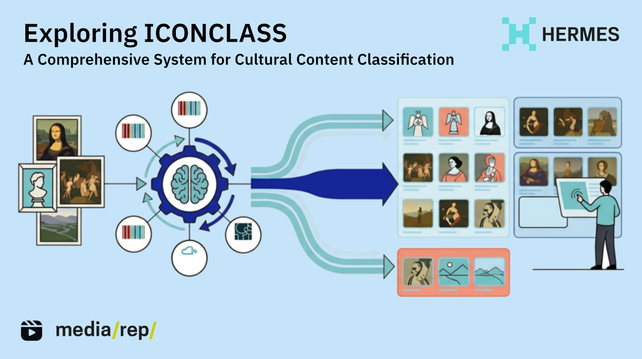
Im #HERMES #OpenColloquium stellten Hans Brandhorst und Etienne Posthumus #ICONCLASS vor: ein standardisiertes, ikonographisches Klassifikationssystem für visuelle Inhalte. Bekannt aus der kunsthistorischen Bilderschließung, ist es nutzbar weit darüber hinaus. Die Referierenden berichteten über den aktuellen Stand und die Einführung der Linked-Open-Data-Version (#LOD).
📺 https://mediarep.org/entities/video/85337334-e330-4480-b0ed-15165a273f08
#DigitalHumanities
📽 HERMES Open Colloquium | Online verfügbar
Wie lassen sich historische und zeitgenössische Katalogisierungssysteme für eine der bedeutendsten Sammlungen der Wissenschaftsgeschichte zusammenführen – und dabei koloniale Strukturen kritisch reflektieren?
Antworten und wichtige Beiträge für die dekoloniale Wissensvermittlung liefern Prof. Dr. Julianne Nyhan (TU Darmstadt) und Dr. Andreas Vlachidis (UCL London).
🎬 Jetzt ansehen: https://mediarep.org/entities/video/24d77c25-bbee-4782-a3fe-d8b41dd16bb9
#DigitalHumanities #GLAM #OpenColloquium
📢 Reminder: HERMES Open Colloquium auf der #LoveDataWeek – Institutionelle Resilienz für Kulturerbe im digitalen Raum
🗓 10. Februar 2026 ⏰ 18:00-19:30 Uhr
💻 Online via Zoom (Link nach Anmeldung)
Thema: Institutionelle Resilienz für Kulturerbe im digitalen Raum
Speaker: Dr. Katja Sternitzke (Staatsbibliothek zu Berlin) – @nfdi4culture
👉 Jetzt anmelden: https://adwmainz.zoom.us/meeting/register/VJFg8wWPT-67045nVLiR_g#/registration
Nach der Anmeldung erhalten Sie den Zoom Link.
#OpenColloquium #Kulturerbe #DigitalResilience #Kulturgutschutz
🚀 HERMES Open Colloquium – „Alles, was ich schon immer über Knowledge Graphen wissen wollte, aber mich bisher nicht getraut habe zu fragen“
🗓 28. Oktober 2025 ⏰ 15:00 – 16:30 Uhr (online)
mit Tabea Tietz (FIZ Karlsruhe) und Jonatan Steller (ADWL Mainz)
👉 Reiche hier deine Fragen ein (bis zum 17. Oktober): https://nocodb.nfdi4culture.de/dashboard/#/nc/form/dd47ffdd-239d-4449-b86f-ca2341c53d36
(Anonym möglich – jede Frage ist willkommen!)
👉 Zur Anmeldung: https://nocodb.nfdi4culture.de/dashboard/#/nc/form/bf56ec70-d832-460f-bdc7-992591cbc5ac
#KnowledgeGraph #OpenColloquium #DataScience #GLAM #DigitalHumanities
📢 Upcoming Lecture
📅 Date: December 3, 2024
⏰ Time: 18:00–19:45 CET
📍 Where: Online via Zoom
Join us for an exciting lecture by Prof. Dr. Julianne Nyhan (Chair of Humanities Data Science and Methodology, TU Darmstadt), titled:
🎓 “Exploring collections as data: the Sloane Lab. Looking back to build future shared collections”
👉 Register now to receive the Zoom link:
https://tu-darmstadt.zoom-x.de/meeting/register/u50tfu-urjkqGtCtP54DlzHwJP3HMw_mjBWzA
#DigitalHumanities #SloaneLab #OpenColloquium #OpenData #CulturalHeritage #DecolonizingCollections
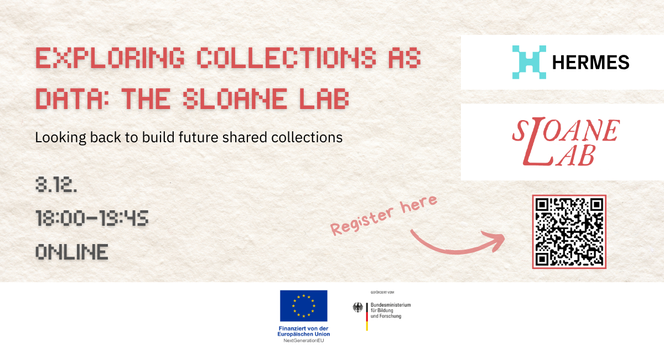

Welcome! You are invited to join a meeting: Exploring collections as data: the Sloane Lab. Looking back to build future shared collections. After registering, you will receive a confirmation email about joining the meeting.
The presentation will take you through the journey of integrating Sloane’s historical catalogues and current cataloguing systems, driven by insights from a participatory design process and contemporary understandings of cultural heritage collections that emphasise the requirements of decolonised and multivocal heritage.
Crucially, the participatory design process has sought to co-create with expert and interested communities, knowledge of the questions that individuals and communities wish to ask of Sloane lab-also in light of the highly problematic nature of Sloane's collection, having been partly funded through the profits derived from the enslavement of Human beings-and to respond to this via the technical design of the lab.
Uniting the Sloane collection serves as a microcosm of the challenges faced in integration of disparate data and mobilisation of historical datasets for facilitating access to knowledge and information held in such a vast and varied collection. At the core of the Sloane Lab resides the Knowledge Base (KB), which extends CIDOC-CRM with semantics that handle uncertainty, multivocality and modality of the collection (e.g., conflicting data from different records about the same object), data absences, the difficulty of classifying objects, and the fact that some of the objects described in the historical catalogues are now lost. Providing a homogeneous data environment using formal semantics to allow data integration, semantic enrichment, and knowledge discovery across a disparate environment of resources the KB facilitates resourceful query, visualisation, and fact-finding.
The presentation will provide an insight to the design and development of the Sloane Lab knowledge base, the modelling choices, and priorities in relation to semantics and vocabularies and the range of challenges addressed in the process of aggregation in terms of data disparity, integration facility, conflicting information and inconsistency, uncertainty and data absence.
 HERMES Datenkompetenzzentrum