Words of the double-tongued #NovNov24
Jane Stanton-Wilson: ‘Brixton Bus’ (acrylic and pastel, 1992).
The Ballad of Peckham Rye
by Muriel Spark.
Cover illustration by Jane Stanton.
Penguin Books, 1963 (1960).
‘Have you observed, Mr Willis, the frequency with which your employees use the word “immoral”? Have you noticed how equally often they use the word “ignorant”? These words are significant,’ Dougal said, ‘psychologically and sociologically.’ — Chapter 6.
Who is Dougal Douglas? What’s he doing in Peckham in the former London borough of Camberwell? And what’s his game?
These are the sorts of questions the reader may well be asking themselves from the start of Spark’s sparkling but dark novella, when Dougal’s is the name mentioned in absentia by various individuals in Peckham whose lives have been affected or, worse, disturbed by his time living among them.
And at the end the reader may well also be asking themself what the precise significance is of what they’ve just read: are these merely the exploits of a picaresque character or is there something more profound that Spark is trying to say to us?
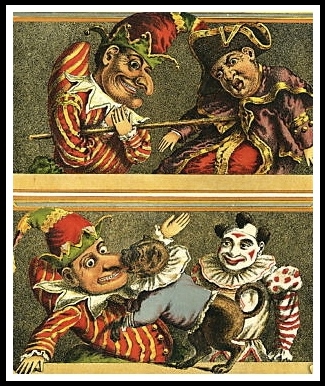
Vintage print of Punch & Judy puppet show. ‘All human beings who breathe are a bit unnatural.’ — Dougal.
Dougal Douglas – who also calls himself Douglas Dougal – is the enigmatic figure at the centre of Spark’s narrative. An Arts graduate of Edinburgh University (as he tells potential employers in Peckham) he opines that having someone undertaking ‘personnel research’ will help combat absenteeism in the workforce. But, as he insists, he will have to do it on his own terms, entailing him being himself absent for much of the time.
He may initially be able to con management but he divides opinion amongst the ordinary people of this part of Camberwell, South London: some roundly declare they admire him, in others he inspires distrust, even strong dislike. In the Meadows Meade typing pool Connie says ‘My Dad says he’s nuts. But I say he’s got something. Definitely.’ And later, ‘You can’t help but like him. He’s different.’ Dixie, engaged to Humphrey, disagrees: ‘I don’t like him, he’s got funny ideas.’ Similar conversations are had by others Dougal comes in contact with.
How does this Scotsman, sometimes mistaken as an Irishman, provoke such contrasting responses? First of all he’s seen as a hunchback, probably due to scoliosis, less likely kyphosis or achondroplasia – Spark leaves Dougal’s condition vague – but Dougal plays on his singular appearance. He also plays on his personality, claiming he’s ‘a man of vision’, that he’s fey because he’s got ‘Highland blood’, that he has ‘powers of exorcism’, all qualities that seem to attract certain individuals.
But others are repelled, as may be the reader when we’re told Dougal gazed at a potential employer “like a succubus whose mouth is its eyes.” Mr Weeden is more explicit about his dislike: ‘But it’s my belief that Dougal Douglas is a diabolical agent, if not in fact the Devil.’ Is he indeed? Or is he a witch, unable to cross water? Or possibly merely a ghost writer, making up a past history for the memoirs of an aged actress in North London?
We’re meant to understand Dougal is a mystery to all, and we too are meant to simultaneously like and mistrust him. To me this story is partly Spark’s rewriting of the history of Mr Punch, with Dougal as a conceited coxcomb who mistreats or manipulates everyone, from ex-girlfriend Jinny (the equivalent of Judy) to the local police, with echoes of puppet characters such as the Devil, hangman or ghost, and a leg bone taking the place of Mr Punch’s trademark slap stick. Indeed, like the puppet show itself The Ballad of Peckham Rye is dark entertainment, for all its wit and humour.
When Dougal, a self-styled student of human nature, divides morality into four categories – functional, emotional, puritanical and classical – are we wrong to believe that they could reflect his creator’s own philosophy and approach to writing characters in fiction? A Scot herself, Muriel Spark was living in Camberwell while writing some of her novellas, including not only this but also The Prime of Miss Jean Brodie, and so was in a good position to observe people, their speech patterns, and their goings-on as well as attitudes towards those seen as ‘Other’ – Scots, Irish, and West Indians for example, or people with visible disabilities.
But she leaves it to one of these ‘Others’ to pass judgement on such attitudes (as well as on the duplicitous Dougal) – the often inebriated Bible-thumper Nelly Mahoney.
‘The words of the double-tongued are as if they were harmless, but they reach even to the inner part of the bowels. Praise be to the Lord, who distinguishes our cause and delivers us from the unjust and deceitful man.’
Ballads were traditional songs in verse form telling tales of comedy, tragedy, romance, adventure and the supernatural. Spark’s playful ‘ballad’ manages to touch most of not all these aspects and, true to form, manages to entertain while revealing human foibles.
#NovNov24 @BookishBeck @Cathy746books
Read for #NovNov (Novellas in November), my late 1990s edition of this novella has as its cover illustration an atmospheric wrap-around design from a painting by artist Jane Stanton Wilson: https://newport40yearson.org.uk/about/the-students/jane-stanton-wilson/
The Ballad of Peckham Rye (1960) is the latest of her titles which I’ve enjoyed and reviewed; another dates from around this time: The Girls of Slender Means (1963). Two others I’ve so far read date from around three decades later: A Far Cry from Kensington (1988) and Symposium (1990).
Muriel Spark, 1960 (image: Evening Standard).
#NovNov24 #MurielSpark #TheBalladOfPeckhamRye
 Sarah Matthews
 Davida (Chocolate Lady) Chazan
 Christopher Lovegrove


 Calmgrove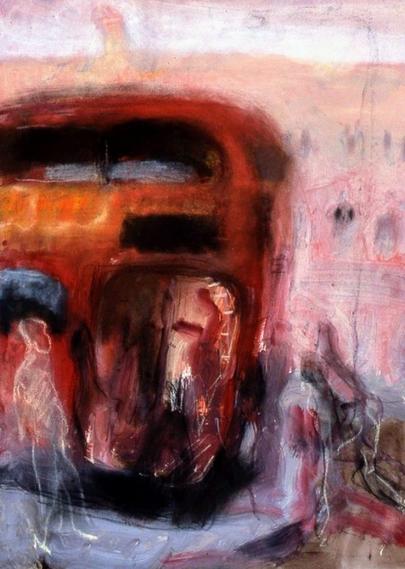


 kaggsy59
