Programmes nationaux de recherche : prise de position de l’ASSH

Avec les Programmes nationaux de recherche, dénommés « Centres of Competence in Research (NCCR) », la Confédération encourage des projets de recherche d’importance stratégique. Ces derniers sont sélectionnés suivant une procédure d’évaluation en plusieurs étapes et dotés de fonds considérables.

A #unibern and #NCCR PlanetS team has developed a machine learning model that predicts potential #planetary systems with Earth-like #planets. It could significantly accelerate and revolutionize the search for habitable #planets in the universe.
👉 https://mediarelations.unibe.ch/media_releases/2025/media_releases_2025/where_to_find_the_next_earth/index_eng.html
Where to find the next Earth

A team from the University of Bern and the National Centre of Competence in Research (NCCR) PlanetS has developed a machine learning model that predicts potential planetary systems with Earth-like planets. The model could significantly accelerate and thus revolutionize the future search for habitable planets in the universe.

Media Relations
Ein #unibern und #NCCR PlanetS Team hat ein maschinelles Lernmodell entwickelt, das potenzielle #Planetensysteme mit erdähnlichen #Planeten vorhersagt. Es könnte die Suche nach bewohnbaren #Planeten im Universum deutlich beschleunigen und revolutionieren.
👉 https://mediarelations.unibe.ch/medienmitteilungen/2025/medienmitteilungen_2025/wo_die_naechste_erde_zu_finden_sein_koennte/index_ger.html
Wo die nächste Erde zu finden sein könnte

Ein Team der Universität Bern und des Nationalen Forschungsschwerpunkts (NFS) PlanetS hat ein maschinelles Lernmodell entwickelt, das potenzielle Planetensysteme mit erdähnlichen Planeten vorhersagt. Das Modell könnte die zukünftige Suche nach bewohnbaren Planeten im Universum deutlich beschleunigen und damit revolutionieren.

Media Relations

BCFSA Releases Natural Catastrophe and Climate-Related Risk Consultation “What We Heard” Report

https://www.bcfsa.ca/media/3400/download

#BritishColumbia #ClimateChange #nccr

3 animated stories about the origins, the present and the future of 🧠 language with the #NCCR #EvolvingLanguage https://evolvinglanguage.ch/3-animated-stories-to-explore-the-origins-the-present-and-the-future-of-language/
3 animated stories to explore the origins, the present and the future of language with the NCCR Evolving Language - NCCR Evolving Language

What does the NCCR Evolving Language study? And how can it be useful? Discover the broad field of research of the NCCR Evolving Language through 3 animated stories, by Robbie L'Anson Price.

NCCR Evolving Language
In the FORS workshop we had a crucial discussion of the rights and responsibilities of scientists, the outlook on personal and sensitive data in the age of A.I. This is a team that has clearly dealt with many conflicts of opinion across organisational and national borders. See https://forscenter.ch/topics/ #nccr #OpenResearchData
Cool tool from USI/eLab by @CCdigitallaw to check for #dataprotection norms that apply to your research
https://dmlawtool.ccdigitallaw.ch/ #nccr #openresearchdata
DMLawTool

DMLawTool guides researchers through the most relevant legal aspects of research data management

Data protection: legal considerations for research in Switzerland (Diaz 2022)
https://serval.unil.ch/en/notice/serval:BIB_FBDCAEAD1615 #FORScenter #NCCR #OpenResearchData
Serval - Data protection: legal considerations for research in Switzerland

The advent of Open Science poses a number of challenges for researchers with regard to research data management. Amongst the most salient is the necessary balance between data protection and openness. This guide aims to clarify the rights and obligations of researchers regarding the protection of personal data, following the main questions that should be asked before conducting a research project.
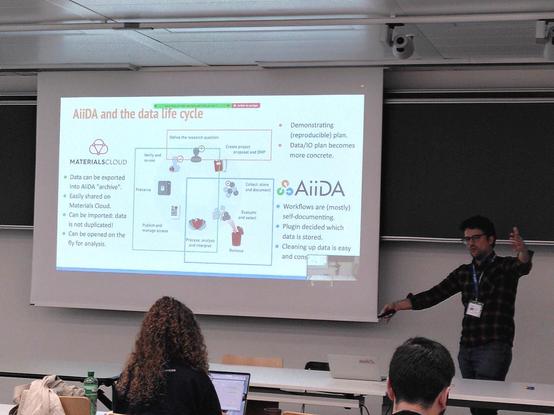

The #NCCR presentation on #AiiDA has great insights into the data engineering behind open science publications, nice thoughts about building a community of technical exchange. See http://aiida.net/sections/about.html#what-is-aiida and https://aiidateam.github.io/aiida-registry/ #OpenresearchData
About — AiiDA documentation

"To evaluate potential bias .. we collected 2742 datasets .. from seven studies representing three different countries." 😮 Via @linathekim@twitter https://www.nature.com/articles/s43588-022-00247-8 #nccr #OpenResearchData
Large-scale microbiome data integration enables robust biomarker identification - Nature Computational Science

An efficient algorithm is proposed to integrate large-scale microbiome datasets. This unbiased data integration method enables the identification of robust biomarkers associated with various diseases through assessing shifts of microbial network modules.

Nature