A new paper by Silber et al. has cited REBOUND:
Shock wave formation in the thermosphere by an earthgrazing fireball: Empirical evidence for volatile-enhanced hydrodynamic shielding https://ui.adsabs.harvard.edu/abs/2026arXiv260529150S/abstract #nbody #astrodon
A new paper by Wu et al. has cited REBOUND:
Eccentricity as a signature of hierarchical subsolar-mass mergers in collapsar disks https://ui.adsabs.harvard.edu/abs/2026arXiv260426912W/abstract #nbody #astrodon
A new paper by Schambeau et al. has cited REBOUND:
JWST and Gemini Observations of the Active Centaur 450P/LONEOS: Nucleus and Coma Characterizations https://ui.adsabs.harvard.edu/abs/2026arXiv260524260S/abstract #nbody #astrodon
A new paper by Radzom et al. has cited REBOUND:
Hot Jupiters' Isolation Is Not Unique to High-Eccentricity Tidal Migration https://ui.adsabs.harvard.edu/abs/2026arXiv260527362R/abstract #nbody #astrodon
A new paper by Belyakov et al. has cited REBOUND:
Nereid as a regular satellite of Neptune https://ui.adsabs.harvard.edu/abs/2026SciA...12b1429B/abstract #nbody #astrodon
A new paper by Smirnov & Carruba has cited REBOUND:
Evaluating multimodal commercial and open-source large language models for dynamical astronomy: a benchmark study of resonant behavior classification https://ui.adsabs.harvard.edu/abs/2026NatSR..1610785S/abstract #nbody #astrodon
A new paper by Webb et al. has cited REBOUND:
Life Is But a Stream: The Distribution of Planetary Systems along Stellar Streams and Their Properties https://ui.adsabs.harvard.edu/abs/2026ApJ..1003..198W/abstract #nbody #astrodon
A new paper by Agenor et al. has cited REBOUND:
Spectral and Dynamical Study of 12p/Pons-Brooks https://ui.adsabs.harvard.edu/abs/2025RMxAA..61c.224A/abstract #nbody #astrodon
A new paper by Ginat et al. has cited REBOUND:
Dynamical evolution of quasi-hierarchical triples https://ui.adsabs.harvard.edu/abs/2026MNRAS.549ag944G/abstract #nbody #astrodon

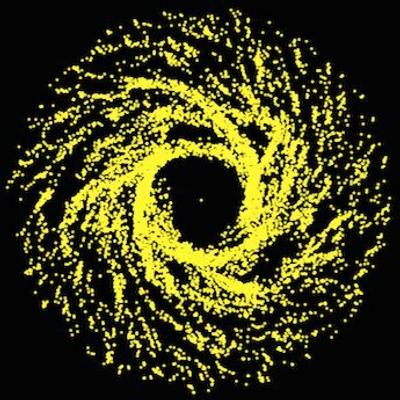
First render in a while. It's a simulation nodes gravity simulation. I went through many phases of overcomplicating it to varying degrees of success before going the absolutely simplest approach of Newtonian gravity with a force filter that drops very close particles to 0 influence (otherwise particles get flung into the Twilight Zone). I cheated a bit and optimized calculation time by using a Merge by Distance in my simulation zone and only calculating the influence from those. It does cause closely-clustered points to have only as much influence as a single point. In another study, I had found a way to make the merged points have the mass of all the points in the merge, but the way that I did it had worse performance than the raw N^2 N-Body calculation.

The color of each particle is simply the absolute value of the velocity, mapping XYZ to RGB.

I should work with Geometry nodes more. They are very stimulating. My real addiction is programming, and I often neglect my art, and geo nodes give me the opportunity to scratch both itches at once.

I wish I could get this one done in Cycles, but it's just too damn slow. Low frame time and denoising alone would make a 30 second render take over 5 hours, and it doesn't really look that much better than Eevee.

#Blender #BlenderEevee #EeveeRenderer #EeveeRender #Video #MotionGraphics #MoGraph #Gravity #GeometryNodes #SimulationNodes #Suzanne #NBody #NBodySimulation