 goetz
goetzNetworking equipment maker #Unifi is late to the #IPv6 game.
The first thing I come across is, that they build #NAT66 support which is neither standardized nor needed.
Why?
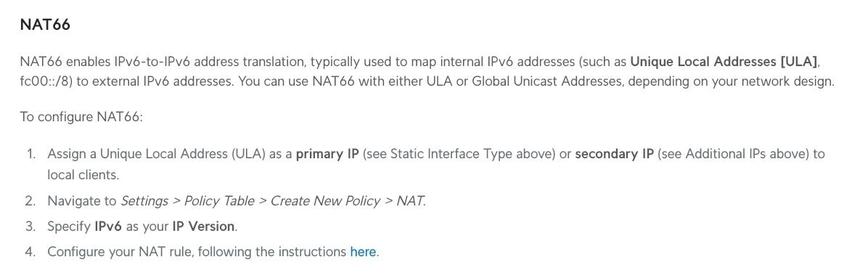
Networking equipment maker #Unifi is late to the #IPv6 game.
The first thing I come across is, that they build #NAT66 support which is neither standardized nor needed.
Why?
@tschaefer das Problem an #IPv6 ist dass es annimmt dass Leute statische Adressen haben und diese sich nicht nur nicht ändern sondern darüber erreichbar sind.
with internal #NAT66 DNAT and SNAT in an unwholesome combo.
All network engineers, in sympathy:
"I understand. I weep, but I understand."

After toiling for a few hours, I've managed to achieve a working #Palworld server on my #IPv6only #k8s cluster. The server is responsive on both modern and legacy IP, which I think might be fairly unique, since the game server doesn't listen on #IPv6 and I suspect the game client doesn't connect on IPv6 either.
This works using a Tundra-NAT64 CLAT sidecar, doing #464XLAT, with internal #NAT66 DNAT and SNAT in an unwholesome combo.
Occasionally, it pays to have a strong networking background.
In a cluster like #Kubernetes, would a Layer 3 load-balancer operating on #IPv6 traffic be considered a #NAT (specifically #NAT66)? There certainly is address translation happening but not necessarily port mapping. Would this be better described as round-robin routing, to fungible destinations?
I'm poised to think that it's not a NAT, because the goal is for the cluster to present a single face to the network, rather than to provide the cluster's nodes with IP connectivity.
 Kevin Karhan
 Jan ☕🎼🎹☁️🏋️♂️
 Hugo Slabbert ⚠️
 Litchralee_v6
 lamp
lamp