Gamefinds: NANDgame
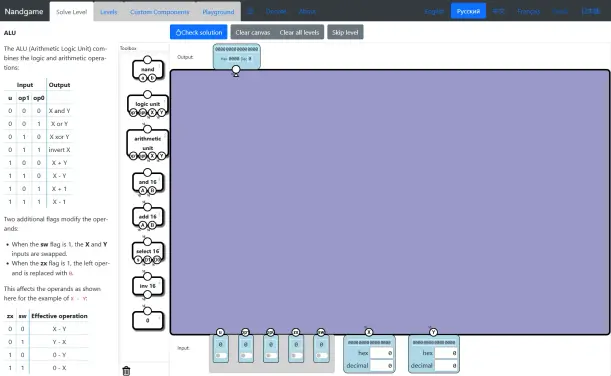
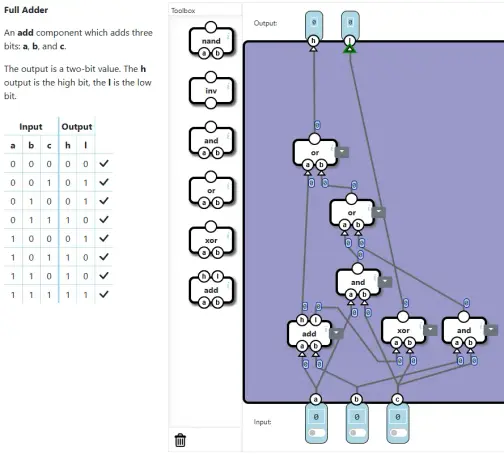
NANDgame is one of those puzzle games that's really an educational game in disguise. By hooking up wires and relays, then logic gates, then larger pieces of basic computing hardware, you construct a basic processor from first principles, step by excruciating step.

This is actually a puzzle solution, which I don't usually in
https://setsideb.com/gamefinds-nandgame/
#gamefinds #indies #niche #ComputerArchitecture #gamefinds #indie #LogicGates #NANDgame #niche #puzzle

Gamefinds: NANDgame

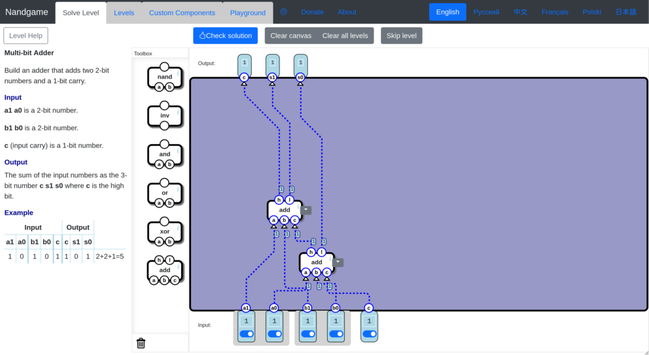
NANDgame is one of those puzzle games that's really an educational game in disguise. By hooking up wires and relays, then logic gates, then larger pieces of bas

Set Side B

@ashed

...Ну вообще выглядит интересно, но у меня пока вот #Nandgame пройден чуть менее чем наполовину...

#гамез #Nandgame

Ебать мои кастрюльки! ©

#гамез #Nandgame

Абсолютно незаконно. Полностью проклято.

...Но своя логика в этом есть 🙃

My Nandgame CPU now has an Assembler.

Yes, it's LLM generated.
I run into the problem that I want to solve problem X, for for that, I need to solve Y, Z, Q, a.s.o first.
I needed a shortcut.

Anyway, I now can sum the numbers from 0 to 10.
I need to manually calculate jump positions. No labels.
I have no proper halt instruction and will probably simply use the nand2tetris convention of "these instruction bits need to be 1". Which is fugly for future extensions.

I have no idea how to properly solve this.

https://git.uvok.de/fpga-exper/tree/nandgame/assembler?h=main

#nandgame #nand2tetris #verilator

assembler « nandgame - fpga-exper - FPGA experiments

In other news, I finished a disassembler for the nandgame CPU.
Using a "more proper" assembly syntax instead of this half-assed C-like syntax the game uses.

On the other hand,

inc <dest>, <register to increment>

looks weird.
I'm not sure how I want the final language to look lile...

https://git.uvok.de/fpga-exper/tree/nandgame/assembler/disas.py?h=main

#python #nandgame #assembler

disas.py « assembler « nandgame - fpga-exper - FPGA experiments

Hm, the #nandgame instruction set seems not to use bit 11, but #nand2tetris apparently uses this bit?

I was given the impression they're the same...

I think I finished my #nandgame CPU implementation.

Now, I still need to write some testbenches....
... and then figure out whether I should write an assembler.The only one I could find was https://github.com/gmfCoding/Nandgame-Assembler.

https://git.uvok.de/fpga-exper/tree/nandgame?h=main

GitHub - gmfCoding/Nandgame-Assembler: This is a CLI utility to compile Nandgame assembly code into machine code.

This is a CLI utility to compile Nandgame assembly code into machine code. - gmfCoding/Nandgame-Assembler

GitHub
nandgame - fpga-exper - FPGA experiments