@EVDHmn I'm not sure about that, but apparently there could have been a #MaunderMinimum triggering the #Megadrought during the #MingDynasty (which I did not know about)!
Excerpt: "Our results indicate that the late Ming megadrought from 1625 – 1644 CE occurred in both the northern and southern parts of the East Asian monsoon region in China. However, variations in the onset, duration, and magnitude of this event differ between regions. The combination of factors such as Pacific sea surface temperature anomalies, weakened solar activity, and large-scale volcanic eruptions may have contributed to the occurrence of the late Ming megadrought. These factors are also identified as key drivers of interannual to decadal fluctuations in drought in the middle reaches of the Yangtze River. Our reconstruction provides an historical context for the development of adaptive measures to mitigate future drought impacts in the region."
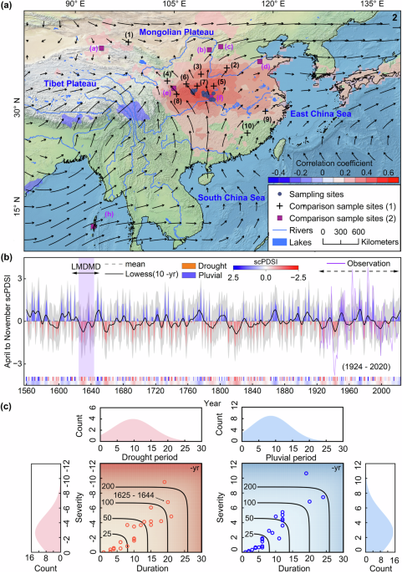

The late Ming megadrought across north-to-south China, lasting from 1625-1644 CE, was influenced by Pacific sea surface temperature anomalies, weakened solar activity, and volcanic eruptions, according to reconstruction of the Yangtze River's water balance using tree-ring chronology.
A new wave of climate research is sounding a stark warning:
Human activity may be driving drought more intensely
– and more directly
– than previously understood.
The southwestern United States has been in a historic #megadrought for much of the past two decades,
with its reservoirs including lakes Mead and Powell dipping to record lows
and legal disputes erupting over rights to use water from the Colorado River.
This drought has been linked to the 👉 "Pacific Decadal Oscillation",
a climate pattern that swings between wet and dry phases every few decades.
Since a phase change in the early 2000s, the region has endured a dry spell of epic proportions.
The PDO was thought to be a natural phenomenon,
governed by unpredictable natural ocean and atmosphere fluctuations.
But new research published in the journal Nature suggests that’s no longer the case.
Working with hundreds of climate model simulations, our team of atmosphere, earth and ocean scientists found that
💥the PDO is now being strongly influenced by human factors and has been since the 1950s.
It should have oscillated to a wetter phase by now -- but instead it has been stuck.
🔥Our results suggest that drought could become the new normal for the region unless human-driven warming is halted
https://theconversation.com/climate-models-reveal-how-human-activity-may-be-locking-the-southwest-into-permanent-drought-262837
"The outlook calls for continued dry conditions in the #Southwest, where global warming is a key driver of a long-term #megadrought that is already disrupting water supplies to cities and nationally important agricultural zones.
The outlook is bad news for Colorado River and Rio Grande flows, and for soil moisture and vegetation health across the region. Drying vegetation heightens concerns for another bad wildfire season in the Southwest."
https://insideclimatenews.org/news/24032025/noaa-critical-drought-warnings-spring-climate-outlook/
The embattled agency continues to disseminate crucial updates in a hostile political environment, while scientists warn that cutting climate intelligence is folly at a time of escalating climate extremes.