pub2post
Trade-offs in Medical AI
🤖 Lack of relevant metrics hinders AI integration.
🔬Absence of clinical trials affects validation.
👥 Need for patient and physician involvement.
Trade-offs in Medical AI
🤖 Lack of relevant metrics hinders AI integration.
🔬Absence of clinical trials affects validation.
👥 Need for patient and physician involvement.
Google DeepMind (@GoogleDeepMind)
멀티모달 에이전트가 의료진과 환자를 더 잘 지원할 수 있는지 탐구하기 위한 새로운 연구 이니셔티브 'AI co-clinician'을 소개한다. 의료 분야에서 AI 에이전트의 실제 활용 가능성을 검증하는 중요한 프로젝트로 보인다.
Rohan Paul (@rohanpaul_ai)
의료 비전-언어 모델에서 강화학습(RL) 후학습은 완전히 새로운 능력을 학습시키기보다 기존 능력을 더 정교하게 다듬고, 출력 분포를 최적화해 효율성을 높이는 역할이 크다는 연구 결과를 제시한다.
https://x.com/rohanpaul_ai/status/2036653802204561594
#reinforcementlearning #medai #visionlanguage #machinelearning #research
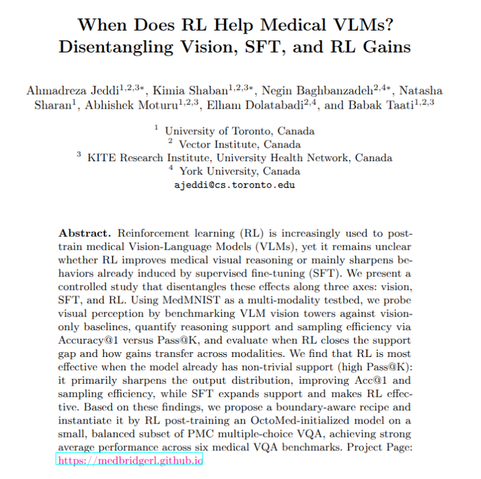
This research shows that reinforcement learning (RL) in medical vision-language models mostly sharpens existing skills rather than teaching entirely new ones. Reinforcement learning post-training primarily refines output distributions to improve efficiency, while supervised

While large language models (LLMs) hold promise for transforming clinical healthcare, current comparisons and benchmark evaluations of large language models in medicine often fail to capture real-world efficacy. Specifically, we highlight how key discrepancies arising from choices of data, tasks, and metrics can limit meaningful assessment of translational impact and cause misleading conclusions. Therefore, we advocate for rigorous, context-aware evaluations and experimental transparency across both research and deployment.
Ra mắt MedAI, ứng dụng Android mới sử dụng Gemini AI để tóm tắt đơn thuốc viết tay! Chỉ cần chụp ảnh đơn thuốc, AI sẽ trích xuất tên thuốc, liều lượng và thời gian sử dụng, giúp người dùng dễ dàng hiểu rõ hơn. Một bước tiến nhỏ giúp mọi người tiếp cận thông tin y tế dễ dàng hơn.
MedAI: Ứng dụng Android mới dùng Gemini AI tóm tắt đơn thuốc! Chỉ cần chụp ảnh, AI sẽ đọc và trích xuất tên thuốc, liều lượng & thời gian sử dụng từ các đơn viết tay khó đọc. Giúp bạn hiểu rõ hơn về thuốc của mình.
#MedAI #AI #YTeSo #AndroidApp #GeminiAI #HealthTech #Medicine

This study investigates how a physician’s use of generative AI (GenAI) in medical decision‑making is perceived by peer clinicians. In a randomized experiment, 276 practicing clinicians evaluated one of three vignettes depicting a physician: (1) using no GenAI (Control), (2) using GenAI as a primary decision-making tool (GenAI-primary), and (3) using GenAI as a verification tool (GenAI-verify). Participants rated the physician depicted in the GenAI‑primary condition significantly lower in clinical skill (on a 1–7 scale; mean = 3.79) than in the Control condition (5.93, p < 0.001). Framing GenAI use as verification partially mitigated this effect (4.99, p < 0.001). Similar patterns appeared for perceived overall healthcare experience and competence. Participants also acknowledged GenAI’s value in improving accuracy (4.30, p < 0.002) and rated institutionally customized GenAI more favorably (4.96, p < 0.001). These findings suggest that while clinicians see GenAI as helpful, its use can negatively impact peer evaluations. These effects can be reduced, but not fully eliminated, by framing it as a verification aid.
 sayzard
 Scott McGrath