Eine über 100 Jahre umfassende Langzeitstudie des Korallenwachstums in der Karibik dokumentiert: Selbst als widerstandsfähig geltende Korallenarten können sich zunehmend schlechter an steigende Meerestemperaturen und weitere menschengemachte Umweltbelastungen wie Küstenverschmutzung und Bebauung anpassen.
https://www.nature.com/articles/s41598-025-08709-5
#macobios @freieuniversitaet
Emerging skeletal growth responses of Siderastrea siderea corals to multidecadal anthropogenic impacts in Martinique, Caribbean Sea - Scientific Reports

Anthropogenic stressors on Caribbean reefs have shifted coral dominance toward stress-tolerant species such as Siderastrea siderea, increasing their importance for reef construction. However, the sublethal responses of these corals to past stressors remain understudied, limiting our understanding of their long-term acclimatization capacity. Here, we reconstructed the annual skeletal growth rates (1912–2020) of twelve S. siderea coral colonies from Martinique (Caribbean Sea) and examined their relationships with changes in human population, sea surface temperature (SST), precipitation, river discharge, and agricultural indicators between 1950 and 2020. Long-term growth rate declines observed since the 1950s were initially associated with human population, a proxy for local stress. Warming SST enhanced coral skeletal growth between 1950 and 1985, suggesting optimal temperatures for calcification during this interval. However, skeletal density exhibited a multidecadal (1950–2020) parabolic response, indicating a surpassing of this thermal optimum in recent decades. This parabolic response included persistent skeletal density declines from 2010 to 2020, possibly related to cumulative thermal stress or the interaction with ocean acidification effects. Our findings suggest a limited acclimatization capacity of long-lived S. siderea corals to cumulative pressures in Martinique and highlight their vulnerability to the compounding effects of local stressors and climate change.

Nature

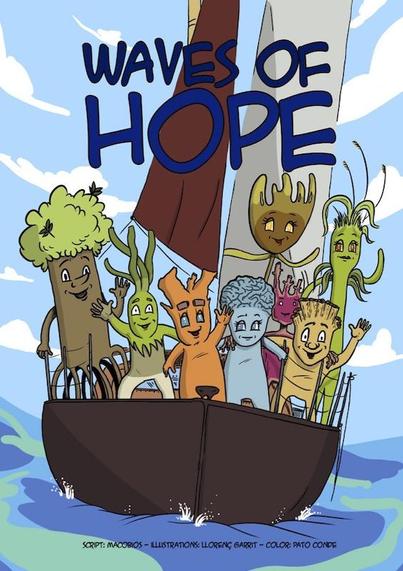
Just published - the translation of our 'Waves of Hope'-Science Comic (of our EU-research project 'Marine Coastal Ecosystems. Biodiversity and Services in a Changing World') into many other languages. 🧪
English
Français
Español
Italian
Deutsch
Português
Catalán
https://macobios.eu/prp/other-products/

#MaCoBioS #NBS #sciencecommunication

other products » MacoBios

Other products <style> @media screen and (max-width: 1024px) { .eael-hamburger--tablet { .eael-advanced-menu-horizontal, .eael-advanced-menu-vertical { display: none; } } .eael-hamburger--tablet { .eael-advanced-menu-container .eael-advanced-menu-toggle { display: block; } } } </style> <ul id="menu-output-other-products-2"><li><a href="#ComicBook">Comic Book</a></li> Youtube Newsletters blogs Factsheet ComicBook English Français Español Italian Deutsch Português Catalán Youtube Channel Newsletters Blogs 11/19/2024 In March 2023, while tourists […]

MacoBios
Our Science Comic 'Waves of Hope' on marine coastal ecosystems and how to better protect them, is out as an eBook. A project of #MaCoBioS, Lead author Ewan Tregarot. Enjoy! See here (also for online reading or download): https://macobios.eu/prp/other-products/#ComicBook
other products » MacoBios

Other products <style> @media screen and (max-width: 1024px) { .eael-hamburger--tablet { .eael-advanced-menu-horizontal, .eael-advanced-menu-vertical { display: none; } } .eael-hamburger--tablet { .eael-advanced-menu-container .eael-advanced-menu-toggle { display: block; } } } </style> <ul id="menu-output-other-products-2"><li><a href="#ComicBook">Comic Book</a></li> Youtube Newsletters blogs Factsheet ComicBook English Français Español Italian Deutsch Português Catalán Youtube Channel Newsletters Blogs 11/19/2024 In March 2023, while tourists […]

MacoBios
New @MaCoBioS paper is out: Trégarot, E., et al.: Effects of climate change on marine coastal ecosystems – A review to guide research and management. Biological Conservation 289, 110394, #OpenAccess, co-authored by 4 members from the GeoBio-group at the Dept. of Geosciences @fu_berlin #MaCoBioS https://doi.org/10.1016/j.biocon.2023.110394.