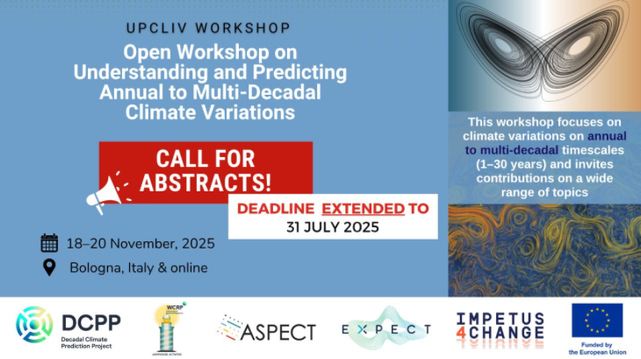
🌍 Call for Abstracts – Deadline Extended to 31 July 2025!
📢 The workshop on Climate Predictability & Integrated Attribution — co-organized by #MPIM_scientists Lara Wallberg & Wolfgang Müller — invites your contributions!

🔍 Topics: climate variability, predictability, #extremes, #AI/#ML methods & more.
💡 Organized by ASPECT, EXPECT, I4C & WCRP.

📄 Submit now: https://www.upcliv-workshop.eu
#ClimateScience #ClimatePrediction #ClimateExtremes #ScienceCollaboration
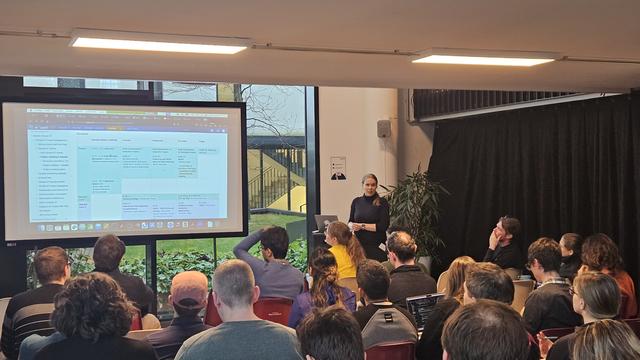
Last week, participants of the European project “Destination Earth” (DestinE), in which #MPIM_scientists are involved, gathered in #Hamburg. During the #hackathon, they worked on the implementation of the Climate #digitaltwin 🌍 🌍 they are developing. This is supposed to help users design #climate adaptation plans & mitigation measures by providing accurate digital information 📊 on climate-related phenomena & hazards. Learn more: ➡️ https://destination-earth.eu @ECMWF #ESA @eumetsat Credit: MPI-M
Destination Earth

Building a highly accurate digital twin of the Earth Join DestinE's community Destination Earth Destination Earth is a flagship initiative of the

Destination Earth

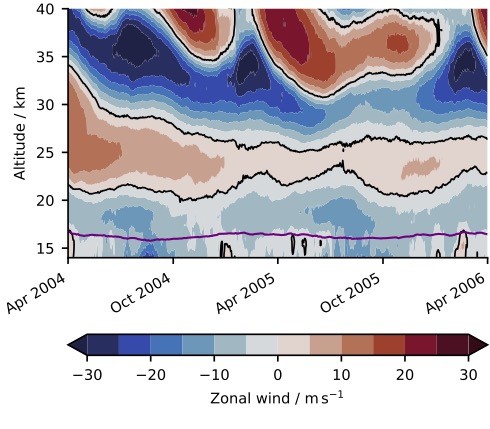
🌬 The quasi-biennial oscillation (QBO), a wind system in the tropical stratosphere, can influence the seasonal weather along many latitudes & could change in the course of global warming. The simulation of the QBO has been a weak point in many climate models. #MPIM_scientists Henning Franke & Marco Giorgetta have tested a new approach to simulating the QBO with the climate model ICON – with promising results. ➡️ https://mpimet.mpg.de/en/communication/detail-view-news-homepage?tx_news_pi1%5Baction%5D=detail&tx_news_pi1%5Bcontroller%5D=News&tx_news_pi1%5Bnews%5D=1156&cHash=6302e349caa5e90b1d18197b591111d3

🖼️ CC BY 4.0 Franke & Giorgetta 2024 https://doi.org/10.1029/2024MS004381

First-time explicit simulation of a tropical wind system in the upper atmosphere

A wind system in the tropical stratosphere that can influence the seasonal weather along many latitudes – the quasi-biennial oscillation (QBO) – could change in the course of global warming. However, the simulation of the QBO has so far been a weak point in many climate models, even for current climate conditions. Researchers at the Max Planck Institute for Meteorology have now tested a new approach to simulating the QBO with the high-resolution climate model ICON – with promising results.

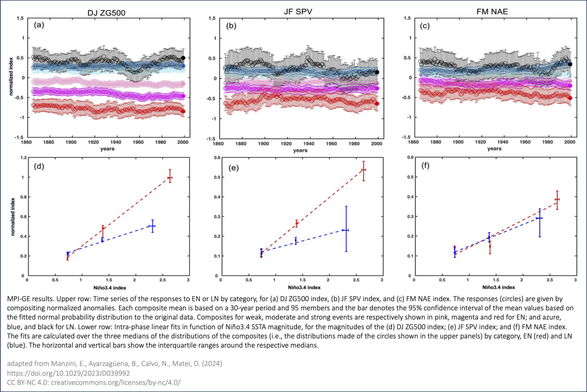
🌍 Dive into the research by #MPIM_Scientists Elisa Manzini, Daniela Matei, et al.!
They explore how warm El Niño and cold La Niña events shape the extra-tropical troposphere and stratosphere during boreal winters. Using extensive climate model simulations, they reveal the evolving impacts as these events intensify, with stronger El Niños having a larger effect on the North Pacific region and the stratospheric polar vortex than La Niñas. 🌊❄️
#ClimateResearch
#ElNiñoLaNiña
Our #MPIM_Scientists are enrolled in many different national 🇩🇪 and international 🌍 projects. One example is the European Union’s Horizon Europe project ASPECT 🇪🇺. End of May, ASPECT together with several other projects has co-organised a workshop on climate prediction and services over the Atlantic-Arctic region, which aimed to improve our understanding of Earth system processes and to improve prediction systems and climate services.
Curious to learn more about ASPECT? 👉 https://www.aspect-project.eu
Home - Aspect

Facilitatingseamless climateadaptation Improving existing climate prediction and projections, and merging their outputs across timescales to provide seamless climate information, spanning for the next months to 30 years Read More Objective A step change​ The overall objective of ASPECT is to improve and produce seamless climate predictions covering the next 30 years. Working closely with stakeholders […]

Aspect
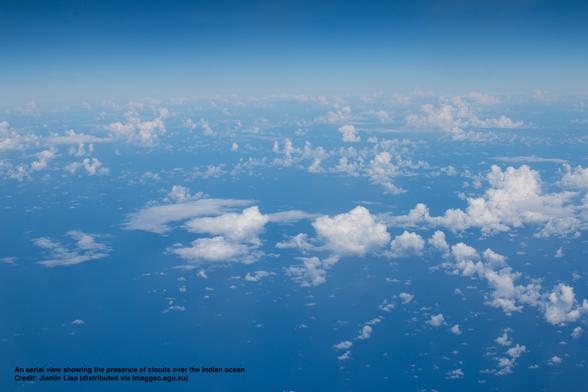
Here comes a colorful look at climate sensitivity 🌈 by #MPIM_scientists Bjorn Stevens and Lukas Kluft. They study the radiative response to warming and to changing CO2 concentrations in spectral space. This approach allows one to derive simple and yet, accurate expressions for clear-sky radiative forcing and the response to warming. With more transparently reasoned calculations, they offer an outline to quantify the uncertainties related to clouds 🌧️

💥 Paper alert: #MPIM_Scientists have analysed the sensitivity of the oceanic Lorenz Energy Cycle — a standard tool for understanding how the ocean general circulation functions. They have established that the Lorenz Energy Cycle, which was previously pictured as a windmill, is insensitive to enhanced energy input and therefore an inefficient windmill regarding the large scale circulation.

📃 Check out for more details here: https://link.springer.com/article/10.1007/s10236-023-01568-6

Sensitivity of the Lorenz energy cycle of the global ocean - Ocean Dynamics

We re-examine the Lorenz energy cycle (LEC) for the global ocean by assessing its sensitivity to model and forcing differences. We do so by comparing LECs derived from two simulations based on different eddy-rich ocean models, ICON-O and MPI-OM, both driven by NCEP/NCAR reanalysis, and by comparing LECs derived from two simulations generated using ICON-O model but driven by two different reanalyses, NCEP/NCAR and ERA5. Regarding model difference, we find weaker eddy kinetic energy, $$k_e$$ k e , in the ICON-O simulation than in the MPI-OM simulation. We attribute this to the higher horizontal resolution of MPI-OM in the Southern Ocean. The weaker $$k_e$$ k e in ICON-O is not caused by the lack of eddy available potential energy, $$p_e$$ p e , but by the strong dissipation of $$p_e$$ p e and the resulting weak conversion from $$p_e$$ p e to $$k_e$$ k e . Regarding forcing difference, we find that considerably more mechanical energy is generated by the ERA5 forcing, which has a higher spatial-temporal resolution compared to the NCEP/NCAR forcing. In particular, the generation of $$k_e$$ k e , which also contains the resolved part of the internal wave spectrum, is enhanced by about 1 TW (40%). However, the dominance of the baroclinic and the barotropic pathways forces the enhanced generation of $$k_e$$ k e to be balanced by an enhanced dissipation in the surface layer. The gross features of LEC are insensitive to both model and forcing differences, picturing the ocean as an inefficient “windmill” that converts only a small portion of the inputted mechanical energy into the interior mean and transient circulations.

SpringerLink

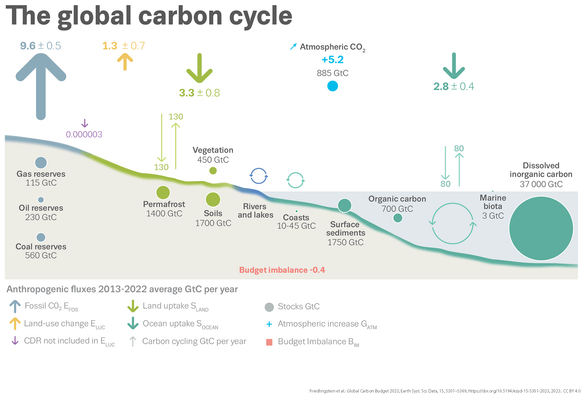
🌍 Yesterday the #GlobalCarbonBudget released its 2023 edition (complete data to 2022 and projections for 2023) with contributions of #MPIM_scientists. It estimates #CO2 emissions from fossil fuels and land use change, atmospheric CO2 increase, and CO2 uptake by land and sea. 📊

🔍 Read more: https://essd.copernicus.org/articles/15/5301/2023/
Or find the key messages here: https://globalcarbonbudget.org/fossil-co2-emissions-at-record-high-in-2023/

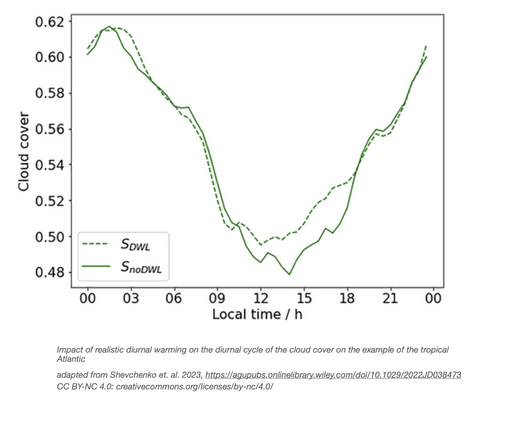
🧵 1/2 The sea surface warms up to several degrees during daytime known as diurnal warming. For decades, the question of coupling between the diurnal warming and convection on global scale remained unanswered. #MPIM_Scientists, for the very first time, answer this question using the coupled #ICON model.

WarmWorld meets again! #MPIM_Scientists and their collaborators from across Germany are gathering this week to make our global storm resolving climate model #ICON even better!

Better at what I hear you ask? We have 4 key focuses: land-atmosphere interactions, turbulence, cloud microphysics and particles. Find out more on the #WarmWorld website: https://warmworld.de/

@awi @DeutscherWetterdienst @fzj @KIT_Karlsruhe @unileipzig

WarmWorld