 Fight Back! News
Red Reviews: “Two Tactics of Social Democracy in the Democratic Revolution”
[...]

Red Reviews: “Two Tactics of Social Democracy in the Democratic Revolution”
[...]
Want to learn how to develop an image classification app with swift and CoreML?
In the fifth post in the series, we will take our app for a spin in our local zoo! We identify that not all animals are labeled correctly and talk about multi-label vs. multi-class models:
https://thinkpractice.nl/post/zooscan_5/
#swift #swiftlang #iOSDev #tutorial #ML #coreml #Buildinpublic #mltheory
[2502.05244] Probabilistic Artificial Intelligence
https://arxiv.org/abs/2502.05244
https://news.ycombinator.com/item?id=43318624
Manuscript 418pp ...

Artificial intelligence commonly refers to the science and engineering of artificial systems that can carry out tasks generally associated with requiring aspects of human intelligence, such as playing games, translating languages, and driving cars. In recent years, there have been exciting advances in learning-based, data-driven approaches towards AI, and machine learning and deep learning have enabled computer systems to perceive the world in unprecedented ways. Reinforcement learning has enabled breakthroughs in complex games such as Go and challenging robotics tasks such as quadrupedal locomotion. A key aspect of intelligence is to not only make predictions, but reason about the uncertainty in these predictions, and to consider this uncertainty when making decisions. This is what this manuscript on "Probabilistic Artificial Intelligence" is about. The first part covers probabilistic approaches to machine learning. We discuss the differentiation between "epistemic" uncertainty due to lack of data and "aleatoric" uncertainty, which is irreducible and stems, e.g., from noisy observations and outcomes. We discuss concrete approaches towards probabilistic inference and modern approaches to efficient approximate inference. The second part of the manuscript is about taking uncertainty into account in sequential decision tasks. We consider active learning and Bayesian optimization -- approaches that collect data by proposing experiments that are informative for reducing the epistemic uncertainty. We then consider reinforcement learning and modern deep RL approaches that use neural network function approximation. We close by discussing modern approaches in model-based RL, which harness epistemic and aleatoric uncertainty to guide exploration, while also reasoning about safety.
Mathematics opens black box of AI decision-making
https://phys.org/news/2025-01-mathematical-technique-black-ai-decision.html
* understanding how neural networks (NN) make decisions
* poorly understood process in machine learning
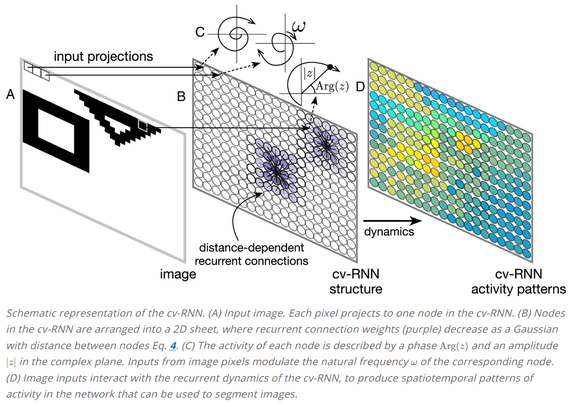
Image segmentation w. traveling waves in exactly solvable recurrent NN
https://www.pnas.org/doi/10.1073/pnas.2321319121
* RNN performing simple image segmentation, also exactly mathematically solvable
* math understanding precisely how int. connections w/i NN create visual computations
Signal processing interpretation of noise-reduction convolutional neural networks
https://arxiv.org/abs/2307.13425
* Encoding-decoding (ED) CNNs: central role in data-driven noise reduction
* ED CNN development often ad-hoc lacking theory
* builds on theory of deep convolutional framelets
* explains ED CNN architectures in unified theoretical framework connecting signal processing to deep learning
...
#NeuralNetworks #SignalProcessing #InterpretableModels #MLtheory #DeepLearning #framlets #CNN #ML

Encoding-decoding CNNs play a central role in data-driven noise reduction and can be found within numerous deep-learning algorithms. However, the development of these CNN architectures is often done in ad-hoc fashion and theoretical underpinnings for important design choices is generally lacking. Up to this moment there are different existing relevant works that strive to explain the internal operation of these CNNs. Still, these ideas are either scattered and/or may require significant expertise to be accessible for a bigger audience. In order to open up this exciting field, this article builds intuition on the theory of deep convolutional framelets and explains diverse ED CNN architectures in a unified theoretical framework. By connecting basic principles from signal processing to the field of deep learning, this self-contained material offers significant guidance for designing robust and efficient novel CNN architectures.
 Tim De Jong
 Victor Nava
 Victoria Stuart 🇨🇦 🏳️⚧️