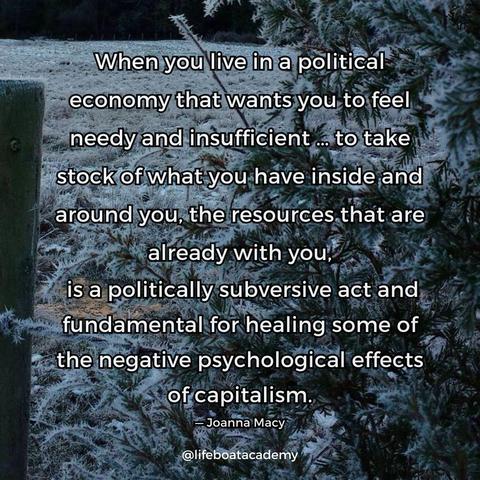
This names a quiet kind of resistance.

When a political economy depends on manufactured insufficiency, taking stock of what’s already present becomes a way of loosening its hold. Not to deny difficulty — but to stop feeding the reflexes that keep us running.

Unlearning often begins by noticing what we’ve been taught to overlook.

Full reflection for this week here: https://substack.com/home/post/p-179417144

#JoannaMacy #LearningToUnlearn #RelationalEconomy #PostCapitalistCare #CollapseAwareness
We often imagine courage as something internal and solitary.

But courage grows differently — through relationship. Through shared presence, mutual support, and the slow building of trust. This is part of what unlearning reveals: isolation isn’t strength, and connection isn’t a weakness.

#BenKadel #LearningToUnlearn #RelationalPractice #CommunityCare

Panic has a role: it breaks denial and demands attention. But it’s not a foundation.

Courage grows through a different rhythm — slower, steadier, more sustainable. This is part of what unlearning asks of us now: recognising when intensity is no longer helpful, and learning how to introduce space without disengaging.

#BenKadel #LearningToUnlearn #NervousSystemWisdom #RelationalPractice

Modern life often trains us into a posture of solitary strain — as if everything depends on our effort alone.

Unlearning begins when we release the reflex to bear the world solo and remember ourselves as part of a living system.

#VandanaShiva #LearningToUnlearn #EcologicalThinking #Interdependence

Confusion isn’t always about misinformation; it's also about exhaustion.

When urgency, outrage, and contradiction never let up, discernment weakens. This is part of what unlearning asks of us — to notice how tiredness, not ignorance, shapes our sense of truth.

#GarryKasparov #LearningToUnlearn #MediaLiteracy #CriticalThinking

One of privilege’s deepest harms is perceptual.

When we’re buffered from consequence, illusion can pass as truth and separation can feel natural. Not through bad intent, but through habit. This is where unlearning starts — noticing how ease shapes what we see, and choosing relationship over reflex.

#BenKadel #LearningToUnlearn #RelationalPractice

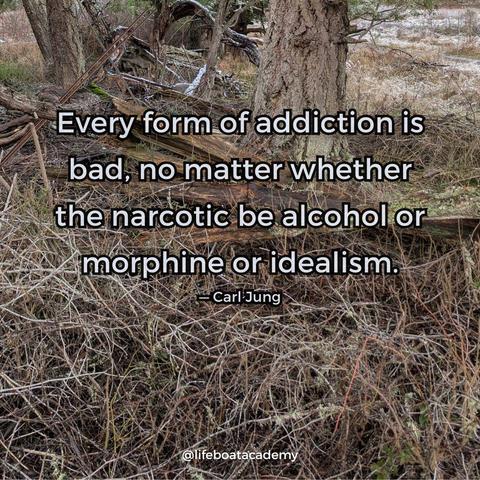
Idealism itself can become a narcotic when it creates a sense of urgency to fix or shields us from uncertainty. That’s where unlearning begins — noticing where certainty has replaced listening, and where speed has replaced care.

Loosening the grip doesn’t mean losing our values.
It means making space for better ones to grow.

#CarlJung #LearningToUnlearn #RelationalPractice

We often assume transformation fails because things are complicated.

But the deeper bottleneck is familiar: urgency, certainty, fixing before listening. This week’s anchor explores unlearning — recognising Business as Usual in ourselves and choosing slower, steadier rhythms that open space for creativity and care.

Unlearning isn’t forgetting.
It’s how better habits take root.

Read the article:
https://emotusoperandi.medium.com/learning-to-unlearn-ff2c6b08fedf

#LearningToUnlearn #RelationalPractice #SystemsThinking

Learning to unlearn - Ben Kadel - Medium

I’m often surprised at how hard people make things for themselves. For example, we treat sociocracy as some complicated, arcane rule-based system when it’s actually amazingly simple. To do that, we…

Medium