I hate, that I have to explain again and again that EUI64 address generation is the worst feature of #IPv6 in terms of tracking and privacy.
Nevertheless nearly all #IoT devices us #lwIP which lacks RFC7217 or RFC4941/8981 support and leaks GUIDs to everyone listening.
When is everyone taking this serious?
Even a famous German CPE vendor uses this method.
Have a look here if you do not understand what I mean:
was sich so alles fast acht Jahre lang in open Source Code unbemerkt verstecken kann.
Uvoks daily struggle.
"Huh?? Why does the LwIP stack send an ACK for a second incoming TCP connection?? I only accept one at a time!?!?"
Apparently, that's a "backlog", and it's suffering you can't turn off completely.
If I really want to only work with one client at a time, I probably have to accept and close the other sockets immediately?
(No, setting backlog to 0 on listen doesn't help)
Progress of the night: Getting the essentials of the #lwip stack running on the #CH32V208.
Still need to clean it up _a lot_ and build the wrapping library, so it's actually useful.
But seeing lwip run at all is amazing.
(So I don't need to depend on the proprietary, closed source #WCHNET library)
Good night :D
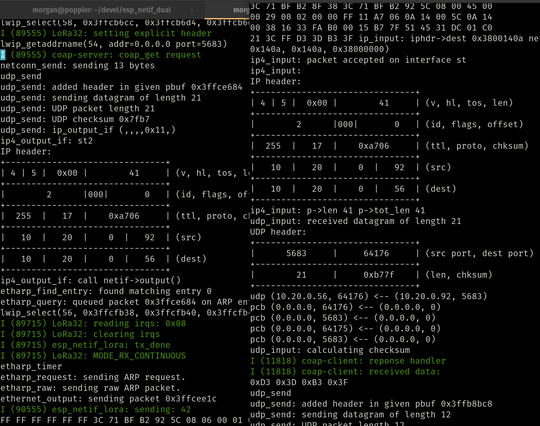
It's still got some issues, but looks like UDP/IP works for the most part. I've done a couple #CoAP requests, so that's cool.
There's a bit of into in the repo but this will need more detail and a larger writeup of the whole project(s), covering
#ESP32 #NetIF <> #ESPNow,
#LwIP over ESPNow
#Linux #TUNTAP <> #ESPNow
And that's all just been groundwork for what I really want to do (recap: CoAP like serverless #MQTT)
I did a write up on my recent work with #ESP32 #ESP-NETIF #ESPNow #LwIP and #CoAP
CoAP over Everything:
https://oit.cloud/posts/2023-12-30-coap-over-everything/
This is going to be a bit of a living post, serving as my memory and progress report on this exploration.
This research deep dive was inspired from using my Dust Collector Remote. It works great, but after a year using it I’ve found the delay to connect pretty annoying. On bad days with a router misbehaving the 4 or 5 second delay while I’m waiting to turn a tool on can get frustrating. This started getting me thinking about how it could be handled faster. I’ve used ESP-Now a handful of times and have appreciated it’s quick boot to ‘do something useful’ time.