 Jazzynupe
BUILDING A MARBLE CLOCK Pt.4 - NOW FASTER!! - YouTube
https://www.youtube.com/watch?v=_hpUnX9buR4&ab_channel=IvanMiranda
#IvanMiranda #Mechanical #MarbleClock #Engineering #3DPrinting

BUILDING A MARBLE CLOCK Pt.4 - NOW FASTER!! - YouTube
https://www.youtube.com/watch?v=_hpUnX9buR4&ab_channel=IvanMiranda
#IvanMiranda #Mechanical #MarbleClock #Engineering #3DPrinting
BUILDING A MARBLE CLOCK - Pt. 3 - YouTube
https://www.youtube.com/watch?v=M6nZiRVzauM&ab_channel=IvanMiranda
#IvanMiranda #MarbleClock #Mechanical #3DPrinting #Clock #Engineering

Upgrade A 3D Printed CNC Milling Machine By Using It
One of the original ideas behind the RepRap project was for the machines to create their own upgrades. That philosophy is shining brightly in [Ivan Miranda] CNC milling machine project, which has been used to upgrade its aluminum and 3D printed frame components to steel.
For precision machining on hard metal, machine rigidity is of utmost importance. [Ivan]'s original CNC mill made extensive use of lightweight aluminum extrusions with 3D printed fittings. The machine worked, but the lack of rigidity was visible in the surface quality of the machine parts. The latest upgrade included a completely new frame from welded steel tubing and heavy aluminum mounting plates. The original machine was used to slowly machine slots in the steel tubes to retain the adjustability of the Z-axis. Some of the 3D printed motor mounts remained, so in the second video after the break [Ivan] used the newly upgraded machine to mill some aluminum replacements.
While this machine might not be perfect, we have to respect [Ivan]'s willingness to toss himself in at the deep end and show all failures and lessons learned the hard way. This project was clearly used as an opportunity to improve his welding and machining skills. His fabrication skills have come a long way from mainly 3D printed projects like the giant tracked tank and screw tank.
#cnchacks #toolhacks #ivanmiranda #machining #millingmachine
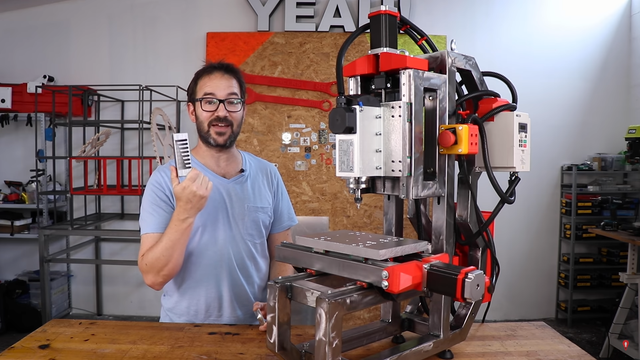
CNC mills will never match real heavy metal mills on hard materials, but that won't stop people from pushing the limits of these DIY machines. One of the usual suspects, [Ivan Miranda] is at it again, this time building a knee mill from aluminum extrusions and 3D printed fittings. (Video after the break.)
Most DIY CNC milling machines we see use a gantry arrangement, where the bed is fixed while everything else moves around it. On most commercial metal milling machines, the table is the moving part, and are known as knee mills. In the case of [Ivan]'s mill, the table can move 187 mm on the X-axis and 163 mm on the Y-axis. The 1.5 kW spindle can move 87 mm in the Z-axis. All axes slide on linear rails and are driven by large stepper motors using ball screws. The table can also be adjusted in the Z-direction to accept larger workpieces, and the spindle can be tilted to mill at an angle.
To machine metal as [Ivan] intended, rigidity is the name of the game, and 3D printed parts and aluminum extrusion will never be as rigid as heavy blocks of steel. He says claims that the wobble seen on the video is due to the uneven table on which the mill was standing. Of course, a wobbly base won't be doing him any favors. [Ivan] also had some trouble with earthing on the spindle. He nearly set his workshop on fire when he didn't notice tiny sparks between the cutter and aluminum workpiece while he was cooling it with isopropyl alcohol. This was solved with the addition of the grounding wire.
While the machine does have limitations, it does look like it can machine functional metal parts. It could even machine metal upgrades for its 3D printed components. One possible way to improve rigidity would be to cast the frame in concrete. [Ivan] has built several other workshop tools, including a massive 3D printer and a camera crane.
#cnchacks #toolhacks #3dprintedcncmachine #ivanmiranda #machining
Building A Robotic Band To Make Up For Lack Of Practice
Learning to play a musical instrument well requires a significant time investment. [Ivan Miranda] had dreamt of doing this but made peace with the fact that his talents and motivation lay in building machines. However, he has decided to play to his strengths and is building a robotic band. See the videos after the break.
So far he has mechanized a hi-hat, snare drum, and a very basic guitar. The guitar is nothing more than a single string stretched across an aluminum frame, with an electronic pickup. Most of the work has gone into the solenoid-driven picking mechanism. He wanted to avoid picking the string when the solenoid is turned of, so he created a simple little mechanism that only comes in contact with the string when it's moving in one direction. A bistable solenoid might be a simpler option here.
For the high hat, [Ivan] built a custom stand with two bistable solenoids to lift and drop the top cymbal. A solenoid-driven drumstick was also added. The snare drum uses a similar mechanism, but with a larger solenoid. So far he hasn't really worked on a control system, focusing mainly on electronics.
[Ivan] points out several times that he has knows very little about making music, but we do enjoy watching him explore and experiment with this new world. Usually, his projects involve a lot more 3D printing, like when he built a giant nerf bazooka or a massive 3D printed tank.
#musicalhacks #robotshacks #guitar #hihat #ivanmiranda #snaredrum

3D Printed Camera Crane For The Workshop
When you make a living building stuff and documenting the process camera setups take up a lot of time, breaking expensive equipment is an occupational hazard. [Ivan Miranda] knows this all too well, so he built a fully-featured camera crane to save his time and camera equipment. Video after the break.
The basic design is a vertical mast with a pivoting camera mounted to the end. The aluminum mast telescopes for increased vertical adjustability, and rides on a plywood base with caster wheels. The aluminum pivoting arm is counterweighed to offset the camera head, and a parallel bar mechanism allows the camera to hold a constant vertical angle with the ground. Thanks to the explosion of home gyms during the pandemic, gym weights were hard to find, so [Ivan] used an ammo can filled with sand and screws instead. A smaller sliding counterweight on top of the arm allows for fine-tuning. [Ivan] also wanted to be able to do horizontal sliding shots, so he added a pulley system that can be engaged with a clutch mechanism to keep a constant horizontal angle with the camera. Most of the fittings and brackets are 3D printed, some of them no doubt on his giant 3D printer.
We can certainly see this crane meeting its design objectives, and we can't help but want one ourselves. [Alexandre Chappel] also built a camera crane a while back which utilized a completely different arm mechanism. As cool as these are, they still pale in comparison to [[mingul]'s workshop-sized 8-axis CNC camera crane](https://hackaday.com/2019/09/17/speed-up-filming-with-this-jawdropping-8-axis-camera-crane/#comments).
#digitalcamerashacks #mischacks #camera #cameracrane #ivanmiranda #tripod
 hackaday unofficial