Why you can’t link to a podcast episode

The other morning I was spun off on a tangent. I was writing a blog post about a Godin/Koppelman podcast episode. I know full well you cannot link to episodes, so I just said the usual “go search…”

I sometimes give my blog post drafts to Claude.ai for critique. For this piece, it pointed out I should just link to the episode… cue my frustration. It’s a valid critique, and I don’t fault that Claude instance for not understanding the reality . . .

So we talked about it until it did understand. Then I told it to write me a prompt (because I didn’t want my writing critic going farther afield) for a Claude-code instance. It took Claude-code about 10 minutes to do the work, which I posted publicly for discussion:

Why you can’t link to a podcast episode

I particularly LOVE its list of sources; There’s so much great reading in there.

Its analysis actually surprised me. I had assumed this was a technical problem. It’s not.

There was a time when I’d make a web site, email people (eg James Cridland), and start trying to rally people into fixing something. But those days need to be behind me, I simply cannot take on another new thing.

My hope? Someone somewhere sees that topic over on the Podtalk Community. Learns something about the problem and gets energized to do something about it.

I love podcasting, but this isn’t a fight I can lead.

Maybe you can?

ɕ

#Claude #InternetTech
Why you can't link to a podcast episode

The inability to reliably link to specific podcast episodes represents a fundamental failure of the podcasting ecosystem to provide what the web has had since its inception: stable, universal hyperlinks. This analysis examines why the problem exists, what solutions have been attempted, and what—if anything—could actually fix it. This is a coordination problem compounded by platform economics that actively discourage interoperability. This is not primarily a technical problem. The technical piec...

Podtalk Community

Sometimes I consult for large corporations

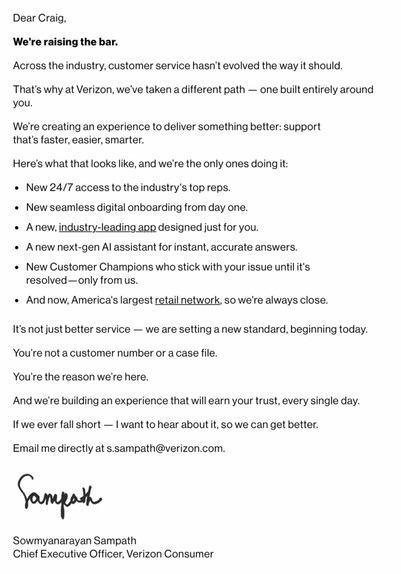
So Verizon’s new CEO sent me an email…

Where shall I begin?

First — You can’t simply reply. I get it. It’s hard to have a mailbox on the Internet these days. So many bounces, to deal with (I’m serious.)

Second — So when you go to drag-select, copy and paste that “[email protected]” email address, you discover it’s not what it seems.

Pasting into your email client’s “To” field, you actually create a list of multiple recipients: The first recipient is “s”, then the second is “sampath”, etc—none of which are the email address you meant to copy and paste. So you have to type it into your email client. Not a big deal, but probably enough to stop most people. If they really cared, they’d just give us an

<a href="mailto:[email protected]">[email protected]</a>

and let us just click or touch it, et voila!

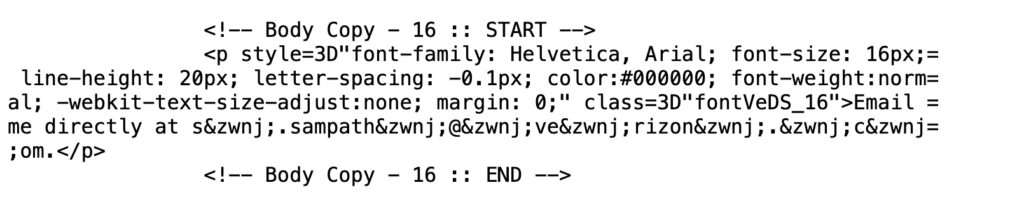
Okay, but why can’t we copy and paste? Because in the HTML source in their email, it’s actually:

If you can read HTML, you see there are HTML entities jammed in various places in that email address. I had to lookup the entity &zwnj; — that’s a Zero Width Non-Joining space. Meaning it’s not visible (“zero-width”) and it’s job is to keep whatever is left and right from “joining”… in the sense that complex characters can join to make a glyph— For example: An ‘a’ and ‘e’ can join to make the single character ‘æ’ if your language supports that. (But, of course, English does not have any joining characters at all.) I’m confident this is just an artifact of their bulk-email-sending composer software; it’s common for such things to “defend” an email address in the middle of text from harvesting looking for emails. So this wasn’t maliciousness on Verizon’s part.

Third — …but it’s ironic that, in a message that contains, “It’s not just better service — we are setting a new standard, beginning today,” I have to flip between windows as I retype that email address.

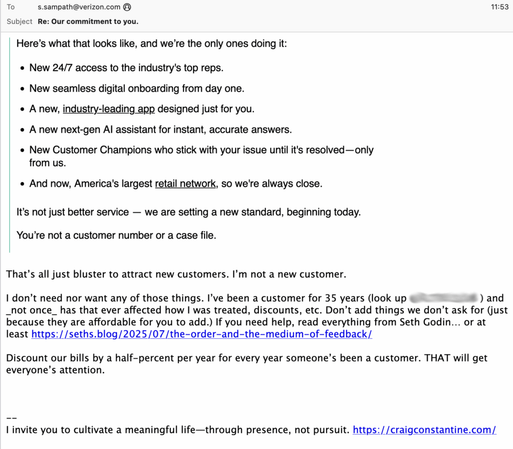
Fourth — Because I’m a level-39 nerd wizard, I do reply to these things. (I mean, I start a new email message addressed to that email address.) And because we (said wizards) are quick to anger and regular Internet users (ie, Sampath) are tasty with ketchup, I send things like this…

I’ll followup when I get my 17.5%.

ɕ

#InternetTech #Snark #Verizon

Long live the indie web, indeed

So, here’s something of a little manifesto or rallying cry:

  • If you only spend your time on Facebook/Twitter/Medium then stream in, stream out – you’re going to get what you ask for. A fleeting set of stories loosely bound.
  • So, spend time in the corners of the web. Subscribe to some newsletters. Bookmark some forums and blogs in your browser and show up regularly. It’s hard, there’s no stream. But you’ll start to find the mom & pop internet not the shopping mall internet.
  • Dabble with your own space. Dabble with your own voice. Own your own platform.
  • But don’t stop there – own your own distribution too! Build a newsletter. Build a messenger bot to alert people to new posts. Build your own stream. Create a shared delusion of showing up regularly.

Long live the indie web.

~ Tom Critchlow, from Indie Blogging & Distribution

slip:4utoii1.

I was a frequent user of the Internet before the web. Today is vastly better than then. The web straight up kicks ass, and the web is not just alive and well, it’s flourishing. If you aren’t seeing great content, you simply haven’t yet figured out where to look for it. Go look. (Right after you go read the above, of course.)

ɕ

#InternetTech #TheOpenWeb #TomCritchlow

Craig Constantine

Caution: Blogging. Randomly.

Craig Constantine

It makes no sense

Whenever anyone tells me that some platform is great, I always nod and think to myself … for now. For now.

~ Bob Sassone, from Bluesky is not going to save you

slip:4uwobu1.

I don’t understand why no one else is saying this: Until I see anyone else running separate federation instances, it’s still just another monolithic platform. This again? If the AT Protocol (what Bluesky is built upon) is really great, how do I run my own instance to join the federation?

If you see only one instance, then it’s a platform. When you see multiple instances talking to each other, then it’s a protocol.

ɕ

#ActivityPubProtocol #ATProtocol #Bluesky #BobSassone #InternetTech #Mastodon

Craig Constantine

Caution: Blogging. Randomly.

Craig Constantine

Publishing while maintaining perspective

This is perhaps the greatest conundrum of our current technological era: the desperate need to connect with one another, because it is our only hope of survival; combined with the fact that nearly all the means of connection available to us are deeply—possibly irredeemably—fucked. Syndication, as I am currently experimenting with it, is then an effort to try and navigate that terrain, to find some productive way to play in the outskirts, to let the work out into the world while (hopefully) minimizing the misery that is reflected back.

~ Mandy Brown, from A peasant woodland

slip:4uaowi9.

Yes, to everything from Brown (and not just this particular piece.) Beautiful thoughts therein around why one should “publish own site, syndicate elsewhere (POSSE)”—my methodology since the beginning.

Unfortunately, the Internet went from “publishing your own stuff is difficult”, straight to “it’s easy to publish on platforms other people control.” To this day, it is still quite difficult to get your own domain name and begin publishing in a way that you control your own content. Worse, we went from people discovered and read your stuff (back in the “publishing your own stuff is difficult” era) to the now where no one can find or read your stuff regardless where you publish it (unless you pay money to the platform brunch-lords.)

Fortunately, if you have a little bit of time and a little bit of curiosity, you can still find everything that people are publishing.

ɕ

#InternetTech #MandyBrown #PublishingPlatforms #RSS #SocialNetworks

Craig Constantine

Caution: Blogging. Randomly.

Craig Constantine
Cardiff schools turn PSTN switch-off into opportunity for improved agility

Civic authorities responsible for education in Welsh capital look to take advantage of switch-off of UK’s analogue copper-based comms infrastructure to drive cloud-based digital transformation of schools’ communications systems

ComputerWeekly.com
Project Gigabit continues pace with £190m broadband build contracts

UK network provider secures two contracts under UK government’s £5bn gigabit broadband scheme to connect around 108,000 hard-to-reach premises in East and North Yorkshire and Lincolnshire

ComputerWeekly.com
Google's cookie conundrum: What comes next? | Computer Weekly

Google's revised approach to third-party cookies shouldn't come as a surprise, and may also be welcome

ComputerWeekly.com
Dublin confirmed as world’s third-largest hyperscale datacentre hub

Data from Synergy Research Group confirms the majority of the world’s 20 biggest hyperscale datacentre hubs are in the US, but Europe is holding its own with Dublin

ComputerWeekly.com
'Black swans' take flight: the legal ramifications of the CrowdStrike incident   | Computer Weekly

Public admission of failure takes courage. In trying to limit reputational damage to his cybersecurity company, CrowdStrike president Michael Sentonas certainly demonstrated chutzpah by accepting an award for the Most Epic Fail at the recent Pwnie Awards awards. The tactic seems to have worked: Sentonas was cheered by those attending the DEF CON event for publicly owning his company’s mistakes.   "Definitely not the award to be proud of receiving," Sentonas told delegates in his acceptance speech. "I think the team was surprised when I said straight away that I'd come and get it because we got this horribly wrong. We've said that a number of different times and it's super important to own it when you do things well. It's super important to own it when you do things horribly wrong, which we did in this case.”       But beyond this astute PR move, the legacy of the CrowdStrike incident is deadly serious. On 19 July, the world experienced one of the biggest ever IT outages when a faulty software update to Crowdstrike’s vulnerability scanner, Falcon Sensor, led 8.5 million systems running Microsoft Windows to crash. Globally, IT infrastructure malfunctioned, creating havoc and financial loss for individuals and organisations.   The most serious such event since the NotPetya cyberattack in 2022, its impact was enormous: the faulty update caused global computer outages that disrupted air travel, banking, broadcasting, hotels, hospitals and other vital services. Insured losses are estimated to be more than $10 billion; actual losses may be far greater with the absence of cover affecting thousands of SME businesses. 

ComputerWeekly.com