'A world from a sheet of paper' - SMRI's #InternationalDayOfMathematics public lecture by Tadashi Tokieda will be on Fri 13 March

Starting from a sheet of paper, explore magic tricks and geometry in this lecture filled with table-top demonstrations

🔗 https://events.humanitix.com/international-day-of-mathematics-pi-day-public-lecture-by-tadashi-tokieda

🧮

'A world from a sheet of paper' International Day of Mathematics Public Lecture by Tadashi Tokieda

This public lecture is hosted by the Sydney Mathematical Research Institute as part of our program for International Day of Mathematics

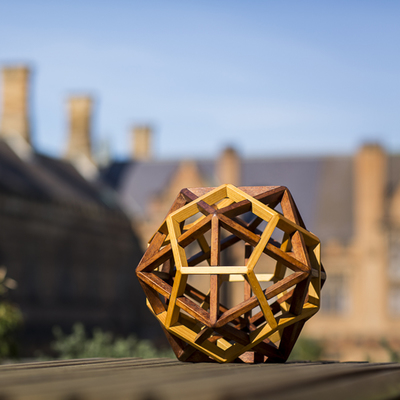
This beautiful crocheted Richmond minimal surface - crafted by Hanne Kekkonen (who we had the honour to feature already: 📖 https://hermathsstory.eu/hanne-kekkonen/) and featured in [📄] - is a perfect example of how mathematics and arts intertwine.

And what better occasion to celebrate this than Pi Day - the International Day of Mathematics? This year’s theme “Mathematics, Art, and Creativity” highlights how maths shapes the world around us in unexpected and artistic ways.

Want to explore more? Here are five fascinating reads on π, where we rate the maths proficiency level from 🟡 (suitable for everyone) to 🔴 (for maths geeks):

🟡 Pi, explained! https://www.snexplores.org/article/lets-learn-about-pi
What is pi, and why does it pop up everywhere? A beginner-friendly dive into the world’s most famous irrational number.

🟠 When maths meets arts https://www.snexplores.org/article/math-is-muse-for-these-artists
From sculptures to paintings - how artists use mathematical ideas to create stunning works

🟠 How pi took over the world https://www.popularmechanics.com/science/math/g26630324/what-is-pi/
A whirlwind history of pi, from ancient times to cutting-edge research.

🟠 7 maths facts that will blow your mind https://www.newscientist.com/article/2418890-these-7-mathematical-facts-will-blow-your-mind/
Pi is just the beginning - get ready for some mind-bending maths!

🔴 Pi and... string theory?! https://www.scientificamerican.com/article/string-theorists-accidentally-find-a-new-formula-for-pi/
Physicists accidentally discovered a new formula for pi - while working on the universe’s deepest mysteries.

Maths is everywhere - sometimes even in yarn! 🧶💙 #PiDay #InternationalDayOfMathematics #IDM #MathsArt #WomenInMaths #HerMathsStory

[📄] Kekkonen, H. (2024). Crocheting Bour’s Minimal Surfaces. Mathematical Intelligencer, 46(4), 306-312. https://doi.org/10.1007/s00283-023-10314-1
Hanne Kekkonen

Born in Helsinki, Finland • Birth year 1987 • Studied Mathematics at University of Helsinki in Finland • Highest Degree PhD in Mathematics • Lives in Delft, Netherlands • Occupation Assistant Professor I was definitely not one of those scientists who showed exceptional talent from a very young age. As a child I was filled with endless curiosity about everything, but sitting still in front of a desk was not one of my strongest skills. In fact, I was rather bad at school, often arriving late because I had found a frog or wandered off after a hedgehog. I did my very best to study for exams but this did not seem to translate to good grades. I kept trying and by the time I started secondary school I finally got the hang of it. I was warned that when you move from secondary school to high school, and later from high school to university, classes become more difficult but I never really experienced this because I had always had to study for the exams. I had also learned that if I couldn't solve a problem it just meant that I had to try harder, not that the problem was too hard. I only realised later how lucky I was to have learned proper studying techniques already as a kid. I like knowing that mathematics has many applications but I have always been mostly interested in the theoretical parts and loved the pureness of mathematics. I never had anything against mathematics (other than mental arithmetic which I'm still very bad at) but I only really got interested in it at high school. At high school maths problems are like puzzles you have to solve using given rules and tricks. In university the emphasis changed and the weight was more on understanding where those rules and tricks come from and why they are true. I like knowing that mathematics has many applications but I have always been mostly interested in the theoretical parts and loved the pureness of mathematics. It is the only field where questions have indisputably correct answers and where the trueness of a statement can properly be proved. I have to admit that I didn't really think too much about what I would do after I got my Master's degree. Throughout my studies I was told that there was a shortage of skilled mathematicians at the job market but there seemed to be a big gap between what I had learned at the university and what was needed in the real world. Thankfully, my Master's degree advisor suggested that I should apply for one of the open PhD positions in the Inverse Problems group at the University of Helsinki, where I was doing my Master’s degree. Starting the PhD was the biggest shock in my studies. Even though the exercises at university were much longer and more complicated than the ones at high school, they always had a clear answer, even if I couldn't find it. But when I started to do research, I had to get used to the idea that no one knew the answers to many problems I encountered or even if they could be solved. Also, instead of following well-structured courses, where I usually had at least some idea on what was going on, I was now attending several seminars about topics I had hardly even heard of. I was feeling really uncertain about my skills and progress. I was told by several more senior members of my research group that they also used to feel like that and it would get better, but this was only somewhat reassuring. I think the key point they forgot to make was that you won't stop feeling uncertain because one day you learn to understand all those talks, but because you just get used to the idea that there are so many research topics that you can't possibly understand them all.  I really like showing people how mathematics is so much more than just the arithmetic they learned to hate at school. During my PhD I was part of a great research group with supporting advisors and I really enjoyed working at the university. I decided quite early on that I wanted to stay in academia and so after I finished my PhD I moved to the UK for a postdoc position, first in Warwick and then in Cambridge. As a postdoc I had to learn to work even more independently than as a PhD student and how to combat the ever-present imposter syndrome. I also started to do some outreach, giving talks to the general public and school students. I really like showing people how mathematics is so much more than just the arithmetic they learned to hate at school. Nowadays I work as an assistant professor at Delft University of Technology. My current job is a nice blend of research and teaching, and it also offers me possibilities to do outreach. I'm happy if seeing a woman mathematician, who is excited about the subject, makes some little girl consider a science career as a real possibility.

Happy #InternationalDayofMathematics!

Mathematics isn't just about equations; it involves discovering patterns, exploring possibilities, and unleashing creativity. It's the foundation for many AI techniques, providing the theoretical underpinnings and tools for AI systems.

Techniques like regression, classification, clustering, and dimensionality reduction are rooted in math. Concepts like Bayes' theorem, Markov processes, and optimization algorithms form the backbone of many ML algorithms.

Today, we celebrate the beauty of numbers and equations that paved the way for the endless possibilities AI brings.

Check out Orca-Math, Microsoft research showcasing a specialized language model outperforming larger ones in multi-step math problem solving. It highlights the potential of feedback to improve language models: https://msft.it/6011cZfu9

Orca-Math: Demonstrating the potential of SLMs with model specialization

Microsoft’s Orca-Math, a specialized small language model, outperforms much larger models in solving math problems that require multi-step reasoning and shows the potential of using feedback to improve language models. Learn more.

Microsoft Research

The International Day of #Mathematics

Pi (π) Day 2024

#InternationalDayofMathematics #piday #piday2024

Years ago in college some friends and I came to an important realization. Perhaps Mastodon is a place to find the rare few who can appreciate it.

Why did the chicken cross the road?

Because <chicken> cross <road> is perfectly normal to both chicken and road.

Math solves all of life's questions.

#InternationalDayOfMathematics #IDM314 #math #puns #DadJokes

Of course 7 8 9.

Everyone should have 3² meals a day!

#InternationalDayOfMathematics #IDM314

"Broti loves math!" - DYLAN GELULA, phillie phanatic//quadratic formula//road trip report 2 with CHARLIE BARDEY!, Lecture Hall #lecturehall #lecturehallpodcast #InternationalDayofMathematics #DylanGelula
"I don't know how to do the math on this one!" - SHERI FINK, Playing God, Radiolab #Radiolab #InternationalDayofMathematics #SheriFink
"He's good at doing the math!" - TONY GILROY, Andor Q&A - Tony Gilroy - (S1 eps 5-9 ), The Q&A with Jeff Goldsmith #InternationalDayofMathematics #TonyGilroy