
@mattslocombe @cogsci @cognition

Thank you! I had a blast talking about #AI, #cognition, #analogy, #OpenWorldLearning #InteractiveTaskLearning. The forum was the very BEST: very insightful students & delightful psychologists.

Honestly, I learned quite a bit from the discussions. Amidst the world wide storm of #AI and #ML, sometimes we forget why #HumanIntelligence is so special.

@SeeTedTalk @melaniemitchell

Interesting - and I can see that.

So what would be a problem that is not our own invention?

We are doing #language #NLP #ELP research in the context of #InteractiveTaskLearning #ITL or how can humans and machines learn from each other through natural interactions?

Do you have recommendations on what we could be studying?
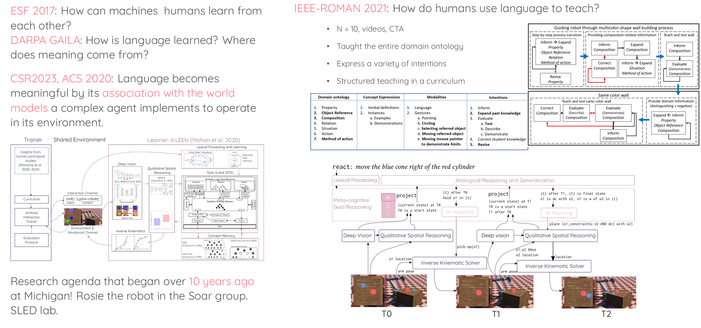
#CollaborativeHumanAISystems 3: #ITL, #InteractiveTaskLearning, #HumanRobotInteraction - how can complex #agents learn from humans? #language is large part of that puzzle.

Focus on #ELP, #EmbodiedLanguageProcessing - what does it mean to 'understand' language for communication, collaboration, & teaching.

Not #InformationRetrieval #IR which #NLP research studies.

#IEEE #ROMAN 2021: https://arxiv.org/abs/2102.06755
#ACS 2020: https://arxiv.org/abs/2006.01962
#ACS 2014: https://arxiv.org/abs/1604.02509

Unpacking Human Teachers' Intentions For Natural Interactive Task Learning

Interactive Task Learning (ITL) is an emerging research agenda that studies the design of complex intelligent robots that can acquire new knowledge through natural human teacher-robot learner interactions. ITL methods are particularly useful for designing intelligent robots whose behavior can be adapted by humans collaborating with them. Various research communities are contributing methods for ITL and a large subset of this research is \emph{robot-centered} with a focus on developing algorithms that can learn online, quickly. This paper studies the ITL problem from a \emph{human-centered} perspective to provide guidance for robot design so that human teachers can naturally teach ITL robots. In this paper, we present 1) a qualitative bidirectional analysis of an interactive teaching study (N=10) through which we characterize various aspects of actions intended and executed by human teachers when teaching a robot; 2) an in-depth discussion of the teaching approach employed by two participants to understand the need for personal adaptation to individual teaching styles; and 3) requirements for ITL robot design based on our analyses and informed by a computational theory of collaborative interactions, SharedPlans.

arXiv.org