 O'Sullivan Lab
We have recently found that #NK cell effector function is sexually dimorphic. How? Female NK cells in mice and human express higher levels of the epigenetic regulator #UTX, which escapes X-linked inactivation. UTX regulates the chromatin accessibility of #IFNg and #Csf2, making female NK cells more potent in response to #cytokines and #viral infection.
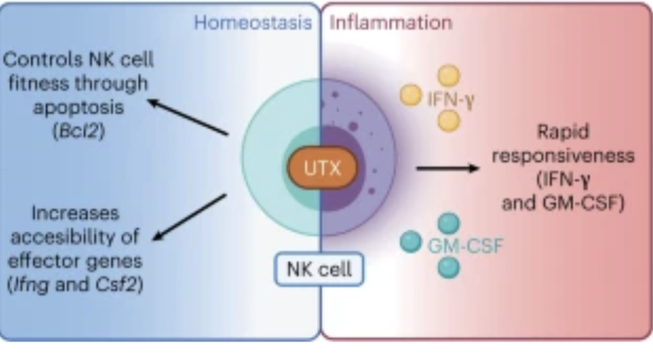

The X-linked epigenetic regulator UTX controls NK cell-intrinsic sex differences - Nature Immunology
Cheng et al. demonstrate that an extra copy of the X-linked epigenetic regulator UTX in females increases natural killer (NK) cell effector function. As NK cells are critical for antiviral immunity, this may explain decreased severity of viral infections in females compared to males.
 Carolyn King