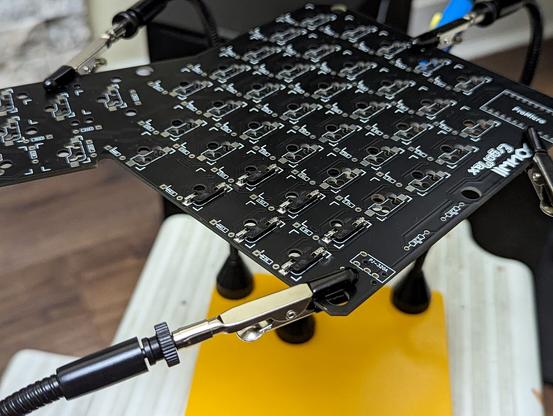
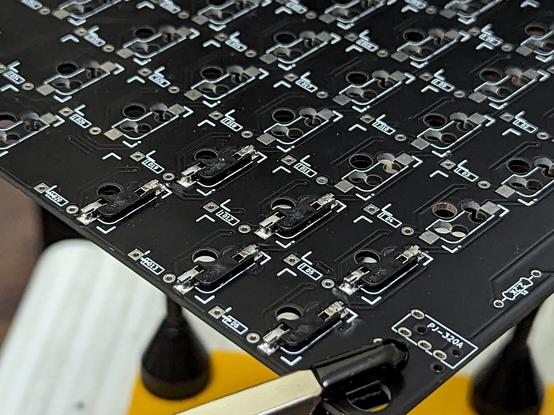
Finally started soldering the key switch sockets on the printed circuit boards (PCBs). Was quicker and easier than I was expecting. Soldered about 20 sockets for now, showing only 6 in the picture. 'Third Hand' or 'Helping Hands' are proving to be very helpful, definitely recommended.

Enjoying it so far.

#MechanicalKeyboard #ErgonomicKeyboard #ErgoMax #Kailh #HotSwapSockets #Electronics #Soldering #DIY

Quick-Swap Socket For Stemma QT Experiments

[kmatch98] shares a quick hack with us over at Hackaday.io - a 3D-printed socket for Adafruit Stemma QT-based I2C modules. Since Adafruit has standardized the dimensions for their Stemma QT boards, it's possible to make a socket that would fit many different sensors at once, where the board just slides in.

This reminds us of sci-fi datadisks, or, thinking of something more grounded in reality, game console cartridges - except that here, the fun you're having is from exploring all the different devices you can get to speak I2C. To make such a socket, you only need to 3D-print two plastic parts, put a JST-SH plug between them, and screw them together - if you want to modify these to your liking, .f3d sources are available. Now you no longer have to use fingernails or tin snips to take the JST-SH plug out of your modules!

[kmatch98] is no stranger to sharing his projects on Hackaday.io with us, and we've covered some of his larger projects before, like this CircuitPython-powered cyber-duck cyberdeck, or the 3D-printable Maypole braider machine!

#mischacks #hotswapsockets #i2c #jst #stemma #stemmaqt

Quick-Swap Socket For Stemma QT Experiments

[kmatch98] shares a quick hack with us over at Hackaday.io – a 3D-printed socket for Adafruit Stemma QT-based I2C modules. Since Adafruit has standardized the dimensions for their Stemma QT b…

Hackaday

Snap-Together Macropad Does It Without Solder

Maybe we're biased, but we think everyone has a use for a macropad. It's just a matter of time before a highly personalized set of speed controls starts to sound like a great time-saving device to have around.

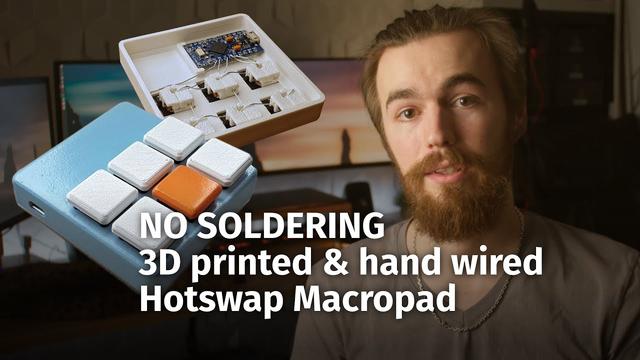
Trouble is, macropads are usually kind of expensive to buy outright, and not everyone feels comfortable building keyboards. Okay, so what if you didn't even have to solder anything? That's the idea behind [Jan Lunge]'s hand-wired macropad.

You will still want to open a window for ventilation if you build this one, because this macropad requires a lot of 3D printing. What it doesn't require is glue or screws, because everything snaps together.

Of course, the star of this build is [Jan]'s hot swap socket design. We especially love the little clip that holds the column wires in place while also providing a spacer between those and the row wires. Everything is connected up to a Pro Micro with non-insulated wire and held in place with bends at the ends and the magic of tension. Be sure to check out the build video after the break.

Thirsty for more than a six pack of switches? This design is easy to scale up until you run out of microcontroller inputs. At that point, you might want to add screens to keep track of all your macros.

Thanks for the tip, [BaldPower]!

#arduinohacks #peripheralshacks #3dprintedeverything #arduino #hotswap #hotswapsockets #macropad

Snap-Together Macropad Does It Without Solder

Maybe we’re biased, but we think everyone has a use for a macropad. It’s just a matter of time before a highly personalized set of speed controls starts to sound like a great time-savin…

Hackaday

Printable Hot-Swap Sockets Make Keyboard Building Even Cooler

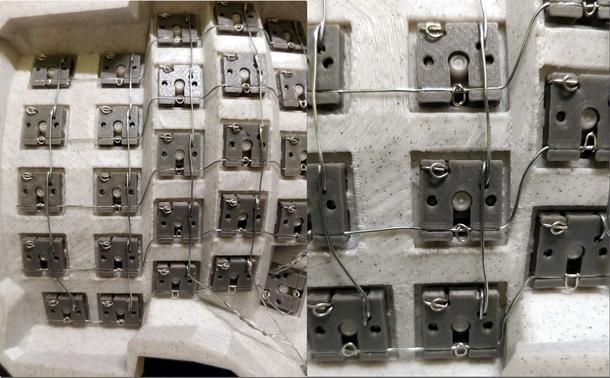
Okay, so you want to build a keyboard -- something crazy-curvy like the dactyl or dactyl manuform. The kind of keyboard that has to be hand-wired, because key wells and rigid PCBs do not play well together. You want to build this keyboard, but all that hand-wiring would mean that you can't easily swap switches later. And it will means hours and hours of fiddly soldering. What do you do? You could buy or design your own switch PCBs, but again, those are rigid and space is limited inside of most of these designs.

If you're [stingray127], you trade those hours of soldering for a week of designing and printing some sweet little hot-swap sockets with wire guides. This is version four, which is easier to print than earlier versions. They are designed to use through-hole diodes and 24 AWG solid-core wire and give a tight fit. Can't figure out how to use them? [stingray127] has a wiring guide with plenty of pictures.

We really like this idea, and it makes the end result feel more like a totally hand-wired keyboard than individual switch PCBs would As you can see, it involves little solder. The only downside is that you can only swap a few switches at a time, otherwise the matrix might fall apart. But that's hardly even a downside.

Just want to make a macropad? You can easily print your way out of using a PCB for those, too.

Via KBD and r/mk

#peripheralshacks #hotswap #hotswapsockets #mechanicalkeyboard

Printable Hot-Swap Sockets Make Keyboard Building Even Cooler

Okay, so you want to build a keyboard — something crazy-curvy like the dactyl or dactyl manuform. The kind of keyboard that has to be hand-wired, because key wells and rigid PCBs do not play …

Hackaday