https://www.scinexx.de/news/kosmos/erster-exoplanet-mit-doppeltem-schweif/
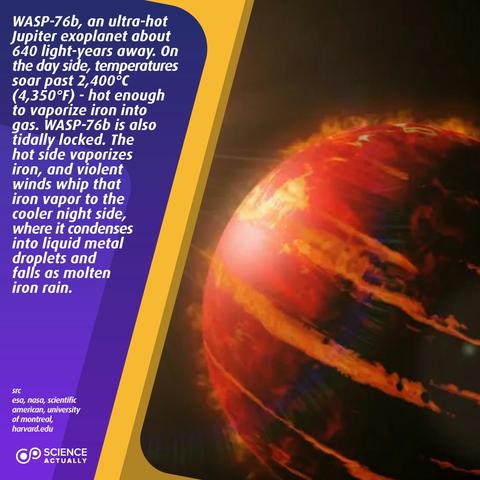
WASP-76b, an ultra-hot Jupiter exoplanet about 640 light-years away. On the day side, temperatures soar past 2,400°C (4,350°F) - hot enough to vaporize iron into gas. WASP-76b is also tidally locked. The hot side vaporizes iron, and violent winds whip that iron vapor to the cooler night side, where it condenses into liquid metal droplets and falls as molten iron rain.
#science #sciencefacts #exoplanet #hotjupiter #wasp76b #ironrain #metalrain
#astronomy #exoplanet #HotJupiter
An article published in the journal "Nature" reports a study on the exoplanet cataloged as TIC 241249530 b which labels it as a progenitor of a hot Jupiter. A team of researchers used various telescopes to study TIC 241249530 b and try to understand its characteristics and evolution. This gas giant has an extremely eccentric orbit, meaning it's extremely elongated, which could change greatly as time passes.
https://english.tachyonbeam.com/2024/07/18/possible-progenitor-of-a-hot-jupiter-discovered/
#astronomy #exoplanets #HotJupiter #Wasp17b #JWST #quartz
An article published in "The Astrophysical Journal Letters" reports a study of the exoplanet WASP-17 b that includes the detection of quartz in this hot Jupiter's atmosphere. A team of researchers used the James Webb Space Telescope to detect the subtle effects of quartz crystals, nanoparticles dispersed in the very hot atmosphere of WASP-17 b, which received the official name Ditsö̀ in early 2020.