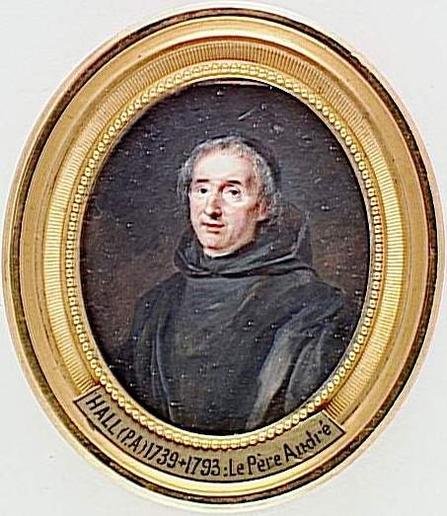
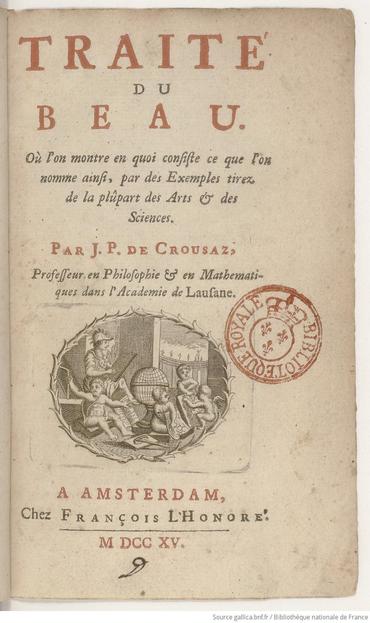
Yves-Marie André's (1675–1764) [https://en.wikipedia.org/wiki/Yves_Marie_André] ‘Essay on Beauty’ (‘Essai sur le beau’, 1741) was an important work of 18th-century aesthetics. In the article on beauty in the 2nd volume (1752) of the ‘Encylopédie’, Denis Diderot praised André's system as the best he knew, elevating it above the work of Plato, Augustine, Wolff, Crousaz, Shaftesbury.

In 2010, I released a #CreativeCommons-licensed annotated English translation [https://archive.org/details/EssayOnBeauty]. I have just made an update: the PDF is now an accessible #TaggedPDF.

(The LaTeX tagging system is still under development [https://latex3.github.io/tagging-project/], but I have been adapting my LaTeX styles to be tagging-compatible.)

Although I was a much less practised typographer 16 years ago, I have left the overall design of ‘Essay on Beauty’ unchanged, contenting myself with minor improvements offered by an updated version of the Baskervald font, ensuring that line-end hyphenations follow the OUP standard, and a few other localized improvements.
#accessibility #OpenAccess #aesthetics #HistPhil

Yves Marie André - Wikipedia

In retrospect, modern aesthetics is seen to have emerged at the end of the 17th and in the 18th centuries, with the term ‘aesthetic’ being coined by Alexander Gottlieb Baumgarten (1714–62) in 1735 from the Greek aisthētikos [αἰσθητικός].

Many of the early thinkers considered mathematical beauty to be an archetypical form of beauty and integrated it into their theories.

For example, Jean-Pierre de Crousaz (1663–1750) and Francis Hutcheson (1694–1746) both analysed beauty in terms of ‘unity (or uniformity) amidst variety’. Hutcheson thought that this explained why regular polyhedra were more beautiful than irregular ones, and that Archimedes' celebrated theorem

‘The ratios of volumes of a cylinder, its inscribed sphere, and a cone of equal base and height are 3 ∶ 2 ∶ 1’

was more beautiful than the less precise

‘A cylinder has greater volume than an inscribed sphere, which in turn has greater volume than a cone of equal base and height’

because they had equal variety (since they applied to the same objects), but the first theorem had greater unity.

1/3

#aesthetics #HistPhil #Baumgarten #Crousaz #Hutcheson #UnityAmidstVariety #UniformityAmidstVariety #MathematicalBeauty

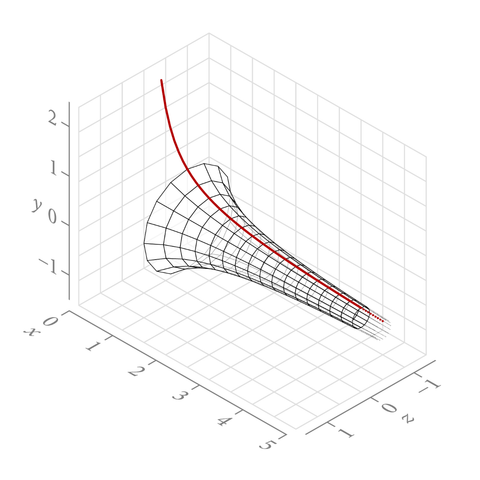
Evangelista Torricelli’s (1608–47) solid is defined by rotating the hyperbola $y = 1/x$ about the $x$ axis and truncating it at $x=1$ (see attached image).

It has infinite length and infinite surface area but finite volume.

This counter-intuitive discovery caused philosophical disturbance, for it seemed to violate the distinction between finite and infinite.

Torricelli, foreseeing the scrutiny to which his work would be subjected, took the precaution of preempting some criticisms by supplying two different proofs, one by ‘indivisibles’, one by exhaustion.

But René Descartes (1596–1650) seems not to have been provoked to any philosophical objections and thought that Torricelli's discovery was beautiful.

Henry Needler (fl. 1690–1718), a perhaps slightly obscure figure who foreshadowed 18th-century discussions of the sublime, seemed to be impressed by the solid's ‘Grandeur and Magnificence’ and thought that it would ‘afford the greatest Delight and Satisfaction to curious Minds’.

(Today, Torricelli's solid is also called ‘Gabriel's horn’ or ‘Torricelli's trumpet’.)

1/2

#infinite #Descartes #HistMath #HistPhil #Torricelli #MathematicalBeauty #sublime #aesthetics

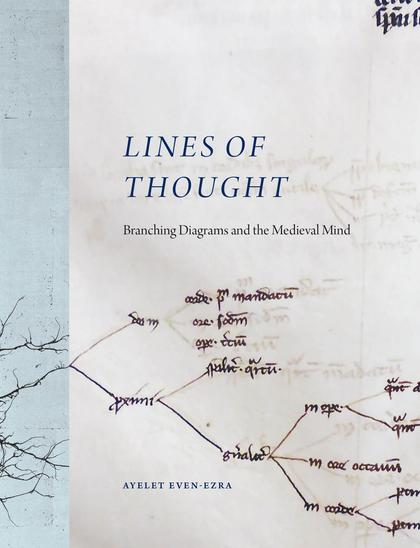
I have been reading Ayelet Even-Ezra's book ‘Lines of Thought: Branching Diagrams and the Medieval Mind’ [https://press.uchicago.edu/ucp/books/book/chicago/L/bo63098990.html] (cover attached), about the use of ‘tree’ diagrams for organizing thought in manuscripts of the middle ages.

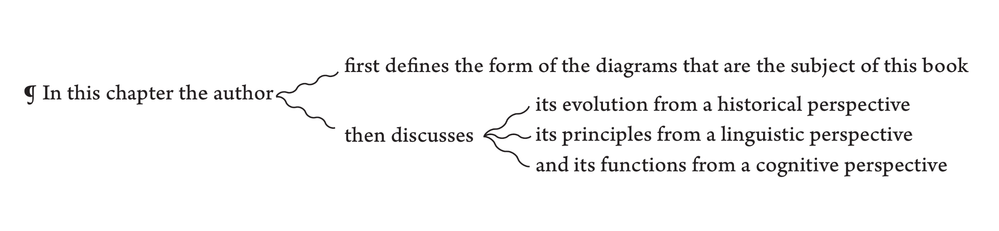
As well as being a fascinating and well-written study, it is typographically very impressive. One interesting feature is that the author uses the very device she studies to summarize or to classify. E.g. the first page of chapter 1 contains a summary in the form of the tree in the second attached image.

1/2

#history #typography #medieval #manuscripts #HistPhil

Big update to the annotated edition of G.H. Hardy's ‘A Mathematician's Apology’: the PDF is now *tagged* (plus various minor improvements).

(A #TaggedPDF contains extra semantic information to assist screen-reading software etc.)

The new version is available (#OpenAccess as always) at https://archive.org/details/hardy_annotated

The LaTeX tagging system is still under development [https://latex3.github.io/tagging-project/], but I have been making progress in adapting my LaTeX styles to be tagging-compatible.

For the annotated ‘Apology’, I also had to re-implement a subset of the functionality of the "manyfoot" package (which is currently not tagging-compatible), because there are two different kinds of footnotes in the annotated ‘Apology’. (Hardy's original footnotes and the annotations.)

Although the PDF passes VeraPDF validation, there may of course be mistakes in the tagging. Feedback, especially from users of screen readers, would be much appreciated, especially because I now hope to add tags to ‘Form & Number: A History of Mathematical Beauty’ [https://archive.org/details/cain_formandnumber_ebook_large].

#GHHardy #HistPhil #Mathematics #MathematicalBeauty #TeXLaTeX #Accessibility

An Annotated Mathematician's Apology : G. H. Hardy : Free Download, Borrow, and Streaming : Internet Archive

This is an annotated edition of G. H. Hardy’s A Mathematician’s Apology and ‘Mathematics in war-time’, including three essays by the annotator: the...

Internet Archive

‘Bertrand Russell & Trinity: A college controversy of the last war’ is a pamphlet written by G.H. Hardy in 1942, giving an account of the dismissal of Russell from his Trinity College lectureship in 1916 following his criminal conviction for anti-war political activity. (Hardy was at the time a fellow of Trinity and opposed Russell's ouster.)

I have uploaded a re-typeset version of Hardy's pamphlet to the Internet Archive [https://archive.org/details/hardy_russellandtrinity].

Creating this version was an exercise for me to learn how to (start to) adapt my LaTeX styles to the new interfaces created by the ongoing LaTeX tagging project [https://latex3.github.io/tagging-project/]. (A #TaggedPDF contains supplementary information to assist screen reading software, data extraction, etc.)

Also, Hardy's work is in the public domain; there seemed to be no downloadable ebook version of this pamphlet; and I thought that it would be a useful companion to the ‘Annotated Mathematician's Apology’ [https://archive.org/details/hardy_annotated].

I have made available the #LuaLaTeX source code on #Codeberg, in case anyone is interested in how the style was created: https://codeberg.org/ajcain/hardy_russellandtrinity

#GHHardy #BertrandRussell #WorldWarI #HistPhil #TeXLaTeX #Accessibility

Bertrand Russell & Trinity: A college controversy of the last war : G. H. Hardy : Free Download, Borrow, and Streaming : Internet Archive

A re-typeset version of a pamphlet printed for G. H. Hardy in 1942 by Cambridge University Press, giving an account of the circumstances of Bertrand Russell's...

Internet Archive