 ICHEP 2026 - Official
We’re happy to highlight Quantum Design Latin America as a sponsor of #ICHEP2026!
Their work in advanced scientific instrumentation supports research across physics and materials science in the region.

We’re happy to highlight Quantum Design Latin America as a sponsor of #ICHEP2026!
Their work in advanced scientific instrumentation supports research across physics and materials science in the region.
ICHEP 2026 is built on more than great physics - it’s built on community.
Please take a moment to review our Code of Conduct and help us create a welcoming, respectful space for everyone:
🛡️ Integrity: Intellectual honesty in every presentation.
🤝 Respect: Tact and courtesy in every interaction.
🌍 Diversity: Fostering equality across all nationalities and backgrounds.

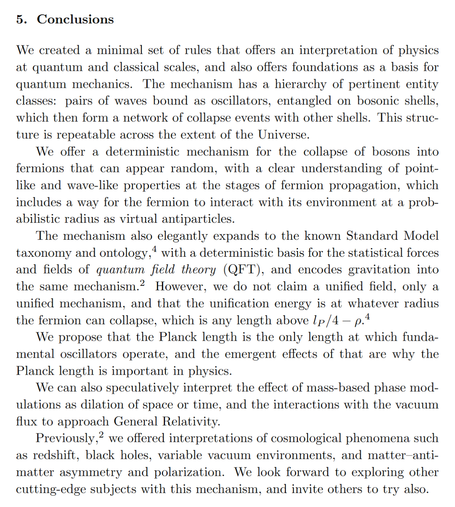
I edited the paper. It's clearer in a few ways.
If there's anything that can be taken away from this, it's a prediction:
"However, we do not claim a unified field, only a unified mechanism, and that the unification energy is at whatever radius
the fermion can collapse, which is any length above Planck-length * (0.25 − 4e-18)"

This paper reports on the design and construction of a chamber for the muon identifier detector (MID) of the ALICE 3 upgrade project. The chamber consists of two sensitive layers separated by a 1 cm air gap. Each layer holds 24 scintillator bars ($1\times4\times100$ cm$^3$) manufactured by FNAL-NICADD. The bars are equipped with Kuraray wavelength shifting fibers and the readout is provided by a silicon photomultiplier from Hamamatsu. The bars in the second layer are orthogonal to the bars in the first layer, thus providing an overlapping cell size of 4$\times$4 cm$^{2}$. The bar assembly as well as the design of the mechanical structure is described. The design of the chamber is close to that considered in the ALICE 3 letter of intent. The chamber was tested at the CERN T10 beamline using 3 GeV/$c$ pion-enriched and muon beams. The chamber was placed behind an iron absorber, with different absorber lengths considered in the test. The muon identification is performed using a Machine Learning algorithm, which was trained and tested using muon (signal) and pion (background) data (50% of the available statistics). The trained ML algorithm was applied to muon data, yielding a muon efficiency above 99% for the OR condition (detection in either layer 1 or 2). The implementation in the pion-beam data gives the fake-muon efficiency as a function of the absorber length that is well described by an exponential function with a slope parameter of 18.79 cm. The next steps towards finalizing the optimization are outlined.

At low temperatures $T$ where $1/T=β\gg1$ the naïve implementation of determinant quantum Monte Carlo (DQMC) methods suffers from loss of precision and numerical instabilities when evaluating the fermion determinant. This instability propagates into the calculation of observables that rely on the evaluation of the inverse of the fermion matrix, or the Greens function. For DQMC methods that rely on the Hamiltonian Monte Carlo (HMC) algorithm, an additional complication comes from evaluating the force terms required for integrating Hamilton's equations of motion, since here loss of precision and numerical instabilities are also prevalent. We show how to address all these issues using various choices of matrix decompositions, allowing us to simulate at $β\gtrsim 90$, which corresponds to room temperature for graphene structures. Furthermore, our implementation has numerical costs that scale similarly to the naïve implementation, namely as $\mathcal{O}(N_x^3N_t)$, where $N_x$ ($N_t$) is the number of spatial (temporal) sites.

We present a quantum-mechanical calculation of positron channeling radiation in a planar harmonic potential, explicitly accounting for the interference between transition amplitudes from different transverse energy levels. Because the planar channel potential for positrons in diamond~(110) is well approximated by a parabola, the transverse spectrum is equidistant, $\varepsilon_n = Ω(n+\tfrac{1}{2})$, and all $n \to n{-}j$ transitions radiate at the same Doppler-shifted frequency. The entry of the positron into the crystal under the sudden approximation creates a Glauber coherent state with population amplitudes $c_n$. Phase synchronization between the $c_n$ and the dipole matrix elements ensures that all occupied levels contribute constructively to the radiation amplitude, giving an intensity $I_{\rm coh} \propto |A_j|^2$ that exceeds the incoherent (Zhevago--Kumakhov) result by a factor $\mathcal{G} = 12\text{--}31$ for positron energies of $4\text{--}14$~GeV in diamond~(110). Numerical results agree with the experimental peak positions of Avakyan \emph{et al.}~\cite{Avakyan1982}. The enhancement is unique to positrons because their nearly harmonic channel potential is not replicated for electrons. We propose a decisive experimental test of the coherent model based on the predicted nonlinear angular dependence of the peak intensity. The transition from $N$- to $N^2$-scaling of the radiated intensity, driven by quantum coherence, opens a route toward high-intensity monochromatic gamma-ray sources for nuclear physics and materials science.
Follows directly after PSR 2026 (Manchester) with easy travel between locations.
More info & registration:
https://indico.cern.ch/e/BOOST2026

Overview BOOST 2026 is the 18th conference of a series of successful joint theory/experiment workshops that bring together the world's leading experts in theoretical and experimental collider physics to discuss the latest progress and develop new approaches on the reconstruction of and use of jet substructure to study Quantum Chromodynamics (QCD) and search for physics beyond the Standard Model. Note: BOOST 2026 will be held in the week just after PSR 2026 in Manchester. For attendees of...
 j5v
j5v Rxiv mechanobio
 MCnet
MCnet CEDAR
CEDAR