 Spaceflight 🚀
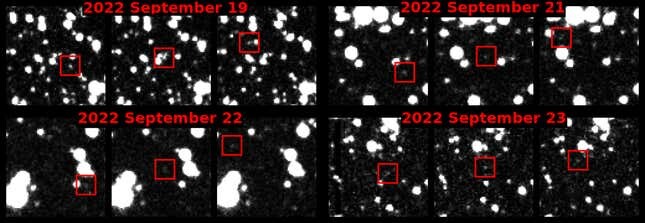
#HelioLinc3D spotted an #asteroid ☄️ that similar surveys had failed to see. It was specifically designed for the @VRubinObs in #Chile 🇨🇱. The #observatory’s huge mirror 📡, massive camera and expansive eye will see 👁️ pretty much everything in the night sky 🌌 in unprecedented detail https://www.nytimes.com/2023/08/05/science/space-asteroids-rubin-heliolinc3d.html

 Benjamin Carr, Ph.D. 👨🏻💻🧬
#Space-Scanning Algorithm Spots 'Potentially Hazardous' 600-Foot #Asteroid
Armed with this promising new tool, a cutting-edge observatory in Chile will sweep the cosmos for all sorts of transient objects. Asteroid-hunting algorithm called #HelioLinc3D spotted a potentially hazardous 600ft rock that's currently about 4 astronomical units from Earth. Asteroid #2022SF289 and "swings by Earth on the opposite side of its orbit, classifying it a potentially hazardous asteroid" https://gizmodo.com/algorithm-spots-potentially-hazardous-asteroid-1850695634
Armed with this promising new tool, a cutting-edge observatory in Chile will sweep the cosmos for all sorts of transient objects. Asteroid-hunting algorithm called #HelioLinc3D spotted a potentially hazardous 600ft rock that's currently about 4 astronomical units from Earth. Asteroid #2022SF289 and "swings by Earth on the opposite side of its orbit, classifying it a potentially hazardous asteroid" https://gizmodo.com/algorithm-spots-potentially-hazardous-asteroid-1850695634

 Spaceflight 🚀
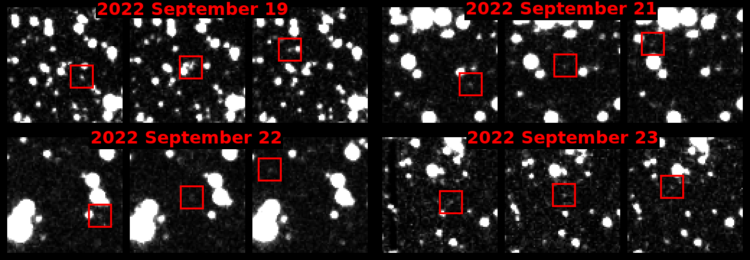
#HelioLinc3D found a near-Earth #asteroid ☄️ that older surveys had missed — one 600 feet long, the type that could devastate 💥 a large city 🏙️ . It was specifically designed for the #RubinObservatory in #Chile 🇨🇱. Telescopic 🔭 surveys have so far found more than 32,000 near- #Earth asteroids. Fainter asteroids ⚫ are mostly #undiscovered at present https://www.nytimes.com/2023/08/05/science/space-asteroids-rubin-heliolinc3d.html
 innovation2
A new hazardous asteroid-finding algorithm previews the coming era of data-intensive astronomy https://innovationtoronto.com/2023/08/a-new-hazardous-asteroid-finding-algorithm-previews-the-coming-era-of-data-intensive-astronomy/
 WinFuture.de
Der Algorithmus #HelioLinc3D soll zukünftig selbstständig nach #Asteroiden suchen, die der Erde gefährlich werden können. Schon im Testlauf wurde er nun fündig. https://winfuture.de/news,137730.html?utm_source=Mastodon&utm_medium=ManualStatus&utm_campaign=SocialMedia

Neuer Asteroiden-Jagd-Algorithmus wird direkt im Testlauf fündig
Ein neuer Algorithmus, der die Jagd nach bisher unbekannten Asteroiden voranbringen soll, kann schon vor seinem offiziellen Start einen ordentlichen Erfolg verbuchen. Das System hat ein Objekt gefunden, das eine potenzielle Gefahr für die Erde darstellen kann.
#UniversityOfWashington 📆 July 31, 2023 “This is just a small taste of what to expect with the #RubinObservatory in less than two years, when #HelioLinc3D will be discovering an object ☄️ like this every night." Any survey 🔭 will have difficulty discovering these faint 🌑 objects near its #sensitivity limit. https://www.washington.edu/news/2023/07/31/heliolinc3d/
