Héctor Llaitul: Boric’s Role in the Neofascist Offensive in Wallmapu

The Boric administration will be remembered as the worst of the post-dictatorship governments for the struggle of the Mapuche Nation. An assessment of the actions carried out by his administration highlights:

– Militarization of Wallmapu through the bellicose States of Emergency, which were maintained permanently throughout his four years in office.

– The failed Peace and Understanding Agreement, which turned out to be a farce and a mockery of the communities, which is why it received widespread rejection from the entire Mapuche movement. Its most concrete result was the complete lack of land restitution.

– Modernization of the State’s repressive apparatus, which involved, among other things, the acquisition of Israeli technology for police use and abuse in Wallmapu.

– Reestablishment of the National Security Doctrine, which provided the ideological framework for persecution and repression, as during the Pinochet dictatorship, and which currently defines the Mapuche people as the internal enemy of the Chilean State.

– Continued criminalization of the Mapuche cause through much harsher legislation, which includes even more cruel and repressive laws and regulations, such as the anti-land occupation law, designed to return land to forestry companies. The Naím Retamal law, or “trigger-happy” law, grants impunity to police and military personnel who commit acts of repression. The refinement of the Anti-Terrorist Law extends to the persecution of even the support networks of those who struggle.

– Persecution and imprisonment of the largest number of Mapuche community members ever seen under previous governments, now exceeding 150 Mapuche Political Prisoners (MPPs). These prisoners are subjected to degrading treatment and violations of their political and cultural rights, including cases of torture.

– Repression of all demonstrations and movements for the essential rights of the Mapuche Nation, primarily those concerning land reclamation, where progress in territorial restitution for many communities was also halted. This was achieved through repressive policies carried out by judges, police, and prosecutors, many of whom are known to be anti-Mapuche and operated within a militarized context where prerogatives and actions are at the disposal of the Armed Forces.

In short, the Boric government used repression, militarization, imprisonment, torture, and various abuses against our people to strengthen the system of domination.

Furthermore, he intensified extreme neoliberal policies. This was evident not only in his economic measures favoring businesses in ancestral territory, but also at the national level, such as the ratification of the TPP 11; the signing of free trade agreements with the European Union, China, and US imperialism; the privatization of copper to Canadian capital; and the privatization of lithium and its transfer to transnational corporations, where the figure of Ponce Lerou, Pinochet’s former son-in-law, was given preferential treatment, despite his active participation in the privatization of ancestral Mapuche territory.

So, what did Boric, the Broad Front, the Communist Party, and the former Concertación coalition do as a government? The answer is clear and unequivocal: they betrayed the Mapuche people and handed us over to oppressive institutions, thus perpetuating the system of domination. Without a doubt, they attempted, with the full force of the State, to halt the struggle for the reconstruction of the Nation, the defense and recovery of our ancestral lands. They disregarded our historical demands. Our fundamental struggle is against the capitalist regime that devastates and plunders our historical territory. Our struggle is against the unscrupulous businesspeople who, through their investments, destroy our ancestral lands.

We are a Nation with a centuries-long history of struggle against domination and invasion, and we know very well how the elites, the Chilean bourgeoisie, have built their power on the foundation of dispossession, oppression, exploitation, and injustices against our people.

Today, Boric leaves with his arrogant rhetoric, but he will be remembered as a despot who sought to use us as a symbol of struggle and then betrayed us, siding with the same powerful elites as always.

Boric will go down in history as a sinister individual who facilitated all the conditions for the far right to bring Kast to power, and to launch a neo-fascist offensive that will amount to a new war of extermination for the Mapuche people. In fact, Boric has ensured impunity for the repressors of the Mapuche movement, giving free rein to forestry capital and revealing his true reactionary and treacherous nature toward the Mapuche cause.

Beyond the measures denounced, Boric will be remembered for having paved the way for the fascists, favoring the powerful and the main economic groups, since his administration reproduced the neoliberal model, allowing the realignment of big capital in Wallmapu and in present-day Chile.

These policies, in structural and ideological terms, have created the conditions for the accumulation and reproduction of large capital in the usurped territories, placing themselves against the processes of autonomous territorial restitution that we, the communities and organizations in resistance, are carrying out with dignity. This will exacerbate the contradictions and intensify the territorial struggle.

The Mapuche struggle will not stop in the face of a new offensive by fascism. Our ancestors already taught us the path of resistance; from our lonko (chiefs) we learned the marrichiweu ka weuwaiñ pu peñi pu lamngen (the spirit of resistance for our brothers and sisters).

Freedom for the imprisoned Mapuche political prisoners and all the imprisoned weichafe (warriors)!

By Héctor Llaitul Carrillanca /Werken Noticias /Resumen Latinoamericano, March 14, 2026.

https://abolitionmedia.noblogs.org/?p=29956 #boric #chile #HéctorLlaitul #mapuche #mapuchePrisoners #southAmerica #Wallmapu

“Operation Huracán Has Not Ended”: Column by Héctor Llaitul

“With the determination of those responsible in the set-up in the Huracán case, the repressive policy of the State is well established and has had and continues with all previous governments and the current one, which, in our opinion, is the worst of all for leaving on a platter to the ultra-right the certain possibility of policies of extermination of our people…”

Knowing the verdict handed down by the Temuco Court in the so-called Huracán Case and which reveals one of the most serious police setups since the end of the civil-military dictatorship, we want to highlight that, beyond the conviction of two generals and the operational heads of the intelligence unit, this resolution does not directly establish, nor does it point out anything about the responsibility of the political authorities who were involved in this intelligence operation against the Mapuche movement in struggle.

Because it must be absolutely clear that it was an operation directed against the Mapuche Autonomist and Revolutionary Movement, where not only evidence was fabricated, information was manipulated that ended with Mapuche community members arrested based mainly on false messages, but also attempted to distort the true nature of the historical conflict.

By the way, we are referring to the responsibility of the government of Michelle Bachelet and her Undersecretary of the Interior Mahmud Aleuy, who are directly responsible for the implementation of this repressive policy of persecution.

Along with this omission, and beyond the fact that it has not been possible to criminally configure the idea of ​​an illicit association to mount evidence against community members – which would have implications in other cases -, here is another aspect that raises a lot of distrust and that has to do with a kind of compromise that the state institutions have offered to the business community, those that are directly committed to our fight for Mapuche territorial and political claims.

A negotiation that offers stability so that the powerful continue plundering the ancestral Wallmapu.

This is why we can deduce and affirm that, from the beginning, the objective sought by this intelligence operation was to try to distort and muddy the just and centuries-old struggle of our Nation People, inventing a supposed intersection of communication and information of the different expressions of the Mapuche cause.

We are also of the opinion that the responsibilities in the Huracán case are not limited to the political, police and prosecutorial authorities.

The media dimension, the actions of the large media outlets at the service of the powerful, have also not been subject to criminal charges, official and right-wing media belonging to large economic groups that contributed to legitimizing an operation that was fraudulent and criminal. A journalism that, as in the times of the dictatorship, has become, by action or negligence, an ally of a state-business setup.

A repressive and fraudulent state policy

We believe that the background of mounting tests responds to a State policy with the aim of primarily persecuting our organization, the expression of struggle that is the Coordinadora Arauco Malleco – CAM and its historical leadership.

Because it was not only about demonizing it, but also about distorting its objectives, its scope, the approaches and the political action, that is, trying to hit the process of transformations against extractivist policies, as well as against the plundering of ancestral territory, to achieve the development of a proposal for the reconstruction of the Mapuche Nation based, mainly, on a project of rearticulation of communities with an autonomist and self-determination perspective, a process based on an anti-capitalist praxis, anti-oligarchic and anti-imperialist.

In this context, the direction of this assembly was very clear, going against a leadership consistent with the revolutionary approaches from the Mapuche world. It is for this reason that we maintain that the scope of Huracán persists, because the leaders who follow the path of territorial and revolutionary political struggle today are prisoners by the Chilean State itself.

It is also necessary to emphasize that with the determination of those responsible for the set-up in the Huracán case, the repressive policy of the State is well established and that it continues with all previous governments and the current one, which, in our opinion, is the worst of all for leaving on a platter to the ultra-right the certain possibility of policies of extermination of our people.

A new justice as far as possible

With this judicial resolution it has been intended to establish justice, but the truth is that it only favors the usurpers, by trying to cover up those who ordered the set-up, the political power of the day that was not reached.

With this sentence, only some will be left with lesser or remitted sentences, despite the fact that the evidence, the facts portray and reveal the actions of the State as a whole.

It is the state institutionality that continued and never stopped in its persecution against the Mapuche Autonomist and Revolutionary Movement. Let us remember that with Piñera complaints were filed against Mapuche werkenes and that Boric expanded them; that with Piñera the State of Exception was imposed, and that with Boric they have become permanent in Wallmapu, consolidating the militarization so desired and applauded by the extreme right.

The police involved will not be sentenced to high sentences as is the case with the weichafe who have been sentenced to more than 40 years in prison. Not even those who murdered our weichafe from behind have been fairly condemned.

Another no small aspect is that this government, along with establishing greater repression, gave the green light to practically the same agencies and agents of the State to devise and apply other intelligence operations, and thereby prosecute and condemn the leaders of the CAM. Therefore, we believe that, currently, with the militarization of Wallmapu and the new imposed order, impunity will prevail for the repressors of the Mapuche cause.

We are your ‘internal enemy’

With the experience of the Huracán case there is a clear consequence and projection, because despite the condemnation of some State agents that includes police generals, the repressive logic and doctrine was maintained and will continue in Wallmapu.

Evidence of this is that despite the background and the length of the case process, this government deepened the repression and political persecution of the movement in struggle, reestablishing the national security doctrine and defining the Mapuche nation as its “internal enemy.”

It was after the Huracán set-up, when the Piñera government filed the complaint against the main leaders of the CAM, primarily against me, (since I had circumvented the Huracán set-up, the main objective of this intelligence operation), a complaint that was expanded with Boric and resulted in the arrest warrant and conviction arbitrarily and without due process.

Today we intend to present the criminal prosecution of a group of police officers, which meant persecuting the actions of the Mapuche movement, only with bad actions, when the background was and is to legitimize the persecution and repression, at any cost, of a political proposal for the liberation and reconstruction of the Mapuche Nation.

The Huracán case continues

In our opinion, the Huracán case, as we pointed out, has not ended, it persists at least in its logic and corrupt practices.

It should be remembered that during the second Piñera government it was Luis Hermosilla who advised on a type of criminal prosecution in the complaints against the Mapuche movement, in addition to racist prosecutors and a corrupt police (the case of Héctor Espinoza).

Subsequently, with the current Boric government, the same prosecutors who participated in the Huracán case have continued in their positions persecuting militants of the Mapuche cause.

To conclude, I must assume a consistent position and affirm that I was convicted under the same logic and repressive policy that derived from the Huracán case, it was certainly in a more meticulous and directed manner, but with the same method of a set-up. Because the purpose was to achieve a conviction as much as possible, the State Security law was applied to me, a regulation that allows political persecution, and which resulted in 15 years in prison just for expressing opinions.

I was also convicted of crimes associated with this law in events where evidence was mounted and records were manipulated (with artificial intelligence) so that judges, in a racist manner and pressured by corporate political power, sentenced me to long prison sentences.

In short, it is clearly established that it was a political condemnation, for reasons of State and business pressure, the same one that mandated the Huracán case.

It should be noted and finally, that despite the persecution, militarization and intelligence operations, the struggle and resistance of the autonomous Mapuche communities continues.

Héctor Llaitul.-

SOURCE: El Ciudadano.com

Resumen Latinoamericano, 13 January 2026

https://abolitionmedia.noblogs.org/?p=26948 #CAM #chile #HéctorLlaitul #mapuche #mapuchePrisoners #PoliticalPrisoners #southAmerica

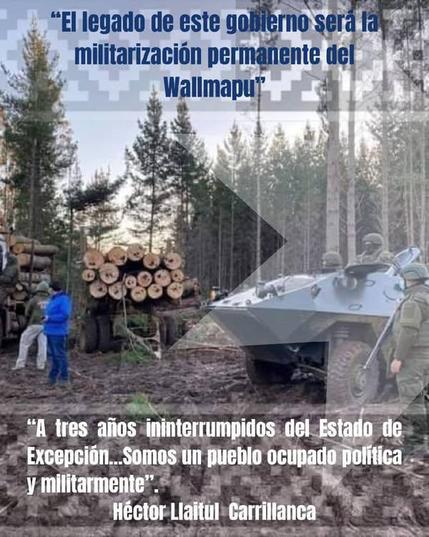
Héctor Llaitul: The Legacy of This Government Will Be the Permanent Militarization of the Wallmapu

By: Héctor Llaitul Carrillanca

“We are a politically and militarily occupied people. Chile is a country of a profoundly racist and colonial nature. Currently we live oppression in all dimensions. The current government is the worst government that we have had to live through since the military dictatorship. We graph it as follows: this May 18 marks 3 uninterrupted years of the State of Exception, which specifically means tanks, armored vehicles, helicopters, drones and numerous military and police personnel for the unrestricted defense of the tasks and interests of the economic groups that devastate the Wallmapu with their extractivist policies.

With militarization and repression, the policy of the stick is imposed very strongly against the Mapuche cause, and the carrot policy is being relegated to the background and is only trying to co-opt some Mapuche sectors, subjugating them to develop new processes of capitalist investment. These are economic policies that are subject to the rearrangement of big capital, as we have already denounced.

Instead of peace and understanding, this government will leave a legacy that will be the permanent establishment of militarization in the Wallmapu. This has resulted in the allocation of many resources for the police and the armed forces, installing a true state of military occupation never seen before. And, without a doubt, repression and persecution of expressions of resistance will continue.

For this reason, we reaffirm once again that with this government the Mapuche people will not achieve any progress through legal and institutional means, and that is why it is more strongly sustained to maintain the resistance against capitalism that attacks the historic Wallmapu.

For territory and autonomy for the Mapuche Nation !!

Héctor Llaitul Carrillanca”.

Source: https://radiokurruf.org/2025/05/19/el-legado-de-este-gobierno-sera-la-militarizacion-permanente-del-wallmapu/

https://abolitionmedia.noblogs.org/?p=19261

#chile #HéctorLlaitul #mapuche #southAmerica #Wallmapu

Radio Kurruf — El legado de este gobierno será la militarización permanente del Wallmapu

Por: Héctor Llaitul Carrillanca «Somos un pueblo ocupado política y militarmente. Chile es un país de naturaleza profundamente racista y colonial. En la actualidad vivimos la opresión en todas las dimensiones. El gobierno actual es el peor gobierno que nos ha tocado vivir desde la dictadura militar. Lo graficamos de la siguiente manera: este 18 […]

Radio Kurruf

Héctor Llaitul: The Peace and Understanding Commission is a Farce

Let us be clear, this Commission does not represent the political objectives of our organization and of the Mapuche autonomist movement that is active in the processes of territorial recovery.

Our policy continues to be national reconstruction and the liberation of the Wallmapu, objectives that, once again, are not understood or addressed by the Chilean political class and all its related sectors.

From the beginning we maintained that this Commission was doomed to failure, since, rather than representing the demands of the communities and groups that fight for their lands, it embodies the interests of big business and the latifundia that are today covered up in false discourses of peace and social welfare.

It is these sectors that seek to legitimize their own conception of “peace and understanding”, which is nothing more than a new device to ensure the best conditions to increase and accumulate their profits in our ancestral territoriality. For the same reason, this Commission also functions as a political and media instrument by trying to exclude the Mapuche autonomist movement, and to publicly affirm that the interests of the State and big capital are under threat, they impose their rules and their way of doing politics on the institutional Mapuche sectors. In fact, only the co-opted and functional sectors have had a voice.

In addition to the above, it is important to emphasize that a Commission that is born, meets and concludes in the midst of an active State of Exception on the territory that is the object of it, has no legitimacy. They want to “do politics”, even if the term is too big for them, with the gun on the table and the military besieging communities. Exhibiting with these “proclaimed democratic practices”, a great contradiction.

A Commission that arises in the midst of the militarization of the Wallmapu, and that gathers positions and information materials from the territories under these circumstances, does not meet even the slightest standards of respect for human rights in international matters. At the same time, it is a Commission that has operated since its inception under a neo-indigenous pattern, because the Mapuche communities were not consulted, nor who their representatives would be, nor what the central issues are, nor what the forms of resolution should be. This top-down and tutelary logic is heir to the oldest colonial political systems, where paternalistic representation was imposed by blood and fire.

The truth is that this logic prevents native peoples from having the right to decide on their reality, while others, powerful and noble, did so for them. Today the colonial and racist format of the Chilean capitalist state is repeated again.

Faced with this reality, which has permeated the mechanisms with which the State of Chile deals with the “indigenous question” for decades, the Mapuche autonomist movement emerged with force, from the ’90s, with its own politics, speaking and doing for ourselves, without others supplanting or representing us. But today again this situation was ignored – by the way – by the enlightened progressives behind the Commission.

And the most paradoxical thing is that those who do have a voice are the representatives of the political class and the anti-Mapuche business community.

They are those who for three decades think that the historical conflict between mobilized communities, the State and the representatives of capital in the Wallmapu is solved with persecution, criminalization, set-ups, trials and jail. It seems ridiculous that the supposed “dialogue” for peace, materialized with this Commission, includes precisely the militarists who do not want it and who have swelled their pockets at the expense of the usurping occupation. This is the case of paramilitary commandos, such as APRA, which carry out political operations, rather than acting as an association that represents a union in search of that supposed “peace.”

At the organic and operational level, it turns out to be a Commission built on quicksand, just as was the participation of the Mapuche in the Constituent Convention. For the same reason, by not reaching concrete agreements, the greatest achievement is to show this Commission in its work of preparing a diagnosis regarding what they have called the recovery of lands, an issue that in the Mapuche world makes absolutely no sense because our people, the communities, are absolutely clear about the territorial claims that interest us, to reestablish a territorial design that allows the reconstruction of our Nation People.

With this diagnosis, the Commission intends to justify that the mechanisms for the return of land exist, in the absence of a concrete and precise proposal that determines or makes the return of the territories a reality. However, it constitutes the “workhorse” to cover up a major deception, which is the imposition of marketing techniques, with corruption included, to rearrange the large capitalist investments in our ancestral territory.

A diagnosis that will be presented as a great objective, but that will not be concluded with this government. Nor will the territorial returns that will be long-term and that will only indicate or establish a type of mechanism, a type of form to politically seek compromises and negotiations in future governments.

In short, this new Commission constitutes a real farce, a new foolishness and will form one more link for the current administration, the current neoliberal governance, to project a future government that will be in the hands of the far right.

Seeking peace and understanding to the exclusion of those who struggle is the big question, how can peace be sought in a context of militarization and greater repression? Even more so, with the existence of many Mapuche political prisoners (PPM) who have been prosecuted and convicted only for representing the territorial, autonomist and revolutionary struggle through ideas, forces and political proposals for the reconstruction of our people. Nothing has been said about the weichafe that are kidnapped by the Chilean state. Because as long as there is militarization and Mapuche political prisoners, it is not even possible to initiate dialogues that lead to agreements.

The existence of the PPM occurs in a context of greater persecution and on the basis of exceptional laws that take us back to dictatorial times. In fact, today there are Mapuche political prisoners as a result of the most sophisticated policies to repress and persecute the autonomist movement, which with more strength has taken on the struggle against extractivism and for the reconstruction of our people, processes sustained with the recovery of territorial spaces, today mainly in the hand of the forestry companies.

As a prelude to the presentation of the agreements or the points of the Commission for Peace and Understanding, a real media campaign has been implemented in which the most fascist sectors of the Chilean right participate, obviously covered by the media that are at their service, where the discourse that demonizes the Mapuche cause is reinstated, condemning the violence exercised by communities for territorial recovery.

A discourse that reinstates the concepts of terrorism, rural violence, organized crime to delegitimize and depoliticize the just struggle for territory.

On the other hand, the idea of a supposed agreement for the return of lands is being installed in which there would be a huge amount of money that will be available for territorial reparation to the communities, which is part of the farce that we already know, because in fact this proposal is always diluted along the way and in the end ends up in squalid resources and in almost no viability of land return.

This is a constant under the legislation in force with the participation of CONADI, a rotten and functional organism of the capitalist state. There will only be money to repair the large landowners and to swell the coffers of the forestry companies, who make a big business with the financial speculation of the purchase and sale of the estates usurped from the communities.

Undoubtedly, a new political operation has been launched that tries to give strength and importance to a Commission that in reality has nothing to offer for the resolution of the conflict, because the confrontation is installed on structural, economic foundations, which imply the struggle of an oppressed native people against an invading colonial state and in the face of which there is already a process of struggle and resistance for the reconstruction of the the Mapuche Nation.

The current Mapuche struggle is and will be for territory and autonomy for the Mapuche Nation.

The struggle continues!!

Amulepe taiñ weichan !!

SOURCE: Werken Noticias

By Héctor Llaitul / Resumen Latinoamericano, May 4, 2025

https://abolitionmedia.noblogs.org/?p=18946

#Autonomy #CAM #chile #HéctorLlaitul #mapuche #mapuchePrisoners #PoliticalPrisoners #southAmerica #Wallmapu

Nación Mapuche. Habla la CAM-Primera parte- La Comisión de paz y entendimiento es una farsa - Resumen Latinoamericano

Por Héctor Llaitul / Resumen Latinoamericano, 4 de mayo de 2025 Seamos claros, esta Comisión no representa los objetivos políticos de nuestra organización y del movimiento mapuche autonomista que está activo en los procesos de recuperación territorial. Nuestra política sigue siendo la reconstrucción nacional y la liberación del Wallmapu, objetivos que, una vez más, no […]

Resumen Latinoamericano

Mapuche Nation. Racist and Revanchist Authorities Denied Héctor Llaitul Transfer to Temuco Prison

The court prioritized security over family roots

When security outweighs family ties, the debate is served. The leader of the Arauco Malleco Coordinator (CAM), Héctor Llaitul, must continue serving his sentence in the Bío-Bío Penitentiary Center, in Concepción, after the Court of Guarantee of Concepción rejected his request to be transferred to the Temuco prison. The defense alleged reasons of family roots, mentioning that his partner lives in Chol-Chol and his mother in Osorno, but the court was not convinced.

The supervisory judgne Marcelo Bustos was in charge of the hearing and explained that the security criterion prevails, so Héctor Llaitul will continue to be held in the Bío-Bío Penitentiary Center.

A sentence of 23 years for crimes associated with rural violence and the State Security Law is not minor. In this context, the Gendarmerie lawyer was categorical: “The risk of escape and the dangerousness of Llaitul require a prison environment with extraordinary control measures” and stressed that the Temuco prison does not have the necessary conditions to keep an inmate considered highly dangerous like Llaitul.

According to reports, the jurist asked the court to declare itself incompetent, a request to which Judge Bustos did not agree.

The judicial response was as clear as it was perverse: institutional stability weighs more than affective connections.

As on a chessboard where each piece must occupy the place that minimizes risk, Llaitul will continue to be secluded far from his loved ones, but in an enclosure where the State feels safer.

5 most important facts:

  • Héctor Llaitul is serving a 23-year sentence for rural violence and crimes against state security.
  • His defense requested the transfer to Temuco for reasons of family roots.
  • The Gendarmerie objected, alleging the inmate’s high danger and lack of conditions in Temuco.
  • Judge Marcelo Bustos rejected the request, prioritizing security criteria.
  • Llaitul will continue in the Bío-Bío prison, where he is already serving his sentence.

Resumen Latinoamericano, April 24, 2025

https://abolitionmedia.noblogs.org/?p=18657

#chile #HéctorLlaitul #mapuche #mapuchePrisoners #PoliticalPrisoners #southAmerica

Nación Mapuche. Abril 24: Audiencia para traslado de werken Héctor Llaitul a Módulo de Comuneros de cárcel de Temuco - Resumen Latinoamericano

Rebelión / Resumen Latinoamericano, 24 de abril de 2025 Cabe hacer presente que el comunero se encuentra desde el mes de agosto de 2022 en el penal de Concepción, y desde aquel momento en reiteradas ocasiones se ha solicitado su traslado, en conformidad a tratados internacionales firmados por Chile, lo que también ha sido motivo […]

Resumen Latinoamericano

Mapuche Nation. Why Does CAM Prevent the Exhumation of Pablo Marchant?

Werken Noticias / Resumen Latinoamericano, March 26, 2025

The recent attempt to exhume the body of Pablo Marchant, frustrated by the resistance of the Lof Pidenko, has revived the conflict between the State and the Coordinadora Arauco Malleco (CAM). But why is the CAM so strongly opposed to this procedure?

A weichafe buried according to Mapuche tradition

For the CAM and the Lof Pidenko, the refusal to exhume is not only a political issue, but also a spiritual and cultural one. Pablo Marchant, known as “Toñito” within the organization, was buried in an eltun, a Mapuche cemetery where his ancestors and historical leaders rest. From their worldview, removing his body would be a serious transgression, since the weichafe (warrior) chose to remain with the pu lonko in their eternal rest.

In interviews prior to his conviction, Héctor Llaitul, leader of the CAM, had already expressed his rejection of any attempt at exhumation, pointing out that “extracting Toñito’s body and leaving it in a common cemetery is a blow to the heart of our cause.” The organization considers this act an affront to their struggle and an attempt by the state to weaken its territorial control in the recovered areas.

A political and territorial struggle

Beyond the spiritual aspect, the CAM sees this procedure as part of a strategy by the State to weaken its presence in the region. The organization maintains that the exhumation does not respond to a real judicial interest, but to an “intelligence operation” to discredit their struggle and justify new incursions into disputed territories.

Llaitul has been categorical in his rejection of what he considers political persecution: “The conditions are created for a new incursion-occupation of the recovered properties.” In this sense, the resistance to the exhumation is not only out of respect for the weichafe, but also a way to prevent the State from continuing to advance in what they consider a strategy of repression.

Distrust of the State and the Media

Another key point in the CAM’s position is its deep distrust of state institutions and the media. According to Llaitul, the legal proceedings against his organization are based on “lies and fabrications,” and the media play a role at the service of the powerful to justify the criminalization of the autonomist movement.

In this context, accepting the exhumation of Marchant would be, for the CAM, validating a system that they consider oppressive and contrary to their struggle. For this reason, they have decided to prevent it at all costs, even confronting the Prosecutor’s Office, the PDI and the Army.

The conflict is still open

With the exhumation frustrated, the tension in the area remains high. It is unclear whether the authorities will insist on the procedure or how the CAM will respond in the event of a new attempt. What is clear is that, for the organization, Pablo Marchant’s tomb is a symbol of resistance and dignity that they are not willing to give up.

Héctor Llaitul’s statements are excerpted from an interview given to the media outlet “Voces en Lucha” in 2024.

LOF PIDENCO RESISTS THE ATTEMPT TO ENTER THE TERRITORY BY PDI AND MILITARY WHO RESPOND WITH HIGH-CALIBER WEAPONS

Maximum tension in the Lof Pidenco. Community members report that PDI, backed by military personnel, try to enter the territory, encountering resistance from the community. According to initial reports, state forces have responded with the use of high-caliber weapons.

Unofficially, it is indicated that the operation seeks to exhume the body of weichafe Pablo Marchant, which would have intensified the reaction of the community. The community members denounce strong repression and uncertainty remains about the development of the events.

The situation is still developing and more information is expected in the coming hours. We will stay tuned for any updates.

https://abolitionmedia.noblogs.org/?p=17908

#CAM #chile #HéctorLlaitul #mapuche #PabloMarchant #southAmerica

Nación Mapuche. ¿Porque la CAM impide la exhumación de Pablo Marchant? / Lof Pidenco resiste el intento de ingreso al territorio por PDI y militares - Resumen Latinoamericano

Werken Noticias / Resumen Latinoamericano, 26 de marzo de 2025 El reciente intento de exhumación del cuerpo de Pablo Marchant, frustrado por la resistencia del Lof Pidenko, ha reavivado el conflicto entre el Estado y la Coordinadora Arauco Malleco (CAM). Pero, ¿por qué la CAM se opone con tanta firmeza a este procedimiento? Un weichafe […]

Resumen Latinoamericano

Mapuche Nation. 100 Years of Punishment for a Young Weichafe: Another Revenge of the Chilean State

Pelentaro Llaitul, my son, is being prosecuted for a series of events that are part of what is the territorial and political claim carried out by the Mapuche Nation people.

His trial, which is currently in the process of preparation, begins in June 2025 after more than 2 years of preventive detention, a case where we are once again in the presence of a judicial process full of racism, prejudice and bias with implications of political persecution. It is undoubtedly a trial that demonstrates once again the position of the Chilean State, the oppressive Chilean institutionality, against the process of struggle carried out by the Coordinadora Arauco Malleco, the CAM.

It is the so-called “Lautaro Case”, of resistance actions against the forestry industry in which several militants of the Mapuche cause, including my son, are artificially involved. A case where a new situation of improper process is already observed, since this judicial case together with the presence of protected witnesses, the lack of concrete and scientific evidence, adds the argumentative fallacy on the part of the prosecution, which indicates that the pu peñi (brothers) were arrested in flagrante delicto, in circumstances that they were arrested many kilometers away from the scene of the events and in an area where another process is taking place of territorial recovery, and where there is a strong ascendant militant insertion of each of them in that Mapuche Nagche territory.

For this reason, the procedural situation is complex and unfair. First, because one of the weichafe prosecuted is my son, which shows a kind of cruelty against my children for the role I have been playing in the autonomy struggle. And on the other hand, the contribution and meaning that the Mapuche youth have had in the concrete struggle. Certainly, Pelentaro’s participation in the Mapuche cause has been very significant not only because of his selfless dedication that gives new energy and freshness to the liberation process, but also because throughout his life, his participation has to be an example for young weichafe to follow.

Pelentaro Llaitul, is one of my youngest sons, he has a lifetime of being involved in the struggle for the historic territorial and political claims of our organization. From a very young age he has participated in this process, becoming at a very early age, an outstanding militant of the Mapuche cause. Fulfilling very specific roles within what is our world and the culture of our people, what are the socio-political and cultural implications of the communities in reconstitution, the lof, and in the Mapuche autonomist and revolutionary movement in general. Thus he became purrufe, curiche, palife and an outstanding weichafe. It is in this framework of outstanding cultural and political participation that he had to fulfill a very important function in the organization, which earned him hatred and persecution by our historical enemies, today represented by the forestry companies and the fascists who attack Wallmapu.

We are in the presence of a new act of directed political persecution and that today is part of a political decision on the part of this specific government, an action of revenge and cruelty against Pelentaro, because beyond being my son, the State intends to achieve a mockery of the new generations of fighters.

With this action, the Chilean State portrays itself as giving an account of the de facto repressive and punitive action against the Mapuche that is applied by the current administrators of justice in Chile, by the current ruling political class and that is carried out by the courts that have historically acted in a racist and intolerant way against our people. This is the reason that explains the bitterness that is reflected and translated into the Lautaro Case where the prosecution is asking for 70 years in prison and this government of Gabriel Boric is requesting 100 years in prison against Pelentaro via complaint. Moreover, aggravating the situation and not satisfied with the above, my son is being formalized again for another cause, in which he also risks many years of political imprisonment, in circumstances that at that time he was a minor.

It is for this reason that we can affirm without fear of equivocation that we are in the presence of an emblematic act of political persecution, where this government in particular wants to install an example of derision and teaching against one of the most consistent Mapuche youth. With this action, the current government contradicts the entire supposed position of human rights and justice for the Mapuche that it shouts so much and that is reflected in absurd peace commissions, revealing the true position towards the native peoples, which is to repress the resistance of the communities at all costs.

Without a doubt, we are in the presence of a new action that portrays this government in its most racist, intolerant and punitive facet that has been seen in recent decades, and which currently has more than 100 Mapuche political prisoners in Chilean state prisons. Because, discrimination and political persecution against the Mapuche who are willing to fight for territorial and historical political claims are and will be repressed without contemplation to safeguard the interests of the powerful.

I am currently a prisoner in a Chilean state prison, but I must continue to denounce injustices and from my role as werken of a Mapuche autonomist organization that is still in force. Especially because this case, in which my son and other young weichafe have been involved, has not had the proper media coverage, which has allowed there to be abuse on the part of the Prosecutor’s Office and the courts, and where due process is imposed in all its magnitude.

Another reason for making this specific denunciation, and which obliges me to disseminate it in the alternative and foreign media, is because the official press, the bourgeois press, covers the facts in a tendentious and malicious way, creating the conditions for the racist action of the oppressive institutions and where the courts and the political police of the State have not only criminalized our struggle but also mount operations and are vicious against the most outstanding weichafe of our people.

It is in this framework that we extend the denunciation against the media that are supposedly alternative and that were pro-Mapuche cause, and that soon ended up selling themselves to power, that were not only co-opted by the current governance as is the case of the newspaper El Ciudadano, El Mostrador, The Clinic who are accomplices with their silence or omission of these dirty intelligence operations. Because only in this way can it be understood why they do not cover or make these cases invisible and only cover supposed demands that are framed in lowly and submissive positions. It is, in the final analysis, a pseudo-progressive press at the service of the model of injustices.

Finally, we continue to reaffirm the profound significance of our struggle in recent times, and where, given the achievements of the autonomist movement, the contradictions between the Mapuche people and the Chilean State have become more acute. Because our struggle has positioned itself in anti-capitalist and anti-colonial definitions that have mostly clearly confronted the interests of big capital. The struggle for territory and freedom does not compromise. It is in this context that there is greater repression on the part of the current government, and that generates the conditions for a new fascist offensive of the Chilean right that is already attacking with great force in historic Wallmapu.

Finally, and a not insignificant piece of information at the last minute, my son Pelentaro Llaitul is currently awaiting the trial, which was set for 39 days from June 24. And that one of the judges that the court ordered for the drafting of the sentence in that process, is Judge Jorge González Salazar, the same one who convicted me without evidence in a case that is currently in international headquarters for various violations of rights that occurred in the process. In principle, this judge had not been appointed, however, a day after the court was formed, one of the 3 judges was changed to leave González Salazar, a recognized anti-Mapuche. It should also be remembered that this judge was the same one who convicted several Mapuche leaders as in the Lonkos Case, for which the Chilean State was condemned internationally due to the way in which Mapuche social protest was criminalized. This new fact clearly illustrates how justice works in the ancestral territory. A justice system at the service of the powerful and that acts under pressure and mandate from the ruling political class.

For territory and autonomy for the Mapuche Nation !!

Out with the forestry companies from the Wallmapu!!

Weuwaiñ

Héctor Llaitul

(*) This column was published by the French newspaper Les 2 Rives

Resumen Latinoamericano, March 5, 2025

https://abolitionmedia.noblogs.org/?p=17356

#CAM #chile #HéctorLlaitul #mapuche #mapuchePrisoners #PoliticalPrisoners #southAmerica

Nación Mapuche. 100 años de castigo para un joven weichafe: otra venganza del Estado Chileno - Resumen Latinoamericano

Resumen Latinoamericano, 5 de marzo de 2025 Pelentaro Llaitul, mi hijo, está siendo procesado por una serie de hechos que se enmarcan dentro de lo que es la reivindicación territorial y política que lleva adelante el pueblo Nación Mapuche. Su juicio, que hoy se encuentra en proceso de preparación, comienza en junio del 2025 tras […]

Resumen Latinoamericano

Héctor Llaitul: “The Current Government Has Become More and More Functional and Servile to the Interests of the Great Capital”

Héctor Llaitul, leader of the Coordinadora Arauco Malleco (CAM), sentenced to 23 years in prison under the Chilean anti -terrorism law, in writing and through a visit, offers a deep look on their personal situation, the Mapuche resistance and the fight for the Territorial autonomy. Llaitul addresses issues ranging from political prison and violations of the rights of Mapuche political prisoners, to the repressive policies of the current government and the impact of these on the Mapuche communities. Through their words, they emerge not only forceful criticisms of the Chilean political and judicial system, but also a reaffirmation of the commitment to the Mapuche cause and its worldview. This look allows us to understand the complexities of a historical conflict that remains in force.

How do you describe your experience in this new political prison and the impact of this sentence in your life and in the fight of the Mapuche people?

The first thing is to point out is that this was a political condemnation and therefore it must be assumed according to the degree of consciousness and politicization that our struggle has reached, which has been undertaken from the autonomist Mapuche movement. And by the way, political prison must be assumed under a context of greater adversity, because with the current government this fighting process has become more complex and adverse since it has demonstrated its decision to keep the neoliberal model with the Extractivist policies throughout Mapuche ancestral territoriality, thus exacerbating confrontation on the basis of the increase in militarization, criminalization and persecution of the most consistent expressions with the line of territorial and political struggle. And it is in this framework that we must also endure harassment and repression within prisons who embrace the revolutionary struggle more strongly. The impact has been greater and is a consequence of the neo-fascist offensive that is reinstated on Wallmapu. We resist in a land of greater threat and punishment towards the Mapuche militants. Today the imprisoned Weichafe must sustain with greater force and rigor the onslaught of racist institutionality. Under this government, many Mapuche have been imprisoned and some are subjected, under Gendarmerie policy, to the violation of our rights, based on the act of keeping us as common prisoners and far from our ancestral territoriality.

What message do you seek to convey with your book “written from jail” and what role you expect to play in the fight for the rights of the Mapuche people?

The message we want to deliver with the book is more than anything of breath and reaffirmation, and this is somehow related to what was said above since its elaboration was in very adverse conditions of political prison, when I assumed hunger strikes and endured punishments for my fighting attitude. It is a publication that occurs in a context in which we are still monitored and repressed only for maintaining our convictions, denying all our political and cultural rights as Mapuche political prisoners. We also want to demonstrate that despite being prisoners we will maintain the line and unalterable principles, and thus contribute to the fighting process being maintained in what is its broader scope. That is, it is our contribution as militants of the Mapuche revolutionary cause that are imprisoned today that we remain firm in the great process for Mapuche national reconstruction.

By the way, it is a message based on our rakiduam with analysis and reflections regarding how we the Mapuche must assume the new political and cultural challenges especially in a context in which the current government has become increasingly transformed into functional and servile to the interests of the great capital, thus raising the way for a new offensive of the most recalcitrant right in this country. It is important to reaffirm in turn that assuming the political prison and writing implies being part of the story of those who fight, and it is a way of denouncing and accounting for the violation of our rights, which had previously been achieved and that allow us to respect our culture and identity, and that are related to our status as Mapuche community members. Because it is not only about human rights, it is about respect for the cultural rights of an original people. In fact, the segregated modules for Mapuche were achieved with mobilization and struggle of prisoners, their relatives and communities, and which at the time had international support, based on ILO Convention 169.

The current situation is different because with the current administration all the rights of Mapuche political prisoners are violated. The treatment that is given to us is as criminals and delinquents, forcing us to be in high security enclosures and in modules with common prisoners with all that that entails in terms of security and exposure to racism and bad treatment in general. In this sense, what affects us most is the violation of our cultural rights in its broadest sense, because racism and intolerance is at all levels and is part of the structural violence of the Chilean State.

Your family has announced that they will resort to international organizations to demand your release. What is your opinion about this strategy and what expectations do you have?

Indeed my family and communities we will resort to international instances for my case, especially since I suffered a conviction that is eminently political in regard to the use of the State Security Law and crimes associated with this legal interpretation, in addition to faults to due process. With my defense – a team of lawyers – we are going to the Inter-American Court of Human Rights IACH, and in turn we will also go to Human Bodies linked to the United Nations, this within the framework of the complaint about the criminalization of the Mapuche case and of the persecution that we are subject to as Mapuche leaders. We are going to undertake these actions, because we do not obtain justice by the Chilean courts who have acted and operated symptomatically with what is colonialism and the deepest racism that still sustains institutionality, which we define as oppressor of the Native peoples. These actions will also allow us to give visibility to our struggle, which we consider absolutely legitimate and fair, thus appealing to international solidarity with the Mapuche cause.

How do you evaluate the relationship between the government of Gabriel Boric and the Mapuche communities, especially in the context of the state of exception and the repression denounced?

The evaluation that we make of the relationship of this government with our people and with the Mapuche communities in struggle, particularly those that are mobilizing for the recovery of their lands, has been deplorable, is a relationship of greater confrontation and violence. Especially when our territorial struggle collides with the interests of the great capital of this country. We can affirm that it is one of the worst experiences that we have had within the framework of the historical conflict in recent times. The state of exception, the increase of military and the members of special forces and police in conflict areas demonstrate it. It is a militarization policy that we had not seen before, as well as the increase in criminalization and persecution against the struggle processes carried out by communities. Undoubtedly, this has increased tension, violence and confrontation with the state of Chile and with the capitalist system of extractivist base that sweeps our ancestral territories.

This is a government that at first defined itself as leftist and progressive but that has gradually subsumed itself to the system of domination and has tried to maintain the bourgeois neoliberal model, which is why it has functioned in a servile and lowly manner in the face of the interests of the large economic groups. For this reason, with this imposed reality we visualize a more adverse situation for the Mapuche autonomist movement that fights for territorial recovery to base our autonomist liberation proposal. We reiterate again and affirm that with the current government the historical conflict has been sharpened because it is not only based on the application of more repressive policies against the movement in struggle, but by the farce in which its alleged instances of dialogue has been transformed, as of the Commission for Peace and Understanding. An initiative that arises and is installed with the sole objective of using and manipulating the co-opted and functional Mapuche sectors to the system, an instance that has resulted in a failure and that constitutes a new mockery for the Mapuche movement in general.

As a synthesis we can affirm that with the Boric government not only a false flag has been installed with its dialog conditions for increasing repression mainly towards land recovery processes, and that in a certain way reinstates extermination policies that we suffer in the last century. Therefore, we affirm that we suffer a new occupation. Perhaps what portrays this government most is its attitude and decision to prosecute the Mapuche autonomist movement, which is registered in the active prosecutors and judges who have green light for this purpose, committing all kinds of procedural and police injustices against our fighting expressions. Today there are more than one hundred Mapuche prisoners in the prisons of the Chilean State.

What advances has the CAM achieved in the recovery of territories and how does it visualize the future of this fight against repressive policies?

From our perspective, we can affirm that we have made substantial advances in what is the recovery of the territory and this is the reason why there has been an increase in repressive policies against mainly the autonomist movement. And in this sense, we can categorically affirm that the recovery of the land has been, mainly, against forestry that are our historical enemy. Since this new reality is that the historical conflict has been exacerbated, because the post-dictatorship governments and this one specifically have put themselves on the side of the powerful, of the rich in the confrontation with our people. These advances allow us to carry out, in some way, our political project of national reconstruction, which is precisely what the state institutionality does not want, is what the fascists of the right do not want, so they have made the decision to repress with greater force the various processes of Mapuche reaffirmation and resistance. It is a fact that reactionary expressions and fascist forces that historically operate in the territory have the approval of the current administration, have the approval of a type of neoliberal governance, in which repressive policies that are increasingly more sophisticated and elaborate try to eliminate and atomize the movement of struggle.

In a context of political persecution, how is Mapuche worldview strengthened as the central axis of resistance and the construction of territorial autonomy?

In a context of greater criminalization of the Mapuche cause and the increase in militarization throughout the Wallmapu, we have opted to maintain resistance with the strengthening of the struggle, which is why we have to strengthen our Mapuche Kimun, our Mapuche Rakiduam, that is, our worldview and culture of our Mapuche nation people. These efforts link us to the entire Mapuche movement in general and has become the central axis of the resistance and reconstruction of our people and are the strategic bases that we as an organization, as Coordinadora Arauco Malleco CAM, we propose.

This is the recovery and defense of the ancestral territory, of the defense of our ItrofillMongen, which would mean the defense of all lives in the Mapuche world. This is the restoration of the communities – of the LOF – based on a proposal to reorganize communities so that the large autonomous territories can be rebuilt butalmapu and ultimately the Wallmapu. It is the recovery and defense of the wallontumapu, of a very diverse and rich world in the cultural, values and ideology, where our own idiosyncratic aspects have a lot of sense and reason for what our Mapuche nation is.

In the current stage of the struggle it is to slowly transform the reality to which they force us to live, and turn this reality into what our ancestors bequeathed. We call this, to get involved and continue fighting in the great reconstruction process of our nation people. We know that there are many diverse contributions, not only from the resistance with the Weichan, but of contributions from the Mapuche that implies understanding and assuming a political project of the size that we embrace from the CAM. It is what we have been raising from the different trenches that we have to assume. Therefore, our people have always strengthened with more and greater ceremonies which in turn strengthen our spiritual forces, everything related to the world of pullu. Which are the fundamental elements in our project.

Source: Clarin.cl
Resumen Latinoamericano, 16 January, 2025

https://abolitionmedia.noblogs.org/?p=13771

#CAM #chile #HéctorLlaitul #mapuche #mapuchePrisoners #PoliticalPrisoners #southAmerica

Nación Mapuche. Héctor Llaitul desde la cárcel, a través de un escrito: «El gobierno actual se ha transformado cada vez más en funcional y servil a los intereses del gran capital» - Resumen Latinoamericano

Resumen Latinoamericano, 16 de enero de 2025 “Con la actual administración se vulneran todos los derechos de los Presos Políticos Mapuche. El trato que se nos da es de criminales y delincuentes obligándonos a estar en recintos de alta seguridad y en módulos con presos comunes con todo lo que eso conlleva en términos de […]

Resumen Latinoamericano

17 Years After the Murder of Matías Catrileo: Héctor LLaitul Reflects on Mapuche Struggle and Legacy of the Weychafe

In an exclusive interview for Werken Noticias, conducted from inside the bio-bio prison of Concepción through his defense, Héctor Llaitul, spokesman and political prisoner of the Coordinadora Arauco-Malleco (CAM), reflected on the current state of the Mapuche struggle, his latest book, the legacy of Matías Catrileo and the necessary strategies to achieve justice and advance in the reconstruction of the Mapuche nation. This in the framework of the 17th anniversary of the murder of the young weichafe.

From the struggle for land to a great process of Mapuche national reconstruction

Llaitul positively evaluates the progress made since the death of Matías Catrileo, highlighting that the Mapuche movement has evolved towards a more comprehensive struggle, which constitutes the great legacy of the weichafe. “We went from the struggle for land to establishing the pillars to develop a great proposal for the national reconstruction of the Mapuche people, which implies fighting more strongly to recover the territory and the other identity aspects linked to political autonomy. This process is essential to guarantee the political, cultural and ideological rights of our people.”

From his perspective, the current struggle not only confronts the Chilean State, but also an entire system based on the neoliberal model, which he describes as “the most direct threat to the processes of territorial and cultural recovery promoted by the autonomist movement.”

The legacy of Matías Catrileo

For Llaitul, the figure of Matías Catrileo is central to the recent history of the Mapuche people. “Catrileo represents total dedication and the highest conviction in the struggle for the reconstruction of our people. His example continues to summon the new generations of weichafe,” he said.

He also stressed that the murder of Catrileo was an example of the systematic repression of the Chilean State in its most colonial and racist format, carried out under a government of the Concertación. “His death made evident the willingness of the Chilean State to politically repress and assassinate those who are decisively fighting for territorial recovery. This is part of the strategies that big business always imposes in defense of capital, using the governments of the day as tools to perpetuate oppression and domination.”

Strategies for Achieving Justice

According to Llaitul, “true justice for the death of Matías Catrileo will not come from the Chilean judicial system, which he accuses of being incapable of offering justice because its nature is colonial and it has always represented the oligarchy.” He adds: “Our way of honoring the fallen weichafe is to continue with the process of territorial recovery and with strategies aimed at the reconstruction of the Mapuche nation.”

“The State has always chosen to implement flawed compromises and negotiations that only seek to contain the struggle and resistance of our people, which leads us to the conviction that the struggle must be maintained from the communities, in the political and cultural fields and with the strength of the true weichafe.”

Facing criminalization and repression

The CAM has faced constant accusations and criminalization strategies. However, Llaitul affirms that these have not diverted the course of the struggle. “We face repression and persecution with dignity, without altering our political, ideological and cultural stance. The confrontation is direct and it is a reality that no one can deny, and resistance from the communities is fundamental in this process.”

Llaitul also pointed out that “the costs of this struggle, including political imprisonment and the militarization of the Wallmapu that affects the mobilized communities, are assumed with conviction, given that the Mapuche cause is absolutely necessary, not only for its justice, but also for the projection of a proposal for a better life for all.”

A call for resistance and solidarity

In his final message, Llaitul called on the Mapuche communities and society in general: “As CAM we continue to call on the communities in resistance, all our people and, of course, the new generations, to maintain the Mapuche cause, to fight with strength, with newen and with the conviction that we have seen in our martyrs. We are aware that the process has costs and consequences, and it is necessary to assume levels of sacrifice and loyalty to rebuild our nation.”

He also calls on oppressed Chilean society and the international movement for just causes to get involved in the recognition and respect of the rights of the Mapuche people, supporting actions of resistance and reconstruction in the face of a system that it considers oppressive.

The legacy of Matías Catrileo, according to Héctor Llaitul, “not only remains alive, but continues to be a guide for the Mapuche autonomist movement, on our path for the recovery of territory, autonomy and justice for a people that is known for never surrendering or abandoning its cultural and political forms.”

“Therefore, our best tribute on this emblematic date will be to continue on the path of the futa keche kuifi yem, maintaining the Mapuche national liberation process.”

¡WEUWAIN!

Resumen Latinoamericano, January 3, 2025

https://abolitionmedia.noblogs.org/?p=13553

#CAM #chile #HéctorLlaitul #mapuche #MatiasCatrileo #southAmerica

Nación Mapuche. A 17 años del asesinato de Matías Catrileo: Héctor LLaitul reflexiona sobre la lucha Mapuche y el legajo del Weychafe - Resumen Latinoamericano

Resumen Latinoamericano, 3 de enero de 2025 En una entrevista exclusiva para Werken Noticias, realizada desde el interior del penal del bio-bio de Concepción a través de su defensa, Héctor Llaitul, vocero y preso político de la Coordinadora Arauco-Malleco (CAM), reflexionó sobre el estado actual de la lucha mapuche, su último libro, el legado de […]

Resumen Latinoamericano