✨ New header picture 🖼️

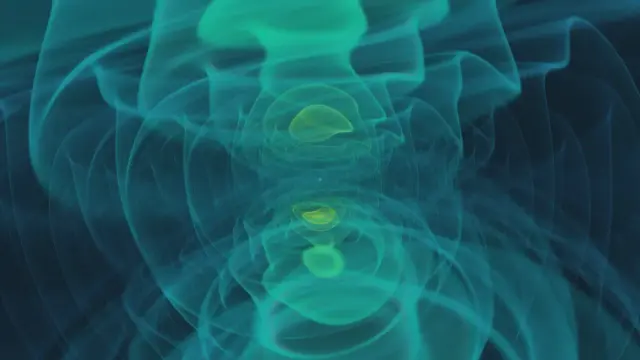
The image shows the numerical simulation results of a binary black hole merger consistent with the gravitational-wave event GW231123.

GW231123 was recently announced as the merger of the most massive black holes ever observed with gravitational waves. Models that account for the complex dynamics of highly spinning black holes, which were developed at the @mpi_grav, were used to analyze the signal and extract astrophysical information from it.

The image is by I. Markin (@unipotsdam), H. Pfeiffer (@mpi_grav), T. Dietrich (@unipotsdam and @mpi_grav)
#BlackHoles #GW231123 #GravitationalWaves #HeaderPicture

🚨 New header picture 🖼️

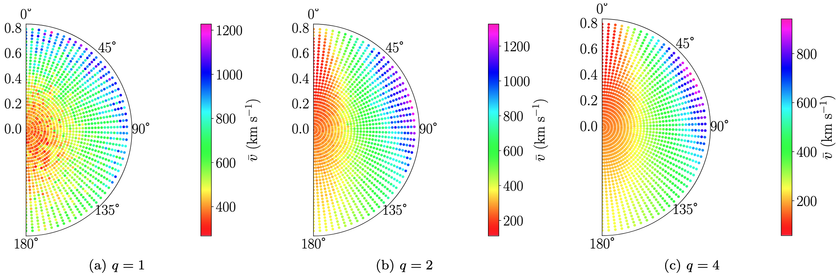
Researchers from the independent @maxplanckgesellschaft research group “Binary Merger Observations and Numerical Relativity” have studied how the spins of merging black holes influence the recoil after their merger, and how this in turn influences the remnant spin magnitudes after repeated mergers in dense stellar environments.

The header picture shows some of their results.

ℹ️ https://www.aei.mpg.de/1244528/towards-a-deeper-understanding-of-black-hole-origins?c=785562

📄 https://arxiv.org/abs/2503.21278 (The header picture is Fig. 5 in there)

#HeaderPicture #BlackHoles #BlackHoleKicks #BlackHoleWeek #Astrodon #Astronomy

Towards a deeper understanding of black hole origins

A new study revisits modelling of the spin distributions from hierarchical binary black hole mergers in dense stellar environments, such as globular clusters. It finds clear deviations from the unique spin distribution described in previous studies, and shows a way to identify black holes from repeated mergers, which could help shed light on black hole formation through precise spin measurements in future observing runs.

🚨 New header picture 🖼️

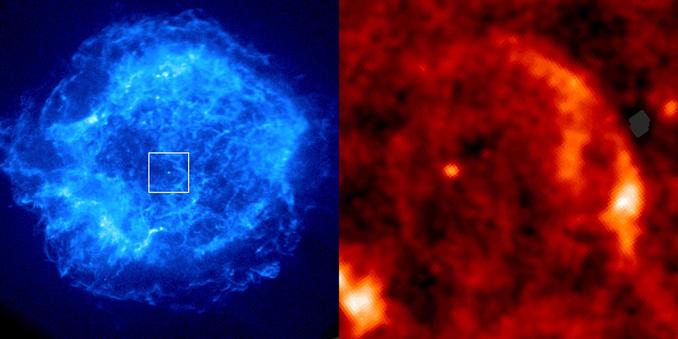
It shows the two supernova remnants Cassiopeia A (left, in X-rays) and Vela Jr. (right, at radio wavelengths). Both harbor a “central compact object”, a neutron star left behind together with the debris cloud after the supernova.

Researchers from the permanent independent @maxplanckgesellschaft research group “Continuous Gravitational Waves” at @mpi_grav in Hanover, Germany, have been searching for gravitational waves from these central compact objects using the volunteer distributed computing project @einsteinathome.

📄 https://arxiv.org/abs/2503.09731

The fact that they did not find any gravitational waves indicates that the neutron stars can only be minimally deformed.

ℹ️ https://www.aei.mpg.de/1188233/digging-deeper-with-einstein-home?c=26149

Images: http://snrcat.physics.umanitoba.ca/SNRrecord.php?id=G111.7m02.1 and http://snrcat.physics.umanitoba.ca/SNRrecord.php?id=G266.2m01.2

#HeaderPicture #supernova #CasA #VelaJr #astrodon #astronomy #NeutronStar

Results from an Einstein@Home search for continuous gravitational waves from Cassiopeia A and Vela Jr. using LIGO O2 data

We conduct two searches for continuous, nearly monochromatic gravitational waves originating from the central compact objects in the supernova remnants Cassiopeia A and Vela Jr. using public LIGO data. The search for Cassiopeia A targets signal frequencies between 20 Hz and 400 Hz; the Vela Jr. search between 400 Hz and 1700 Hz, and both investigate the broadest set of waveforms ever considered with highly sensitive deterministic search methods. Above 1500 Hz the Vela Jr. search is the most sensitive carried out thus far, improving on previous results by over 300\%. Above 976 Hz these results improve on existing ones by 50\%. In all we investigate over $10^{18}$ waveforms, leveraging the computational power donated by thousands of Einstein@Home volunteers. We perform a 4-stage follow-up on more than 6 million waveforms. None of the considered waveforms survives the follow-up scrutiny, indicating no significate detection candidate. Our null results constrain the maximum amplitude of continuous signals as a function of signal frequency from the targets. The most stringent 90\% confidence upper limit for Cas A is $h_0^{90 \%}\approx 7.3\times10^{-26}$ near 200 Hz, and for Vela Jr. it is $h_0^{90 \%}\approx 8.9\times10^{-26}$ near 400 Hz. Translated into upper limits on the ellipticity and r-mode amplitude, our results probe physically interesting regions: for example the ellipticity of Vela Jr. is constrained to be smaller than $10^{-7}$ across the frequency band, with a tighter constraint of less than $2\times10^{-8}$ at the highest frequencies.

arXiv.org

Now for my #ProfilePicture #HeaderPicture I want something perhaps just very golden or "treasure"-ey...

Let's see what happens if I enter this in the 2nd attempt in the #prompt:

"On a plain burnt grass field a dragon guards a large treasure chest and a dragon which breathes golden fire at a troll who is attempting to steal the chest"

#workinprogress

This time I hope it impresses me at least a little bit...

#ArtGuru / https://www.artguru.ai/

Artguru - Free Online AI Art Generator: Create AI Art from Text & Photo

Create stunning and unique art with Artguru's free AI art generator. Just enter some words or a pic and let the power of artificial intelligence unleash your creativity. Discover the magic of AI art generation today!