
🚨 New header picture 🖼️

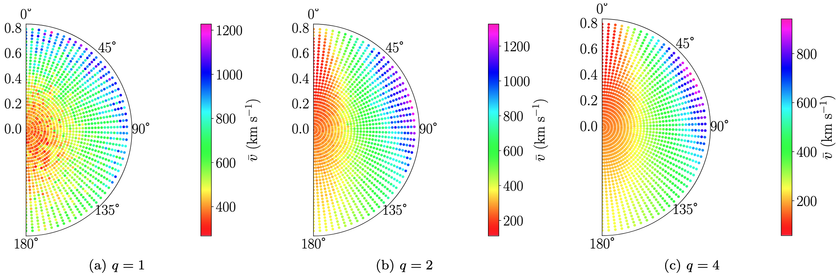
Researchers from the independent @maxplanckgesellschaft research group “Binary Merger Observations and Numerical Relativity” have studied how the spins of merging black holes influence the recoil after their merger, and how this in turn influences the remnant spin magnitudes after repeated mergers in dense stellar environments.

The header picture shows some of their results.

ℹ️ https://www.aei.mpg.de/1244528/towards-a-deeper-understanding-of-black-hole-origins?c=785562

📄 https://arxiv.org/abs/2503.21278 (The header picture is Fig. 5 in there)

#HeaderPicture #BlackHoles #BlackHoleKicks #BlackHoleWeek #Astrodon #Astronomy
Towards a deeper understanding of black hole origins

A new study revisits modelling of the spin distributions from hierarchical binary black hole mergers in dense stellar environments, such as globular clusters. It finds clear deviations from the unique spin distribution described in previous studies, and shows a way to identify black holes from repeated mergers, which could help shed light on black hole formation through precise spin measurements in future observing runs.

✨ New selected research highlight ✨

Towards a deeper understanding of black hole origins

Research team studies the impact of remnant kicks on spin distributions of black holes from hierarchical mergers

A new study revisits modelling of the spin distributions from hierarchical binary black hole mergers in dense stellar environments, such as globular clusters. It finds clear deviations from the unique spin distribution described in previous studies, and shows a way to identify black holes from repeated mergers, which could help shed light on black hole formation through precise spin measurements in future observing runs.

Read more ➡️ https://www.aei.mpg.de/1244528/towards-a-deeper-understanding-of-black-hole-origins?c=26149

📄 https://arxiv.org/abs/2503.21278

#BlackHoles #GravitationalWaves #BlackHoleKicks #GlobularCluster #astronomy #astrodon

Towards a deeper understanding of black hole origins

A new study revisits modelling of the spin distributions from hierarchical binary black hole mergers in dense stellar environments, such as globular clusters. It finds clear deviations from the unique spin distribution described in previous studies, and shows a way to identify black holes from repeated mergers, which could help shed light on black hole formation through precise spin measurements in future observing runs.
✨ New selected research highlight

Binary black hole mergers: What causes the final kick? ⚫🌀⚫➡️⚫🚀

Decoding the physics of asymmetric gravitational-wave radiation and its connection to black-hole kicks.

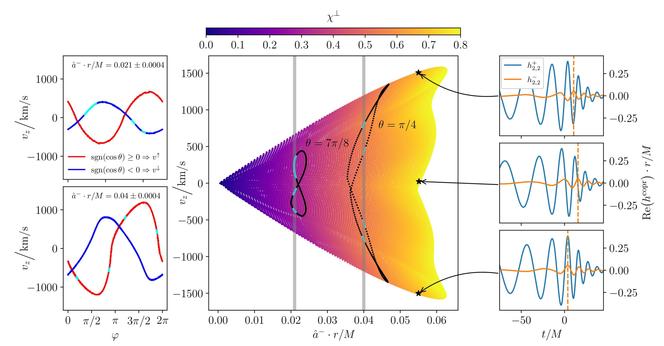
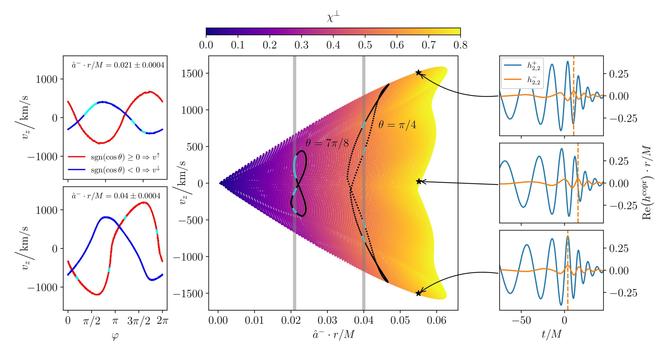
In some binaries, the spins of the black holes are not aligned with the system’s orbital angular momentum. Merger remnants of such systems receive a recoil, also called a “kick”, with velocities of up to 5000 km/s. This happens because gravitational waves carry away linear momentum, which is conserved. Now, a team of researchers from the Max Planck Independent Research Group “Binary Merger Observations and Numerical Relativity” at the @mpi_grav has taken a closer look at the relationship between asymmetric gravitational-wave emission and kicks and found something seemingly counterintuitive…

Read more ➡️ https://www.aei.mpg.de/1209105/binary-black-hole-mergers-what-causes-the-final-kick

📄 https://doi.org/10.48550/arXiv.2412.06913

#BinaryBlackHoles #astrophysics #GravitationalWaves #BlackHoles #BlackHoleKicks

Binary black hole mergers: What causes the final kick?

Merger remnants of binary black hole systems can receive a recoil, also called a “kick”, with velocities of up to 5000 km/s. A team of researchers from the Max Planck Independent Research Group “Binary Merger Observations and Numerical Relativity” at the Max Planck Institute for Gravitational Physics (Albert Einstein Institute) has taken a closer look at the relationship between asymmetric gravitational-wave emission and kicks in binary black hole mergers. They find that a large amplitude of the antisymmetric waveform part does not necessarily correlate with a large kick. Rather, the phase at the merger with respect to the symmetric part determines the kick velocity.

✨ Neues Forschungshighlight

Binary black hole mergers: What causes the final kick? ⚫🌀⚫➡️⚫🚀

Decoding the physics of asymmetric gravitational-wave radiation and its connection to black-hole kicks.

In some binaries, the spins of the black holes are not aligned with the system’s orbital angular momentum. Merger remnants of such systems receive a recoil, also called a “kick”, with velocities of up to 5000 km/s. This happens because gravitational waves carry away linear momentum, which is conserved. Now, a team of researchers from the Max Planck Independent Research Group “Binary Merger Observations and Numerical Relativity” at the @mpi_grav has taken a closer look at the relationship between asymmetric gravitational-wave emission and kicks and found something seemingly counterintuitive…

Mehr lesen ➡️ https://www.aei.mpg.de/1209508/binary-black-hole-mergers-what-causes-the-final-kick [englisch]

📄 https://doi.org/10.48550/arXiv.2412.06913

#BinaryBlackHoles #Astrophysik #Gravitationswellen #SchwarzeLöcher #BlackHoleKicks

Binary black hole mergers: What causes the final kick?

Merger remnants of binary black hole systems can receive a recoil, also called a “kick”, with velocities of up to 5000 km/s. A team of researchers from the Max Planck Independent Research Group “Binary Merger Observations and Numerical Relativity” at the Max Planck Institute for Gravitational Physics (Albert Einstein Institute) has taken a closer look at the relationship between asymmetric gravitational-wave emission and kicks in binary black hole mergers. They find that a large amplitude of the antisymmetric waveform part does not necessarily correlate with a large kick. Rather, the phase at the merger with respect to the symmetric part determines the kick velocity.