 AEI has moved
🚨 New header picture 🖼️
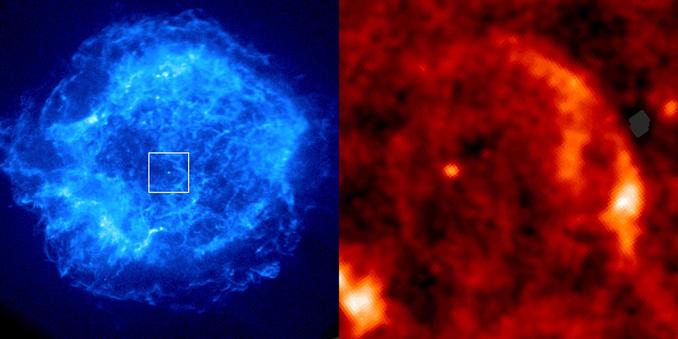
It shows the two supernova remnants Cassiopeia A (left, in X-rays) and Vela Jr. (right, at radio wavelengths). Both harbor a “central compact object”, a neutron star left behind together with the debris cloud after the supernova.
Researchers from the permanent independent @maxplanckgesellschaft research group “Continuous Gravitational Waves” at @mpi_grav in Hanover, Germany, have been searching for gravitational waves from these central compact objects using the volunteer distributed computing project @einsteinathome.
📄 https://arxiv.org/abs/2503.09731
The fact that they did not find any gravitational waves indicates that the neutron stars can only be minimally deformed.
ℹ️ https://www.aei.mpg.de/1188233/digging-deeper-with-einstein-home?c=26149
Images: http://snrcat.physics.umanitoba.ca/SNRrecord.php?id=G111.7m02.1 and http://snrcat.physics.umanitoba.ca/SNRrecord.php?id=G266.2m01.2
#HeaderPicture #supernova #CasA #VelaJr #astrodon #astronomy #NeutronStar

Results from an Einstein@Home search for continuous gravitational waves from Cassiopeia A and Vela Jr. using LIGO O2 data
We conduct two searches for continuous, nearly monochromatic gravitational waves originating from the central compact objects in the supernova remnants Cassiopeia A and Vela Jr. using public LIGO data. The search for Cassiopeia A targets signal frequencies between 20 Hz and 400 Hz; the Vela Jr. search between 400 Hz and 1700 Hz, and both investigate the broadest set of waveforms ever considered with highly sensitive deterministic search methods. Above 1500 Hz the Vela Jr. search is the most sensitive carried out thus far, improving on previous results by over 300\%. Above 976 Hz these results improve on existing ones by 50\%. In all we investigate over $10^{18}$ waveforms, leveraging the computational power donated by thousands of Einstein@Home volunteers. We perform a 4-stage follow-up on more than 6 million waveforms. None of the considered waveforms survives the follow-up scrutiny, indicating no significate detection candidate. Our null results constrain the maximum amplitude of continuous signals as a function of signal frequency from the targets. The most stringent 90\% confidence upper limit for Cas A is $h_0^{90 \%}\approx 7.3\times10^{-26}$ near 200 Hz, and for Vela Jr. it is $h_0^{90 \%}\approx 8.9\times10^{-26}$ near 400 Hz. Translated into upper limits on the ellipticity and r-mode amplitude, our results probe physically interesting regions: for example the ellipticity of Vela Jr. is constrained to be smaller than $10^{-7}$ across the frequency band, with a tighter constraint of less than $2\times10^{-8}$ at the highest frequencies.
