#China 🇨🇳 has four successful #Chang’e robotic landings.

#Failures include #Hakuto-R 🇯🇵, #Beresheet 🇮🇱, #Luna 25 🇷🇺 and #Chandrayaan2 🇮🇳 (#Chandrayaan3 was successful).

#SLIM 🇯🇵, #Odysseus and #Athena 🇺🇸 landed and communicated back to Earth, but all three toppled over after landing https://www.nytimes.com/interactive/2025/03/21/science/blue-ghost-moon-landing.html


#Moon #lander

A Lunar Lander’s Busy Day: Eclipse Photos and Rock Collecting

The sun has set on the Blue Ghost spacecraft, ending a successful mission to the moon.

The New York Times
Bright spots like those are seen around some lunar landers after a liftoff - Apollo 11 and Luna 24 are examples. But these are scattered along a line extending 2000 m northeast, not all close to the lander (and of course, no liftoff...). They might be bits of thermal blanket or wrapping, but why are they spread out like that? I have not seen any explanation yet.
#moon #ispace #hakuto
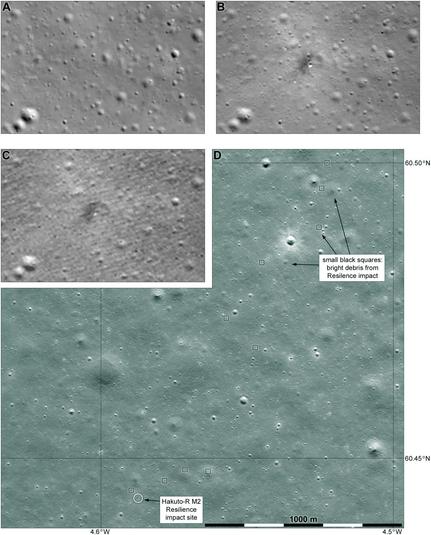
This image starts with 3 views of the Resilience impact site. A is OHRC before the impact. B is OHRC after the impact. C is LRO's Narrow Angle Camera after impact. Usually LRO stands out as a marvellous camera but here OHRC takes the prize. LRO doesn't always look this bad - it might have had some temporary issue like overheating. D is a map showing the small bright debris patches first identified by Shan Subramanian.
#moon #ispace #hakuto

That site was found in OHRC images by Shan Subramanian:

https://twitter.com/Ramanean/status/1935917961929252891

My map in the last post shows debris fragments. How do we know that's what they are? Because OHRC imaged the site before and after the landing (shown in one of Shan's tweets). There are more of them - we will see more about this tomorrow. And we will be seeing more from this amazing camera later.
#moon #ispace #hakuto

Shan (Shanmuga Subramanian) (@Ramanean) on X

Impact site of Resilience Lander (Hakuto-R Mission 2) found in Chandrayaan2 OHRC images! Co-ordinates: 60.4445,355.4108 Quickmap link: https://t.co/FpWi2DqUAX

X (formerly Twitter)
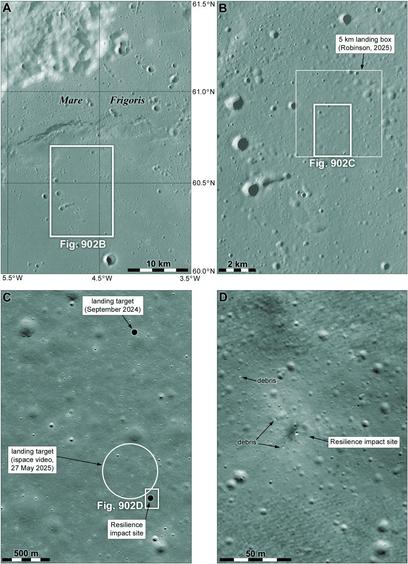
This set of maps zooms in to the Resilience impact site. Map B includes a box showing the area mapped by the LRO imaging team. Map C shows two targets, one from coordinates released in September 2024, the second illustrated in a video just before the landing. The actual impact was only just outside the second target. Map D uses an image from Chandrayaan 2's Orbiter High Resolution Camera, the best camera in lunar orbit today (sorry, LRO).
#moon #ispace #hakuto
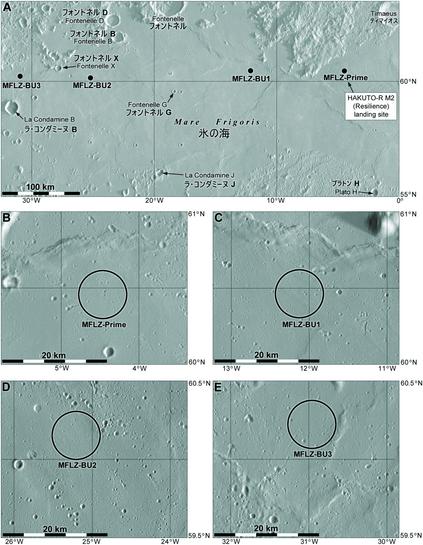
These are the 4 Resilience sites. I expect the site selection process will be published eventually (Mission 1's was). Meanwhile this is what we have. The top map shows all 4 sites, and below each one is enlarged. The prime site was the one used for the mission. If successful this would have been the northernmost landing on the Moon. Alas, it crashed during final approach to the prime site. It would have deployed a rover called Tenacious.
#moon #ispace #hakuto

Back to Resilience, a private Japanese mission by ispace. The company grew out of one of the Google Lunar X Prize teams, Hakuto, which itself evolved from one of the early GLXP teams, White Label Space. GLXP was complicated and its history might show up here one day.

ispace's early missions were called Hakuto-R (R for Reboot). The first crashed in Atlas crater in April 2023. Resilience was targeted for Mare Frigoris at 60 north. Where were the sites?
#moon #ispace #hakuto

But this polar mission study will have to wait for some future implementation. ispace's second mission (the first crashed in Atlas crater in 2023) went to Mare Frigoris in the northern mid-latitudes. Tomorrow we will look at that site.
#moon #ispace #hakuto
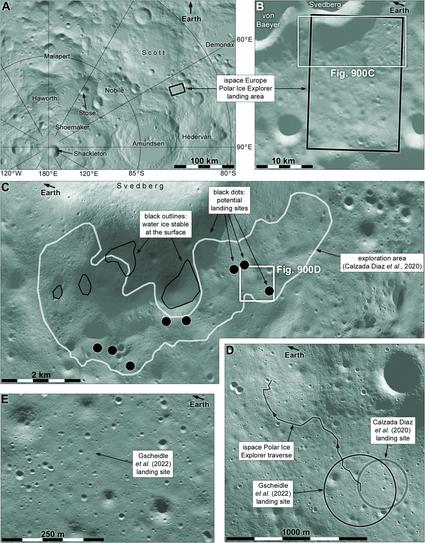
At top left a context map shows the landing area at 82 degrees south. Top right shows the target area south of the crater Svedberg. The southern rim of Svedberg casts a shadow over a hollow which is never fully illuminated by the sun. The middle map shows this target area with 8 landing sites in better-lit areas. At lower right the preferred landing circle has a rover path into an often-shaded area where ices might be found. At bottom left is a closeup of the landing site.
#moon #ispace #hakuto

Finally, insurance for the flight was provided by Mitsui Sumitomo Insurance Company. Names were not always used consistently, and sometimes they were combined to form ‘ispace's SMBC x HAKUTO-R Venture Moon Mission 2’ or other variations. I will call it Resilience.

But first, ispace (through its European offshoot in Luxembourg) spent several years studying a mission near the south pole. The mission was called Polar Ice Explorer. This map shows its study area.
#moon #ispace #hakuto