Oh no, now I want to be in two rooms at the same time: 'Exploring Biographical Networks of Person Objects from Newspaper Clippings' by Erdal Ayen versus 'Networks of Displacement: Spatial and Temporal Dynamics of Post-WWII Migration and Resettlement' by Konstantin Schischka #hnr2024
Fortunately the whole conference is recorded and can be watched later on @HNR YouTube channel: https://www.youtube.com/@HistoricalNetworkResearch
The second kind is network maps, Gephi-style.
It's a different trade-off in terms of method; it comes with its own challenges and opportunities.
Daniele explains that the network map we see below has flaws. We see long chains of nodes: those have "pseudo-nodes" that are artefacts of the method.
Lesson learned: Daniele can now make better decisions when building his networks. Visualization supports reflexivity.
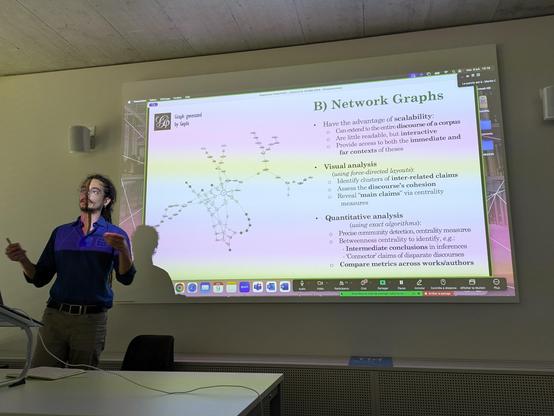
Daniele Morrone is representing discourses as networks, two different ways.
First kind: argument maps. Links between arguments and conclusions in discourses.
Two examples below, a simple one and a rich one. This network is a diagram generated with GraphViz.
Tuba Nur Saraçoğlu visualizes early Islamicate scholars' networks.
Those are narration networks, transmission chains from one actor (ex: the Prophet) to others, until a final inscription in a document. We can track the chains in historical records.
Next up is Geert Kessels from @lab1100 (with Pim van Bree), creators of Nodegoat, the open source tool to analyze relational and temporal data.
https://nodegoat.net/
It's online-based, embeds a rich database system, does geolocated and force-driven visualizations, and always integrates the time dimension gracefully.
Geert and Pim told me yesterday that their tool has been inspired by Bruno Latour and Actor-Network Theory; I think he would be happy about it.
nodegoat is a web-based data management, network analysis & visualisation environment. Using nodegoat, you can create and manage any number of datasets by use of a graphic user interface. Your own data model autoconfigures the backbone of nodegoat's core functionalities. Within nodegoat you are able to instantly analyse and visualise datasets. nodegoat allows you to enrich data with relational, geographical and temporal attributes. Therefore, the modes of analysis are inherently diachronic and ready-to-use for interactive maps and extensive trailblazing.