@joeyh I've read elsewhere that Google's Ngrams (and book scanning) is heavily skewed toward academic publishing from roughly 1920 -- 1990 or so. It's a combination of books falling into the copyright hole, emphasis on academic corpora (e.g., University of Michigan) as major contributors to the scanning project, and the emergence of digital book formats in the very late 20th century.

Douglas Harper of The Online Etymological Dictionary addresses this in a blog post:

https://www.etymonline.com/columns/post/who-lusts-for-certainty-lusts-for-lies

#Etymology #ngrams #GoogleNgramViewer

Who Lusts for Certainty Lusts for Lies

We need to talk about the Google Ngram Viewer n-grams. They are wrong. [D.R.H.]

@johnwehrle I'm defending the notion of effective and fact-based criticism here, not longtermism ...

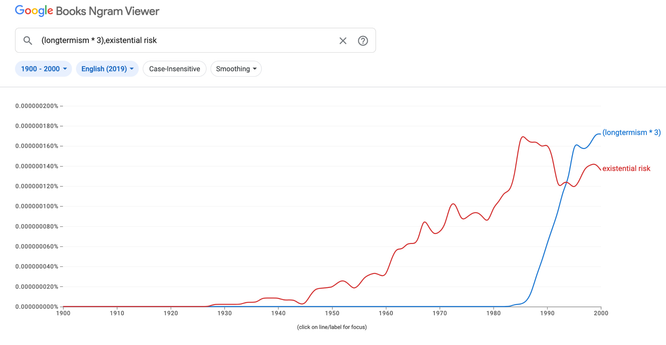
... but note that the term "existential risk" LONG predates the emergence of "longtermism", and through 2000 is also far more prevalent. See screenshot, and note that "longtermism" is multiplied 3x to scale equivalently to "existential risk".

I've strong concerns with any argument which leans heavily on such readily-refuted claims. The viewpoint may well be justified, but a bit less hyperventilating hyperbole and poor scholarship would greatly help the case.

The notion of "existential risk" was originally applied in a religious context (by Paul Tillich) and to nuclear weapons.

See:

#longtermism #ExistentialRisk #GoogleNgramViewer #Ngrams #WeakArguments #EmilePTorres

Bulletin of the Atomic Scientists

Google Books