 Matthias MProve
#GloriaMark said "our #attention spans are declining, averaging just 47 seconds on any screen." [today]
/via » The rise and fall of #TED « 📺 https://www.youtube.com/watch?v=QKg89xaS-GU
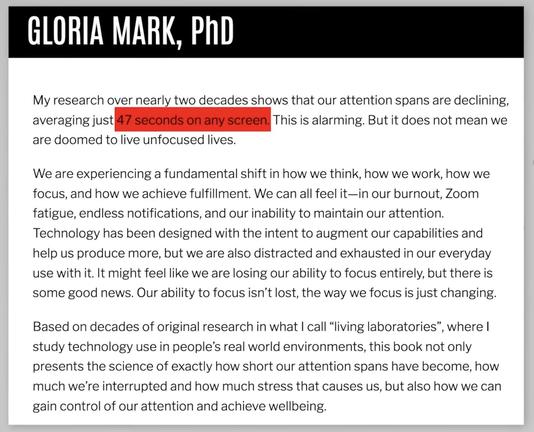
#GloriaMark said "our #attention spans are declining, averaging just 47 seconds on any screen." [today]
/via » The rise and fall of #TED « 📺 https://www.youtube.com/watch?v=QKg89xaS-GU
I can see a theme emerge as I work my work through this series. If you see writing as a precarious achievement then you are liable to throw as much time and energy as it as you can. If you see writing as a perpetual possibility then it’s easier to find a place for it within your days. My experience is the latter is more enjoyable (and sustainable) than the former but that it requires practice and process in order to realise this potential. Limits on your writing practice, being realistic about how long you can spend writing, figure heavily in this process.
In this post I’ll talk about another limit: knowing when (and why) to stop writing. In a 1935 article in Esquire Ernest Hemingway suggested that you stop writing “when you are going good”. If you experience writing as something faltering and unpredictable, a difficult task which requires extensive investment, this can seem profoundly counter-intuitive. But I think what Hemingway says here is rather profound in its implications:
The best way is always to stop when you are going good and when you know what will happen next. If you do that every day when you are writing a novel you will never be stuck. That is the most valuable thing I can tell you so try to remember it […] Always stop when you are going good and donʼt think about it or worry about it until you start to write the next day. That way your subconscious will work on it all the time. But if you think about it consciously or worry about it you will kill it and your brain will be tired before you start. Once you are into the novel it is as cowardly to worry about whether you can go on to the next day as to worry about having to go into inevitable action. You have to go on. So there is no sense to worry. You have to learn that to write a novel. The hard part about a novel is to finish it […] As soon as you start to think about it stop it. Think about
something else. You have to learn that.
If I’m engaged in a spell of intense writing over a period of time, I’ll aim to practice this rigorously. I don’t always manage it because it can be hard to stop when you are going good. But when I do succeed there is a deep and intuitive power to the method. Firstly, it gives you a place to restart the next day. In my experience you can literally pick up where you left off. It stops you worrying about the possibility you will struggle to write the following day. Secondly, it means you stop with a feeling of creative energy and accomplishment, rather than dragging things on until you feel tired. At the very least stop before you are going bad e.g. you feel tired, irritable, drained. This works just as well for stringing together writing sessions on a single day. Thirdly, it leverages the subconscious in the way Hemingway describes, which is a theme I’ll return to extensively in later posts in the series.
If you approach writing with a scarcity mindset in which you’re trying to extract as much creative output from yourself as possible, it’s tempting to see the words as precious resources to be conserved. But if you see the words themselves as functionally infinite, approaching writing with an abundance mindset, it becomes easier to think in terms of sustainability. Rather than exhausting binges which punctuate normal life, we can see writing as an enjoyable activity that is threaded through our days, in flexible and sustainable ways. It’s better to write 1000 words every day for a week, rather than write 4000 words one day and be unable to resume writing for the rest of the week. It’s more enjoyable too, I would suggest.
The mechanism leveraged by Hemingway’s technique is called the Zeigarnik effect: “an activity that has been interrupted may be more readily recalled” because “people remember unfinished or interrupted tasks better than completed tasks”. Interestingly the psychologist Gloria Mark cautions against this because we usually don’t want tasks to keep ‘running in the background’ and distracting us over the course of the day:
A good time to intentionally redirect your attention is when you reach a break point in a task such as finishing writing a chapter or completing a budget—natural places to pause. At break points, fewer cognitive resources are being used than when you are working full throttle. In the middle of a task, memory load is high, and interruptions are most disruptive.
Attention Span by Gloria Mark, loc 1742
In contrast it can be enormously helpful to do this with writing because it forms connections which surface when you later resume writing. The philosopher Bertrand Russell described this as planting ideas into the unconscious mind:
My own belief is that a conscious thought can be planted into the unconscious if a sufficient amount of vigour and intensity is put into it. most of the unconscious consists of what were once highly emotional conscious thoughts, which have now become buried. It is possible to do this process of burying deliberately, and in this way, the unconscious can be led to do a lot of useful work. I have found, for example, that if I have to write upon some rather difficult topic the best plan is to think about it with very great intensity – the greatest intensity of which I am capable – for a few hours or days, and at the end of that time give orders, so to speak, that the work is to proceed underground. After some months I return consciously to the topic and find that the work has been done. Before I had discovered his technique, I used to to spend the intervening months worrying because I was making no progress: I arrived at the solution none the sooner for this worry, and the intervening months were wasted, whereas now I can devote them to other pursuits.
Bertrand Russell, The Conquest of Happiness, Pg 49-50
The importance of capturing fringe thoughts, recognising the feel of an idea, rests on this process of planting. In a later post I’ll discuss the many ways in which you can plant ideas in the unconscious in this way, as well as the importance of working out the methods which are best suited to your own needs. But I would see the most important method as knowing when to stop writing. If you stop writing because you choose to, rather than because you’re defeated by the process, you plant the ideas of this session into your subconscious, ready to be picked the following day.
https://markcarrigan.net/2024/05/07/how-to-enjoy-writing-7-knowing-when-and-why-to-stop-writing/
#BertrandRussell #creativity #ErnestHemingway #gloriaMark #writers #writing #ZeigarnikEffect
This from Gloria Mark perfectly captures the ethos of Generative AI for Academics. We can use these systems in intelligent and creative ways, but that requires a commitment to reflexive engagement. I am extremely worried about the ‘path of least resistance’ Mark describes here, for both staff and students:
Our tendency to opt for the path of least resistance can further exacerbate this reliance on AI. Who wants to write a monthly report which is busy work? If we relegate that to AI, then what a boon for us. What I worry about though is that while we may have the best intentions to use LLMs in a limited way, it’s so easy for us to slide down that slippery slope. We may rely on using AI more and more to process that information for us, because we humans want to do what’s easiest. As a result, we risk losing the ability to reason critically, because we’re not doing it– AI is. Deep thinking is a skill that we cannot afford to lose.
We are doing ourselves a disservice when we blindly use AI to process information. We need to carefully consider which information we can relegate to AI and what we can best benefit from by engaging directly with the information. We risk weakening our mind’s muscle for critical thinking if we outsource much or all of our work to AI to do the processing. The only way to keep our mind’s muscle strong is to regularly practice deep processing of information. AI is a tool designed to help us, but let’s use it carefully. Let’s preserve our mind’s powerful muscle so that we can be present, say at a meeting or a lecture, so that we’re not there just physically but we’re also there with full mental awareness.
https://gloriamark.substack.com/p/lets-not-lose-our-ability-to-deeply?
 Mark Carrigan
