 %%sitename%% [Unofficial]
Bangladesh Makes Global Diplomatic History: Dr. Khalilur Rahman Elected President of the 81st UN General Assembly
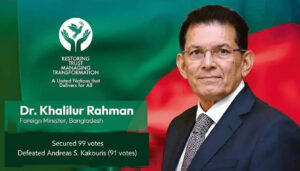
Bangladesh Makes Global Diplomatic History: Dr. Khalilur Rahman Elected President of the 81st UN General Assembly
The UN CSTD Working Group on Data Governance is entering a critical phase.
Join our online discussion on 27 January, 13:00 UTC/14:00 CET to explore its progress, ongoing consultations, and how to engage in 2026.
Save your spot! ⤵️
https://www.diplomacy.edu/event/decoding-the-un-cstd-working-group-on-data-governance-online-series-3/
>>> The Forum on Internet Freedom in Africa will take place on 22-26 September
In addition to ongoing efforts to shape technologies in support of social, gender, and environmental justice, #fifafrica will also serve as a platform for African voices to influence global digital governance processes, such as the #WSISProcess review and the #GlobalDigitalCompact:
APC at WSIS+20 Review High Level Event / Highlights of Day 2
With @redesac_mx, @derechosdigital, @keith, IT for Change and others
#wsis20 #DigitalJusticeNow #DigitalInclusion #CommunityNetworks #globaldigitalcompact #environmentaljustice


“While there are many claims being made, we lack answers to basic questions. Are the AI capabilities being developed today actually going to help with gender equality (goal 5)? With food security (goal 2)? With decent work (goal 8)? And more?
THIS should be the primary work of the scientific panel and global dialogue.“
Read my full remarks on the International Scientific Panel and Global Dialogue on #AI Governance for the #UN #GlobalDigitalCompact here: https://www.aspendigital.org/blog/global-digital-compact/
#AusDerWerkstatt 2025-03
Die Themen der Woche: Ein halbes Jahrhundert – es ist kompliziert. Eine offene, freie, sichere digitale Zukunft für alle – #GlobalDigitalCompact als Ergänzung der allgemeinen #MenschenRechte in Digitalien.
Global coalition calls for renewed commitment to an inclusive information society
> Organisations from civil society, the private sector and the technical community urge governments and institutions to reaffirm the World Summit on the Information Society's vision of a people-centred, inclusive information society.
Read our statement: https://www.apc.org/en/pubs/cross-community-statement-civil-society-private-sector-and-technical-community-wsis-igf-and
#WSIS20 #InternetGovernance #Inclusion #GlobalDigitalCompact

As the 2024 Internet Governance Forum (IGF) concludes, we, the undersigned organisations and individuals from civil society, the private sector and the technical community, call on all governments, institutions and organisations to affirm the vision of the World Summit on the Information Society (WSIS) of a people-centred and development-oriented inclusive information society.
"A people-centred and development-oriented inclusive information society".
> As we confront the challenges of rapid digitalisation, climate change-related uncertainty and persisting inequalities that are mirrored in digital divides, this vision is even more relevant now than it was 20 years ago.
Read the cross-community statement from civil society, the private sector and the tech community on #WSISProcess, the #InternetGovernanceForum and the #GlobalDigitalCompact:

As the 2024 Internet Governance Forum (IGF) concludes, we, the undersigned organisations and individuals from civil society, the private sector and the technical community, call on all governments, institutions and organisations to affirm the vision of the World Summit on the Information Society (WSIS) of a people-centred and development-oriented inclusive information society.

"The adoption in September of the Global Digital Compact (GDC) – a new multilateral framework for global digital cooperation towards “an inclusive, open, sustainable, fair, safe and secure digital future for all” – has been met with a cautious response from many in civil society. Cautious, because despite positive outcomes in the final text, there are also oversights, omissions, and problems with framing that we feel are fundamental to a just digital future.
As a way of reviewing where these gaps are, it is useful to look back at what we wanted out of the process a year ago, and where the gaps emerged. This is important because the implementation phases that lie ahead are as crucial as the negotiation process that led to the final text being adopted. There will be new opportunities for civil society to influence the outcomes of the Compact, and perhaps to help push the impact of the GDC closer towards some of the goals we previously envisaged."
https://www.apc.org/node/40393
#DigitalInclusion #HumanRights #DataProtection #InternetGovernance #Privacy #Encryption #GDC #GlobalDigitalCompact
The adoption of the Global Digital Compact (GDC) has been met with a cautious response from many in civil society – cautious, because despite positive outcomes in the final text, there are also oversights, omissions, and problems with framing that we feel are fundamental to a just digital future. As a way of reviewing where these gaps are, it is useful to look back at what we wanted out of the process a year ago, and where the gaps emerged.
 Open Knowledge Foundation
 APC
APC it's B! Cavello 🐝
 Franziska Köppe | madiko
 Matthew Rimmer
 Miguel Afonso Caetano