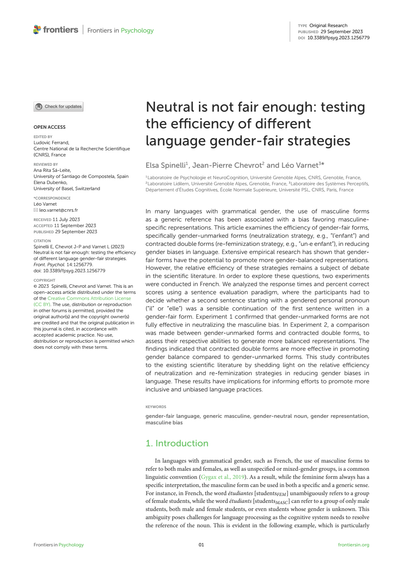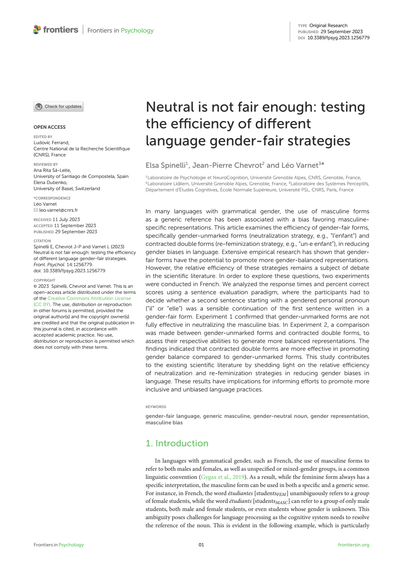
Our latest article on #GenderFairLanguage has been published in Frontiers in #Psychology! You can read it #OpenAccess here: https://www.frontiersin.org/articles/10.3389/fpsyg.2023.1256779/full
As one of the coauthors, I’d like to share some key insights from our research as a thread:
https://fediscience.org/@LeoVarnet/111311425433854277
#EcritureInclusive #GenderFair #GenderNeutral
Frontiers | Neutral is not fair enough: testing the efficiency of different language gender-fair strategies

In many languages with grammatical gender, the use of masculine forms as a generic reference has been associated with a bias favoring masculine-specific repr...

Frontiers

Using #language to counter bias favoring masculine-specific representations:
• gender-unmarked forms (neutralization strategy, e.g., “l'enfant”) are not fully effective in neutralizing the masculine bias.
• contracted double forms (re-feminization strategy, e.g., “un·e enfant”) are more effective in promoting gender balance compared to gender-unmarked forms.

Elsa Spinelli, Jean-Pierre Chevrot, @LeoVarnet: https://www.frontiersin.org/articles/10.3389/fpsyg.2023.1256779/full @psychology @psycholinguistics @linguistics

#rédaction #écriture #GenderFairLanguage #écritureInclusive #GenderFair #GenderNeutral

Neutral is not fair enough: testing the efficiency of different language gender-fair strategies

In many languages with grammatical gender, the use of masculine forms as a generic reference has been associated with a bias favoring masculine-specific representations. This article examines the efficiency of gender-fair forms, specifically gender-unmarked forms (neutralization strategy, e.g., “l'enfant”) and contracted double forms (re-feminization strategy, e.g., “un·e enfant”), in reducing gender biases in language. Extensive empirical research has shown that gender-fair forms have the potential to promote more gender-balanced representations. However, the relative efficiency of these strategies remains a subject of debate in the scientific literature. In order to explore these questions, two experiments were conducted in French. We analyzed the response times and percent correct scores using a sentence evaluation paradigm, where the participants had to decide whether a second sentence starting with a gendered personal pronoun (“il” or “elle”) was a sensible continuation of the first sentence written in a gender-fair form. Experiment 1 confirmed that gender-unmarked forms are not fully effective in neutralizing the masculine bias. In Experiment 2, a comparison was made between gender-unmarked forms and contracted double forms, to assess their respective abilities to generate more balanced representations. The findings indicated that contracted double forms are more effective in promoting gender balance compared to gender-unmarked forms. This study contributes to the ex...

Frontiers
Our latest article on #GenderFairLanguage has been published in Frontiers in #Psychology! You can read it #OpenAccess here: https://www.frontiersin.org/articles/10.3389/fpsyg.2023.1256779/full?&utm_source=Email_to_authors_&utm_medium=Email&utm_content=T1_11.5e1_author&utm_campaign=Email_publication&field=&journalName=Frontiers_in_Psychology&id=1256779
As one of the coauthors, I’d like to share some key insights from our research as a thread 🔽
@psychology @psycholinguistics @linguistics #EcritureInclusive #GenderFair #GenderNeutral
Neutral is not fair enough: testing the efficiency of different language gender-fair strategies

In many languages with grammatical gender, the use of masculine forms as a generic reference has been associated with a bias favoring masculine-specific representations. This article examines the efficiency of gender-fair forms, specifically gender-unmarked forms (neutralization strategy, e.g., “l'enfant”) and contracted double forms (re-feminization strategy, e.g., “un·e enfant”), in reducing gender biases in language. Extensive empirical research has shown that gender-fair forms have the potential to promote more gender-balanced representations. However, the relative efficiency of these strategies remains a subject of debate in the scientific literature. In order to explore these questions, two experiments were conducted in French. We analyzed the response times and percent correct scores using a sentence evaluation paradigm, where the participants had to decide whether a second sentence starting with a gendered personal pronoun (“il” or “elle”) was a sensible continuation of the first sentence written in a gender-fair form. Experiment 1 confirmed that gender-unmarked forms are not fully effective in neutralizing the masculine bias. In Experiment 2, a comparison was made between gender-unmarked forms and contracted double forms, to assess their respective abilities to generate more balanced representations. The findings indicated that contracted double forms are more effective in promoting gender balance compared to gender-unmarked forms. This study contributes to the ex...

Frontiers
The findings indicated that gender-unmarked forms do not fully neutralize the masculine bias. For example, “l’enfant” has no fixed grammatical gender, still our participants mostly interpreted it as “male child”. This is probably because, in everyday language, gender-unmarked forms are often used as generic masculine terms (“Ils ont eu un enfant”) or carry underlying masculine stereotypes (e.g. “citizen” in George Bush’s “We cannot tolerate attacks on the wife of an American citizen”). (5/7) #EcritureInclusive #GenderFair #GenderNeutral #GenderFairLanguage
Neutral is not fair enough: testing the efficiency of different language gender-fair strategies

In many languages with grammatical gender, the use of masculine forms as a generic reference has been associated with a bias favoring masculine-specific representations. This article examines the efficiency of gender-fair forms, specifically gender-unmarked forms (neutralization strategy, e.g., “l'enfant”) and contracted double forms (re-feminization strategy, e.g., “un·e enfant”), in reducing gender biases in language. Extensive empirical research has shown that gender-fair forms have the potential to promote more gender-balanced representations. However, the relative efficiency of these strategies remains a subject of debate in the scientific literature. In order to explore these questions, two experiments were conducted in French. We analyzed the response times and percent correct scores using a sentence evaluation paradigm, where the participants had to decide whether a second sentence starting with a gendered personal pronoun (“il” or “elle”) was a sensible continuation of the first sentence written in a gender-fair form. Experiment 1 confirmed that gender-unmarked forms are not fully effective in neutralizing the masculine bias. In Experiment 2, a comparison was made between gender-unmarked forms and contracted double forms, to assess their respective abilities to generate more balanced representations. The findings indicated that contracted double forms are more effective in promoting gender balance compared to gender-unmarked forms. This study contributes to the ex...

Frontiers