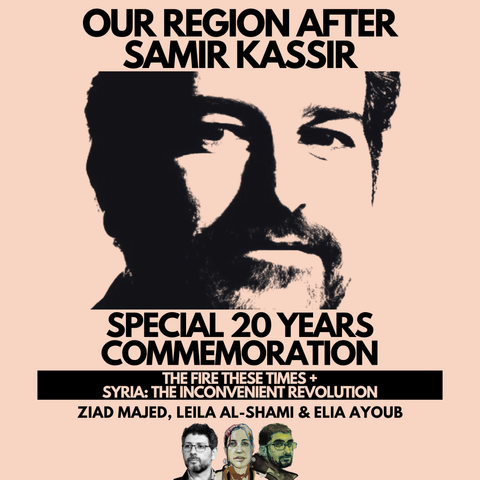
Our Region After Samir Kassir: Special 20 Years Commemoration w/ Ziad Majed

It’s been 20 years since the Assad regime assassinated Samir Kassir, the Lebanese-Syrian-Palestinian historian, journalist and writer in Beirut on June 2nd 2005.

For episode 197, Lebanese-French political researcher and academic Ziad Majed, a friend and comrade of Kassir, joins Elia Ayoub and Leila Al-Shami to talk about his legacy in the two decades that have passed given how much has changed since for Lebanon, Palestine and of course Syria.

This is a special cross-over episode between The Fire These Times (TFTT) and Syria: The Inconvenient Revolution (STIR). We are both part of the From The Periphery Media Collective. To support all of our projects please head out to⁠⁠ ⁠⁠⁠⁠⁠Patreon.com/fromtheperiphery⁠⁠

Resources:

Samir Kassir:

Credits and More:

  • Hisham Rifai (Illustration)
  • Omar Offendum and Sami Matar (Music)

Date of recording: May 30th 2025

#FreeHomayoun

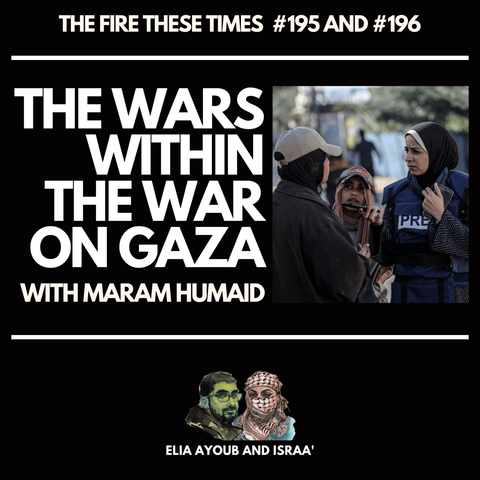
The Wars Within the War on Gaza w/ Maram Humaid

For episodes 195 and 196, Elia Ayoub and israa’ are joined by Gaza-based journalist Maram Humaid to talk about the many layers of Israel’s genocide, the everyday of those trying to survive it.

The Fire These Times is a proud member of⁠ ⁠From The Periphery (FTP) Media Collective⁠⁠. Check out other projects in our media ecosystem: Syria: The Inconvenient Revolution, From The Periphery Podcast, The Mutual Aid Podcast⁠, ⁠Politically Depressed⁠, ⁠Obscuristan⁠, andAntidote Zine⁠.

To support our work and get access to all kinds of perks, please join our Patreon on Patreon.com/fromtheperiphery 

More:

The Fire These Times is a proud member of⁠ ⁠From The Periphery (FTP) Media Collective⁠⁠. Check out other projects in our media ecosystem: Syria: The Inconvenient Revolution, From The Periphery Podcast, The Mutual Aid Podcast⁠, ⁠Politically Depressed⁠, ⁠Obscuristan⁠, and ⁠Antidote Zine⁠.

For more:

Credits:

Elia Ayoub (host, producer, episode design), israa’ (host), Ayman Makarem (producer, sound editor), ⁠⁠Rap and Revenge⁠⁠⁠⁠⁠⁠ (Music), ⁠⁠Wenyi Geng⁠⁠⁠⁠⁠⁠ (TFTT theme design), ⁠⁠Hisham Rifai⁠⁠⁠⁠ (FTP theme design) and ⁠⁠Molly Crabapple⁠⁠⁠⁠⁠⁠⁠ (FTP team profile pics). pics).

Transcript prepared by Lizartistry and Antidote Zine:

Every day coming is not a new chance. It’s a new challenge. It’s a new circle of inventing solutions for everything.

Elia J. Ayoub: Welcome to another episode of The Fire These Times. We have a special episode today. We interviewed Maram Humaid, who is a journalist from and based in Gaza. How would you describe this episode, Israa’?

Israa’: The thing I’ve been sitting with is the humanity backing what we’ve been witnessing. There’s a different telling of the story that’s happening here: it’s the day-to-day lived experience, it’s the survival, it’s the facing death non-stop and still trying to cultivate life in the face of constant death. 

Something that kept coming up for me during the episode was the aura of resiliency and how strong Palestinians are. But also, it’s collective devastation and suffering—resiliency at this point feels like an insult to me. It’s a way of separating, distancing, idolizing and putting it on a pedestal, and making it okay for the rest of us to be okay with what’s happening.

EA: I agree. The details of our every day, the past few months, the past couple of years almost, that’s what got to me the most. The headlines are what they are at this point. Most people who are informed are as informed as they can be. What Maram offered was telling us the difficulty of the mundane. How do you maintain an education for your kid? How do you get basic food? Stuff like that. She clearly had a lot to say. As we say in Arabic, fasshit khele’—Let it out

We were both very grateful for the time she put in, given everything that’s happening. In the episode itself there was an airstrike not too far from where she was. It’s these things. She’s only been eating lentils and pasta for a long time now—when her kids are watching YouTube videos, they have to pay attention to whether there’s certain foods that appear that are not available in Gaza that her kids will then ask, Why don’t we have that? These are the things that really stuck out for me and made it really meaningful again.

I: It had me reflecting about comrades and friends in Gaza. When I asked the question, How are you?, what does that actually mean? A lot of what she said is repeated over and over again. It’s unbearable. It’s getting worse by the day. The people need support. There is no way to fully capture what’s happening there, and the reality is: that is part of the war. One of the things that came up in the conversation is the war within wars, and one of those wars is trying to convince people that it is beyond anything you could actually imagine or think.

EA: The metaphor she used of wars within wars really stuck with me. There is no way of explaining perfectly what happened, but the entire episode is as good an approximation as it gets. She has so much she needs to share and so much to tell us. You even get the sense that as deep as the story goes, there’s always another layer that she doesn’t have time to get into. She does a good job as a storyteller. 

As someone who’s not in Gaza, and same for you, it felt like this is as close an approximation as humanly possible without actually being there.

I: It also became very apparent for me: the failures of journalism and how much it strips down, because We want to focus on the facts—but it’s stripping the humanity of what’s actually happening, and so it’s diluting the experience. It’s generalized statements, facts, and numbers, and it’s too big for most of us to hold or understand, or comprehend what that means. Listening to her talk really brought the people back into the picture. This is what it means to be going through genocide. This is the experience of genocide.

EA: There’s a kitchen in Gaza you’re involved with. Do you want to tell us a bit about it?

I: This is a community kitchen I’ve been working with for over a year and a half now. We’ve operated basically everywhere—the north, the central, the south. Beyond the community kitchen there’s free water distribution. Yesterday we did both the kitchen and water distribution, and baby formula distribution. We’re individuals coming together and doing what we can. We’re solely funded by people’s solidarity and support. 

We’ll put the link in the show notes, but it’s gazamutualaid.org/aid. Spread the word out. Give what you can. This is literally a lifeline. You’ll hear in the episode Maram talking about her privilege in being able to access, and how many other people don’t have access, and this is who we’re trying to reach with the community kitchens, the ones who have no access.

EA: Here’s the episode everyone. Thank you for listening.

Maram Humaid: This is Maram Humaid. I’m a journalist from Gaza. I work with Al Jazeera English Digital—I’m their correspondent on the ground in Gaza for six years. This is my second year covering the war in Gaza.

EA: Thank you so much for taking the time to talk to us. We were trying to record this about a month ago but the situation forced us to delay everything. We’re grateful that you managed in the end. The first question—I feel ridiculous asking it, but how are you and how are you coping? What can you tell us? Whatever you want to share.

MH: How are you in Gaza? I hate this question, actually. I’m so sorry. Every time someone asks me, How are you feeling, how are you? I can’t find the appropriate words to describe the situation going on. Every time I receive messages from my friends and colleagues checking on me—when I get back to the messages asking me, How are you? it would be one answer: The situation is getting worse and it’s unbearable, unbearable, unbearable

Here I’m living the worst stage and the worst phase of the war in Gaza. And yet, I was answering the same: unbearable, unbearable. I was giving these answers before. It’s so insane. It’s so sad that the situation in Gaza only gets worse. It gets unbearable for every one of us. For myself, I find every day coming is not a new chance. It’s a new challenge. 

It’s a new circle of inventing solutions for everything, starting from the food for my kids, then charging my batteries and charging my mobile, then finding a space to work on some pieces with a desk, and then go back to wash the laundry by hand for the kids, and plan out what we would prepare for lunch for the kids. And hearing the constant bombing and shelling around us—this is a forgettable layer of our constant struggle: it’s not only about bombardments. It’s not only about bombing. It’s not only about the continuing of this genocide. No. There are layers of suffering that make the life under this genocide impossible for everyone. This is the answer for How are you?.

EA: It’s not a good question. I completely understand why you would hate it at this point. 

We wanted to record about a month ago. How much has changed in the last month? What can you tell us about how much worse things are getting?

MH: Today is day eighty-two of the continuation of the borders that were shut down around three months ago. During those three months, the first question and the first concern for everyone in Gaza was about food—the food crisis. Every one of us is out of stock. We are just consuming what is remaining. It’s so funny. It’s so sad that the first question that occupies any chat here and any phone call is How are you? What are you doing with the flour? What are you doing with food? Did you try making bread with the pasta and the lentils? I am sharing experiences and they share their experiences: Let you add a cup of flour, let you add a cup of lentils, just mix the pasta with the flour. This wouldn’t consume the amount of flour that you have. This will help you save more flour for the upcoming days

And they would share how they prepare kebab out of lentils. They sent me the recipe to make kebab out of lentils—this is the everyday chats. I feel that we are immersed in endless suffering and it just became our daily life. In our chats and when we do family gatherings, we sit around each other talking about who has died, who was killed, who survived, what happened when we were displaced, and that moment when we ran away because of the nearby bombing, and our plans because we have the last remaining bag of flour. 

This is the concern during those months: the bag of flour. How can we get an extra bag of flour? I was calling my sister just a few minutes before this call, and she was telling me that their home is the only home inside the building that they live in who still has flour. She celebrated this news to me. We are the ones now who still have the flour! They are just exhausted and concerned to find other ways of how to prepare food.

The past three weeks, as you can see in the news, Israel heavily escalated their military operations in Gaza. While you are concerned for food, you feel the non-stop airstrikes around you. The non-stop bombing and shelling, the news of threats that Israel will escalate their operations in Gaza. Imagine that people are hungry, concerned for food. They have no energy to stand even, and to practice their lives easily. They are facing this unbelievable way of dealing with displacement, dealing with atrocities and brutality, with the Israeli genocide around them. 

The start of this week was miserable for me, because the building just before us is a six story building and they told me (because I’m living on the ground floor) they could see the tanks out of the building. I’m living in Deir al Balah and Israel deployed more of their forces on the eastern borders of Deir al Balah. I’m living near the eastern borders, and people in the building told me that they could see the tanks. Someone who started the day hearing this news—it was very frustrating, very devastating. What should I do? How can I plan? What should I plan? What is the plan? 

We (me and my husband) went to the top of our house, looking to the borders, planning out, and talking about If the tanks would come through here they would come from that gate. I was thinking, What are we talking about? We are mere civilians, people who used to live freely, not plan for the military and how we could evacuate, how we could jump out of this place to another place in order to escape the shelling. This happened while the artillery shelling was hitting, with horrible sounds around us. 

This has been the situation for the last two weeks—precisely, ten days. You could see now how people are being kicked out of the north of Gaza, of Beit Lahia and Jabalia and also from Khan Younis, from the east of Deir al Balah. Rafah as well was occupied a long time ago. People are being pushed into unknown areas. We are living in the central area but we still don’t know if this is the meant area—people are being bombed in the central area, in Al-Mawasi, Khan Younis, the south of Gaza, the north of Gaza. Every single area in Gaza is being bombed, targeted. 

There is no safe place. We’re just waiting. I’m just waiting for the unknown. I don’t know. I’m sure when the zero hour came, I would take my children and run away. I will leave everything behind me, and this has been the case for many people who were displaced under fire at a random hour. At a random moment you would hear the crazy bombing around you, and the only idea you would think about is how to survive this and how to run away completely with your children, with your family. This is the biggest dream at that moment. 

I: We see all these headlines, these numbers of X amount martyred or displaced, or this many people are starving, and what you’re bringing in right now is the daily lived experience of these numbers and the actual struggle of what it means to survive a genocide, a mass starvation.

MH: I’m one of the few luckiest ones in Gaza who are living in a home, who still have internet access, electricity somehow through solar panels. But the vast majority of people don’t enjoy these privileges I get—after I paid a huge amount of money in order to secure it. Still I’m suffering. I’m hugely suffering. I’m suffering because it’s not a normal life. 

Let alone the people on the ground who are living in tents, in the streets—just total displacement. This is not my home. I rented this home five months ago. My home was destroyed back in the north of Gaza. I was displaced in Deir al Balah. It’s my second year of being displaced after my home was bombed back in Gaza, and also my family’s home, my in-laws’ home. When people returned to the north, I wasn’t able to return because there was no plan, no place. So I stayed in the place I rented, which is now in Deir al Balah.

After this long circle of trying to find solutions for every step—every step here is struggle. You end up facing hunger, facing starvation, facing famine. Facing the huge appetite for killing. They need just to kill, kill as much as they can. Yesterday I did a “suicide attempt” because I went to the market. Stepping out of your home is a huge risk these days, but I was forced to yesterday because I needed to buy something from the market and I went there. The moment I arrived, there was a bombing in the market. People were trying to buy groceries and some of their needs, and there are people who were in chaos and they were shouting, Open the way! Open the road! And I found myself picking a thing and trying to get home as quick as I can. 

My husband told me, You see? You went to the market and I told you that it’s very dangerous to go out! I’m alive. I’m alive. It was so unbearable. Unbelievable. Those words aren’t enough for me to describe the situation. Every time when you try to practice and grab a glimpse of your life, that life of getting dressed and going to the market to buy something you need, this is a risk. This equals a huge risk that you may lose your life. 

But still, it was so common, on the way to the market that you see people who are standing by the road holding white shrouds of their beloved ones killed, and asking drivers to take them to the cemetery in order to bury them. You could end up in a car in a seat next to the driver and in the backseat there are three people holding shrouds, and it’s a normal life. People are just picking cars to go to the cemetery like it’s an ordinary life. It’s an ordinary scene of life. You are going to shop, and those people are also going to the cemetery like it’s a usual thing they are doing. 

There is an error here, implanted in our minds, how life in Gaza had developed and reached to this point. It’s the silence. We were left to face this death, we are abandoned and live in misery, trapped in this situation with no end. It’s an endless suffering, and everyone adapted with it. That’s it. We are not adapted, but this is life. This is how you survive this life, how you can plan it out with yourself.

Khalas! I’m not a normal person. I’m not thinking like the default system of this world. I’m out of the default system of this world. That’s it. As someone who’s living in Gaza, I’m excluded from the whole system running this universe. There is another total normality and reality in Gaza.

EA: I watched some of the interviews you’ve done for Al Jazeera and I’m thinking of some of the people you’ve interviewed who would say things like, “Badi amoot bi dari”—I will die in my house, I want to be there. The video I’m thinking of was a few months ago during the brief ceasefire. How are people thinking about the recent developments? Is this more, We’ve already been abandoned so this is more of the same, just worse and worse, or is there a sense that now things are different?

MH: There are always those people who are stuck to the idea of staying in their country—We won’t leave no matter what happens—especially those people who are in their fifties and sixties, elderly people. They stick with their lands. And there are also some of the youths—but in general when you talk to the people in their twenties and thirties you will hear, frankly, that they want to leave. They want to go out. The spring of their lives shouldn’t be spent in this suffering. They share that they will leave no matter what is the method or the means—if it’s an Israeli one, if it’s being kicked out by Trump, if they open the borders officially for the people. 

They want to leave, and I can’t hide that I’m one of those who are thinking of this now. I can’t continue my life like this, especially because I have kids. My daughter is nine years old and my kid will turn two years next July. He spent the first two years in his childhood living this situation. For the sake of their future, I would like to search for another place. 

This is a luxury! The huge problem for the people of Gaza is that the self-determination is taken out of them. We don’t have this pleasure, this luxury, of deciding what we want to do. We are trapped, and the crossings are shut down in front of people. They are being bombed, starved, humiliated by all means. We are trapped. In all the crisis that has swept the whole world—Sudan, Syria, Lebanon, Ukraine—the borders were open in front of people to flee. This should be the least demand for any human beings. 

Okay, you will fight against Hamas, you want to erase Hamas, you want to eliminate Hamas bases in Gaza? Khalas! Open the borders for the people to leave. That’s it. Even this is not available for the people, and we are being killed. Everyone could see the number of civilians, kids, women, and innocents who were killed during this genocide. 

I spent the whole eighteen months of this genocide reporting from a hospital. Every day I was standing in front of an emergency department, and I was seeing the bodies of people who were killed and evacuated from the bombed places. Most are women, most are kids—shrouded in white, kids shredded into pieces. In every attack to a home, without being notified or alarmed that it would be bombed, twenty-five to thirty people. And there are people who were displaced to the south, so you have crowded homes, with people who were displaced to their relatives, to their friends’ homes, where they were living together. So when it was bombed, the number would be doubled and tripled with the people living in these homes. 

You cannot imagine the situation of punishing the people of Gaza this way. I’m totally convinced it’s a genocide. It’s meant to erase those people from the ground—with a green light from all countries, from all people! Arab, Islamic, European countries, the US. Everyone gives the green light to erase the people of Gaza. 

It shouldn’t be…you see—I think this one is near.

EA: For those listening, because they may not get it on Zoom: you’re saying there was an airstrike nearby.

MH: Yeah, it’s a near strike, an airstrike nearby. I think it’s in the central area because the sound shook the home.

EA: I saw the home shaking.

MH: This has been the case throughout the past days. Still, this is a calm day, by the way, because the past three days—nonstop. Literally nonstop, every two minutes, every three minutes. It was really tense, bombing everywhere.

EA: I listened to the episode your daughter did with This American Life last year. 

MH: I will give you some of Banias and Iyas’s life, my children. I rented a home and I spent all my savings in order to secure some solar panels and buy a screen to create a small escape for them, to watch TV and have access to internet. I did many attempts in order to have internet access back—three months of struggles with the telecommunications company. Now they sit in front of the TV watching YouTube channels and videos. There was a surprising point I didn’t think about, which is that the only meals I can give to my family now are pasta with tomato sauce and lentils. This is the only thing. People outside are not even able to provide this for their families. 

One day I was cooking. I prepared pasta with tomato sauce. I was serving this to Iyas and Banias who were watching a video, and it was calling, Are you hungry? Yes, I am. And there was watermelon, strawberry, all these candies and sweets on the screen. I was like, Oh my gosh. It was like the world is moving on one side and we are living on another side. All over the world, kids are watching these videos as this is the normal way—kids are interested in watching these things. This is the common curriculum for kids to watch. And for the people of Gaza, the kids of Gaza, this is a totally other experience. 

Banias was telling me, Mama, you see? Even the dolls are eating strawberries and bananas and apples! The point here is that no matter how hard I tried to escape from the atmosphere of war and to create an atmosphere for my kids, every step or every scene will chase me to remind me: You are not living a normal situation. It was my kids who were eating pasta with tomato sauce for maybe the thirtieth, fortieth, fiftieth time (there is no count!) during the past three months. No eggs. No good nutrition for them. No chocolate, no candies, none of these things that children love—and when it comes to watching TV, they could see these things in videos. As a mother, I could only stand in front of them numb. I couldn’t do anything.

One time I was reading a book for my kids, and there was a scene: the character of the story left their home and went to a place, and they erected a tent in order to have a warm, calm moment away from the chaos of the city. He was talking about how it’s lovely to live in a tent and be away to do some camping. Oh my god, people in Gaza are camping throughout the whole two years! How could I convince my son to implant this idea that living in a tent is interesting? No, it’s not interesting. For me in Gaza, it’s not interesting. Camping is forbidden. This idea is totally the opposite.

I’m not a normal person anymore, khalas! I’m not a normal person. I’m not thinking like the default system of this world. I’m out of the default system of this world. That’s it. As someone who’s living in Gaza, I’m excluded from the whole system running this universe. There is another total normality and reality in Gaza. How people are establishing things, the rules that are running the whole universe around us are totally different. What I’m watching, what I’m reading—these are things that should link the whole of people around the world together: the food they are eating, the things that children are interested in, these tiny ideas of reading books. But when it comes to the details, I feel I’m different. I’m someone who is excluded from these pleasures of life and these privileges out there.

I: In the article you wrote for Al Jazeera, in your dedication to your mother—Allah yirhama u yibarek feeha—you said, “Mama, we, the tormented in this land, are in a free-for-all festival of death.” That line keeps running through as I’m listening to you talk. There’s the fighting for normalcy, for life, to cultivate some kind of life, but death permeating everything. Like you’re saying, no matter where you go, no matter where you turn, it’s there. It’s facing you. Every single action you’re taking throughout the day, this is something that you’re encountering.

MH: When my mother died, it was another layer of feeling that you are more oppressed, you are more alone. The way she lived through the war and then left to Egypt for treatment, and died back in Egypt—the story that was hiding between these details and how we were chasing time just to call her! There wasn’t even internet at the time to call her. Even when it wasn’t with the typical communications company, it was a normal act of punishment that Israel would cut the whole telecommunications, the whole internet. We are out of coverage, and people are connected through e-sim. I was trying to walk miles and long distances in order to reach a place that I would be able to connect from an e-sim and send to my sister with my mother that we are okay, that we are doing well. 

I was thinking of her. Her health wasn’t good, her psychology. She would be very worried now about us. We were disconnected, and for her in Egypt, she would think that we may be bombed or killed or something happening. So I would take this long journey in order to send her this text message.

Since my mother died, they closed the borders. It was the last day when they had invaded Rafah—Rafah crossing, the only crossing for the people of Gaza to travel outside Gaza. The crossing of Rafah was open for the first seven months of the war, and then it was closed totally. It was open in front of the individual movement but the thing that everyone should know was that it wasn’t open for free. Everyone that should leave Gaza has to pay five thousand dollars in order to leave. It wasn’t a reasonable amount. You have to pay a huge amount of money in order to leave. 

My brother paid this amount of money. He paid twelve thousand dollars in order to leave. Once he arrived in Egypt he told me, We paid the price of our lives. My life cost five thousand dollars, so I paid for my life and for the life of my wife and kid. And this is how we evacuated Gaza and left.

Since then, life has become darker for me. Somehow you live depressed and immersed in more and more crises. But somehow I wasn’t feeling alone. I would assure myself that Maram, you are standing every day in front of shrouds, in front of people crying for beloved ones. This is the festival I meant: the free death festival—because it was really a festival, every time I was entering the hospital. I remember the first time I entered the hospital, I saw around forty bodies shrouded and white in front of me. I was shocked, and my body was trembling with fear. It’s the huge loss, what we call the “hayba,” the huge fear of death, the huge size of death, that occupied my body. 

Then, after that, day by day, it became a totally ordinary scene for me. I wouldn’t be shy to say that I started to drink coffee while seeing people praying al-Janāzah, shouting and crying, and seeing the chaos of the ambulances evacuating, more people killed. It became an ordinary scene. I see on my laptop, working on a piece, and Oh, okay, there was an airstrike in Deir al-Balah, oh my god. It seems like five people were killed. Okay. And then I would continue my life.

When my mother died—no one can replace the mother’s place and it’s a huge loss. But they say, “Almoot ma aljamaa rahma” [“Death in a group is a mercy”]. I was lucky because my mother died—for many of my friends and my colleagues, they lost their whole families. I know many of them, they stand alone. No sisters, no brothers, no relatives. They are alone. They lost all the members of their family with one bomb, one strike on their homes. Now they stand alone. 

I would remember those tiny, little kids whom I worked on their stories. I feel shy to even mention that I am sad for my mother’s death, because those children are just a few months old. Some of them just two, three years, under five years, and they’ve lost both mother and dad, both of their parents during the war. Adding to that, I met many kids who didn’t only lose their families, their parents, they also lost parts of their bodies. Their legs were amputated—both of their legs were amputated. Some of them have triple amputations.

Living and spending time in the hospital, I feel this is the biggest thing that helped me to feel a little comfort after my mother died. I imagine if she died before the war or in another situation, I would have felt crazy. But during the war, there was huge grief. There was huge suffering, but somehow it was comforted by the huge amount of atrocities and the free meaning of death happening and going around us at the time.

I: Something that I hear a lot is that there is no time to grieve.

MH: It’s a luxury to sit and cry. There is no time for grief. I would add to this point: when my mother died, we cried and it was a total moment of feeling devastated. And then [came] the moment they declared they would invade Rafah and people were coming to evacuate from Rafah to Deir al-Balah. My aunt was crying. She was very sad with my mother’s loss—she’s in Rafah, and saying Forgive me, I can’t come today. We are packing our stuff and we’ll be searching for a place in Deir al-Balah. I offered her a space; my mother died three hours ago and I was offering my auntie space. We have extra space in our home and you can come to stay with us. And she said, We are fifteen members. We can’t come! We are already forty people living in the same place so we cannot come

We were chatting about what we should do and she was telling me about how it’s difficult to secure a car or a vehicle to move her belongings from Rafah to Deir al-Balah. It was totally chaotic in the streets that day. People were evacuating. When you go to the street you would see people packing their stuff and their belongings on the carts dragged by animals, and tuktuks and trucks holding people with their stuff and belongings, and people erecting new tents in their place. It was totally chaotic. There was no time to grieve. 

We were directly occupied by the scenes and the situation around us, and many of our family members were offering their condolences over the phone and saying, We are evacuating from Rafah. We could see you after we come and organize our stuff in Deir al-Balah. And we would say, No, no, we don’t blame any one of you. Allah yirhamha [god have mercy on her], it’s totally fine, and Allah yieen alnas [may god ease people’s suffering]. This is how people are assuring each other. Everyone is totally busy with his own concerns, his own endless suffering that kept unfolding throughout the genocide. 

People were experiencing displacement and evacuation more than fifteen, thirty, forty times. You have endless stories of those people. So yeah, no moment—no time to grieve. People were burying their beloved ones at the hospital, in the cemetery, and after a mother would calm herself down because the home was bombed, now there was another task of pulling out their belongings from under the rubble and going to search for another place to stay. If there are some injured people in the family, they will take care of those injured people, and if some of them need medical treatment outside Gaza they would run in order to secure some medical evacuations for those injured. 

No time to breathe. It’s suffering that you cannot even feel balanced to absorb what is going on. No time for anything. Sometimes if you thought about it, it would feel that those who died, those who were just killed, are enjoying comfort and rest, but those who stayed alive are suffering, and they are trapped in this endless misery around us.

Part II

I am fighting. The war has a lot of hidden wars inside the war—the war of keeping your family alive and fed with food, the search for an escape for your children.

EA: I have a kid. She’s going to turn two in October. She was born a week after the genocide started. She had a very difficult first few months of life: she was born very prematurely, she had to be in the incubator, all of that stuff. But throughout the entire thing, even at the end of 2023, I still remember those stories; there was the hospital that was bombed that also had incubators in it. I was very worried for her, but she was getting all the care that was humanly imaginable. It was very difficult—on the one hand I’m very worried, and on the other hand, alhamdulillah, we have everything we need. Things are okay and stable. 

I listened to your kid talk on that podcast, still having a childhood of some kind, and you still being able to keep them busy and stimulated—I don’t know what to say other than yaatikeh el aaffyeh [I’m grateful for your work].

MH: I am fighting. The war has a lot of hidden wars inside the war—the war of keeping your family alive and fed with food, the search for an escape for your children, especially for my daughter because she’s aware of what’s going on. 

It has two shapes, because Banias herself has been a positive girl and her life before the war was interesting and filled with activities. I enrolled her in a private school; it was one of the modern schools in Gaza, and she was enrolled and trained in swimming, horse riding courses, memorizing Qur’an. She was also enrolled in a music institution and learning how to use a piano, and participating in chorus. Her life was busy. Her room was packed with books. She was reading. Screen time and mobile was forbidden in my home. I was giving only two hours after her schoolday time, and that’s it. The whole day she was busy with those activities, especially reading books. 

I could remember her in her room busy with reading books, and spending time—especially the time before sleep—reading books. That’s reflected in her personality, character, and her way of thinking. Sometimes she would surprise me in how she responds, and this was totally reflected in the American Life episode. I myself was surprised by the way she responded to the presenter. I know my daughter, but I knew her more through this episode. It was totally different for me, the way she was dealing with the situation. 

This is what surprised and saddened me: because I was busy with reporting and my work, I didn’t realize that my daughter was creating an escape from what was going on. In front of me, she was showing her sadness and frustration and being worried of the situation, especially when the tanks were near us back in last August and July. The tanks were nearing us, and we were trying to find a place to evacuate—my family was also living with us—and she was crying and crying. When she called the presenter, she was like, Everything is okay. Nothing is happening. I’m not afraid. Nothing is happening! I was surprised, like, What is going on? 

That day I discovered that that call with that presenter during months of the war was like her escape bubble of the situation. This presenter lives in the US; she’s not living with us, so [Banias] could see tisrah feeha ala keifha [she could roam as she pleases]: everything she wants, her imaginary life, her pinkish world, and giving some spices of the war going around us. Every time Chana was asking about the war, Banias felt dizzy and Okay, it’s time to sleep. Khalas, it’s over. I won’t continue this convo anymore. Chana was her escape during the war. 

Out of this conversation, I decided to focus more on this escape zone and to create as much as I can, and plan. That’s why I bought the screen, I rented a home in a place that is in a garden, in agricultural land in Deir al-Balah. Once we came here, she’s busy discovering the bugs and the insects. Every time she would come to me holding a flower: Mama, I discovered this flower and this bug! Now she’s having this—this is called muthaqaraat alshakhsiya alyawmiya la yuslah al itilaa min ghair ithin [my daily diaries that no one can look at without permission]: she’s writing her daily remarks. I tried to help her, now she’s calling herself a naturalist and she’s discovering nature. 

Every time, her phone is packed with videos: running behind the cats and the bugs. This is a ladybug. Mama, see, this is a snail! I try as much as I can to encourage her, to be focused with such things. I taught her how to use Google photos in order to take pictures of the things she’s discovering, in order to read more through the internet. 

It was about striving to create another world for our kids, liberating us from this harsh and brutal world we are living in. This is my first target, my first goal every day. That’s why I felt very frustrated and crazy when I saw that “I am hungry” song. I felt like, Oh my god, what should I do? What in the hell is going on? 

Today she was happy, because we finished our second year online. She’s studying online, and that’s why I insisted on the internet connection, to let her continue her education online. For the children of Gaza, they missed the second school year being under the war. But for myself, it was a matter of life. I worked as much as I can with my sister back in Egypt, because there was a program launched by the Palestinian embassy in Egypt in order to help children and students who left to Egypt to continue their education online. 

My sister, my mother, and I at the time did tazwir [forgery]; it was an unlawful way of bringing Banias a crossing stamp that shows she is in Egypt. We submitted it to the Palestinian embassy, and that’s how we enrolled her name inside the lists of students in the Palestinian embassy. I did a big fight in order to have the internet back in my home, and I paid a bribe to someone in the telecommunications company. Every time she would sit in front of the computer or the mobile taking her online classes, if there was a drone or the sound of bombing or airplanes around us, I would tell her to mute the mobile and don’t answer. You can just say anything, that there is a problem in the internet. It was a secret education process. 

The first year ended up with her being accredited, and we received a certificate that she officially finished her third class. Now she’s in the fourth grade, and today she celebrated that her name is again accredited for those who would receive the fourth grade certificate. For the second year we achieved success, and this means a lot to me as a mother: that I put all my efforts for my kid not to miss a school year, not to miss anything. I keep encouraging her all the time that education is our tool for everything, and we should keep our minds occupied with useful things as much as we can, and you should feel lucky that you have this chance. 

Imagine a child living in this situation of the war, being deprived of everything—food, school, friends, colleagues, just enjoying time alone. She’s totally deprived of the normal life. Sitting in front of the internet and attending online classes is such a big challenge, but I don’t put pressure on her to be the skillful one. I tell her always that you need to attend and absorb and focus as much as you can. Sometimes it works and sometimes she would protest, No, I won’t attend and that’s it! But at the end we succeeded, and inshallah within a month we would be finishing the fourth grade and receiving another certificate. 

EA: What I’m hearing is a mother who is very proud of her kids.

I: And fighting against hell itself, against empire itself, to offer everything.

MH: Survival management. This is the mechanism I’m following these days. These years are being taken out of our lifetime. Nothing will compensate us for these years. For myself, I’m a grownup—I had my childhood, I continued my education. But it was unbelievable to witness that the life and education of your kid is being taken away, and your plan for him is being stolen in front of yourself and you’re not able to do anything. 

The plan being set for Banias before the war was just a talented kid immersed in knowledge and self-development. Even languages: she speaks English and French, and she was trying to learn some Russian. She was open to learn herself. I wasn’t forgiving anything around me that would stop this little project. I see her: This is my future project. I was not forgiving any attempt to destroy her future. That’s why I tried to seek this unlawful way of enrolling her in official education, in order to continue her education. 

I feel very sorry about how kids in Gaza missed the second year of education. For me, this is a disaster. I can’t even stand seeing my kid just sitting, busy with filling water and standing in lines for food and for takiyas [community kitchens]. This is how life for kids here in Gaza looks. It was an attempt somehow.

I: We hear about the destruction of academics and you hear about university students not being able to continue their education, but we don’t hear about the children who are just starting their education journey and what it means for them to not have opportunities to even build the foundations. Like you’re saying, for every child that gets a chance in this disaster, in this death-permeating space, there are thousands upon thousands who don’t have an opportunity to even try. We don’t hear from them. Those are the silent voices.

MH: This is my biggest problem, actually, and what drives me crazy the most. 

One time I went to a camp, and I brought some candies (when the borders were open) from a child—she was maybe ten years old. I was surprised by the way she was calculating: she was a talented math student, it looked like. I told her, You are talented in math, right? And she told me directly: I was at the top of my class. And she was selling some candies and sitting in front of a tent. I felt very sorry for her. I couldn’t feel how her mother feels now for her. Your child is at the top of his class and he’s talented in math and science, he’s had this talented mindset, and now he’s sitting and selling candies to make a living for the family and to afford the family’s needs. 

It’s a disappointing, catastrophic situation, and we could see the impact of this problem after more years. Destroying the mentality of going to schools, going to education, and keeping the people of Gaza busy with how to secure and transfer food and water—step by step this will implant the culture of not going to schools and abandoning education. This wouldn’t be a basic thing for us, because people are just focused on the survival process. That’s it. 

Everyone in the family, even the elderlies, everyone! I could see in the camps: when the water truck would come to a camp, and maybe this camp didn’t see water throughout the past week, so people would go with their jugs to the truck and you would the grandmothers, the grandfathers, the little kids, the mothers, the fathers, the sisters, all the family holding their jugs to fill the water. This is a survival process implanted in every family member. Everyone feels the responsibility that we need to act directly in order to keep ourselves alive and have our needs completed. 

The father would go to work or to sell something; the little kid would go with his little sister to stand in queues in order to fill water while the mother and the sister would go to fill their pots with food from the takiyas. This is how the ordinary day looks like for the vast majority of people here. This is up to ninety-five percent of the families here in Gaza, this is their ordinary life. It’s about lines and queues and how to secure food and water. 

Water is another huge concern for many families here. I entered many places and tents, and they don’t even have a bathroom. They don’t have a place to shower. Sometimes initiatives supported by NGOs and local organizations distribute water trucks between places and tents, but the need is huge. They move from a place or camp to another. You would see a camp that is left without water for more than a week. Imagine yourself without water, drinking water, water to shower—now we’ve entered summer so it’s horrible. The situation looks like hell. 

People would tell me how, in the time when they don’t have water, they go fetch water. They walk long distances to find water, and sometimes they have to pay money in order to fill water. Sometimes they go to hospitals or mosques in order to fill water. It’s totally about jahim—it’s about hell. This is hell. The least thing around this is the genocide and the targeting of the tents and people in the safe zones, chasing people with death with all means—starvation, thirst. All means.

I’m out of any words that could describe the situation happening on the ground. The reporting itself became a torture more than a job.

I: I’ve been working with a team in Gaza since January of last year, for over a year and half now, doing takiyas—community kitchens—and clean water distribution. We document our work. We’re not a big NGO. We’re a group of people working together, fundraising outside, and getting the funds in to run these takiyas and water distribution. Baby formula is the other big one. There’s no access; it’s incredibly expensive, and everyone needs baby formula now because everyone’s malnourished and mothers don’t have what they need to produce milk. 

Alhamdulillah, we’re serving about fifteen hundred people a day in the takiyas, and what’s not captured is always the thousands that are turned away empty-handed. And you’re right: if you look at any of the videos or images, it’s all children. It’s mothers, grandmothers. Predominately children—and really young children too. Everyone is there trying to get what they need to try and survive. 

The level of death—like you’re saying, it’s a parallel reality that’s happening in Gaza. Those who aren’t directly experiencing this, or are new to understanding what genocide and mass destruction and the violence of empire is—the understanding of the reality is not fully grasped. I say this because I’ve had experiences where people doubt the work that we’re doing because to them it’s like, You’re feeding them the same thing; the images all look the same. We’re sourcing what’s available in the market, and when there’s nothing available and all there is is pasta and lentils, guess what? All we’re going to be serving is pasta and lentils every single day. 

I’m sorry that they don’t have new clothes to change every day to show you it’s a different thing. Our response was to have the people serving the food start wearing the dates on their clothes to show Look, no, it’s a new date. It’s crazy. It’s not reality. Watching people outside of that trying to make sense of it but not being able to hold that, and the response being to doubt! That in itself is crazy-making. This is not something that you could make up.

MH: That’s why we insist that we should have this nawawi as soon as possible—to be bombed by this nuclear bomb as soon as possible, because it’s really complicated. The ways we’re dealing with things are really complicated. It’s layers of layers of dealing with the situation. As much as we could explain it to the people living outside Gaza, it remains unexplained. People would judge you sometimes. Sometimes they would give their fascinating interpretation of the situation. 

I have no words, actually, to describe how it is going. I felt many times that I am exhausted enough as a journalist to deal with the situation. Since I wrote my last piece about my mother, I wasn’t able to contribute, I wasn’t able to do anything. I’m in touch with my desk and they are totally understanding the situation. In our meetings I always complain—I feel like I’m out of any words that could describe the situation happening on the ground. 

The reporting itself became a torture more than a job. It became a torment for myself. A torment on the physical side, a torment on the journey itself to go to report on places. This is risky, but this is the default system. And also on the mental side, that you are living the same thing and you are hearing the same stories with repeated faces and with new faces as well. 

When you are watching how people and the world are reacting to and interacting with the situation, you feel more helpless. There is a missing point, a missing angle, of our work. And seeing how many journalists on the ground are being targeted and killed day after day with no one standing for the rights of journalists and protecting them—it makes me question myself day after day. Am I ready to pay this price at the expense of my kids who could continue their life without me? Without their mother? Is it worth it for me to pay my life in exchange for telling the truth? 

But the truth for myself, it’s blatant. It’s clear for everyone. No words needed, no more lives to be taken away to show you the truth. But again, there is no determination from the world and the political powers to solve the problem of Gaza. It looks like they signed onto the mass killings of Palestinians in Gaza by trapping them in this genocide, this killing without any mercy. Forgotten and abandoned. We are in God’s hands, that’s it. How can I describe the situation we are in? We are in God’s eyes and hands and that’s it.

I: I feel that deeply. I don’t know how many hours I’ve spent trying to figure out the right words in order to get more attention to a fundraiser to be able to raise more money. Then the images start being the same, and the numbers. I’ve tried every combination, and what more? You need to just understand at this point that you need to give and do everything you can, because there’s nothing else to say. There’s nothing else to see.

MH: The problem always is that the world gave the opportunity for this genocide to last this long. You are talking about nineteen months of the ongoing genocide. We could see how people reacted in the first months of the war: many people were getting into protests, maybe a few people were following with full emotions and attention to what was going on. Then Israel played this game of prolonging the bombing and exceeding all the limits, all the red lines, by bombing the hospitals, the mosques, the shelters, the schools, the tents, the safe zones. This turned to be the normal situation. 

The first time when they bombed Al-Ahli hospital back in October 2023 in the first month of the war, people reacted when more than two hundred people were killed in one blow. But all the powers were satisfied, and it was sufficient for them to issue some statements and condemnation and that’s it. So this was repeated more than one time. 

Today as we are talking, there’s a focus on how they distribute the aid in Gaza, and this humiliation of people here in Gaza in the south, while in the north they are attacking Al-Awda hospital. Yesterday they bombed the third floor there, and today they are bombing the hospital again. They bombed the medications store. They are besieging the Kamal Adwan hospital. It became normal news, because the world allowed this from the beginning. There was no real stand to stop it. 

That’s why I don’t place blame on the governments only. I also place blame on the people who chose just to watch. We don’t have anything! We pray and that’s it. What could we do? No, you can do anything, many things! From the start of this war, if the world and the people—especially the Arab people and the Islamic countries, and also the European countries—if they chose to stop their lives and have everyone stand in the street or in front of his home (I just need to start my role, I need to do this mass protest) for only one week, it would have stopped from the beginning. As life has stopped in Gaza, they also have to stop in order to prevent this genocide from going on. 

But now we have reached this point of not only losing the sympathy of people around us, we are being blamed! Now we reached a point of people feeling upset at us and feeling bored of seeing us this way. We are being called in comments and places to die in silence! Every time there’s a voice from Gaza asking people to intervene, to move, to protest, do anything: What should we do? You would see these choirs online and the discussion would end up with people blaming Palestinians in Gaza and saying that you deserve what is going on. 

We turned out from being a trend in the beginning that people could join to sympathize with us, and now we are at a trend that has gone and people are bored from seeing the same scenes of displacement. It’s very boring for them. We saw this before! They saw how we were massacred, and they saw how hospitals were targeted, and everything became normal for them. Nothing new is happening, so they continued their lives. But they didn’t think for a moment that if you are adapted to this, or if this is something happening every day, that doesn’t mean that this is a normal thing!

Being displaced more than one time, being killed, being bombed and being targeted more than one time, being starved to death, seeing the famine spiraling among the population—this won’t make this normal! This has been repeated. For us who have been living under this situation, every time we face displacement we feel that it’s the first time. Every time we face the bombing we feel it’s the first time. Every time we face the life of being starved, experiencing this famine, for us it’s like the first time. 

There is no human being that could adapt to this situation. None of us could adapt to this abnormal situation. This should be implanted in the minds of people in the world who are watching us: this shouldn’t be a normal situation, that’s it. They have to restore their humanity back. They have to think about how there is no dignity of the world without supporting the Palestinian people in Gaza. 

Last night I wasn’t able to sleep for a moment because of the scenes that circulated from that bakery when people were fighting for the bread. After eighty days of starvation of people, the country is bleeding for Israel to allow aid, and when they allowed aid, they allowed this humiliating situation. When I saw the people running for bread and the WFP asking people If you want bread, you should go to these places—Why? We used to be normal people going to the groceries, the markets, the malls, to buy whatever we can. We didn’t used to think about the bread or the bag of flour. We were going to buy all that we need, the yogurt, the cheese, the candies, whatever we can. Why are you now putting all of our food needs with bread only? Not even a bag of flour. 

The mechanism should distribute a bag of flour for each family, but now they are insisting on the bread being distributed to the people in the most humiliating way. Food, for god’s sake! We used to buy everything we have. How can people outside Gaza accept this happening? The food that’s been allowed into Gaza since the aid trucks were allowed—it’s only bread and baby supplements, which is a combination of peanut butter, it’s filled with nutrients for the babies. We didn’t even used to eat these things! What is going on? You are punishing us with food? You are depriving and starving people, and when you allow anything you are only allow bread for them. How are people accepting them? 

Today is Friday, and all people in Arab and Muslim countries are sitting today to eat fancy meals and celebrate family gatherings while we in Gaza are sitting without anything—literally anything. Even rice, even beans. I won’t tell you what I had for breakfast today, for someone who’s able to buy anything. But there’s nothing in the markets so I served some white beans. I crushed them with some seeds for my family, for my kids, and I fed them these white beans. I didn’t even imagine that I would have this for breakfast, and now for lunch we don’t have anything. My husband will try. This became our situation throughout the past months. 

Seeing that when the international pressure was exerted on Israel, and when they did all the attempts to convince Netanyahu to allow some trucks, it was only bags of flour—and the bags of flour were not distributed to the people. They were only given to the bakeries, and the bakeries shouldn’t sell them to the people. The WFP would take these bags of bread to be distributed to the people in the tents without any organized system. It’s totally like the takiyas, when people gather in the crowd and fight with each other to receive food—it’s also the case when receiving bread. 

What the hell is going on? We are being punished by food! The biggest problem is celebrating this in the media: Yeah, Israel allowed food in Gaza! It’s only bread, and it’s being given to people with the worst means ever. People are fighting over this bread because they are starved. I know that more than ninety percent of people, the vast majority of people, don’t have flour. It’s normal that they would fight over this—the organizations should find a solution. But I know Israel tries as much as they can to humiliate people and weaponize hunger as much as they can, in order to impose their policies by bringing up this American food company to distribute the food for families in an Israeli-policy way.

We are being punished by food! I was only thinking throughout the night of this. What is going on? People cannot even have the pleasure of receiving a bag of flour. What if I want to make a cake for my family, for example? I want to prepare bread for them. I want to make some pastries for them. It’s only bread, and it’s being distributed in the most humiliating way, dropping food on the people’s heads like the takiyas. It’s so sad. I can’t even find the words. 

That’s why every time I report on anything, I feel like nothing’s worth it, no one listens, and we’ve reached a point that we are living in a world without dignity. When I saw these images, I feel that we are living in a disgraceful world, a world stripped of dignity in every sense of the word. Watching us being starved for over twenty-two days, and now watching us being humiliated by every possible means, for nothing more than a piece of bread! I feel that we will never forgive for as long as we live, and may this entire world—I’m so sorry—taste what Gaza has endured. Because they allowed this. They allowed people to be punished by a bite of bread.

EA: How can I disagree with that? I completely agree. 

Maram, is there anything you wanted us to get into but we didn’t have time to or we didn’t expand as much?

MH: Many things. You are talking about a long genocide. But I think we summarized as much as we can of what is going on. As Israa’ has said: people see the headlines, the news, the media, but in order to dive into the details you have to talk to the civilians and the people present on the ground, because it’s totally a different matter on the ground. 

Everyone should stay in touch with at least one person in Gaza in order to understand how the situation looks on the ground, and try as much as you can to help with whatever means. Solidarity and support are very important components of the current situation. We feel abandoned, but this wouldn’t spare me from taking this call to all free people around the world to continue their support, and not to forget the people of Gaza. Israel has exceeded all the limits because they know we are totally alone, and the lives of Gazans do not matter. But we should raise the slogan that the lives of Gazans matter, again and again. 

Maybe there could be another chapter of this conversation. I would tell you more about the life of women under the genocide. If I started talking about this it would be another three hours, at least, of talking about the reality that women are experiencing under this genocide. Because I’m a female journalist, I have access to how women are enduring this suffering, especially those living in tents and open areas. Because of the sensitive nature of the women and girls, it adds a complicated layer of their suffering under the war.

I: That would be great. There’s definitely a lot more for us to talk about, and the various experiences and how different people are surviving this. One of the things coming up in our conversation right now is the little things people are doing to continue to try to cultivate life in any way, and fight against death in all possible ways. 

The reality is, you’re right: Gaza cannot be forgotten, and we already see that because what’s happening in Gaza is being exported everywhere else in every possible way. I remember there was a point when [attacking] hospitals and mosques became normalized to happen in Gaza, and then I started to see the news about the same thing happening in Sudan and all these other places. Gaza is critical in this moment, and what’s happening there will happen everywhere else. If we don’t stand up now, then it’s too late for all of us. It’s a fight of the people against the governments, and at this point the people need to come together.

EA: We would be happy to do another episode focused more on women. 

Maram, thank you so much for being with us. Thank you for taking the time, and for everything you do as well, your writing. We’ll include all of the links in the show notes as we always do, and we look forward to having you on again.

MH: Thank you so much for having me. This is a space to discharge mentally what is going on. I hope this would help raise the awareness of what is going on and get more understanding of the reality on the ground. 

I want to show you this article, because you told me about your baby that was born premature. I wrote it last December, and it was about two mothers who gave birth to premature babies in Al-Shifa hospital, and recording their emotional journey of separation and not knowing their fate. I wanted to share it with you.

EA: For listeners, the title of the article is “Emaciated but alive: Gaza mothers, premature babies reunited in Egypt.” It was published in December 2023 and we’ll include it in the show notes as well. 

Maram, thank you so much for your time.

MH: Thank you. Thank you Israa’ as well.

I: It’s been an honor to be here with you.

#FreeHomayoun

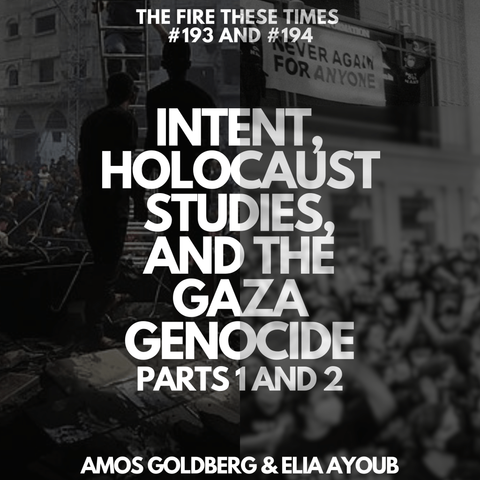
Intent, Holocaust Studies and the Gaza Genocide w/ Amos Goldberg

For episodes 193 and 194, released on Patreon in full and on the public feeds as a two-parter, Elia Ayoub is joined by Amos Goldberg, Professor of Holocaust History at the Department of Jewish History and Contemporary Jewry at The Hebrew University of Jerusalem. Goldberg is among the most vocal Israeli historians of the Holocaust to have called Israel’s actions in Gaza genocide. In 2024, he wrote a paper for the Journal of Genocide Research exploring how the question of ‘intent’ is used in discussions around genocides, including the Gaza one. They also get into how genocide is often preceded by claims of self-defense. They then get into the crisis within Holocaust and Genocide Studies since the start of the Gaza genocide. Finally, they spoke about “The Holocaust and the Nakba: A New Grammar of Trauma and History”, which Goldberg co-edited, and argue for the necessity of new horizons in our imaginaries. 

The Fire These Times is a proud member of⁠ ⁠From The Periphery (FTP) Media Collective⁠⁠. Check out other projects in our media ecosystem: Syria: The Inconvenient Revolution, From The Periphery Podcast, The Mutual Aid Podcast⁠, ⁠Politically Depressed⁠, ⁠Obscuristan⁠, andAntidote Zine⁠.

To support our work and get access to all kinds of perks, please join our Patreon on Patreon.com/fromtheperiphery 

Articles by Goldberg: 

Books by Goldberg:

Other Links:

For more:

Credits:

Elia Ayoub (host, producer, sound editor, episode design), ⁠⁠Rap and Revenge⁠⁠⁠⁠⁠⁠ (Music), ⁠⁠Wenyi Geng⁠⁠⁠⁠⁠⁠ (TFTT theme design), ⁠⁠Hisham Rifai⁠⁠⁠⁠ (FTP theme design) and ⁠⁠Molly Crabapple⁠⁠⁠⁠⁠⁠⁠ (FTP team profile pics).

Transcript via Antidote Zine:

Instead of developing our historical sensitivity to violence, Holocaust memory actually blocked us from understanding history and being sensitive and cautious about political violence, because we say, “It’s not the Holocaust, so it’s not genocide.”

Amos Goldberg: Thank you very much for having me here, it’s an honor. 

My name is Amos Goldberg, and I am a historian at the Hebrew University of Jerusalem specializing mostly on Holocaust and genocide studies. I have three main topics: the Jewish experience during the Holocaust, Holocaust memory, and debates in Holocaust and genocide studies on the integration between Holocaust and genocide, genocide and Holocaust. We might encounter those issues down the road.

Since January 2024, I became more and more vocal against the war and the genocide; I’ve written and interviewed about that in Hebrew and also in other languages. I’m also a fellow at the Van Leer Institute in Jerusalem.

Elia J. Ayoub: Thank you so much for joining me for this conversation. It’s not going to be a light one, and I appreciate you taking the time to do this.

I’ve been familiar with your work since you co-edited The Holocaust and the Nakba, which is relevant to what we’re going to be discussing. I reached out to you after reading a paper you published last year in the Journal of Genocide Research entitled “The Problematic Return of Intent” as part of a broader forum on Israel-Palestine, the subtitle of which is “Atrocity, Crimes, and the Crisis of Holocaust and Genocide Studies.” 

The question of intent is something I’ve seen brought up time and time again in conversations related to the genocide in Gaza. Can you start by telling us a bit about that paper? What was on your mind while you were writing? What was the intention?

AG: First of all we have to thank and appreciate the Journal of Genocide Research and its chief editor, professor Dirk Moses, for initiating this forum that now contains more than two dozen papers reflecting on the Gaza genocide and the events of October 7, 2023, the atrocities and the massacre, and what happened since, reflecting on the ways we understand this field and the way it functions, and what we can learn about it and its relation to what is called the “Palestinian-Israeli conflict.” Conflict,as we know, is not the right word, but for the sake of this conversation.

First of all, it’s about time that not only Gaza but the Palestinian Nakba will be integrated into this field. It’s an ongoing event of ethnic cleansing and mass atrocities, and maybe a special case but still a case of settler-colonialism and now full-scale genocide, as I and many others see it. It should be integrated, and somehow it was excluded from the field of genocide and mass atrocity studies—but it belongs there, and this was the first achievement of this forum; it already integrates it in relation to the competence of this field, the discourse and discussions. They are all short essays, and I really recommend to go and see, because all of them are really good. 

There is a discrepancy between what we understand as genocide in disciplines of history and sociology, and how law views this. We all feel it, all those who work in the field. The word genocide actually comes from the legal field, because it’s a crime. A Jewish-Polish lawyer, who fled Poland after the invasion of the Nazis and ended up in America, coined it as a legal term. On the other hand, he himself was also a historian of this term and wrote quite a lot about previous genocides. 

The legal term and the historical-sociological-political phenomenon are not the same—there is a gap between them. The legal term was discussed in various circles, particularly between 1946 and 1948, in the UN—until December 1948, when the Genocide Convention (the convention to prevent and punish the crime of genocide) was adopted by the UN general assembly. But in those two years of discussions, there were all kinds of understandings and suggestions how to define it, and they ended up on a pretty narrow definition, mostly because of political reasons. It was a power game, mostly between America and the Soviet Union: they had their interests, so they formed a definition which put great emphasis on intent.

I’ll quote exactly what Article 2 of the Convention says: “In the present convention, genocide means any of the following acts [and then there are five acts] committed with the intent to destroy, in whole or in part, a national, ethnic, racial, or religious group as such.” As we see, it puts special emphasis on the issue of intent. When we look historically at the annihilation of people or collectives, whether nations or even social groups not mentioned in the convention, we can say it’s not genocide because we can’t prove the intent to kill as such, as the convention says. We have the same historical phenomena, but maybe we didn’t find the documents to show special intent. It’s also not important—the political, historical, social phenomenon is quite the same, if we want to understand it. 

In Holocaust history, there was a big debate in the eighties and nineties between two big schools. One put really special emphasis on antisemitic intent to understand the Nazis acting out of intent. The other was a functional school that didn’t put such great emphasis on intent but on functions of bureaucracy and other mechanisms, local initiatives that all together compiled into what we now call the Final Solution. Both were legitimate. Since then, we moved forward to develop very sophisticated explanations of various forms of mass violence, ethnic cleansing, and genocide, but boundaries between those phenomena are not very clear. 

If we stick to the very high bar of the definition, I don’t know if we’d be able to talk about most of those events, because they do not necessarily fall within this very strict definition. Moreover, we will not understand the political, historical, social phenomenon. If we have to reduce the explanation and the understanding of this historical phenomenon to just intent in this strict way, we reduce the whole intellectual richness of the field.

I spoke about this tension between the legal and where it takes us, because now many of us are just looking at how to explain against “But where’s the intent in Gaza?” and we’re all focused more and more on intent because of the legal procedures that are taking place in the ICJ—and that will distort us from actually seeing and understanding what is happening in Gaza, and why genocide and such atrocities happen in our modern world.

EA: You make the distinction very eloquently in the piece between how the legal field talks about intent and how historians, including of the Holocaust and of genocides more broadly, talk about genocide. It caught my attention that in the paper, you start with a fairly infamous moment in history, Hitler’s Reichstag speech at the end of January 1939 where he talks about the destruction of European Jews.

As you mentioned, there have been two positions around that speech as an example; one that focuses a lot on intent (as in, This proves that as early as 1939 the Holocaust is on the way; that’s what they wanted to do and that’s it), and the other, the more functionalist school, focused more on how even if one can demonstrably prove intent that’s not necessarily the main question—it’s more like, What are the conditions that led to the Holocaust, the Final Solution?

What I find interesting is that you said you’ve noticed, especially since October, a shift among Israelis who you’ve talked to or witnessed. Before we get to the Israelis specifically, can you explain why that speech is so central to your argument?

AG: The question of when the Holocaust, or the Final Solution (which means the complete annihilation of the Jews in Europe), was decided on is a question that preoccupied the field for many decades. In the beginning, there was an intuition that already in the twenties, when Hitler wrote Mein Kampf and a second book, it was already on his mind after the First World War, and it developed, and he waited for the right moment to execute. But then when people started drilling more into it, we see that it is not true, because until they reached the Final Solution, there were many other solutions.

During the thirties in Germany, they tried to encourage Jews to emigrate, not to be killed. They didn’t want to keep them until the right moment and then kill them. No, they pushed them away. And then we see at the beginning of the war several territorial “solutions”—We will take them here or there, or to Madagascar, or deep into the Soviet Union. Those were all not what we know now as the Final Solution. There was no plan to kill the Jews until mid-1941 at the earliest.

In January 1939, Hitler made a big speech to celebrate six years of being in power, since 1933, in the Bundestag. It’s a very long speech, like two and a half hours. It’s a very antisemitic speech. But this is not even the main issue. He talks about all the achievements in foreign policy and reviving the nation, the army, and so on—making Germany great again. It is all very antisemitic, but at the end he comes to the Jewish issue, and says that if the Jews will push the nations into a world war again, not the annihilation of the world will be the outcome, but the annihilation of the Jewish race. That’s January 1939, and many say, Come on, here we have a clear intent, a planned intent to kill the Jews.

But you see, that’s January 1939, and only in June 1941, two and a half years later (which is quite a lot), is there the beginning of mass killing. And it will take a few more months, maybe a half year, until it is “crystallized” into what we call the Final Solution, the plan to kill each and every Jew in Europe and perhaps even beyond. 

How can we put this together? It’s the first time, in January 1939, that Hitler talked publicly about annihilating the Jews. But we don’t see anything happening afterwards—on the contrary, the Nazis come up with territorial plans; nothing works for them at that point. So how can we put these two together? Historians try to confront this question, and one line of thought was, Yes, there was no plan, but it was the first time we see what was really in his head, the intent

The other one says, No, it’s politics! Since 1938 they became very aggressive with the Jews, they tried to push them out of Germany and, with the Anschluss, also Austria. The Jews were identified as a refugee problem at that time, and they were negotiating, particularly with America, how many Jews they will accept. The cumulative radicalization came throughout the war, but it’s not serious—it’s vicious, it’s racist, I can’t say anything good, but it’s just a matter of him trying to raise the stakes in negotiations, raise the bar much higher in his rhetoric. 

I’m paraphrasing of course. Those are two lines of thought, and usually when I bring it to class, Israeli Jewish students tend to identify with the first, because of Israeli education—and I am not saying anything bad about this line of thought—we tend to explain the Holocaust by the issue of antisemitism, which makes it unique; it’s a problem disconnected from other forms of racism and other forms of violence, mass violence, and genocide. The other explanation always seems kind of weird to my students: Why not take him at face value? He says what he thinks!

This year, it was not a class but a group of research students, and my impression was that they were much more willing to accept this kind of functionalist approach that says, No, you know, it’s just within the negotiationsyes, it’s a radicalization, and eight months down the road he will open the Second World War, but you don’t have to take him at his word. It’s just a matter of radicalizing rhetoric within the political context. I saw that many more were willing to accept that this year, and I connected it: I thought it was because this was actually the case in the ICJ, the Gaza genocide case, because of the countless genocidal expressions in Israel after October 7.

Israel, when it came to the ICJ, said, No, no, don’t take us at our word! Those are not intentional genocidal utterances. It’s an expression of anger and rage after such a blow! Don’t take words at face value! I thought that maybe because Israeli Jews don’t want to be accused of genocide, they are more willing to accept this kind of explanation, because it takes us off the hook. Nobody can deny there was such horrible dehumanization and genocidal rhetoric—but it didn’t mean anything except for rage and trauma and so on.

I thought that was an interesting anecdote. Maybe I’m wrong, but I had the impression that something had changed, that people are looking at history differently because of their subjective position and the existential unease with the accusation of genocide which they wanted to brush away. Ninety-nine percent of Israelis, even those who acknowledge atrocities, even now, would not say it’s a genocide. That was a way to say, Don’t take words seriously!

EA: I’ve had a similar impression—not necessarily through direct interactions, or not as much, but I do cultural and media studies, and looking at how media discourses have been covering the ongoing genocide since October, it seems like a lot of the discourse has revolved around this misunderstanding (or at times purposeful distortion) of the importance of intent.

The debate seems to be less about the actual acts committed by the Israeli government and its military—in my experience, most of the time they don’t even discuss the details of certain military acts; they keep it broad. They talk about, This is what the Israeli reports suggest, this is what the Israeli military has said; they claim this, they claim that. Unless they’re doing a very specific investigation, it’s kept very abstract, rather vague.

In that context, the notion of intent—it’s very easy to say, Well, this cannot be genocide because of X, Y, and Z. They can easily say things like, Israel has allowed aid from time to timethey wouldn’t do that if it was genocide! Or: They’ve said they do not want to harm civilians! If it were a genocide, they wouldn’t say that. This seems to work with many people. It seems to have the desired effect.

Part of the reason has to do with how genocides are usually imagined in the popular imagination, how they are usually talked about or conceptualized, especially in movies or TV series, which is the most readily available imagery for most people, more than reading the transcript of a speech or seeing historical footage. It’s a bit silly, but even Captain America or Indiana Jones punching Nazis, or the storm troopers in Star Wars, cartoonish characters—for the most part, it tends to be reduced to that, when a lot of people think about World War Two.

If you have that in mind, or if this is the easiest thing that one draws from one’s own imagination when they think about genocide, it’s much harder to think of the Armenian genocide—not because there weren’t cartoonishly evil characters in that story as well, there were. But it’s further back in the past, and there aren’t as many movies or media, or certain symbols of the Ottoman empire, that you can easily associate as readily as you would with a swastika, which is much more present in our imagination. This came with the advent of movies and documentaries—and the Nazis themselves did a lot of that for their own purposes as well. 

The reason I’m bringing this up is, a lot of the time the argument that is made in order not to say This is genocide, or to downplay it, or to avoid the topic altogether—someone will bring it up on a panel, and you’ll see the host immediately feel uncomfortable and say something like, Well, the Israelis would dispute these allegations. Part of it is editorial policy, the politics of the BBC or whoever, but part of it is that functionally a lot of people just cannot imagine, or don’t have the tools to understand, genocides can also occur without the cartoonishly evil characters goose-stepping like the Nazis did in Germany.

Of course we have the Bosnian genocide, the Rwandan genocide, that would have these resonances and resemblances to the Holocaust—but you cannot necessarily tick all of the boxes, and yet they are still considered genocide. In your experience, with regards to the Gaza genocide specifically, how has it been talked about? Specifically in connection to this conversation—not just in terms of intent, but with comparisons to the Holocaust and how that can be very sensitive?

AG: In the minds of Israelis, October 7 has no context. It cannot be explained by anything—but it can explain anything afterward. That’s wrong! We have to understand the context. It doesn’t have a context and it’s the right context for understanding what came after? That’s a kind of self-deception.

October 7 had context of course. It was a huge blow to us Israelis. It was a trauma; it was heinous crimes. I always say it was also very personal. I knew people taken hostage, killed, their communities completely destroyed. And there was a sense of self-defense afterwards. I tried to write—and it took me almost half a year to find my words again—but I wanted to say then (and I didn’t publish it anywhere): Look, yes, we were hit very hard, and some eight hundred civilians were killed, and children were killed. That was a crime. But at this particular moment, history tells us and teaches us that in such moments, those are the most dangerous moments in history because you can very quickly become genocidal, because of revenge and self-righteousness and the right of self-defense.

This is what happens in almost all genocides. Most genocides—put the Holocaust aside; I will talk about the Holocaust in a second. If you look at Srebrenica or the atrocities in Bosnia within the many Yugoslavian wars, and also within Kosovo, and then Myanmar, or in Rwanda, or the Armenian genocide you just mentioned—these genocides or mass atrocities or crimes that were done by the stronger party were intrigued by this sense of self-defense.

Self-defense is not exclusionary of crimes, but it is a motive of crime. When you feel you must hit so hard—the stronger party allows itself, because it’s always a matter of life and death, and now you have to annihilate your enemy—then you reach levels of violence that were not foreseen before. 

But we have this cartoonish image about the Holocaust that genocide must be enacted between two parties: one complete evil and one complete innocent. In the case of the Holocaust it’s pretty much true, because there was no real conflict between the Jews and the Germans; on the contrary, German Jews in Germany (and this can be extended to the whole of Europe) were very loyal, and wished to assimilate and contribute to this culture. They were patriots and fought in the First World War; there was no real dispute between them. 

But if we take the Armenians and the Turks in the Ottoman empire, there was a dispute. Because the Armenian nationalists wanted some kind of self-defense, and since the end of the nineteenth century, there were also violent clashes between them. Most of the time, there is a dispute between those parties. Same for the Hutu and Tutsi in Rwanda. And actually, the Tutsi committed real atrocities and crimes against the Hutu in Rwanda and outside of Rwanda at that time. But this is when most genocides happen: when one is attacked and it has the capacity to annihilate and “solve the problem once and for all.”

In this sense, instead of developing our historical sensitivity to violence, Holocaust memory actually blocked us from understanding history and being sensitive and cautious about political violence, because we say, It’s not the Holocaust so it’s not genocide, it’s okay, we can go along with it. Then you put the intent. You don’t have a full-scale genocide in the sense that every Jew was to be annihilated, with antisemitic intent, by the Nazis? Ah! You don’t have that? That’s okay. We’ve seen this a lot and it’s not such a big deal. We can go on with our lives.

We always said, Look, we teach the Holocaust in order to be more sensitive to violence and human rights and the mechanism of violence so we can understand better and maybe prevent the next one! But in fact what happened: it blocks our understanding. If we compare it always to the Holocaust, and it’s not the Holocaust, we say it’s okay. But if you look at what historians—there’s a growing consensus among many legal scholars and the most prestigious human rights bodies and NGOs that the case of Gaza also adheres to the very strict Genocide Convention. 

So maybe it’s not the Holocaust—it has its own features, it’s in a conflict, yes. But it is still a genocide according to what we understand in history as a genocide, and what we understand in legal studies as a genocide. This is my understanding. We can talk afterwards about historians who understood this problematic, someone like Dirk Moses, and suggested to drop the term “genocide” because of what you said: it distorts our understanding and we have to talk about some other term like “permanent security” in order to focus on when a state kills so many civilians, which is the crime. This is what we want to understand, and this is what we want to prevent.

EA: The Assad regime has been accused by many actors of committing genocide, but the term that was used in a 2016 report by the UN is “extermination as a crime against humanity.” This is the actual sentence: “These actions, in the pursuance of a state policy, amount to extermination as a crime against humanity.” That’s in the report. When it came down to it, one of the consequences of that report (this was part of a broader discourse in 2016; at the end of that year was the fall of eastern Aleppo, which was one of the bloodiest battles) is that it felt like as long as some action of a state cannot be described as genocide with a capital G, it’s not as severe, as serious—it’s not the ultimate crime.

So for me, as early as a decade or so ago, I started questioning why there is such an importance on attributing a crime against humanity (which is horrible enough) within a hierarchy of what is considered worse. I’m not saying there aren’t hierarchies of crimes—there are. But in terms of the label—if a crime against humanity, this “extermination,” as the UN called it, by the Assad regime up until its fall in December of 2024, that has a death toll reasonably in the hundreds of thousands, some reports put it in the higher hundreds of thousands (we’ll probably never have a final death toll), cannot be described as genocide with a capital G but can still be described as a “crime against humanity,” at what point is the term “genocide,” as the only thing that matters, very problematic?

I personally see a lot of reason to argue, as you do as well, that the actions of the Israeli military and state in Gaza is in fact a genocide. But there’s still a part of me that wonders: what if it wasn’t, but is “just” a crime against humanity, an extermination á la Assad? Would that be less serious in the international discourse and according to the international community? It leads to a very uncomfortable conclusion.

It’s these two things at the same time: on the one hand, the burden of proof to determine in legal terms whether something has “intent” is very high, quasi impossible in many cases, which already lets off the hook actors like the Israeli government. And even if there weren’t that entire conversation in the first place, like in the case of the Assad regime, it doubly lets it off the hook: It’s not even that, and therefore not even worth the attention it would get if we called it a genocide.

This is more philosophical I guess. But as a historian, how do you think about that?

AG: We can unpack this problem. On the one hand, this is something that was discussed before. There’s a kind of competition that in order to break into public opinion, into international diplomacy, into international courts, you have to elevate, in a way, the crime that was committed against you and compare it to the Holocaust and say it’s a genocide. While at the same time, many more killed—like in the Vietnam war, it is estimated that the United States killed two million civilians in southeast Asia; is that less severe, less punishable, less of a crime, if it could not adhere to the Convention in its legal definition of genocide?

This is a real problem. Because of that, one of the main historians in the field, Dirk Moses, recently wrote a book The Problems of Genocide, which means not only that genocide is a problem, of course—annihilating groups and killing so many people and so on—but the problem is of the very concept that, as you said, somehow makes hierarchy between crimes according to whether they fit some kind of definition that was decided upon in 1948 by some international political powers. Undoubtedly that’s a big problem.

I’m not familiar enough with the Syrian case, unfortunately, but since the amount of killing and annihilation, and also certain groups were targeted—I don’t want to be decisive, but it could certainly fall within this understanding of genocide, particularly if you think of genocide as a crime or an event or a process of annihilating groups. Not necessarily the entire group, but by annihilating some of it, destroying it. Therefore, perhaps the Syrian case is also relevant. I should say that whether it was a genocide or not a genocide, there was an exhibition for a pretty long time at the United States Holocaust Memorial Museum on Syria because, whether it is or not a genocide, they understood the enormity of the crime; it’s the same family of crimes.

How do we cope with this “competition” for events to be considered a genocide because then they are the “crime of crimes?” That’s a question that we cannot completely solve. I don’t think we have to give up this term. In one of the most famous books in the field, by Samantha Power, a problem for her is she called it the “crime of crimes,” and some of the international legal tribunals discussed it also as the “crime of crimes”—like it’s a very special, very severe crime. But not all agree with that. It’s just a crimea certain kind of crimeand it’s not worse than a crime against humanity on a big scale, and we should not hierarchize these crimes.

But we should not drop this term altogether, despite all the difficulties. We cannot solve all problems. It’s always a tradeoff, what you gain and what you lose when you use a term. I think it does focus us not only to crimes but to certain political processes of annihilating a group rather than many individuals. This is for me the essence, or the core. This was also the core for Raphael Lemkin, who I mentioned at the beginning of our talk. A very simple and common-sense way: genocide is an attempt, sometimes successful, to annihilate a group, not only many individuals.

And maybe it’s more severe, maybe it’s not, maybe it’s a crime of crimes, maybe it’s not, I don’t care about this. But it’s a special kind of dealing with your enemy in a conflict when you actually want to annihilate it—whether to kill all its members or to annihilate it as a group. Sometimes crimes against humanity on a huge scale may not be genocide, but they were even worse than genocide! But still, “genocide” enables us to focus on this kind of political violence that does not just want to beat the enemy or act in self-defense, but to annihilate the group completely.

I think it’s very important to keep this term, because it signifies this kind of radical violence, which is very common in modern times and particularly in certain political and historical contexts. There’s no good answer. In our world there are never clear-cut answers. When you use a term, you always have to ask what you win and what you lose. Of course you get into some conceptual and moral problems. But still I would keep it.

EA: I agree. It’s not so much that I think the term itself is not useful; it’s more the de facto hierarchy that is created when a crime can be described as everything-but-that.

Interestingly enough, this leads us pretty well to the next point. In the paper, there’s a warning that you make. I’ll quote parts of what you said: “At the heart of this forum lies the question of whether the field of Holocaust and Genocide Studies is currently in crisis, in light of the events in Gaza. If the question of intent, the dominance of which is rooted in legal discourse, takes over Holocaust and Genocide Studies, then it will push us back decades. And, indeed, in the current Israeli-Palestinian context, the historical seems to be collapsing into the legal.”

We’ve gotten into this already, but what I’m curious about is: this was published in October 2024. Is it fair to say that, as far as Holocaust and genocide studies as a field is concerned, things have gotten worse?

Part II

With this huge abyss between Jewish Israelis and Palestinians, that rivers of blood are streaming inside, how can we talk? Many are trying to find some kind of framework to talk about traumas and atrocities and genocides—the ongoing Nakba on the one hand, and the Holocaust and its reverberation in Israeli society on the other—somehow together.

AG: Very difficult to say, because the genocide is still going on. In many ways it becomes worse: it’s total starvation that Israel imposes on Gaza. I can’t describe the horrific scenes, the viciousness and sadism that is expressed in this. So we don’t know. We are still in the event, and academic fields develop. 

Even now, when everything is online, it doesn’t catch the pace of the events. This Gaza genocide, which started with the atrocities of October 7 (I don’t compare; we should not put them on the same level, but it was still a foundational event for Israelis)—but certainly the genocide, the annihilation—you said people don’t read or go into details, and that’s too bad because there are so many details, and so many reports, and good media investigations. I really recommend some of my friends in the Hebrew University; one of them is Lee Mordechai, who has a very impressive synthesis of all the reports

Yes, there are a lot of details. But we are still in it, and what I’m trying to say is it’s something that is called an epoch-making event. It has already changed our world. We don’t know yet how. Certainly, as a Jewish Israeli I say it is going to change Jewish history and it will haunt Jewish history for decades and centuries, maybe, to come. 

So we don’t really know exactly how it will impact this field. I really recommend reading some of the essays in this forum that reflect on where there is a kind of chasm within the field—I hope it will now integrate the Israeli-Palestinian case into this field “naturally” now. But we don’t really know, so I can’t really answer your question, it’s too soon. Academic fields develop much slower, and post-facto. We still don’t have distance to talk about it and understand it. At least I can’t say anything intelligent on this.

EA: That makes sense. It’s fair to say that there is the crisis as you describe it, and we’re still in it. 

You mention in the paper this open letter by historians in the New York Review of Books from December 2023 comparing Hamas’s massacre of October 7 to the Holocaust, and you pointed out that some of these scholars who have signed that open letter have previously argued “that the Holocaust is unique and must not be compared to any other event.”

The way I’ve interpreted such a letter—we’ve seen a few of them along those lines; if not open letters then interventions in various platforms—is that many people have been willing to compromise on a lot of what they previously believed in, to defend or downplay Israel’s actions in Gaza. And the irony is that you are in the field of comparative genocide studies, and you’ve always argued that comparing the Holocaust to other genocides is not the same as relativizing and therefore downplaying the severity of the Holocaust—and yet it was those who did argue that it’s unique and cannot be compared to anything else who have, since October 2023, seemingly been willing to make an exception for the first time, to say that Israel is effectively fighting the new Nazis, or something along those lines.

I don’t even have a question here. I’m just curious about your reflections on that.

AG: We can analyze it or unpack it on two different levels. On the academic level, I think it’s a good question; the events of October 7 and the Gaza genocide will bring the issue of analogies. Because we can’t do without them, but analogies are always weak.

In the philosophy of rhetoric, when they analyze analogy—we always do analogy, we can’t think outside of analogies, because language is, in a way, analogical. Analogy, on the one hand, is an important tool, but it’s weak, because two events—whatever you analogize or compare—you always compare different things and you say the similarities are enough to draw analogy from one to the other, but the opponent would say, No! Even if I could recognize some similarity, the differences are much more important, and therefore you cannot make the analogy.

There’s a moral problematic in analogizing, because you somehow dilute the uniqueness of each event—and with such extreme suffering, its particular totality. When I’m talking about uniqueness of the event, I’m not talking about the uniqueness of the Holocaust, I’m talking about the uniqueness of each event and the totality of each event, particularly of mass violence. The suffering of each group and every individual is something that should not be reduced to analogy. 

We should look at Gaza and see what’s happening in Gaza, not trying to say whether there’s an analogy or not. We just have to look at the atrocities of Gaza and acknowledge. The whole issue of analogy is coming now to the fore, and what is a valid analogy and what is not, and there is no balance. You don’t have to negate one analogy and then negate all analogy. Some analogies are good and some analogies are bad, and we have to debate them and discuss them in the public sphere and in the academic sphere and between these spheres.

This is on one level. On the other level (and I will get back to this letter you mentioned), in public and colloquial discourse, we always make analogies in our daily life, in our experiences. And many Israelis, really authentically, because the Holocaust is so present in our consciousness, in the first instance of this traumatic blow, that was the historical metaphor ready for use and we used it. But then, more than a year and half later, we have to make distinctions and understand that no, Hamas are not the Nazis, we can’t compare them whatsoever, because they are not killing us because we are Jews, they are killing us because we are occupiers. 

There is a real political war between us on this land, and within the settler-colonial context (not the only context, but one of the contexts). So yes, of course after the apartheid, the siege, the ongoing Nakba, and now the ongoing genocide, what do you want? They fight. And sometimes they fight in a dirty way and commit crimes, even crimes against humanity! But this doesn’t make them the Nazis, and they are also not this superpower that Nazi Germany was. No, it’s one of the poorest and most crowded and small places on planet Earth. 

It’s a wrong analogy, it’s a foolish analogy, it’s a propaganda analogy. That doesn’t mean that any analogy which is more precise shouldn’t be used; yes, it should be used, because this is how we think. When we think of genocide, we think of a family of crimes, or a family of events or processes or political happenings that have something in common—that means you can make some analogy between them. That’s the nature of this concept.

They said they are antisemitic. Certainly the 1988 charter of Hamas is antisemitic in some of its paragraphs, but then came the 2017 document, which is allegedly not. And yes, you can still hear antisemitic utterances. But not every group that uses antisemitic rhetoric are Nazis! And certainly it completely distorts things to put the emphasis on that instead of the real fight, and the oppression, and the apartheid that Israel commits.

Some analogies are complete distortion, but some analogies are very good. For example, with all the differences, in my article in April 2024 that was published in Hebrew and then translated to other languages including English, I say yes it is a genocide, and I explain why it is a genocide on the level of self-defense, that this is one of the major causes of genocide, and how we can make analogies to other cases within this same group under the term genocide.

But I think those scholars are really dishonest. Because as you said, they always claimed that the Holocaust is unique, but then when it comes to the enemies of Israel, suddenly you can make analogies. They were so cautious—if, God forbid, you compare or even hint at some kind of connection, even a moral connection and not a historical connection, between the Holocaust and what is happening in Gaza, then you are a Holocaust denier, an antisemite!

I’ll give you an example very briefly. In March 2022, [then US secretary of state Anthony] Blinken came to the Holocaust Museum in Washington—there specifically (the Museum hosted him)—in order to declare, I came here particularly to declare that we acknowledge what is happening in Myanmar is a genocide. So this association—maybe analogy, maybe association—was completely legitimate, and it somehow bestowed some kind of moral authority on what he said, because he said it in the Holocaust Museum. But if you dare say, I want to come to Yad Vashem and declare we acknowledge the Gaza genocide—my God. You can’t. This is beyond our imagination, something like that.

Maybe it might happen in five, ten years’ time, at least partially and in certain places, that the Gaza genocide will really integrate into this field of Holocaust and genocide studies.

EA: You co-edited the book The Holocaust and the Nakba: A New Gramma of Trauma and History with Bashir Bashir, notably also forwarded by the late Lebanese intellectual Elias Khoury. In the book there is a passage from his novel, Bab al-Shams (Gate of the Sun). 

There’s two questions to this. In that story, the narrator warns: “We [the Palestinians] mustn’t see ourselves only in their mirror, for they [the Zionists] are prisoners of one story, as though the story had abbreviated and ossified them. Please, we mustn’t become just one story. Believe me, this is the only way if we’re not to become ossified and die.”

I’ve done a few episodes on the Palestinian story on this podcast, including one with Dana El Kurd, my friend and colleague, called “Remembering the Nakba, Imagining the Future,” so we won’t get into that specific bit as much now. But I am wondering how you would assess the Israeli story in terms of “ossification?” We’ve clearly seen a lot of examples of Israelis being very willing, seemingly, to dehumanize Palestinians and become what James Baldwin called “moral monsters.” I saw a video of IDF soldiers blowing up a house in Gaza, with blue smoke coming out of the fumes of that explosion—because it was a gender reveal party. They were laughing and all of that stuff.

There are so many examples of that, which truly shock people watching them—understandably so. As a historian who looks at these things, you’ve intervened in the public domain a number of times. But how would you assess Israeli politics today, based on your own readings of history?

AG: All of what you mention is true, and when you look at those things—Al Jazeera made a documentary out of them—we have to not only see the atrocities in Gaza, but first of all the suffering of the victims. Unbearable scenes come every day from Gaza in reports. But then we also have the Israeli soldiers’ side, which is not only shock, but also shame: How do we become those monsters?

For me as an Israeli, I don’t dissociate myself from this society. I am part of this society. And there’s nothing to say. I knew—this process of denial and dehumanization started long ago. But it escalated, with such monstrous peaks, in this war and genocide. For example, there was recently a documentary released on Shireen Abu Akleh. If you remember her funeral, the coffin almost fell because they were so aggressive. What kind of dehumanization—and now it’s a light thing compared to what we see and what you just mentioned.

I don’t know how to explain it yet, beyond the obvious explanation: that in order to kill so many people, you have to dehumanize them. To annihilate the whole place, to commit such a genocide—how can you bomb a hospital if you think human beings are there? So you have to either justify retroactively or explain and justify in advance. And the bigger the crimes are, and the more continuous, the more you need to dehumanize, because otherwise how can you live with this?

I don’t read Arabic well enough—I read most of Elias Khoury’s books and novels either in English or in Hebrew. Many of the recent ones were translated to Hebrew by a beautiful binational project translating Arab literature to Hebrew, groups of Palestinians and Israelis working together under the great intellectual Yehouda Shenhav-Shahrabani, who was a very good friend of Elias (I also had the chance to meet him twice). If you read Elias Khoury, this ossification—you stop the movement of life, the movement of narration, the movement of narrative changing. 

You ossify; it’s like an internal death. This is something that comes up again and again; it’s kind of a Lacanian metonym, that you move from one signifier to another in order to pursue your object of desire and shape your identity. He warned against that, and unfortunately, Israel is really ossified, in such a dehumanizing way; it’s dichotomizing completely: We are the sons of light and they are the sons of death! They like death, we like life! All this propaganda; in the end they have ossified and simplified our collective narrative in the most brutal way.

But I should say that I’ve sensed changed now in Jewish Israeli society. Things start to change because of the hostages, but not only because of the hostages. We understand that something went wrong, and we start reflecting internally on what we actually committed in Israel. And of course the forces of denial are very strong. But I hope through this major trauma and atrocities and crimes and genocide, maybe it will break in a few years’ time.

I’m not talking about the Palestinians—I don’t know how the Palestinians do it. I’m not a Palestinian; I have many Palestinian friends and colleagues but I can’t talk for them. I can talk for Israelis: maybe something in the long run will change and pull us out of this dehumanizing ossification. Because it also reduces us to such poor human beings. I hope that this major crisis that we are facing and experiencing might change course, opening (though in such a violent and genocidal way) new ways to tell our stories in a more humane, more egalitarian way.

I don’t say that it will happen, but I see pockets where these discussions take place. It’s not a source of optimism, not at all. But you see change. At least we are not completely ossified. Those forces are still very weak compared to the very strong forces of evil in our society, of sadism, of hyper-nationalism and fascism, and of death, of killing, of revenge, of dehumanization. Those forces are still much stronger, but you can see pockets of exactly what Elias Khoury was describing so eloquently in his novels.

Maybe, maybe they will expand. I see them expanding. They are still in the minority, but they are expanding; more people come to reflect and rethink the ossified narrative of identity. 

EA: Thanks for that. It’s a perfect segue to an open-ended last question; we’ll see where it leads us, maybe to end on a hopeful note—I do make the distinction between optimism and hope, in the sense that hope is more of a “discipline,” to quote [Mariame Kaba]. 

This book you co-edited with Bashir Bashir, The Holocaust and the Nakba—even before we started recording today you mentioned how at the time it was received in a very specific way, but since then its relevance has grown more and more important.

Can you talk to us a bit about the book? As far as I’m concerned, it’s pretty unique. It should be less unique; there should be more and more works along these lines. I do see pockets of that here and there, but certainly for its time, I don’t know many that are like that.

AG: Gladly. First I would say my work and very close friendship that developed with Bashir Bashir, who is a Palestinian political theorist, has so enriched me over the years. We worked for more than a decade on this project; we wrote articles and edited some books, and had many talks about it, and it’s still an ongoing project. On a personal level, it’s a way to say, Okay, I understand your ossified, cruel narrative; I want to live a little bit different. We found a way to keep not only our friendship but our intellectual work ongoing, even in this crisis, and I’m grateful and thankful and appreciative of Bashir, and learn a lot from him.

As you said, when we came out with the book in Hebrew—a different book; we co-edited two books, one in Hebrew and then in English, with very similar names. When it came out in Hebrew in 2015 or 2016, it made a huge splash, but we got such pushback. Very critical: How can you put them together?! I understand this reaction, because those are not the same events—and for both sides. It’s very difficult to put them together, for both sides. 

Jews usually think it’s only their problem—How can you compare or put together and analyze the Holocaust and the Nakba? The Holocaust was the biggest crime in modern history and the Nakba was an outcome of the war [this is reductive, of course]. 

Then it came out in English in 2018, and also there was a lot of pushback, by many. And as I said to Bashir—at that time, we were the problem. How dare you? It was also How dare you? from the Palestinians. Why do we have to care about the Holocaust? We have enough of our own problems and we have to care about the Holocaust? 

Today we’re kind of a solution, in the sense that with this huge abyss between Jewish Israelis and Palestinians, that rivers of blood are streaming inside, how can we talk? Many are trying to find some kind of framework to talk about traumas and atrocities and genocides—the ongoing Nakba on the one hand, and the Holocaust and its reverberation in the Israeli society and its ongoing traumas—somehow together. And not only Israelis, but Jews and non-Jews and Palestinians and Arabs and Muslims in the diaspora who are looking for some kind of historical and theoretical framework to talk about them together, to start some kind of conversation to bridge those abysses.

We said, Of course there are differences between the events. Even now we say it. The genocide in Gaza and the Holocaust are not the same; there’s no Treblinka, and there’s no Auschwitz, there’s no gas chambers, there’s no complete annihilation in terms of killing each and every Palestinian. On the other hand, there are asymmetries in the power relations, and the Palestinians have really no responsibility whatsoever for the Holocaust, while the Israelis have full responsibility, or the major part in bearing responsibility for the Nakba, the ongoing Nakba, and certainly the genocide now in Gaza.

There are a lot of asymmetries; nonetheless we have to put them together, because they are so interconnected. They are interconnected in so many ways, I don’t know how we can talk about them separately. They are connected historically; it’s one historical continuum. They are connected in the minds of people. Both are the foundational traumatic events of both nations, of the Palestinians and the Israelis (and Jews at large), and maybe beyond that.

They are so interconnected, and our histories are interconnected, and it’s not right to talk about them separately because they are so interconnected. And we talk about “empathic unsettlement,” a term we borrowed from Dominick LaCapra, who was my teacher (who is still my teacher, I would say). If we bring them together—which is difficult to say in our time, but it’s still essential—it takes us each out of his own narrative capsule; he has to reach out and understand others and not be immersed completely in his own narrative. It somehow destabilizes in a good way—it has a positive destructive element that opens the discourse of both sides to be changed.

We use Khoury’s literature quite a lot; this is exactly what Khoury meant. Don’t ossify on your own narrative. Find mechanisms to open it to other possibilities, to other options, because otherwise you will be caught in it until a tragic end. This has a kind of unsettlement, but in an empathic way, putting them together—and explaining how, historically, culturally, and theoretically, and psychologically.

But it has a second phase, which is what Bashir called “egalitarian binationalism.” It’s not only a matter of history or culture or psychology or group psychology; it’s about politics. And the outcome is what he calls egalitarian binationalism, which means we are so interconnected that we have to think about both, we are a binational unit: two nations that are combined, intertwined in many ways, now also geographically, and we have to find an egalitarian solution to this. 

This can take many shapes and forms—one state, two states (not the Oslo two-state vision, but co-federation). There are all kinds of political settings we can think of. But the principles are that because we are intertwined, and because there should be no supremacy whatsoever, no Jewish supremacy whatsoever, each group has to have its own completeness within those frameworks, which are against a complete separation but also a complete conflation of the two parties. Both have to have full collective, individual, and civil rights—not as it is now, that one half of the population between the river and the sea has full rights and one doesn’t have rights at all, or only partial rights.

The outcome is a political agenda of what he calls egalitarian binationalism, that acknowledges two national groups that cannot be completely separated. Even now, we have to think about how we can live together, not separately—this vicious and brutal symbol of the wall of separation should be taken down—and in a way that we do not conflate into one another, but we are not completely disconnected, and we all have complete equal rights on all levels. This is the political outcome.

Today, it’s almost science fiction to think along those lines. Sometimes I even feel it is obscene, when the rivers of blood are flowing all over. But still, it can provide, even in a dialectical way of negating it, some kind of a discursive framework to imagine and to create small groups that discuss a completely different way of living together. Maybe ten, twenty years down the road, we will be more hopeful. Right now, as you said, I’m not an optimist, I don’t have hope right now, I can’t see hope. But I see obligation to continue this discourse even though it’s a kind of sumud to our humanity, to imagine some way of re-humanizing both sides.

But I can’t say more than that. If we become commercial and materialistic: the book is reprinted and reprinted because people are looking for something like this framework. Good people, people who do want to imagine and think different, politically. 

EA: That was my experience as well. Almost ten years ago I did my master’s at the University of London, at SOAS, and the topic was the politics of language. As part of that, I looked at how Hebrew and Yiddish were used and talked about politically, especially when it comes to Zionism. There were the Bundists, of course, who were Yiddishists, and a lot of Zionists who were Hebraists—it was more complicated, but that was part of what one person called the “kulturkampf” in Yiddish.

One thing that led me down that path—as a Lebanese-Palestinian, doing that sort of research is not exactly encouraged, and was the topic of quite a few uncomfortable conversations at family lunches—is James Baldwin. He is someone who, when interviewed during the civil rights movement, a lot of times was accused of doing too much to talk to white people or try and convince white people. The way he framed it was that he did not want their story of him to dominate his life.

If someone like him, who was the grandson of an actual enslaved person, who can trace his lineage centuries into the past to conditions that are so horrific that most of us who are not in Gaza cannot even fathom circumstances as horrible as chattel slavery in the US—if someone like him, with that legacy, was still able, through a lot of struggle, to not even just see the humanity in the oppressor, but recognize if he doesn’t do that he is the one who is at risk of being “ossified,” to use Elias Khoury’s term…

AG: Some of the major works in post-colonial theory talk precisely about that. Despite the abyss between the colonized and the colonizer, they are so interconnected. Think of Fanon, Black Skin, White Masks. Think of Homi Bhabha on mimicry. Think of many others! Both sides are mirroring each other in a distorted way, and we influence each other, and we internalize and externalize each other. 

We have to acknowledge that, and work with it for the good, not for the bad.

EA: That was really the end of my thought anyway. There has to be that work, regardless of the conditions. I do understand and I of course empathize with those who say “mish wa’ta,” (now is not the time)—I get that. It’s just that functionally speaking, there is very rarely any time that could be said to be the right time. And if we’re talking about seventy-plus, almost eighty years since the Nakba, my grandfather was born and raised in Haifa and exiled, and he passed away a few years ago—at what point will there be time?

AG: Undoubtedly. As a descendant of a Nakba refugee, I can’t tell you anything. I can tell you with humility this is how I suggest to move forward. If someone like you accepts it, I am honored and happy. And if not, I can truly understand it. If someone in Gaza says it’s obscene now—Look, just stop the genocide—I can understand that of course as well. 

Nonetheless, I feel we should not abandon language altogether. Silence is an even worse option.

EA: For me it’s whether I allow “them” (the Israeli state, not the people) to dominate my story, or what they determine should be my reaction to something they are doing. In Gaza there is more than enough reason to hyperfocus on just stopping the genocide, this is completely understandable. But in my personal capacity, in terms of stopping something like that, I can do my best, and I platform people, I talk to people, I share their stories—ultimately that’s the best I can do. There is an additional responsibility because I do have the resources, mentally speaking especially, because I’m not in such a situation.

And you mention yourself: there is a history to that. I’m not reinventing the wheel here. Elias Khoury of course talked about this himself; he was born in ’48, the year of the Nakba, and he grew up with that. But when we think of the big names of Palestinian literature, or intellectual movements, whether it’s [Edward] Said, or Mahmoud Darwish, or even [Ghassan] Kanafani, they understood this to various extents, that there has to be some kind of reckoning. Not because it’s “the right thing to do,” but because there doesn’t seem to be any other options anyway. The discomfort that this causes can lead to different horizons than the ones we’re currently limited by.

With such a platform as this one, a very privileged one, it gives us tools to explore these things. That’s why I wanted to have this conversation. I want to give you the final words, if you have anything to share.

AG: I just second you: all our energies should be to stop the genocide. That’s number one, whatever we can do—because this is part of our era, that we are powerless against those dark forces that erupted. But if we can also create some new words—the subtitle of The Holocaust and the Nakba is A New Grammar of Trauma and History—that may give some new spaces for discussion. To counter the rhetoric of evil, this is also an obligation we should consider seriously.

EA: On that note, Amos Goldberg, thank you a lot for being on The Fire These Times.  

AG: Thank you very much for having me, Elia.

#FreeHomayoun

Cracks in the Walls: Global Perspectives on Migration

Presented by guest hosts Michelle and Daniel, Cracks in the Walls: Global Perspectives on Migration brings together eight individuals active in migration struggles around the world (Mexico, Haiti, U.S., and Europe) for a discussion on root causes of migration, current and past repression, and, most importantly, impactful approaches to solidarity and resistance. 

Participants are:

Juan Carlos (he/him) – (Translating for Vivianne.) Director of “Tijuana: Ciudad de Migrantes”. https://youtu.be/kGjR8_ZVfnA?si=Uk3Aocc56FgJSmxQ

Michelle (she/her) – Filmmaker/writer, free clinic herbalist/nutritionist, teacher, and activist based in California. www.underexposedfilms.com

Daniel (any pronouns) – A member of the solidarity movement at the Polish-Belarussian border.​​https://nobordersteam.noblogs.org/ Fundraising: https://zrzutka.pl/rab8e2

Vivianne (she/her) – Activist and Social Work student. Community worker within the Haitian community in México. Haitian Bridge Alliance: https://haitianbridgealliance.org

Diana (she/her) – Mexican Psychologist and activist. Working at Refugee Health Alliance: https://www.instagram.com/alianza_para_la_salud

Edin/Andrea (they/them): Independent artist and rebel. Collaborator with Enclave Rabia Caracol and its various projects. Enclave Caracol: https://www.instagram.com/enclavecaracol
Also: https://www.instagram.com/tijuanacomidanobombas

Marie (she/her) – Activist from Germany within the noborder-movement and civil SAR (Search and Rescue). Links: https://resqship.org/ + https://alarmphone.org/ + https://captainsupport.net

Anne (she/her) – Activist of the Seebrücke and the #FreeHomayoun campaign, based in Switzerland. https://www.freehomayoun.org

Some ways to act in solidarity with migrants in the U.S.(from an outside source): https://crimethinc.com/2025/02/11/eight-things-you-can-do-to-stop-ice

The Fire These Times is a proud member of⁠ ⁠From The Periphery (FTP) Media Collective⁠⁠. Check out other projects in our media ecosystem: From The Periphery Podcast, The Mutual Aid Podcast⁠, ⁠Politically Depressed⁠, ⁠Obscuristan⁠, and ⁠Antidote Zine⁠.

To support our work and get access to all kinds of perks, please join our Patreon on Patreon.com/fromtheperiphery 

For more:

Credits:

Michelle (host, producer, sound editor), Daniel (host, co-producer, co-editor), Elia Ayoub (episode design), ⁠⁠Rap and Revenge⁠⁠⁠⁠⁠⁠ (Music), ⁠⁠Wenyi Geng⁠⁠⁠⁠⁠⁠ (TFTT theme design), ⁠⁠Hisham Rifai⁠⁠⁠⁠ (FTP theme design) and ⁠⁠Molly Crabapple⁠⁠⁠⁠⁠⁠⁠ (FTP team profile pics). Episode photo taken by Michelle.

Transcript via Antidote Zine:

For us, networking is a very important way of taking action against repression. It is only through exchange with those affected and activists that the systematic patterns become visible at all.

Michelle: Hey, my name is Michelle, and it’s an honor to be hosting this guest episode for The Fire These Times with my friend Daniel. Today we’ll be having a conversation on migration, in which seven of us will be sharing perspectives and experiences from Mexico, Europe, and the US, reflecting on various contexts and struggles faced by migrants, refugees, and those acting in solidarity.

This dialogue is just a starting point for us to expand connections and opportunities to learn from each other. With the international onslaught of repression and fascism, it is imperative that our resistance is also global—that it includes bridge-building and the exchange of lessons and tactics learned locally, with an examination of their global interrelation.

We want to be clear that there are many important voices that are not represented today, and that hopefully this conversation can be expanded by other geographic perspectives in the future. We are going to be speaking in English, for the majority of the participants—but one person joining us will be speaking in Spanish and will have translation right afterwards.

We’re going to go ahead and start with introductions, if everyone can take two minutes to share: first, whatever name and pronouns you’re comfortable identifying yourself with; second, where you are based; third, context and/or groups you are working in or have worked in; four, communities you are part of or collaborate with most closely; and five, anything else you want to briefly add about yourself.

I am Michelle, she/her, based in indigenous Ohlone territory of Huchiun, or what is now called Oakland, California. I am a filmmaker, teacher, and herbalist/nutritionist. I worked for fifteen years as an integrative health provider at a multilingual free clinic for immigrant communities here in Oakland. I got to know our comrades who are participating from Tijuana through volunteering at a migrant clinic and shelters down there. 

My last film was on immigrant and refugee experiences in the healthcare system and the importance of culturally responsive care, centering healthcare providers who come from the communities they are serving. 

Currently I teach English to immigrant and refugee students at an adult school, and coordinate resources including legal referrals and know-your-rights trainings. I also collaborate in some loose collectives that are developing mutual aid and resource-redistribution responses to the current crises.

I got to know Daniel from Poland a few years ago through an event we did looking at both inspiring resistance in Ukraine and the racism of how Europe embraces white Ukrainian refugees while excluding Syrian, Afghan, and other refugees from around the world. 

Daniel: Hello, my name is Daniel. I’m involved in the solidarity movement on the Polish-Belarusian border. I am part of the No Borders Team collective, but also I am collaborating with other anarchist and leftist groups in Poland and in Europe. 

No Borders Team is a collective that started work in 2021, when the eastern corridor from Belarus to Poland was widely opened. In the very beginning it was focused on direct humanitarian aid in the forest on the border. People on the move faced a huge amount of violence from Belarusian border guards, but also in Poland their rights weren’t respected. Humanitarian aid was banned by the state in Poland, so all help was in the hands of local people and grassroots groups and some small NGOs, and we managed to create together a quite good working network since that time.

I mean “good working” in terms of the amount of people involved into the movement—but No Borders Team’s activity is not only direct aid. One of our main goals is to change the narration of migration, especially in Poland—because it wasn’t present in public debates of the last years—but also we just want to point out that racist migration policy is a result of capitalism and has systematic causes; it’s not like some bad individuals are responsible for the suffering of millions of people, but it’s a more systemic thing.

That’s why we run some social media and a blog site, and we spread information about migration, because in Poland this topic is really not well known. Other than this, we organized some solidarity pickets in front of detention centers in Poland, for example in Przemyśl or in Lesznowola (close to Warsaw).

Andrea: Andrea, I use they/them pronouns. I am an artist and community-active individual based in Tijuana, Mexico, working directly with LGBTQI+ folks here in my local area, and actively at the cultural center Enclave Caracol, which is located on the northside in Tijuana, which provides a safer space for queer folk here in the City of Death. Because it is close to the physical border, we work in the shadows of the structural and systematic limits that it gives us.

I live and organize with people from the houseless community, working closely with LGBT folks in the streets, and migrants coming both from the south and the north in the States, as well as with people who have been deported. I’ve been working actively at this for the last almost eight years.

Diana: Hello, my name is Diana. I am from Mexico; I am a humanitarian psychologist who works with people on the border between Mexico and the United States. I provide mental health services: I assist children, some adolescents, some entire families, single women, and men with their needs as refugees in Mexico—people seeking refuge in the United States, internally displaced people from Mexico, homeless people, and deportees.

I am also a professor at a university in Guadalajara, where I lead online groups for Spanish-speaking women living in the United States: along with a group of psychologists, I hold workshops to support them in the process of seeing a new country. 

Vivianne (translated by Juan Carlos): Hello, my name is Vivianne Petit Frere, I’ve lived in Mexico since four years ago. I started my journey in Brazil and I went through ten different countries trying to reach the American dream. When I arrived to Mexico, I was disillusioned and I felt the need to help, so I started as a volunteer and a little later I became a community organizer in the Haitian Bridge Alliance organization, where I support Haitian migrants and francophone African migrants with integration and defense of their rights.

Juan Carlos: My name is Juan Carlos Gazca, I’ll be serving as Vivianne’s translator today. I have a degree in international relations, and I study migration studies—I’m making my specialty in international migration and interculturality. I’m the director of the documentary Tijuana: City of Migrants, and it’s a pleasure to be here. 

Marie: I’m Marie, and I use the pronouns she/her. I’m based in Germany, and I’ve been a no border activist for around six years now. I started out within the no border movement on land, trying to support people on the move through the area’s grassroots organizations and anarchist groups, but also with NGOs—for example doing human rights monitoring in the Aegean, or trying to document and expose police violence and border violence at sea.

Then I gradually moved on to search and rescue at sea, where we stand in solidarity with people on the move who cross from countries like Libya or Tunisia by boat to reach Europe. Unfortunately, many people have died and gone missing on this route, and there is a rather large movement trying to prevent that from happening.

Anne: I’m Anne, I use she/her pronouns. I’m an activist based in Switzerland, and my main organization is Seebrücke, a European movement that does public relations on the topic of sea rescues, and we also try to get Switzerland to accept more refugees. 

One of our current campaigns is #FreeHomayoun, where we are fighting for the acquittal of Homayoun Sabetara, and all migrants who are criminalized for smuggling. Through that campaign I am connected across Europe, and there are many organizations working for freedom of movement on the same issues and struggles as us.

Michelle: Thank you so much, everybody, for being here with us today. It’s amazing to have so many different perspectives brought to the table.

As far as where we’re coming from: we’re all anti-authoritarian, anti-hierarchical in our preferences for organizing; a lot of us identify as anarchists, and we’re trying to create this space to have a dialogue about how those who are coming from similar perspectives in the world can be working towards addressing issues around migration.

We have a general umbrella in terms of what we’re going to be trying to cover, in three main areas: 

We’re going to start with looking at the root causes of migration generally, trying to encapsulate what would bring people to move from the place that’s home, with respect for remembering that in most cases nobody wants to leave their home, and it’s generally pretty serious conditions that cause people to do so—we’re going to be looking at Haiti through the eyes of Vivianne as a case study for what is actually going on there now, and what brings so much movement from the country.

Then we’re going to look at the context for current state repression, at borders and in the daily life of immigrant communities in the locations that we’re based. 

Then we’re going to close with focusing on solidarity strategies: what are our ideas? Both existing practices we’ve seen that have been particularly effective, as well as things we might propose working towards, again with an intentional focus on autonomous groups and individuals (many of us are in positions where we also either collaborate or work for NGOs, for nonprofits, but we all recognize the limitation of that structure, and in addition do work and position ourselves outside of that).

We see that root causes of migration, globally, for the most part, are connected to colonization and forced displacement. There are various reasons why people may be forced to migrate. A lot of times that falls under the umbrella of the impacts of imperialism and settler colonialism, different types of war, other forms of violence; economic oppression (people don’t have the resources to survive where they’re at); more and more, we’re seeing the outcomes of environmental devastation putting people on the move; also identity persecution, which can take many different forms, and political persecution.

Daniel: As we’ve already mentioned, most people would prefer to stay in their homes, if they had decent conditions there. But it’s also very difficult to identify a boundary where people are forced to migrate. The obvious examples are open armed conflicts and threats to life, but even here it is all the decision of individuals. For example, when Russia invaded Ukraine in 2022, we could see hundreds of thousands of migrants fleeing Ukraine, but also we could see movement in the opposite direction: many Ukrainians who were returning to their country to support family and friends. 

Also in areas devastated for years by wars, some people are choosing to stay and risking their lives. Just as they have the right to decide to stay, the same right to self-determination applies to those who decide to leave.

However, the situation is not always so clear as in war or direct religious or national persecution. Many regions in the Middle East or Africa have been devastated by years of colonial exploitation. Living in such places where it is impossible to cultivate the land, where there are no jobs or a functioning health system—all of this kills more slowly than bullets, but it is still violence and oppression.

Diana: We must also add significant violence that is generated against the LGBTQ community—that is super important to say, for me.

Michelle: Thank you, Diana. 

We are going to turn now to Vivianne to offer us a more in-depth look at what’s going on in Haiti and how that has forced a massive amount of migration. She’ll be translated each time by Juan Carlos.

Vivianne: Speaking of causes—what causes migration? Haiti was first a Spanish colony; after that it became a French colony from 1697 until 1803. Those were four centuries of systematic stealing of our agricultural and mineral resources. Haiti didn’t mess itself up; it was a result of all the foreign intervention and foreign powers messing with Haiti.

In 1804, we decided to be free. But this freedom wasn’t complete, because it came with a set of imposed conditions. We didn’t have the human resources or our own structures, and being free—we didn’t know how to read or write, and all our institutions had been manipulated by the colonizers. Since then, Haiti has lived in chaos. Jean-Jacques Dessalines was murdered—he was the leader of our independence—and since then we have faced division, struggles for power, constant instability, and a deep structural vulnerability.

Our elites from foreign origin and white skin—they didn’t consider themselves part of the people but as superior to them, and they didn’t have any sense of belonging. This has created a system that excludes others, fomenting instability to distract and to continue stealing. Without mercy, they kill or exile those who oppose their regime (may they be journalists, presidents, activists, among others).

Haiti has been historically a country that has been oppressed economically, without the necessary resources to develop its people and its community. Also, we are an island that is really vulnerable to natural disasters. Among all these factors, there is a deep wish for survival that comes from us, and the only option is to migrate. Sometimes we migrate even though we don’t want to, leaving behind children, wives, husbands, family, memories, and having to start from zero all over again in different places with different languages. That is not easy for the migrant or for their family.

All these frustrations and this emotional baggage that we carry sometimes makes us stay in a defensive posture, and this drives us to our limits.

Michelle: This is something we see globally: in so many cases where people are forced into migration, the countries that then want to close their borders to people are actually the same countries that have contributed to the conditions that make migration necessary.

Vivianne: Instability has been a constant in our nation. The coup d’etats, the political crises, the violence, corruption, and the lack of an effective government have keptHaiti in a perpetual state of vulnerability. Every time we try to move forward, we see ourselves being dragged back by a system that keeps weakening us.

Haitian immigration proceeded in three big eras: the first one is since the decade of the eighties, Haitians started migrating in search of better opportunities. This was because of extreme violent conditions and repression under the dictatorship of Duvalier, who governed Haiti for almost three decades. During this time, the country experienced an environment of oppression and fear which led thousands of Haitians to flee, especially to the United States, France, and other Caribbean countries.

This migration wave continued in its second stage after the fall of the Duvalier regime in 1986, which started a period of even more uncertainty, where Haiti was experiencing intense political chaos with many failed attempts at democracy, coup d’etats, and an international embargo that lasted from 1991 until 1994 which deepened the crisis even further and gave origin to the phenomenon called “boat people.” This started to intensify since thousands of Haitians confronted these dangerous journeys by sea, fleeing this instability.

Then in the third stage, after the devastating earthquake of 2010, the migratory fluxes started to take a new direction: searching for work and stability, a lot of Haitians directed to South America and especially to Brazil, where a lot of employment options appeared in construction related to international events such as the World Cup and the Olympic Games.

Nonetheless, since 2008 since the arrival of Barack Obama to the presidency of the United States, since he was the first Black president, this generated a change in the hopes for a new direction of migratory politics. This, along with the discourses of inclusion and human rights, led to an increase in migration to the Mexican border and attempts to enter the United States. This is what gave birth to the first big wave of migration in 2016, when thousands of Haitians arrived to Mexico and they were stuck in migratory limbo, looking at the American dream arriving in a neighboring country. But it didn’t turn out that way. 

Michelle: As many people know, Obama was known as the deporter-in-chief, because despite the promises and hopes that Vivianne has explained, he ended up deporting more people than any president prior to him. 

Vivianne: Before, Haitian migration was mainly composed of men who were traveling alone in search of better quality of life for their families. Nonetheless, after the 2010 earthquake, this dynamic changed: women who were alone and complete families started to migrate as well. In this new context, Mexico offered regular migrants the possibility of also applying for family reunification, which benefited a lot of Haitian parents.

After starting this paperwork and this process on Mexican territory, many of them were able to cross to the United States, which gave origin to the phenomenon of unaccompanied minors who arrived to the Mexican borders looking to reunite with their families. Although Mexico was offering th possibility of family reunification, the minors who were traveling alone faced a lot of really difficult situations because of the cultural and linguistic barriers. 

Since many of them arrived without the necessary documentation or the company of their parents, this placed them in a really vulnerable situation, especially with migration authorities and the Mexican organization DIF (Integral Family Development). Many of these children suffered bad treatment since the system was not really prepared to address their situation in an adequate manner. 

Michelle: Thank you so much Vivianne and Juan Carlos.

Daniel: Thank you very much to Vivianne for her story and giving us a view about Haiti.

Now we would like to focus on the current situation. We will start in Europe. What we can see is the global narration of states changed in the last years. Migration was a positive thing, at least in part of the propaganda of the European Union, this idea of “open borders”—of course borders weren’t open for people, but more for money and business, but also businesses in Europe need people to work, so that’s why this whole idea of open borders from the state was created. 

For many people it was easier to get to Europe and get legal work here and legal status, but as we can see, the nature of capitalism is making the story not so simple, because you cannot grow forever. So at some point when the economy of Europe had trouble, then all this racist propaganda appeared. 

For us it’s not super strange, because we more or less know how the propaganda works, but for people living in the European Union it was quite a radical shift: one day they are saying We will make open borders and we can travel wherever we want, and what we have now in Europe is like war propaganda: We need to buy more weapons and close our borders.

I will start with a bit about what is happening in Poland. The topic of migration in Poland is quite new, because for a long time Polish people were migrating to the West looking for better jobs and a better life. But this changed in the twenty-first century when Poland went to the European Union and Polish society got more and more wealthy. In 2015, when the Balkan corridor was open, there was a whole story with relocations, but Poland didn’t take any migrants at the time—the state already started some anti-migrant propaganda in a really bad way.

This same thing came back in 2021 when the eastern migrant corridor from Belarus to Poland was opened widely. For people who don’t know, in the middle of 2021 the Belarusian regime and Russia organized some flights for people from Africa, the Middle East, and different countries, and they provided them, for a lot of money, with travel to Europe. This was a fake story, because the border between Poland and Belarus is permanently closed. These people paid a lot of money, and they came to Minsk, and they went to the border with Poland, so then the soldiers took guns and told them, Now you need to go or we will shoot you. In 2021, thousands of people tried to cross the border, and of course the response of the state was super harsh. 

I will tell now about some strategies, because we can see that police states use the same things in the last years, and also other countries in Europe do the same strategies against migrants and against the solidarity movement. 

For example, the first thing that the government did when people started to come massively from Belarus was make an “emergency zone” on the border: it was a strip on the whole border, a few kilometers wide, a zone that no one can access. In the beginning, local people were helping refugees, because the border area is forests and swamps, so it was really hard to survive there if you don’t have food, if you don’t have good clothes. A lot of local people and some solidarity movements tried to help, but after that the government closed it and it was forbidden to go there. It was guarded by military and police. So the whole solidarity movement went underground—if you gave someone a glass of water, you were a criminal. 

This strategy of an emergency zone started in 2021, but it’s now 2025 and we still have it. We have a new government, but they are using this the whole time. Normally in the Polish constitution, you can do this for one month; after that you can make it two more months, but you cannot make it more. The first emergency zone was for one year, so it was super anti-constitutional, but no one in government cared about this. Now we have a new government, and it seems like a lot of months we’ve had a new emergency zone. It’s much smaller than the first one, but the amount of violence inside it is the same as before.

Another part of the strategy is you make an “exclusion zone”—no media, no activists can go in. Of course a lot of activists like our collective and a lot of different groups were going there anyway, but for mainstream media it was impossible. So no news from these areas. In this way you can cut off all information on what is happening to migrants.

A second strategy—Poland shares this with all countries in the European Union—is the cancellation of human rights (that’s how I call it). We have some fundamental roles that were established in the Geneva Convention after the Second World War: all my life it was said that these laws are irremovable; they are fundamental. But now a lot of the things written there are canceled. When you hear politicians, they are saying, This convention was for peacetime, and now we have wartime

It’s another shift that is shocking, especially for liberals and all the people who believe in governments, that even the most fundamental thing can just be canceled in one year. One law that was canceled in Poland recently is the right of asylum. This is also in the Geneva Convention, that everyone who feels insecure in his country can apply for asylum in another country, and this country needs to review this application—of course it doesn’t mean that it will be a positive verdict, but at least they need to review it and provide some safe space for this person for this time.

Of course this law is not perfect, because it was connected with detention centers; most of the time, in Poland at least, in the last years, when someone applied for asylum, the state locked him in a detention center which looks like a prison, and conditions there are even worse than in prison. And of course most people don’t get asylum, so they get deported or they stay illegally after this. So we don’t like how this asylum law works, but anyway it was an attachment point for people on the move. At least when they were in the forest and their life was in danger, they could ask for this, and at least for the next month or two they can be in a safe place, and after that they probably get deported.

In different countries there is anti-migrant propaganda, which is also connected to the previous two points. Like I said in the beginning, migration was shown before as a kind of chance, and people were encouraged to migrate, and the European Union myth is based on open borders and Schengen, where everyone can go freely—and now it’s closing. For example, the German-Polish border: these two countries are in Schengen, but Germany is making border controls again. Not permanently, but from time to time, and it looks like borders are not going to be as open as before.

It’s also not comfortable for people from Europe, so we also have this crisis; capitalism is permanent economic crisis. We have huge inflation in Poland, and I guess in different countries it’s also not so easy. So to keep people’s minds away from it, the governments are making this anti-migrant propaganda.

Michelle: There were several themes that came up for me in what you were saying that those of us in the US and Mexico can relate to, in terms of this process of dehumanization. It seems like governments need to use propaganda that undermines the humanity and the stories and experiences of the people and their migration processes. 

The other thing is the scapegoating. It seems that globally, governments are scrounging to deal with their own internal failures and have increasingly been using the scapegoating of migrants.

Anne and Marie, do you want to chime in more about the situations you’ve seen in Europe and in the boats before we shift to other continents?

Marie: It’s been really interesting what’s being said, and maybe I can also give some examples from the perspective of solidarity at sea, within the search-and-rescue community.

For a little bit of context, it would be interesting to know that this is a relatively young movement, roughly ten years old. The Mediterranean sea has always been a place of migration; throughout history people have traveled across the Mediterranean sea for various reasons, and only within the last couple of decades it’s become a restricted place where imaginary lines called borders were drawn and movement was really restricted.

It was around 2013 when migration started picking up: people leaving from countries such as Tunisia or Libya, and then going mostly to Italy, or also to Greece. This route became one of the most deadly routes of migration in the whole wide world. Many people disappeared without a trace. The official numbers say around thirty thousand people have died on this route since 2014—and these are only the numbers that we know of. These are the official documented cases, but there are so many more invisible deaths and missing, because of the so-called “invisible shipwrecks.”

What happened was that search-and-rescue was something that governments were responsible for; there were areas called “search-and-rescue zones,” they were divided between different governments, and it’s their responsibility to conduct search and rescue operations. They started drawing back more and more, closer towards the coast, and leaving bigger and bigger areas uncovered. Then Italy, who was leading the biggest mission, called Mare Nostrum, then terminated it because other countries refused to support it financially. And suddenly nobody really was doing search-and-rescue in the central Mediterranean.

Of course there was search-and-rescue for privileged people, white people in coastal areas—but not for people on the move who crossed on sea-unworthy boats. At that time, then, several groups started organizing. Among them were really big NGOs such as Doctors Without Borders (MSF), but then also solidarity movements of grassroots organizations got together and built up rusty buckets—really old ships; one of the first ships was a fishing vessel that was nearly one hundred years old—and people who were not really used to doing this got together—doctors, seafarers, activists, anarchists—and tried to prevent this from happening, and standing in solidarity with people on the move.

That proved to be really efficient, but still not enough. As a movement, we thought we would hopefully cease to exist, that there would be no need for us, that state actors would pick up their work again and do what needs to be done. Ideally, we would move on to an even better stage where there would be safe passage and freedom of movement, that people could just move freely from the country of their origin to the country of their choosing. 

How wrong we were! It’s been ten years; there is still civil search-and-rescue going on, more than ever. State actors have withdrawn, completely. There are some maritime search-and-rescue coordinating centers that don’t even pick up the phone anymore, or that block numbers where they know it’s connected to people fleeing on boats. What different governments have done is try to stop the solidarity movements in different ways. We’re looking at ten years of repression, and I can’t really name everything, but it’s the blocking of ships, and then the criminalization of solidarity.

One of the most recent things is the distant ports—when there’s a rescue being done, there are now laws that force us to immediately ask for a next port, and by international law, this would be the closest port possible. But what Italy (for example) is doing is assigning us ports that are sometimes over one or two thousand miles away. That means we need to travel with people who just survived horrific journeys, who a lot of times have been fleeing for years and years, and have escaped torture camps in Libya, and sometimes have been really close to death—rescuing these people, we need to bring them to the next safest port, but then we get assigned a port which is sometimes five days away. This also then takes the boat from the area of operation for ten days.

Just as an example, imagine that you are in New York; you get hurt and call an ambulance, and the ambulance is sent to Chicago. This is what’s happening there on a daily basis.

There was also a time when there was the criminalization of people in solidarity crews. There was a famous case in 2019 where the captain Carola Rakete was not allowed to an Italian port on the small island of Lampedusa; they had over fifty survivors on board, and they had been waiting for over two weeks, and the condition of the people was constantly decreasing (Diana, as a person who gives psychological support to people on the move, can also say a little more about this, how incredibly stressful that is). There were also people trying to commit suicide.

Carola at one point just went into the harbor, against the orders of the authorities, and then she was arrested. That created a huge media outcry, and got quite a bit of attention, and the solidarity all across the countries was quite big. But it also then created this legend that there’s a really highly criminalized field of activism—which is actually not true. There’s no white people in prison for this kind of work at the moment. There is repression, and sometimes people suffer consequences when it comes to their career or things like that, but at the same time what is incredibly invisible in Europe is that all along the borders (especially along the Mediterranean but also on land), prisons are full of people on the move. 

We’re talking about thousands, if not tens of thousands of people. For each boat, there’s at least one person arrested as the boat driver, and therefore as somebody who “facilitates smuggling.” These are people who actually seek asylum themselves. And we have outrageous cases. Just recently we had a sixteen-year-old minor in Greece who was supposed to go to prison for 4,670 years—I think you need to let that sink in. This is a child who fled from a war-torn country. He actually did get sentenced to 280 years.

There was also a case of a shipwreck in Pylos. It was quite a big shipwreck; there were seven hundred people on it who were crammed in horrific conditions and they’d been at sea for over a week, and then the boat started sinking and they called the coast guard. The coast guard ignored them for over twenty-four hours, and when they realized that they couldn’t get rid of them, they actually turned up with their ship—this has been proven—and they tried to tow them to Italian waters so the Greek coast guard wouldn’t have to deal with them. By this, they made the boat capsize, and six hundred people died. 

None of the coast guard officials have been held accountable, but nine people from the few survivors that actually made it were then imprisoned, and were threatened with charges of several hundred years, and they tried to make them responsible for the deaths of all these people.

This is a constant thing that is developing. There are repressions against solidarity, mostly privileged and white solidarity structures, but what is really happening is that it’s an essential part of so-called “border protection” that people on the move are strategically and systematically imprisoned and criminalized.

Anne: Through these cases of criminalized sea rescues, we learned that thousands of migrants in Europe are also criminalized as “smugglers.” We wanted to know more about this, and we looked for people who were affected and were willing to talk about it, because in general the treatment of migrants in Europe is quite invisible. The system of camps and prisons isolates people, and there is relatively critical media coverage of the issue. 

That’s how we met Mahtab Sabetara, whose father was sentenced to eighteen years in prison in Greece as a smuggler. He had no legal way to get to Europe, where his children live. He was stopped in a car with seven other people, and criminalized as a smuggler, when he himself was a refugee fleeing Iran. After we heard that story, we started the campaign #FreeHomayoun, fighting for his acquittal.

We started to inform ourselves and to network, and we learned that Homayoun is really not an isolated case. All across Europe, migrants are criminalized as alleged smugglers, for entering the country to claim asylum, and then disappearing into prisons. In Greece, for example, at least one person from every arriving car or boat carrying migrants is arrested and charged. As a result, these people are already the second-largest group in Greek prisons, with sentences up to hundreds of years. That’s really crazy what’s going on there.

European states claim they are concerned about the safety of migrants, and therefore acting heavily against smugglers, but in fact they are making the way to Europe extremely dangerous by not providing resettlement programs, by building walls, and by using border violence. It is almost impossible to cross the European external border without assistance, and at the same time the states criminalize that assistance.

The responsibility is completely reversed—it is not the state that is judged for not helping people, but there are parents who are held responsible for the deaths of their children at sea. This happened again this week near the Greek island of Lesvos, when the Greek coast guard tried to push back a boat, causing it to sink. Among the passengers of that boat was a family; twenty-three people were rescued but three children and four adults drowned, and one child still remains missing. As usual in Greece, one man has been arrested and charged with smuggling for allegedly steering that boat. This man, now in custody, lost his wife and child. 

This case is so brutal in many ways, because in principle no one should be criminalized for steering a boat—but the man is also being used to cover up a deadly crime committed by the coast guard which led to the death of his family members, and for which he is now being blamed.

Just to add some other aspects: imprisonment is not the end of problems and repression. With a conviction, it is really difficult to get asylum in Europe, so many people are forced to leave Europe again. And even if they are allowed to stay, they have to deal with the traumatic experiences of migration and imprisonment. This includes, for example, living in uncertainty for years, not being allowed to make decisions in that time in prison, and having no control over their own lives. 

To come back to the #FreeHomayoun campaign, Homayoun Sabetara’s sentence was reduced in the appeal trial from eighteen to seven years, so he was allowed to leave prison after three years—but now he has to stay in Greece, which is not the country where his children live, so is not the country he wanted to go to. There he has no social network he can use. He has to go to the police station every month for the next three years. He describes that situation as being still in prison, just in a larger one.

He’s not allowed to work, but he has no financial support from the state. He still does not know if he will get asylum. So Greece is doing everything to force him to leave the country again. That is how the European states want to prevent people from coming to Europe and to force those who have arrived alive to leave again.

Michelle: Thank you to Daniel, Marie, and Anne for sharing that update on the current situation around people on the move in Europe. 

Part II

Michelle: I’m going to do an overview of some of the most recent developments that have been happening in the US, repression-wise, and then we’re going to switch over to how that’s been looking across the border in Mexico, as far as the impacts.

In general, there’s been a lot of global media coverage in terms of the disturbing developments in the US under Trump in the last couple months. Obviously, the US gets a disproportionate amount of attention globally, as it causes a disproportionate amount of damage, but as we have listeners from all over, I’ll just do a quick update on some of what we’ve seen here.

These attacks on immigrant communities in the US and globally are nothing new. Nor are they particularly partisan. As many people know, Obama ended up deporting more people than any president prior to him. And likewise, Biden topped Trump’s numbers from before that in his first term. While clearly the rhetoric and threats under the current Trump administration—along with what we’re seeing more visibly in terms of actual deportation activity—is terrorizing communities, it is also important to see the non-partisan long-term trends that have been gravely impacting people’s lives here for a very long time. In fact, Bernie Sanders even said the other day that the one area he agrees with Trump is in his focus on stifling immigration. As far as I’m concerned, none of them are getting anything right.

Some specific developments that we’ve had lately in terms of legal changes and repression activities: 

Trump had a very public collaboration that was agreed upon with El Salvador’s president Bukele, where Bukele agreed to house migrants in private Salvadoran prisons for money. A few weeks ago, 238 Venezuelans were sent there. This seems to overtly fit the definition of what gets called “human trafficking.” Bukele was agreeing to receive migrants from the US and house them indefinitely in very dire conditions in private Salvadoran prisons so that he could make money.

Similarly, we’ve seen people sent to the concentration camp at Guantánamo Bay that was used for twenty years for folks related to the “War on Terror,” and is now being used to house migrants who are being shipped out of the US. Due to its remote location, there is very little access for lawyers or any kind of support once people are sent there.

We’re also seeing the re-establishment of family detention, where entire families are being incarcerated. We’re essentially seeing families disappear once that gets enacted.

One of the most recent things that is really ominous is a potential collaboration with the Internal Revenue Service, the tax collection agency in the United States—for decades, people who are undocumented have been strongly encouraged to pay taxes, so people are essentially contributing to public funds and receiving no benefits in return. That has been sold to people as a “pathway” to help with legalizing their status eventually: they’ll be positioned much better if they’ve been paying taxes for a certain number of years. 

Paying taxes involves revealing your address, revealing all kinds of personal information—and that information has been collected by the IRS but never, until the current time, been shared with other agencies. Now the agreement that’s being worked out is that ICE (Immigration and Customs Enforcement) will have direct access to all of the Internal Revenue Service’s information. This sets a horrifying precedent, because it reveals everybody’s locations, personal details, and information in a way that has never previously taken place.

What we’re hearing is they’re very close to solidifying that agreement, and for anyone who has been following what Elon Musk is up to, getting hold of all kinds of information through Social Security and other places.

Finally, we’ve been seeing the revocation of visas and green cards, followed by ICE detention and deportation, to criminalize students who’ve been protesting Israel’s genocide in Gaza. To date, there’s been at least seven somewhat high-profile students and scholars of color from various countries who’ve had their visas revoked and are being detained. This is a direct attempt at criminalizing particularly people of color who are students in this country raising their voices against the genocide. Again, the precedents around this are a first in terms of revoking people’s legal immigration status.

Personally, in the Bay Area, while it feels like while we’ve been slightly less impacted by the visibility of ICE in our communities, we are seeing that presence more and more. But it has been more obvious in other parts of the country. One place we’ve been seeing it flare up is directly at immigration courts. We have immigration courts in San Francisco and Concord that are both nearby, where people are showing up for their standard immigration hearings and are subsequently not granted the status approval that they previously would be, and then are unexpectedly and immediately arrested and deported, arriving back in their home countries as soon as the following day.

Again, this can include entire families who are suddenly disappeared without any notice. Some folks who I don’t know personally but am in community with had that experience, where a mother, partner, and a child showed up for their hearing, and with surprise even to their attorney, were not granted status and were arrested—and were in Guatemala the next day. So things are shifting and changing very quickly.

[This is future Michelle chiming in about a month later, on May 8, for an update since I had last recorded the information about the situation in the United States. The first thing to note is the speed at which a lot of the repression towards immigrant communities is escalating, and the complete dismantling of so many structures in the United States as an intended part of fascism’s encroachment on life here.

I’m going to name a couple of the most recent egregious measures that have been taken, because it’s probably impossible to encapsulate all of them. Comparing what I recorded a month ago to some of these updates gives a sense of where things are at.

The first thing to note is that while there are a lot of horrible measures being declared by the Trump administration, a lot of them are tied up in court. As much as ICE are actually following through on a lot of these threats, they are not necessarily legal and they are still being contested, with some victories in holding them off. That is important to note.

For instance, the Alien Enemies Act, which is an obscure eighteenth-century war powers act that had been used to deport Venezuelans to El Salvador as I mentioned in the last announcementit’s been rejected that they can use that. It’s still already happened, and people have been unable to bring back the people who have been taken out of the country. But it is not deemed legal how it happened. That’s still being contested.

Likewise, further plans that Trump had to revoke the TPS (temporary protected status) that granted two years of safety to Haitians, Cubans, Nicaraguans, and Venezuelans in the United States have also been blocked by the courts. It’s not clear how that’s going to play out. 

One of the biggest things that has happened was an announcement that they were going to reinstate the CBP One app, which was the Customs and Border Patrol application that had been used to revamp some of the asylum process, and it was complete chaos. It resulted, now, in them reopening the app with the announcement that nine hundred thousand people would need to self-deport and register that they would do so on the app.

Recently, as in a couple days ago, they announced there would be a $1,000 stipend and travel assistance to any of those people who chose to self-deport. I’ve been working with a student who received the email that went out to so many hundreds of thousands of people, and the language on it is horrifying. It shows up in your inbox saying that your time in the US is up, and this created panic in many communities. It is still unclear how that’s going to play out.

Likewise, in my last update I had said there were seven student visas that had been revoked; at this point, that number has drastically climbed to the low estimate being fifteen hundred, up to certain estimates of around five thousand student visas related to protests against Israel’s genocide of Palestinians in Gaza, where people who were here on student visas have had those visas taken away as a result. Again, this is totally unprecedented, and a number of those folks have been arrested and sent to immigration detention centers.

We have seen in the last couple days a judge blocking intended administration flights to send a number of Asian migrants to Libya and Rwanda. As we know, Libya’s record around migrant detention and torture is horrifying, and this is a first that the country would be sending people abroad in that way, just like what’s happening with Latino immigrants being sent to El Salvador. So far, a judge has blocked those flights, but it’s not clear what’s going to happen.

Another high profile case related to the deportations to El Salvador that happened a couple months ago is Kilmar Abrego García, who was deported from Maryland and had very clear legal status and protections here, and was “mistakenly” deported but they have refused to bring him back.

In the last couple days, there was a DACA recipient who had received permission to leave who was deported upon his return. So we’re seeing explosions undermining people’s rights in every direction, and it would be fairly impossible to encapsulate all the updates, but I wanted to highlight how much has changed in the last month and how much worse things have gotten.]

I’d love to turn it over now to Andrea or Diana or Vivianne to talk a little bit about how this is looking on the other side of the border.

Diana:From Tijuana, the first month is super weird. I have a lot of feelings for that situation. Since the interaction between the president of Mexico and the president of the United States, there has been a strong crackdown on people coming to the border. In the airports and bus terminals, there has been a lot of guarda nacional—maybe Juan Carlos Gazca can help me describe these persons in Mexico.

Juan Carlos: The guardia nacional, or the national guard, is a new institution that was made in Mexico by the previous government of Andrés Manuel López Obrador. It’s a new institution in between the police and the army, but its members come from mostly the army, so at the end of the day it’s the army, just with a different name and with uncertain lists of activities they can handle. 

Sometimes they are given police enforcement activities; they have been given construction activities for some of the president’s projects—for the airport, for the train, things like that. One of the most important features is the one Diana means: they were given the authority on migration matters.

When Trump started this set of negotiations on migration with Mexico, he kept saying “Mexico is going to pay for the wall.” In the end, there might not be a new physical wall on the border between Mexico and the United States, but there is a new wall on the southern border between Mexico and Guatemala, and that is the guardia nacional.

Andrea: Here in the city of Tijuana, violence in the city has a long history. More recently we have seen the effects of the Trump administration and the decisions you just mentioned, such as the appearance of the new national guard that only solidifies the militarized border here on the Mexican side. 

For a more clear example of my own experience, and from the daily struggle, that is the constant deprivation of people’s liberty while moving within the city—especially those without government documentation within this “hot spot” in the city where people are always on the move:

Here, people who fit a certain racialized profile are illegally stopped and robbed by the police without any consequences to the violators. Now with the added militarization of the borderland in the last few months by the Mexican government, military and Mexican national guards persecute and jail migrants in “shelters” where they are literally locked in cells. While doing all this, the state claims a “humane” migration policy, even calling it a “new humanitarian Mexicanism.” But this is not less than a disguised armed anti-migration force.

Daily we see cases of people being picked up by police-marked vehicles made for kidnapping people by the dozens—poor people, including migrants and deportees—in the name of this fake fairy tale called the “fight against narcos.” Most of the time they are taken in for hours, and sometimes they are taken and never seen again.

That is the violence that is lived on the streets here in the city on the micro scale, you could say. On a bigger scale, in a bigger frame, the violence and oppression of the military and national guards can manifest in them being physically aggressive to the migrant community, to migrants and poor people trying to physically cross the border. Their violence extends to a point of killing without any consequences, not even outcry from the public. Last year, a report from Punto Norte shows the national guard killing and burning the bodies of young migrants trying to jump over the wall. 

This shows the intentions of the state are not only to harass the people but to stop migration by any means, even lethal force—once again going against the pro-humanitarian migration campaign held up by the Mexican state that locates itself (or tries to) away from our neighbors up north, but it is not. It has become an extension of that very same American anti-immigrant strategy that the Mexican government is using for its economic and political benefit when dealing with US foreign policy, kind of a chess game where the lives of humans—migrants, LGBT people, queer people, and poor people—are the pieces of the game to be lost or won.

This is a direct manifestation of the militarization and action of the police here right next to the physical border.

Vivianne (translated by Juan Carlos): The Mexican people and Mexican society are ready to interact with Haitian people, but institutions are the ones that are not acting accordingly yet. In my experience as a migrant and as a community worker, I can repeat that the Mexican people are ready to live alongside the Haitian community. With time, more intimate relations of friendship and intercultural exchange have developed. 

More than racism, what I have perceived in a lot of cases is classism. In Mexico, the color of the skin goes to a second degree, after the status or resources that a person has. So I would say it is not color, it is social condition that still marks these barriers.

Nonetheless, this social openness contrasts with the institutional response, which is still deficient, especially for the migratory fluxes from Haiti. I’ll give two examples. The first one is about the National Institute for Migration, that has never hired anyone to properly translate from Haitian creole to Spanish—which has caused enormous difficulties to get access to legal procedures for a lot of people. Even though this clear lack of infrastructure is present, the National Institute for Migration has received at least 16,919 Haitian people between 2020 and 2021, with Chiapas being the state with the highest number of migratory processes being held. 

This big difference between social solidarity and institutional indifference shows that a will to integrate exists at the base of society, but the state hasn’t modified or adapted either their policies nor their bureaucratic system to the reality of an Afro-descendent, plurilingual, and socially excluded population.

The second example is racial profiling. In my personal case, having lived in Mexico for four years and having this temporary residence permit, whenever I’m in an airport arriving to Mexico I’m asked many questions on what I’m doing in Mexico, why I have this residence permit; I’m always interviewed in these aspects. I see that in other situations, people with white skin color are not asked even though they might have some illicit things going on—either being on substances, or paper issues. 

But in my case, as soon as they identify me because of my skin color, they begin questioning everything. Just when they hear my accent they know I’m not an American citizen. I sometimes see that people with a lighter skin tone don’t get bothered as much in the airport, but in my case, even though I have all the documents and proof, I still need to give a long explanation of what I’m doing here. 

Michelle: Thank you so much, everyone, for outlining the repression that’s happening. We can see a lot of global trends.

Now we’re going to shift gears to something a little more inspiring, which is the ways that people have been autonomously trying to fight back against this. As we said earlier, a lot of us are doing so, sometimes in collaboration with nonprofits or NGOs when those resources are necessary, but sometimes that’s happening in smaller collectives in forms of solidarity and mutual aid.

There is a lot that we’re scuffling to figure out in the midst of these changing times, and trying to figure out, by building these international relationships, how we can make some of our movements stronger in the face of repression.

Vivianne, do you want to chime in on what you’ve seen and experienced?

Vivianne: In my role as a community organizer in front of all the decisions from the state—whether Mexico or the United States—since December 2021, I started as a volunteer in Tijuana, and since then I have provided orientation and defended members of the Haitian and francophone community. 

Today, I am no longer a volunteer but an organizer in this community work, and my work consists of implementing strategies of solidarity, and being a bridge between the community and institutions. I’ll describe some of the actions that I have made in critical moments marked by migratory politics in Mexico and the United States.

For starters, with exemption 42 under Trump’s government: I identified all the persons in vulnerable situations—may it be persons who were sick, with different capacities, pregnant women—and I was providing humanitarian assistance and aid. I was also enrolling them into waiting lists to make their crossing process easier.

Regarding education, I was part of the know-your-rights program, so I secured translation of all the contents of know-your-rights workshops about rights and duties. I translated to Haitian creole, providing real access to the information.

Later on, in the transition after exemption 42, I acted as a mediator between the Haitian community and diverse institutions, promoting social and labor inclusion through different workshops and community orientations. Then, when the CBP One application arrived, I provided information and orientation around how to use this app—not only in Tijuana but in Mexico City as well, which was another place you could get your appointments for this app. To do this, I was in coordination with different attorneys from the organization.

When the CBP One app arrived, it came with a lot of malfunctions, so I dedicated myself to gathering evidence on all the technical problems the app was going through—especially that it didn’t work properly on darker skin, and sometimes you needed to take pictures and it would only work at two in the morning or something like that. This different evidence and proof I was gathering was a key element in the following legal actions and suits that happened against this app, that ended up in modifications being made to the system.

Regarding campaigns in public health, I coordinated and mediated implementation on health campaigns at strategic points where the Haitian community was concentrated, collaborating always in the preparation of these campaigns and translation for the events.

In humanitarian aid, every fifteen days I participated in the distribution of economic aid to different shelters that hosted Haitian people who were in vulnerable situations. After the CBP One app was suspended, I dedicated myself to gathering evidence of every appointment that was canceled by the app, so this could back all the public and legal complaints that were made against this app.

On violations to human rights or institutional abuse, I always take the role as a speaker on media or with reporters for different organizations, to always try to communicate and speak up about what’s happening, against authorities or promoting alliances with other organizations. Right now I’m still working with an organization as an advocate for human rights and the Haitian community in general.

Some limitations that I have encountered through my work and different challenges that I have faced have to do with instability in institutions. The constant changes of directives in key institutions such as the National Institute of Migration or Integral Family Development have challenged the continuity of previous agreements. Every new functionary needs to start from zero, and I need to go back again and explain and generate trust and restructure the previous agreements, so it is really difficult to have continuity in the process.

Also there is excessive bureaucracy in the institutions. The administrative processes tend to be slow, complex, and really inaccessible sometimes. This bureaucracy acts as a barrier that prevents us from taking urgent action or implementing programs with agility, especially in crisis contexts.

A key element that I feel needs to gain strength is the attention and inclusion of the Haitian community in Mexico, to recognize the value of Haitians’ work in Mexican society. The Haitian community has demonstrated itself to be a resilient labor force, always willing to integrate and support. Nonetheless, the handiwork of the Haitian community is sometimes overestimated in the public discourse, like they are really hard workers but at the same time it’s undervalued in terms of workers’ rights and just salaries, or even stability and recognition in enterprises.

There is a contradiction in the practical usage that talks about Haitian efforts, and low interest in institutions to generate fair conditions—from one of silent exploitation to one of just economic inclusion and fair treatment, with formal contracts, with access to social security, with opportunities for entrepreneurship and professional mobility. It’s not just about integrating them as cheap workers, but as citizens with proper prospects of life.

Michelle: Thank you so much, Vivianne. 

We’re going to shift gears a little bit to look at some of the types of solidarity that have been happening in the healthcare sphere. In particular, as was brought up earlier, something we don’t discuss enough is often the impact of stress and anxiety on people who are dealing with situations of migration.

Diana, as a psychologist do you want to chime in on some of the work you’ve been doing?

Diana: The people’s mental health, especially in recent years, with this shift in population which has seen more families—women, children, and adolescents—here in Mexico, organizations working on the border between Mexico and the USA don’t know a lot about how to work with that population. A lot of these years, people know how to work with men and adult people, but now the young people really don’t have a lot of tools or strategies of support. 

A lot of families and women come to the clinic where I work, and just say the physical problems that they have. They are adult people, you know? But nobody sits down and asks the children, How was the travel? How are you?—all these things. It’s interesting, because for all the organizations here in Tijuana, I am the only psychologist who attends to kids from zero to eighteen years old—for free. I’m the only person who attends to that. A lot of organizations, universal organizations, work with children, but only eleven to thirteen and older, not to the young. It’s interesting to see that, and the demand of the people here on the border. 

I worked in the past in Guadalajara, more in the center of Mexico, and the people really don’t ask about mental health service a lot, because people want to go to the north, to the border, and cross. But when the people come to Tijuana and need to wait a lot of time to see what happens with the individual cases for their families, the people need a psychologist!

And not just a psychologist—all the services for mental health, like psychiatrics, or for example something like herbalists is something that can help with mental health service. It’s super interesting, because for example for the Haitian people, they need some natural service that can calm the stress or anxiety or depression or something like that, and it’s help for the people—but you need to have more tools, not just a psychologist for that situation, you know?

It’s really interesting to my way to see the mental health from the people. And from my experience, it’s not just from the people to migrants, it is from the people who work for the migrant people—you know? All of you, and me. And it’s a mental health service, because it’s a lot! 

Something that I think has helped in Tijuana is being able to unite and communicate among organizations with our strengths, needs, and actions, so we can strengthen ourselves in the fight. Also, uniting as organizations to file complaints and demands with the Mexican government and society—our so-important issues of violence help strengthen our voice. Being able to be like, migrants having organization, and activists who flow with the needs and don’t force necessity into the actions you take—because otherwise you won’t be attentive to the reality of the migrants’ situation, which changes daily. 

I feel that, like everyone else in the world, there are things that we always need to improve and take care of. I believe that our borders are not stronger than our humanity. Migration should not be a problem to be solved, but a story to be heard, a life to be accompanied, and a dignity to be defended. Thank you. 

Michelle: Thank you, Diana, that was beautiful.

To comment on the part you brought up: I had the privilege of meeting Diana and her colleagues at a clinic called Refugee Health Alliance in Tijuana a couple years ago. As she was mentioning, I was able to bring down a bunch of herbs that were donated by different small companies or individuals in the US who harvest herbal medicine. In the last fifteen years in migrant communities I work with here in Oakland, I’ve found that for a lot of people, on the topic of mental health—at our clinic we had a medical doctor, a therapist, and then myself doing nutrition and herbal medicine, so working a lot with trauma, working a lot with anxiety, insomnia, stress, depression.

Having that opportunity to take some of that medicine—which in many ways is indigenous to the communities that we’re serving—across the border and collaborate with comrades in Mexico was great, and Diana and I were able to work together at the migrant shelters, and, even in a minimal way, were able to help people to decrease anxiety, decrease depression, and—pretty much ubiquitously—to sleep better (because the journey, the trauma, everything takes a toll on your ability to sleep and rest, and that in turn makes everything more challenging).

We were able, through the help of places like Herbalists Without Borders, to get a bunch of essential oils, as well as donations from Five Flavors Herbs and other places, to have tinctures I prepared for sleep and stress that we brought down. And we found that in particular the essential oils were really helpful to people, becuase it was something they didn’t have to take internally, if they had any discomfort using teas or other remedies, and it was something that felt familiar to a lot of people and took the edge off.

Obviously it doesn’t resolve the larger structural issues in any way, but in a certain sense if there is a way to provide any kind of lessening of the stress and pain, it makes people that much stronger for dealing with what they’re up against. 

I’m going to turn it over to Europe. We’ll switch gears to some of the things that you all have found effective and inspiring in fighting back against the repression, and then maybe we’ll shift back to Mexico and the US briefly just to add a few more thoughts about solidarity over here.

Daniel: It’s really cool to hear all these inspiring things, and examples of self-organization. I believe that difficult times create strong connections between people, because when we are alone, we are easy targets. 

What was especially inspiring for me in the struggle in Poland was that, like I mentioned before, we managed to create quite a good working network in a really short time. Of course, the solidarity movement existed in Poland before, but compared to the scale of what happened in 2021, it was really small. 

There is one fact also that can be really optimistic nowadays: that anarchist and grassroots strategies in organization are spreading, even within people who never called themselves an anarchist or leftist. Especially in post-Soviet Europe, to be called “leftist” is a big offense. 

Back to the thing I want to say: we could see during the lockdown in 2020, when COVID started, the movement took an important part in supporting people when the state made a lot of prohibitions but failed totally with helping citizens. So many initiatives were created in a totally grassroots model—a lot of them were started by anarchists, and people joined massively. In the squat where I was living, for example, we even created a little factory and we sewed masks, because the state couldn’t even provide this.

Again, a year later when the Black Protest against the anti-abortion law became a huge demonstration in all cities in Poland, police often used violence—so knowledge of Anarchist Black Cross and other grassroots organizations was priceless for demonstrators. Again, one year later, when thousands of people on the move needed help in the border forest, it was no-borders tactics that work best.

All these big NGOs didn’t know how to handle things, because the state illegalized almost all kinds of help. Also the narration that they are using now, they took totally from the no borders movement. There was one funny but significant scene at the beginning of this, when a politician came to the border and all media of course gathered around him—but he didn’t know what to say, because he didn’t know nothing about migration, the causes of things that were happening, or what soldiers were doing, so he was trying to ask anarchists the whole time what he should say. 

It sounds a bit ridiculous, but how I see it, in this way we can distribute our ideas really widely. What we have heard since forever is that our ideas and strategies are utopian and have no chance to work. But in more and more years, we can observe that these tactics and ways of organizing work better than classical hierarchic models. 

In this way we could also make some ties with local communities of the border area. This region is called Podlasie, and it was always considered one of the most conservative ones—but at the same time it’s one of the most multicultural; it is the only place where Catholics, Orthodox, and Muslims have lived since hundreds of years in Poland. For sure, conservative, but also sensitive and aware of injustice and human harm. They don’t calculate if it’s forbidden or not if someone needs help—they will do it.

And because we are in large part working class people, and not big NGO workers that despise Polish rednecks, we could talk with them normally. Of course, active locals are the minority, because most people prefer not to see or do anything—but still I felt that the trust for police is not as big as in other parts of Poland. 

Of course, we are facing really difficult, dark times now. We have a war behind our eastern border, in Ukraine. Solidarity is called often “treason” by rightwing politicians, and rightwing politicians are getting more and more attention because they know how to play with people’s fear. For them, all activists on the border are Putin agents. As the No Borders Team we also organized humanitarian convoys, together with Operation Solidarity and ABC [Anarchist Black Cross] Galicia, to Ukraine. We could really see that for the same work we were doing in Ukraine, we were called heroes, but for what we were doing on the Belarusian border we were called traitors. That’s how the fascist logic works, but we don’t care.

Marie: Within the no border movement in Europe, and probably many other places, we’ve learned how important it is to connect the different struggles and to learn from each other. For example, I’ve had the privilege to be on ships together with people from the US who were doing search-and-rescue in the desert between Mexico and the US, and I learned a lot from them. Or from the Anarchist Yacht Club—people from the US coming over and supporting in search-and-rescue. 

These moments are really inspiring, and also we have different layers of solidarity, and it’s incredibly important that we work together. Daniel mentioned an “alarm phone” structure in Poland, and there are several of these structures that have been implemented. For example, the first one was for the central Med, and it’s an activist network of people who provide a number that can be called by people in distress, and who then try to pressure authorities and the public to launch rescue missions—which has been an amazing tool, and really effective, and has developed into an amazing tool of documentation and really effective solidarity.

Another thing that went quite well within the search-and-rescue movement or structure has been just staying flexible. Because the state comes up with new repression, governments change laws. We live in a pretty fucking daunting time, with fascism on the rise, and it’s not easy to keep up the spirit. But if we keep flexible—for example, at times we worked with bigger ships that were able to withstand longer standoffs, and were able to stay out in the area of operation for longer, and currently, because they are a lot of times blocked by governments, right now really small ships, even sailing ships, have proven to be some of the most effective assets.

Another aspect we need to remember is that we have to be kind to each other, and also to ourselves. Burnout, and what Diana mentioned, this high level of stress, is taking a toll on individuals in the movement. Self-care and mutual aid is a revolutionary act that we need to continue to make it in the long run.

Anne: For us, networking is a very important way of taking action against repression. It is only through exchange with those affected and activists that the systematic patterns become visible at all. This allows us to see that the criminalization of migrants is taking place in a similar way throughout Europe. 

In these networks, resources can be shared and donations generated, and joint strategies can be developed, and experiences can be shared. To give an example on the legal level, in the beginning there were hardly any successes at the legal level, but today there are regular acquittals for people who’ve been charged with smuggling. That exchange and cooperation have led to the system no longer being untouchable, and that’s very important. 

Also, personal victories such as acquittals are crucial as they give hope and resilience to those affected. We supported Homayoun Sabetara through his entire traumatizing time in prison, and gave him hope to keep going until the next trial, and to still believe in an acquittal. We have heard from a great many people that this has motivated them, and that they now also want to show more resistance for their relatives, and that they no longer accept the sentences. 

To sum up, I would say that effective solidarity combines direct action, resistance on the legal level, public awareness, and direct support of affected people, so we can combat systemic injustice. All of these things strengthen the no borders movement and motivate more people to take action.

Michelle: I feel inspired just by hearing you all talk. As you all mentioned, centralizing the role and voices of people who are directly impacted seems like one of the most crucial things. We’re really grateful to have Vivianne here to talk about the work that she’s been doing, and I see similar work happening in the United States, particularly among the Latinx community organizing to prevent a lot of what ICE is trying to do.

I’m going to talk for just a second about some of the specific ways that’s been happening. There’s been a lot of work around know-your-rights and making sure people who may be approached for deportation by ICE and during ICE raids are very aware that they do have rights, and that regardless of your status in this country, you currently still have rights to not talk to and not engage with ICE.

Doing workshops that are led by lawyers, but also peer-to-peer workshops—at the school I work at, we’ve been organizing those, and also as individual teachers working directly with our students. But even more important is the role that community members have taken in going door-to-door, handing out leaflets. We have what’s called “red cards,” which are small pocket-sized documents that have your rights laid out clearly, generally on one side in English, then with an explanation in people’s first language on the other side. They can tangibly hand those cards to immigration officials, or put them up in their window during a raid, to make it very clear they don’t intend to cooperate, they don’t intend to speak.

At that point, without having a specific warrant, the ICE officials have no legal jurisdiction to enter people’s homes. That doesn’t mean that they always follow those rules, but at least having a leg to stand on and say, Fuck off, we’re not participating in this is extremely important.

For instance in Chicago, there was a really important Latinx and immigrant community-led move to make that education ubiquitous so that nobody was working with or collaborating with ICE, and it was so successful that the Department of Homeland Security actually said, We’re having trouble doing our job in Chicago because there is so much community resistance to collaborating with ICE in any way. That is certainly a model that can be followed, and needs to be followed, and is being followed by other cities; it’s something we’re focusing on here in the Bay Area as well.

In collaboration with know-your-rights, we also have rapid response networks where people can call in when they see any ICE activity, where people can inform each other, where the people who are taking the calls on the rapid response hotlines can put people in touch with legal representation and potentially even get folks out to accompany people who are feeling insecure or unsafe. These working collaborations have created somewhat of a pushback, though again, there is certainly a sea of repression there. But that type of effort has been inspiring.

Among anarchists and other more autonomous folks, there has been wheatpasting of know-your-rights information and other information around cities, just making some visibility about the fact that there is not tolerance for that behavior. Other things that have been happening are mutual aid and resource redistribution to help cover people’s bail expenses, to help cover people’s daily needs. We’re also trying to do more of that and catch up on how to create trust, because a lot of people feel so unsafe right now that it’s sometimes difficult, or there’s stigma in asking for help.

So really building relationships—and again, the importance of that work coming from impacted communities themselves as the leaders in it so that trust is there and so there’s a sense of empowerment, because it’s certainly about solidarity and not charity in any way.

Court accompaniment is another thing that can happen, since we are seeing these disappearances where people show up for what should just be a standard procedural hearing an end up getting deported—having some kind of record, some kind of videotaping on phones when these things are happening. When people are afraid to leave their homes, supporters can go grocery shopping or perform other daily tasks, help do childcare or petcare in case of emergencies, day-to-day tasks that become more difficult in the face of the escalating repression. 

We will link to something in the notes that was published by Crimethinc. that provides a nice synthesis of a lot of different areas that people based in the US can look into for providing solidarity if they are able to. 

I also want to recognize NorCal Resist up in Sacramento and La Resistencia in Seattle, who have been organizing to shut down the Northwest Detention Center, and their protests can often give a sense of solidarity to those who are imprisoned even if the center remains open, because people inside the detention centers can hear people on the outside. NorCal Resist has been doing a lot of different angles of support. Again, a lot of these groups may not always have exactly the same values or approaches, but oftentimes they have more resources and potentially more capacity, and at times a longer-standing relationship with the community. As was mentioned by our comrades in Europe, it’s important to find ways that we can overlap and work together when that’s possible, to make the resistance stronger.

Another thing is simply storytelling and media-making as a tool for people to be able to amplify their experiences from their own words, from their own perspectives, as we are seeing demonization in certain media outlets that fail to tell the human story behind what people are experiencing.

I’m going to pass it back to Andrea, because we’d like to hear more about Enclave Caracol as an amazing autonomous space that’s been around for years in Tijuana, doing a lot of really important work. In fact, some of the clinics down there—Refugee Health Alliance, and El Otro Lado, who does really important legal work—both of those, that are now NGOs, originally started out of Enclave Caracol when they were more DIY exercises. I’ve seen your herbal medicine room there, and it’s very impressive.

Andrea: Adding to the conversation on effective solidarity strategies: on this side of the border we have Enclave Caracol, located a few blocks from the physical border wall. Here, individuals come together to create a safer meeting point in the city. Here, all kinds of folk can come together and be themselves—many of them migrants who have just arrived in the city; others who just happen to have been deported a few days ago; but most of us looking to reconnect with the city and survive in this chaotic environment.

In that way, the building provides food, connectivity, and a physical place for dissonant dialogue to happen. Enclave has become a hub for resources needed by the local community, in relation to education, recreation, and community organization—and many other amazing things that the state will not provide. We have been able to do so by creating alliances with many organizations and NGOs and individuals who are active in the community in the area to distribute tools and goods for free (and sometimes for a low, accessible cost).

The space is here to be used actively in the resistance, whether for resting, connecting to the internet, or even partying—whatever the community needs, the space is always changing and open to be used, and is available for that through horizontal organization. Thanks to being an autonomous space, we are able to address the specific needs pointed out by individuals in the city, such as linking people with specific health services (abortions, gender-affirming therapy, access to AIDS medication, and other stuff) all the way to providing a place for gathering for LGBTQI+ individuals, without any real limitations on what we can coordinate with or for, other than our own abilities, resources, and collective values.

That’s thanks to community organization, unlike many other NGOs or active organizations here in the area whose own funding limits their margin of actions, and are mostly based on bureaucracy. Like many other self-organized and -maintained spaces, here at Enclave the struggle is always constant—lack of hands, lack of funds, lack of energy—but we’re always motivating people to come to Enclave and see how you can add to the work and the coordination and organization being done here. 

As always, the space is open to change, and to make the change we want to see in the world happen. Like Michelle mentioned, the space has hosted legal clinics, spaces for medical services, spaces for individual therapy; it has provided spaces for information specifically needed by the LGBT community here in Tijuana, and information on what to do in case of being detained by the police; we provide food with Comida No Bombas every Monday and Wednesday; and we provide a space for the community with things such as dance classes and theater classes. We have an open cafe with an accessible price for people who come by who are not able to afford coffee in any of the other shops in the area. 

To make the story a bit clearer, it’s a four-story building that we have here in Tijuana Zona Norte, which is a “hot” (as in violence and crime) area. We work toward creating a space where people from all backgrounds and all forms can come and be their happiest and fullest selves, where we can actually push forward to the outside world the change that we need. 

Enclave can be all that and everything—it’s open to whatever the community needs. We just ask folk to come in and be part of this. Come to Enclave Caracol!

Michelle: Thank you Andrea. I have to say that having had the opportunity to spend a little time down there, I was very inspired by Enclave. I can’t remember if you mentioned this, but the bikes! They have a whole bike library that gets bikes fixed, gets them given out to the community. For me, this melding of the work of autonomous people, anarchist people, and all of the migrant and deported communities—

That is something we should distinguish. There is a multi-directional flow of people coming through Tijuana: there are the people who would be arriving at the border with the intention of trying to cross into the US, but then there’s also community that has been deported from the US, who’s living in Tijuana. That’s more from before, because something we didn’t really go into was that between these discussions, and also having the opportunity in California to fairly easily get down to Tijuana, we were looking at trying to solidify more of our communication to provide resources and support if a lot of people were now going to be deported to Tijuana—but really what’s happening is that you guys haven’t seen an increase in numbers, because deportations have been (as we said earlier) to prisons in El Salvador, to Guantánamo, but also, for people who are Mexican and being sent back to Mexico, they are being taken to either Tabasco or Tapachula for the most part.

Both of those places are more dangerous, with less resources, and much harder to get transportation out of. So this seems like part of the whole regime of making people’s lives more difficult and the whole process more painful. For us, it’s revisiting how we establish more connections in places where people are physically arriving at this point.

Back to the more inspiring: I don’t know if you folks in Europe remember, but many years ago I had the opportunity to visit EKH [Ernst Kirchweger Haus], which was a squat in Vienna which had a really cool model, where on the first floor was an anarchist library, an anarchist kitchen, a concert and activities space—but on the floors above, there was housing for migrants who had no place to stay and who needed safe and protected housing. That was probably in 2001 or 2002, and for me that was really inspiring, because we don’t have as many spaces like that in the US.

When I had the opportunity to go to Enclave, I had that same feeling, particularly as we have a devastating problem of people who are unhoused, and we’re in a huge housing crisis, so trying to look at what creative ways all of these things can be addressed. 

Marie: If there are listeners who are interested in learning about squatting as a measure to create space for people on the move, there’s also quite a bit of knowledge to be found in Europe. There’s been great projects in the Netherlands, in Austria, all sorts of countries. There’s also programs of sharing that knowledge, how squatting can be done quite efficiently. 

Michelle: And that’s so much a part of where the idea for this conversation came from, between Daniel and I. There’s just different tendencies, approaches, tactics, and strategies that have happened in different places. Traditionally in the US we haven’t had as much success in that realm, though certainly some. But we can learn from each other, and I think now is the time when we have to be globalizing even more these conversations. 

It is now incredibly late in Europe. A little less late in the US and Mexico, but we’ve been here for a while. Thank you so much to everybody for this conversation. We really hope this relationship between the eight of us will continue, as well as grow into more connections between people trying to do similar work and fight back against borders and repression against human beings around the world.

Daniel: Thanks again for joining us. It wasn’t easy as we are in different time zones, so we really appreciate it. Like Michelle said, oppression became global, so our struggle also needs to be global. Learning from other strategies and other problems that we are facing is crucial to understanding the world, and is especially significant now when changes appear so fast.

I have in my mind that we just started this discussion, and we needed this to get to know each other better, and to learn more about us—and anyway, we can start to think about more specific podcasts or publications in the future. For me personally, I was a bit confused following really contradictory news from the Americas, so I really appreciate that I can now hear from people that are directly involved there in the solidarity movement with people on the move.

In the same way, I hope we also put some more light for people from outside of Europe about what is happening here. So let it be a good start for the future! And last but not least, I would like to thank our listeners. If you managed to stay with us until now, that’s amazing. Thanks.

Michelle: And thank you so much to Elia and the rest of the crew at The Fire These Times for helping us distribute this. I encourage everybody to check out the rest of the amazing podcasts on The Fire These Times and all the other ones offered by From The Periphery, as there’s really essential information that we can learn from each other. 

Wishing everybody all the best in these really intense times.

#FreeHomayoun

3 Monate nach seinem Berufungsverfahren und 3 Jahre nach seiner Verhaftung ist #Homayoun endlich frei! Viel zu lang musste der aus dem Iran geflüchtete Homayoun Sabetara in Griechenland in Haft unter unwürdigen Bedingungen auf seinen Berufungsprozess warten, nachdem er im September 2022 in einem unfairen Prozess zu 18 Jahren Gefängnis verurteilt wurde. #freehomayoun
Endlich einmal eine gute Nachricht:
Der iranische Geflüchtete Homayoun Sabetara kommt frei! Er saß die letzten Jahre, so wie viele andere, unschuldig in #Griechenland im Knast wegen #Schleuserei. Nur, weil er sich und andere in Sicherheit bringen wollte.
#FreeHomayoun
https://www.nd-aktuell.de/artikel/1185558.berufungsverfahren-homayoun-sabetara-kommt-frei.html
Homayoun Sabetara kommt frei

Nach mehr als zwei Jahren Dauer ist am Mittwoch in Thessaloniki der Gerichtsprozess gegen den Migranten Homayoun Sabetara abgeschlossen worden.

nd-aktuell.de

„Es trifft vor allem Flüchtende selbst“

Der krebs­kran­ke #Geflüchtete Homayoun Sabetera saß drei Jahre aufgrund zwei­fel­haf­ter Beweise in #Griechenland wegen #Schlepperei in #Haft – weil er das Flucht­au­to fuhr. Das Kam­pa­gnen­team #FreeHomayoun erstritt seine Frei­las­sung. Er ist kein Ein­zel­fall

Interview Sham Jaff @shamjaff
https://www.taz.de/!6035840

„Es trifft vor allem Flüchtende selbst“

Der krebskranke Geflüchtete Homayoun Sabetera saß drei Jahre aufgrund zweifelhafter Beweise in Griechenland wegen Schlepperei in Haft – weil er das Fluchtauto fuhr. Das Kampagnenteam #FreeHomayoun erstritt seine Freilassung. Er ist kein Einzelfall

Es gibt noch keine offizielle Mitteilung, aber der auf heute verschobene Berufungsprozess von Homayoun Sabetara hat die Strafe auf ein Minimum reduziert und er wird aus dem Gefängnis entlassen!

Das ist endlich mal eine gute Nachricht. Alles Gute an Homayoun und seine Nächsten und vielen Dank an alle, die sich an der #FreeHomayoun Kampagne beteiligt haben.

Weiter gilt: #FreeThemAll #FluchtIstKeinVerbrechen

https://www.freehomayoun.org/

Home | Free Homayoun

Free Homayoun

Αναβλήθηκε για αύριο Τετάρτη 25/9 η εκδίκαση της έφεσης του Χόμαγιουν Σαμπετάρα

https://infolibre.gr/2024/09/24/anavlithike-gia-ayrio-tetarti-25-9-i-ekdikasi-tis-efesis-toy-chomagioyn-sampetara/
#Κόσμος ##freehomayoun #HomayounSabetara #ΕφετείοHomayoun24/9 #ΧόμαγιουνΣαμπετάρα

Αναβλήθηκε για αύριο Τετάρτη 25/9 η εκδίκαση της έφεσης του Χόμαγιουν Σαμπετάρα

Μετά από πέντε ώρες αναμονής άρχισε γύρω στις 14:00 η εκδίκαση στο Εφετείο Θεσσαλονίκης της υπόθεσης του Χόμαγιουν Σαμπετάρα, ο οποίος πρωτόδικα έχει καταδικαστεί σε

infolibre
Heute ist der Prozess gegen Homayoun Sabetara. Wieder wird die EU zeigen, ob sie Flucht für ein Menschenrecht hält oder für ein Verbrechen (bestrafbar mit 18 Jahren Gefängnis!). #FreeHomayoun #FreeThemAll #FluchtIstKeinVerbrechen

RE: https://bsky.app/profile/did:plc:mn5d7mdehlw3snzb2u6fkp4k/post/3l4twhgs3sn2n