 The Ashton Times
Directive UFO
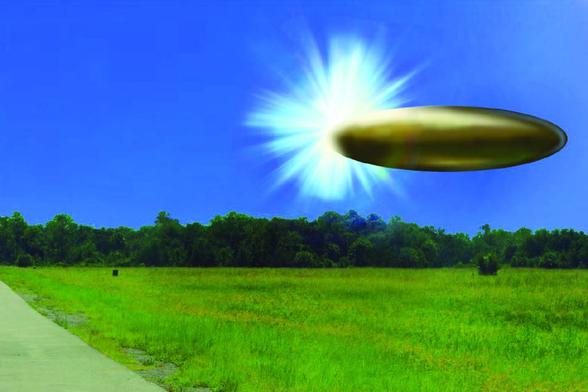
2024-04-30 Composite Sketch. Actual site photo with FBI Lab rendered graphic overlay depicting corroborating eyewitness reports from September 2023 of an apparent ellipsoid bronze metallic object materializing out of a bright light in the sky, 130-195 feet in length, and disappearing instantaneously.Over the last 50 years, only a few U.S. presidents have addressed the release of UFO/UAP files. President Carter once reported that he saw a possible “UFO” in 1969 and said he would publicly disclose UFO information. Due to national security concerns, nothing was released. President Reagan’s now-famous speech at the United Nations (and one I used in First World) said in part, “I occasionally think how quickly our differences worldwide would vanish if we were facing an alien threat from outside this world.” Despite some claims that Reagan received classified UFO briefings, nothing was ever released. President Clinton said he looked into the mysterious Area 51, but nothing was released. While President Obama’s administration documented UAP encounters, nothing during his occupancy of The White House was ever released.
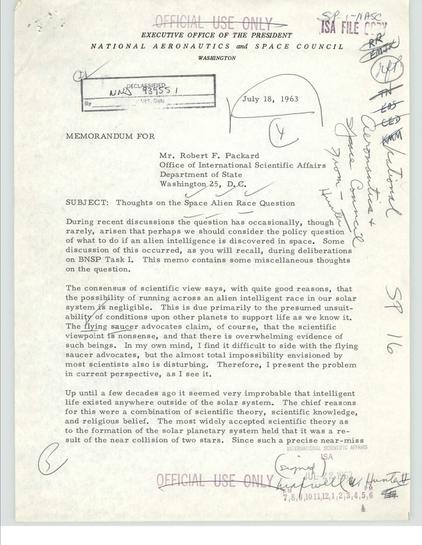
This memorandum, dated July 18, 1963, from the Executive Office of the President, National Aeronautics and Space Council, relates to thoughts on the space alien race question. Included are details relating to plans if alien intelligence is discovered, expanding scientific knowledge, the possibility of life on Mars, and diplomatic policy.In February 2026, President Trump ordered the Pentagon and related agencies to identify and release records on UFOs/UAPs. On May 8, the Department of War released an initial tranche of files. For the first time in this country’s history, actual files on one of the most secretive, guarded, and mysterious subjects on this planet have been released to the general public. To say this is unprecedented in a presidential administration would be an understatement. I understand there will be future releases on a rolling basis from numerous government agencies. Suffice it to say, we look forward to them.
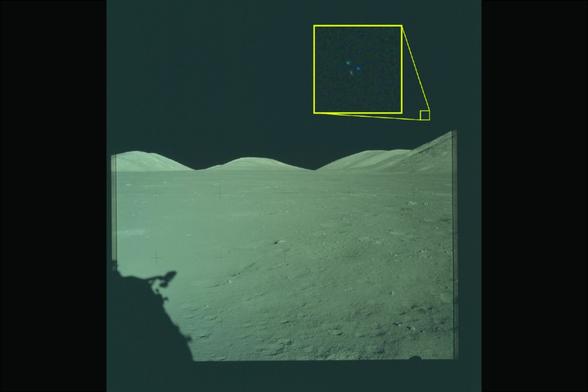
NASA-UAP-VM6, Apollo 17, 1972 Archival imagery from the Apollo 17 mission to the Moon. The yellow box contains an enlarged area of the original photo in which three lights are visible above the lunar terrain.Ever since the Roswell incident in 1947, involving the apparent crash of an extraterrestrial spacecraft, there has been a simple question almost everyone wants answered—are we alone in the universe or not? In my view, there’s no question that we are not alone. But until definitive proof is presented, this subject will remain mired in one conspiracy theory after another. It’s one thing to think you saw a UFO; it’s another to take a picture of it. But until some sort of device, ship, or signal is received, it’s just speculation. Of course, this entire discussion is the basis of First Signal and the larger First World Universe I created.
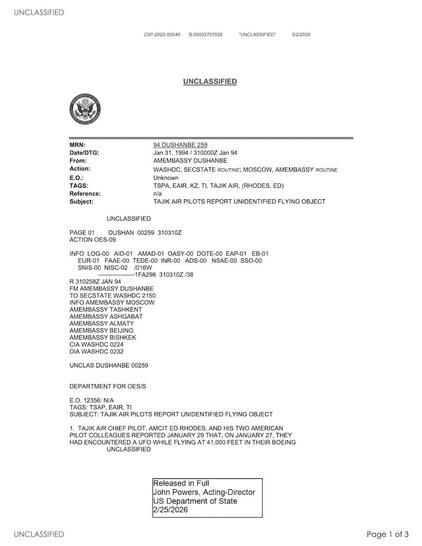
This document is a U.S. Department of State diplomatic cable from the U.S. Embassy in Dushanbe, Tajikistan to the Secretary of State in Washington, D.C. on January 31, 1994.The question of whether we are alone in the universe won’t be answered easily by the release of government files. But what we may see is the emergence of a pattern. Let’s think about this for a moment. In my film First Signal, aliens already live on Earth. Some participate in our society (Elisabeth Seward/James Griffin), while others (Cedric Yonah) are more observers and governors of the planet. Their technology, from communications to transportation, operates not only in secret but largely remains invisible to us. In the world of First Signal, a superior alien race knows the level of paranoia and doubt on the planet. Even Cedric’s antagonist, General Reager, states, “Do you think it’s a good idea for the public to know about this? Do you? They can barely handle bad weather?” Once the general public knows, one has to wonder whether there will be a global panic, acceptance, or worse. Then the overall question will be how the news of an alien civilization reconciles with the 84% of the global population that identifies with some form of religion. Trust me, this question is being discussed somewhere.
DOW-UAP-PR46, Unresolved UAP Report, INDOPACOM, 2024 U.S. Indo-Pacific Command reported UAP that resembles a football-shaped body near Japan.But what President Trump did with his order to release UFO/UAP files needed to be done. If this is the first step toward the absorption and dissemination of this information to prepare us for an inevitable announcement, I’m certainly all for it. Again, in my view, there’s no question that there are others in the universe. The James Webb Telescope alone has imaged parts of the universe that, until its launch, had only been speculation. There are estimates that there are approximately 2 trillion galaxies in the universe that we can see. Personally, I think it’s tremendously exciting to know that we are not alone. And if we are or have been visited by an alien civilization, we should count ourselves lucky. Because out of the billions and billions of galaxies and Earth-like planets, someone, somewhere, thought we, as a planet and as a species, despite all our issues, were worthy enough to visit.
Not alone.
Each of these incident summaries includes a “Check-List – Unidentified Flying Objects” that contains details about the incident. Many summaries also include witness lists or statements and other narrative reports or descriptions. #Aliens #Area51 #DepartmentOfWar #FirstSignalMovie #JamesWebbTelescope #NASA #paranormal #PresidentCarter #PresidentClinton #PresidentObama #PresidentReagan #PresidentTrump #religion #Roswell #Science #UAP #UFO #ufos #UnitedNations