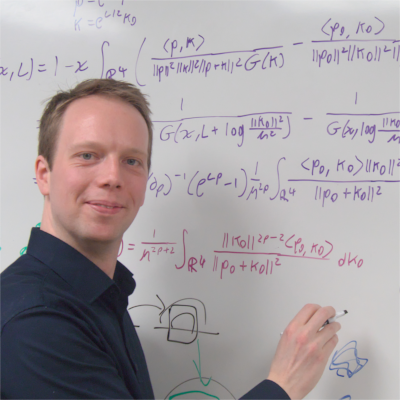
Thursday's #paperOfTheDay: "Almost zero-dimensional quantum field theories" from 1992. That paper considers the behaviour of #quantumMechanics and #quantumFieldTheory close to zero spacetime dimensions. The actual limit D=0, the zero-dimensional field theory, is well understood. The authors now study a (radially symmetric) Schrödinger equation, and then a free field theory, close to D=0. They find that this limit exists (i.e. there is a continuous family of theories for real parameters D which interpolates between the physical and the 0-dimensional theory), and the linear approximation in D already gives numerically meaningful estimates of the physical theory.
This setup is in the same spirit as our #tropicalFieldTheory , but the difference is that the older paper varies D alone, whereas the tropical limit arises when one reduces D and the power of the kinetic term (i.e. spacial decay rate of propagators) simultaneously. Secondly, we now have a much better understanding of analytical properties of #FeynmanIntegrals than 30 years ago, so that we can perform this limit in a mathematical clean way for all graphs of an interacting field theory. https://journals.aps.org/prd/abstract/10.1103/PhysRevD.46.5557
At the EPS-HEP conference last summer, I gave a talk about statistical properties of #FeynmanIntegrals at large loop order. These integrals appear in many places in #physics , I had looked at the special case of scalar theories with quartic self-interaction. The #proceedings of my talk have now been accepted for PoS. The original papers are, as usual, much more detailed and longer, but I believe that the proceedings can be a good way for readers to quickly get a feeling for the type of phenomena one can observe in Feynman integrals at large order in perturbation theory: There are very many integrals, but most of them behave similarly, in a rather structured way with many correlations and only a few outliers. https://doi.org/10.22323/1.485.0462
PoS - Statistics and asymptotics of subdivergence-free Feynman integrals in $\phi^4$ theory

Over the last 2 years, I did several research projects regarding the statistical properties of #Feynmanintegrals in #QuantumFieldTheory . Basically, we have by now the numerical power to compute millions of these integrals and treat them statistically in a Monte Carlo sense. In summer, I gave a talk about key outcomes at @EPSHEP2025 . The preprint for the proceedings of my talk is now on arxiv. This document is a good starting point to get an overview without reading 150 pages of data tables and plots. https://arxiv.org/abs/2512.06898
Statistics and asymptotics of subdivergence-free Feynman integrals in $ϕ^4$ theory

Recent algorithmic improvements have made it possible to evaluate subdivergence-free (=primitive=skeleton) Feynman integrals in $ϕ^4$ theory numerically up to 18 loops. By now, all such integrals up to 13 loops and several hundred thousand at higher loop order have been computed. This data enables a statistical analysis of the typical behaviour of Feynman integrals at large loop order. We find that the average value grows exponentially, but the observed growth rate is accurately described by its leading asymptotics only upwards of 25 loops. This is in contrast with the $N$-dependence of the $ON(N)$-symmetric $ϕ^4$ theory, which is close to its large-order asymptotics already around 10 loops. Secondly, the distribution of integrals has a largely continuous inner part but a few extreme outliers. This makes uniform random sampling inefficient. We find that the value of the integral is correlated with many features of the graph, which can be used for importance sampling. With a naive test implementation we obtained an approximately 1000-fold speedup compared with uniform sampling. This suggests that in future work, Feynman amplitudes at large loop order might be computed numerically with statistical methods, rather than through enumerating and evaluating every individual integral.

arXiv.org
This Friday, I will give an overview talk of my work on #statistics and #sampling of #Feynmanintegrals in the #Tutte Colloquium at Combinatorics&Optimization, University of #Waterloo. The talk starts at 3:30pm, free cookies and coffee are served before. Everybody is welcome, MC building 5th floor.
https://uwaterloo.ca/combinatorics-and-optimization/events/tutte-colloquium-paul-balduf
Tutte Colloquium - Paul Balduf | Combinatorics and Optimization

William Tutte Colloquium for June 21, 2024.