Sin, Scripture, and the Smell of Rot.
1,848 words, 10 minutes read time.
I don’t expect you to believe me. Not really. People like James—men who carry their brokenness like a badge and a burden—we’re more warning sign than testimony. The kind of story folks scroll past on Facebook between a political rant and a cat video, pausing just long enough to click “like” on a Bible verse they won’t live by. I know because I take care of him. Every week. I’m his nurse. My name is Clara Jensen.
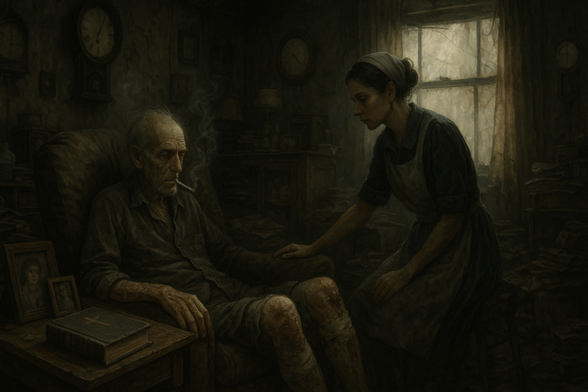
I’ve seen a lot in my years of home care, but James stuck with me. Not because he’s kind or cruel, but because something about him lingers. His presence, his silence—it’s heavy, like regret that never got named. It’s in the air when you walk through the door: mildew, cigarette smoke, painkillers, and something deeper that clings like old shame.
He’s missing a leg, and the other’s not doing well either. Diabetes, infections, surgeries—doctors have tried everything. But the real rot runs deeper, past the bloodstream and into the soul. His medical file tells a hard-enough story, but it’s the part that’s not in the file that matters. A past he doesn’t talk about. The kind people whisper around. He was involved in things that left scars—on others and on himself. Some of it petty, some of it cruel. Not infamous, just a man who made too many wrong turns and burned too many bridges.
He’s kept much of that life hidden from his family. Covered it up with silence, selective memory, even a few bold-faced lies. But the truth always finds a way through, like mold breaking through drywall. People in the community know more than he thinks. They remember the fights, the broken trust, the way he vanished when responsibility came knocking. Still, James acts like no one sees. Like if he reposts enough scripture, the past might blur around the edges.
His house is a cluttered echo chamber of old tools, stacked books, flea-market leftovers, and framed sayings about strength and faith. His Bible sits on a table nearby, dusty and closed. He shares Christian memes like they’re armor—loud declarations about sin and truth and justice, almost always aimed outward. Rarely about grace. Never about himself.
He never talks about it when I’m there, but I see them when I change his dressings. One day Pastor Micah finally addressed it. Calmly, without accusation. Just a question, light as a scalpel:
“You think sharing those posts helps anyone?”
James blinked, caught off guard. “Just sharing truth.”
“Whose truth?” Micah asked. “God’s truth calls everyone out. Not just the people you don’t like.”
James didn’t answer. Just stared past Micah, toward the wall where a cracked mirror hung—one of the few things in the house that could still reflect anything clearly.
I remember the first time Pastor Micah Reynolds came by. James acted like it was nothing. But I could tell it rattled him. Micah walked through that house with quiet dignity, stepping over stacks of junk and ignoring the smell. He didn’t flinch at the sight of the bandages or the pills scattered on the end table. He just sat down and opened his Bible.
“You ever get tired of posting verses you don’t live?” Micah asked, cool as a spring breeze.
James chuckled and took a drag off a cigarette. “They’re not for me. They’re for the people watching.”
“Is that what you think God is? A spectator?”
James didn’t answer. He just shook a couple pills into his hand—one labeled, one not—and swallowed them dry.
Micah read from Psalm 49. He talked about people who trust in their wealth, who name lands after themselves but still go to the grave with nothing. “Their graves are their homes forever,” he read. James rolled his eyes.
Then Micah told a story about Herod Agrippa. I’d heard it before, but not like that. Herod Agrippa was a king of Judea, a man who craved power and applause more than anything. He was the grandson of Herod the Great—the same tyrant who ordered the massacre of innocent children. Agrippa ruled with an iron fist, crushing anyone who opposed him, including the early Christians. But his greatest flaw was his pride. During a public speech, the crowd hailed him as a god, praising his words as if he were divine. Instead of humbly rejecting their worship, Agrippa accepted it, soaking in their adulation like a man drunk on his own glory.
That moment sealed his fate. Suddenly, without warning, his body began to betray him in the most gruesome way imaginable. According to the Bible, he was struck down by God’s judgment and “eaten by worms.” The worms—parasitic and merciless—devoured him from the inside out, turning his flesh into a rotting, festering ruin. It was a slow, agonizing death that stripped away every bit of his false pride. The man who sought to be worshipped as a god ended his life consumed by decay, a horrifying warning about the price of arrogance.
James called it dramatic. Micah called it justice.
“You saying I’m Herod now?” James asked.
“No,” Micah replied. “I think Herod had more humility.”
I kept quiet in the corner, checking vitals, replacing a bandage. But even I felt the sting of those words—and the heavy, sour smell of rot that seemed to cling to the room, like a silent echo of Herod Agrippa’s fate. James didn’t argue. Not really. He lit another cigarette and stared into the smoke like it held secrets.
After Micah left, James didn’t say a word. He reached down and pulled out an old, faded family photo buried under piles of junk—a snapshot of better days, smiling faces frozen in time before life’s hardships took hold. He didn’t speak of who was in it. I saw him wipe the dust from the frame with his sleeve before setting it gently beside his Bible, its dusty cover closed and untouched.
James isn’t the only one Pastor Micah visits. There are others in similar medical straits—shut-ins with amputations, oxygen tanks, and chronic pain. But their homes feel different. Quieter, cleaner. The air smells of ointment and lavender, not stale smoke and regret. They speak with kindness, gratitude, humility. Their pasts aren’t perfect, but they don’t wear denial like armor. They ask for prayer, not applause. You can tell they’ve made peace with what was, and they’re trying to make peace with what’s left.
The rot hasn’t stopped. James’s leg’s still going bad. The infection’s still spreading, and the rot in his good leg is beginning to bloom, like mold that’s found new flesh. The pills are still there—some from doctors, some not.
I don’t know how this story ends. Not yet. Maybe that’s the whole point—the uncertainty, the unfinished business that makes it real. Because the last chapters—his repentance, his healing, his truth—haven’t been written. Not yet. And as long as those pages remain blank, there’s still room for change, for grace, for something different to take hold. Maybe that’s hope. Maybe that’s what keeps us coming back to stories like James’s. Because if a story isn’t finished, it means it’s still alive. And if it’s still alive, then maybe it can still be changed.
Author’s Note:
This story is a work of fiction. James, Clara, Pastor Micah, and the events within these pages are not based on any real individuals, though they are inspired by the struggles and complexities I’ve witnessed in many lives. The characters and situations are crafted to explore themes of pride, regret, grace, and redemption, not to portray any actual person or event.
The story of James is unfinished, and intentionally so. As the writer, I didn’t want to close the book on him—because real people rarely get neat endings. His journey is still unfolding. Redemption, if it comes, will come in small, unglamorous ways. Maybe he finds peace. Maybe he doesn’t. But the choice to change, to confess, to finally live what he shares—that choice remains. And as long as that choice exists, the story isn’t over. Not for James. And maybe not for you, either.
Your story is unfinished as well. No matter what you have done, no matter the mistakes you’ve made or the pain you’ve caused or endured, how you finish your story is up to you. There is a powerful truth in the saying: you may not have caused the problem, but the problem is yours to fix. That responsibility can feel heavy, but it is also where hope begins. The chapters ahead can be written with courage, honesty, and grace.
So take this story as a mirror and a challenge. Like James, you carry the power of choice within you. The past does not have to define the future, and the weight of regret can be lifted, step by step. The story isn’t finished—not really. And that means it can still be changed.
D. Bryan King
Sources
Disclaimer:
The views and opinions expressed in this post are solely those of the author. The information provided is based on personal research, experience, and understanding of the subject matter at the time of writing. Readers should consult relevant experts or authorities for specific guidance related to their unique situations.
Related Posts
#addictionAndRecovery #BibleStoriesInFiction #BibleTeachings #bibleVerses #biblicalJustice #brokenFamily #ChristianFaithJourney #ChristianMemes #ChristianPastorStory #ChristianRedemptionStory #ChristianSocialMedia #chronicIllnessStory #diabetesComplications #diabeticLegAmputation #drugAbuseConsequences #faithAndDoubt #faithAndPain #faithStruggles #familyConflict #familyEstrangement #fictionalShortStory #flawedNarratorStory #GodSJustice #graceAndForgiveness #healingAndGrace #homeCareNursing #homeCareStory #homeHealthNurse #illnessAndFaith #JamesStory #KingHerodAgrippa #LGBTQPosts #modernChristianStory #moralAmbiguityStory #nursePerspectiveStory #painkillerAddiction #pastoralCare #personalDownfall #PersonalGrowth #personalRedemption #personalReflectionStory #personalTransformation #prideAndRegret #prideAsAFlaw #Psalm49 #redemptionIsPossible #repentanceTheme #socialMediaSharing #spiritualDecay #spiritualHealing #sufferingAndHope
 Kalvin Carefour Johnny
 Bryan King
 Medical Lake Community Church