@teixi

By the way, unlike what the piece says, Murrhy and Seung did NOT "have the idea to use those images to identify and map the connections between each visible neuron, creating a connectome".

That idea had been floating about the field since Brenner and his C. elegans connectome, and those in a position to execute were the groups at Janelia with discretionary HHMI finding, like Rubin, Bock and myself. And we did.

What the Seung lab did was capitalise on the published EM volume of the adult female fly brain to apply more effective image registration and neuron segmentation approaches than the ones tried so far at that point by the Fly EM Project Team at Janelia. Synapses were detected by Julia Buhmann in saalfeld's lab at Janelia as well. The research groups led by Seung, Jefferis (at MRC LMB) and Murthy then put in the gargantuan effort of proofreading to deliver the published connectome.

#Drosophila #connectomics #FAFB

@plaidtron3000 @uni_matrix

Good question. Surely all the bug reports and interface and workflow improvements contributed immensely, as did the drive to improve the CNNs doing the segmentation. The actual training data I doubt it: the nature of the images is dramatically different.

First, the retina EM volume was stained for extracellular contrast, and synapses or intracellular organelles weren't visible.

Second, the resolution and imaging modality are vastly different, with the retina imaged with SBEM at about 12x12x25 nm per pixel, whereas the female adult #Drosophila brain (#FAFB) was imaged at 4x4x40 nm per pixel with ssTEM. Both are anisotropic but rather very differently so.

Albert Cardona (@[email protected])

Attached: 1 image Whole adult fly brain connectome for FAFB (female adult fly brain) – last year in preprint form, today as an immersive feature in Nature. 140,000 neurons, over 50 million synapses – organised into over 8,000 cell types. (VNC not included.) https://www.nature.com/immersive/d42859-024-00053-4/index.html The whole connectome: Dorkenwald et al. 2024 (Seung, Murthy) https://www.nature.com/articles/s41586-024-07558-y Cell types: Schlegel et al. 2024 (Jefferis) https://www.nature.com/articles/s41586-024-07686-5 by @[email protected] Network statistics: Lin et al. 2024 (Murthy) https://www.nature.com/articles/s41586-024-07968-y Visual system: Garner et al. 2024 (Wernet, Kim) https://www.nature.com/articles/s41586-024-07967-z and Matsliah et al. (Murthy, Seung) https://www.nature.com/articles/s41586-024-07981-1 Seung also put out a solo paper on predicting visual function from the connectome: https://www.nature.com/articles/s41586-024-07953-5 Control of halting in walking: Sapkal et al. 2024 (Bidaye) https://www.nature.com/articles/s41586-024-07854-7 FAFB imaged by @[email protected] 's group back in 2018: https://www.cell.com/cell/fulltext/S0092-8674(18)30787-6 #neuroscience #Drosophila #connectomics #FAFB

Mathstodon

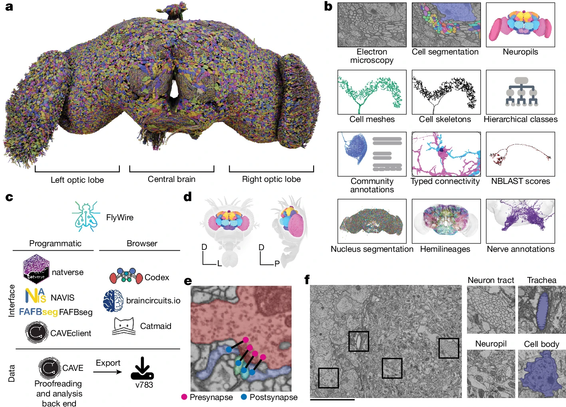
Whole adult fly brain connectome for FAFB (female adult fly brain) – last year in preprint form, today as an immersive feature in Nature.

140,000 neurons, over 50 million synapses – organised into over 8,000 cell types. (VNC not included.)

https://www.nature.com/immersive/d42859-024-00053-4/index.html

The whole connectome: Dorkenwald et al. 2024 (Seung, Murthy) https://www.nature.com/articles/s41586-024-07558-y

Cell types: Schlegel et al. 2024 (Jefferis) https://www.nature.com/articles/s41586-024-07686-5 by @uni_matrix

Network statistics: Lin et al. 2024 (Murthy) https://www.nature.com/articles/s41586-024-07968-y

Visual system: Garner et al. 2024 (Wernet, Kim) https://www.nature.com/articles/s41586-024-07967-z and Matsliah et al. (Murthy, Seung) https://www.nature.com/articles/s41586-024-07981-1

Seung also put out a solo paper on predicting visual function from the connectome: https://www.nature.com/articles/s41586-024-07953-5

Control of halting in walking: Sapkal et al. 2024 (Bidaye) https://www.nature.com/articles/s41586-024-07854-7

FAFB imaged by @davi 's group back in 2018: https://www.cell.com/cell/fulltext/S0092-8674(18)30787-6
#neuroscience #Drosophila #connectomics #FAFB

The FlyWire connectome: neuronal wiring diagram of a complete fly brain

Artificial intelligence and human expertise meet to generate a map of all the connections in the fly brain. The resource is already being used by experimentalists and theoreticians to further our understanding of neural circuits in the fly and beyond.
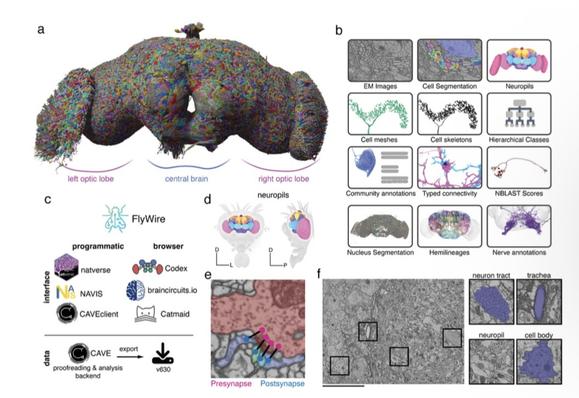
The connectome of the adult female fly brain, Drosophila melanogaster:

“Neuronal wiring diagram of an adult brain” by Dorkenwald et al. 2023 https://www.biorxiv.org/content/10.1101/2023.06.27.546656v1

A project that started with Davi Bock and Wei Lee developing the TEMCA for the mouse visual cortex in Clay Reid’s lab (Bock et al. 2011 https://www.nature.com/articles/nature09802), then Bock moving to #HHMIJanelia and developing the instrument much further to deliver the #FAFB volume (Zheng et al. 2018 https://www.sciencedirect.com/science/article/pii/S0092867418307876 ), and then the Seung, Murthy and Jefferis labs automatically re-registering, segmenting and annotating the whole volume via #FlyWire and more.

Extraordinary!

#Drosophila #connectomics #neuroscience #brain

"A leaky integrate-and-fire computational model based on the connectome of the entire adult Drosophila brain reveals insights into sensorimotor processing", by Shiu et al. 2023, from Kristin Scott's lab https://www.biorxiv.org/content/10.1101/2023.05.02.539144v1.full

"Our results demonstrate that modeling brain circuits purely from connectivity and predicted neurotransmitter identity generates experimentally testable hypotheses and can accurately describe complete sensorimotor transformations."

#connectomics #Drosophila #FAFB #neuroscience