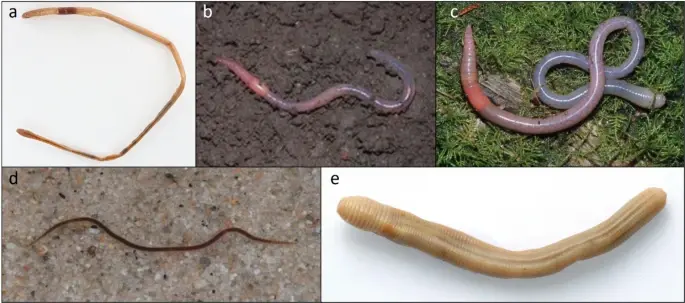
New publication: The applicability of regional red list assessments for soil invertebrates: first assessment of five native #earthworm species in Canada. #speciesatrisk #soilfauna #extinctionrisk #soil #biodiversity #climatechange #landuse
https://doi.org/10.1007/s10531-025-03068-z
The applicability of regional red list assessments for soil invertebrates: first assessment of five native earthworm species in Canada - Biodiversity and Conservation

Earthworms (Annelida: Clitellata: Crassiclitellata) are prominent members of the soil community, important to many ecosystem functions. Despite this, and like many other soil invertebrates, they are rarely considered in conservation assessments, including the International Union for Conservation of Nature (IUCN) Red List assessments used to assess species’ extinction risk. To investigate the applicability of the IUCN Regional Red Listing protocol to soil invertebrates, we assessed the conservation status of five earthworm species native to Canada using this protocol and all available occurrence records. In Canada, no earthworm species have yet been assessed by the Committee on the Status of Endangered Wildlife in Canada (COSEWIC). Due to the lack of data on population sizes and their trends, all five species were assessed using their Extent of Occurrence (EOO) (Criterion B). One species was assessed as Vulnerable (Arctiostrotus vancouverensis), two were assessed in non-threatened categories (A. perrieri and Sparganophilus tamesis), and two were assessed as Data Deficient (A. fontinalis and Toutellus oregonensis). For the majority, the main threats identified were the continuing loss of potential habitat due to land conversion and resource exploitation, as well as the effects of climate change. Increasing the amount of data, including but not limited to distribution and habitat preferences, would make the assessment process easier and status decisions better supported. By undertaking regional assessments for five native earthworm species in Canada, we show that Regional Red List assessments are feasible for soil invertebrates.

SpringerLink
Oh, look! Another tech 'visionary' gushing over AI as if it's the second coming of sliced bread. πŸ™„ Apparently, if you're not worshipping the AI overlords, you're just a dinosaur waiting for extinction. πŸ¦–πŸš‚ Better hop on that bandwagon, folks, before it leaves you coding in the stone age! πŸ§±πŸ’»
https://cekrem.github.io/posts/coding-as-craft-going-back-to-the-old-gym/ #techvisionary #AIhype #codingrevolution #digitaltransformation #extinctionrisk #HackerNews #ngated
Coding as Craft: Going Back to the Old Gym

Why 'reflexive AI usage' sounds like a diagnosis I don't want next to my name

cekrem.github.io
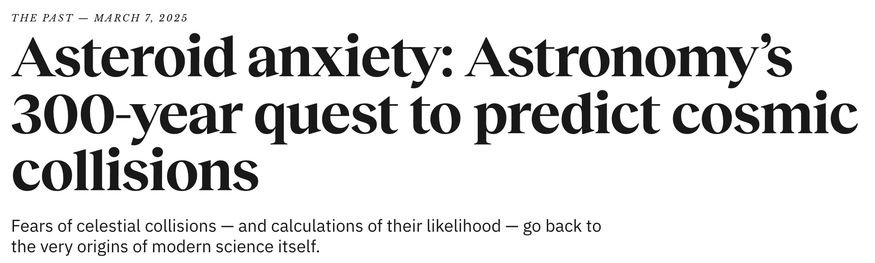
Asteroid anxiety: Astronomy's 300-year quest to predict cosmic collisions

Fears of celestial collisions β€” and calculations of their likelihood β€” go back to the very origins of modern science itself.

Big Think
The world is on track for between 1.9 and 3.7Β°C of warming by 2100

While some progress has been made in limiting greenhouse gas emissions, we are still on the path for high levels of global warming

New Scientist
A lack of crucial data prevents assessment of @IUCN #ExtinctionRisk for most species of #MarineFish. @NiLoiseau @NicolasMouquet &co use #MachineLearning to infer a 12.8% extinction risk for marine fish species, surpassing existing estimates. #PLOSBiology https://plos.io/4dXJh9O
Inferring the extinction risk of marine fish to inform global conservation priorities

Empirical data on occurrences and vulnerability are still lacking for most marine teleost fish species, preventing assessment of their IUCN extinction risk status. This study uses machine learning with occurrence data, species biological traits, taxonomy and human usage to infer a 12.8% extinction risk for marine fish species, surpassing existing estimates.

New artificial intelligence study: Why can’t anyone agree on how dangerous AI will be?

Researchers tried to get AI optimists and pessimists on the same page. It didn’t quite work.

Vox
Now published in Peer Community Journal, #Ecology section: Influence of mimicry on #extinctionrisk in Aculeata: a theoretical approach https://doi.org/10.24072/pcjournal.342
Influence of mimicry on extinction risk in Aculeata: a theoretical approach

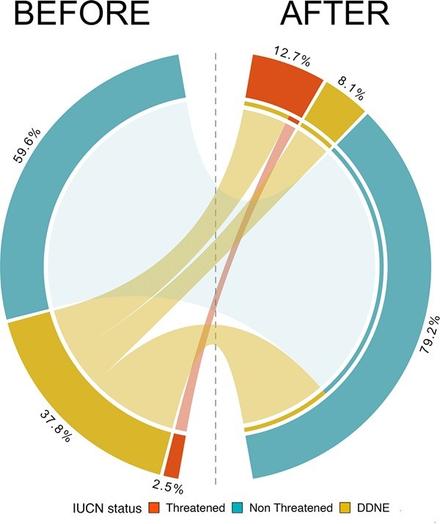
Do you care about undescribed biodiversity?

Feel like more and more new plant species are already threatened with extinction?

Need a reminder of why taxonomy continues to play a key role in science?

Check out our new paper, where we show that a whopping 75% of plants described after 2020 are threatened 🌿

If you're describing new species, assume they're threatened and, if poss, assess them straight away!

https://nph.onlinelibrary.wiley.com/doi/full/10.1111/nph.19214

#plantscience #conservation #newphytologist #extinctionrisk